Results by title
5 books match the query 'Piano'
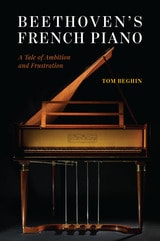
Beethoven's French Piano
A Tale of Ambition and FrustrationTom Beghin
University of Chicago Press, 2022
In 1803 Beethoven acquired a French piano from the Erard Frères workshop in Paris. The composer was “so enchanted with it,” one visitor reported, “that he regards all the pianos made here as rubbish by comparison.” While Beethoven loved its sound, the touch of the French keyboard was much heavier than that of the Viennese pianos he had been used to. Hoping to overcome this drawback, he commissioned a local technician to undertake a series of revisions, with ultimately disappointing results. Beethoven set aside the Erard piano for good in 1810.
Beethoven’s French Piano returns the reader to this period of Beethoven’s enthusiasm for all things French. What traces of the Erard’s presence can be found in piano sonatas like his “Waldstein” and “Appassionata”? To answer this question, Tom Beghin worked with a team of historians and musicians to commission the making of an accurate replica of the Erard piano. As both a scholar and a recording artist, Beghin is uniquely positioned to guide us through this key period of Beethoven’s work. Whether buried in archives, investigating the output of the French pianists who so fascinated Beethoven, or seated at the keyboard of his Erard, Beghin thinks and feels his way into the mind of the composer, bringing startling new insights into some of the best-known piano compositions of all time.

Mozart the Performer
Variations on the Showman's ArtDorian Bandy
University of Chicago Press, 2023
We know Mozart as one of history’s greatest composers. But his contemporaries revered him as a multi-instrumentalist, a dazzling improviser, and the foremost keyboard virtuoso of his time. When he composed, it was often with a single aim in mind: to set the stage, quite literally, for compelling and captivating performances. He wrote piano concertos not with an eye to posterity but to give himself a repertoire with which to flaunt his keyboard wizardry before an awestruck public. The same was true of his sonatas, string quartets, symphonies, and operas, all of which were painstakingly crafted to produce specific effects on those who played or heard them, amusing, stirring, and ravishing colleagues and consumers alike.
Mozart the Performer brings to life this elusive side of Mozart’s musicianship. Dorian Bandy traces the influence of showmanship on Mozart’s style, showing through detailed analysis and imaginative historical investigation how he conceived his works as a series of dramatic scripts. Mozart the Performer is a book for anyone who wishes to engage more deeply with Mozart’s artistry and legacy and understand why, centuries later, his music still captivates us.
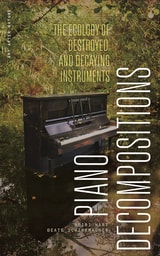
Piano Decompositions
The Ecology of Destroyed and Decaying InstrumentsHeidi Hart
University of Minnesota Press, 2026
Examining musical instrument destruction through an ecological and intermedial lens
Musical instruments are typically seen as objects both used and maintained with ritualistic care. But what happens when they’re tossed from homes in mudslides, burned during ecstatic parties, or waterlogged by pop stars in viral videos—and how do these elemental interactions transform the way we see and play instruments? Piano Decompositions asks what happens when we let go of controlling musical instruments. What kind of meanings start to sound when instruments are moved out of the protected cultural space and engage with their surrounding elements?
Heidi Hart and Beate Schirrmacher trace the history of destroyed and decaying pianos, both sorting them within the realm of artistic violence against instruments and following their return journeys into water, sand, and soil. They parse the artistic vision of Annea Lockwood, whose iconic burning, drowning, and decaying Piano Transplants presented a novel means of drawing attention to the increasing threats of climate change in the 1960s and ’70s. Turning to instruments made from found materials and others played collaboratively with wind and water, they demonstrate how human sound making is entangled in the more-than-human world.
Showing how the piano can transform conversations around the Anthropocene and environmental destruction, Hart and Schirrmacher find the instrument to be a potent creative and ecological force, a medium to connect with environments in an explorative, attentive way. Piano Decompositions unearths new ways to relate our concepts of curiosity, pleasure, and music to the natural world.
Retail e-book files for this title are screen-reader friendly with images accompanied by short alt text and/or extended descriptions.
Piano in the Dark
Nancy Naomi Carlson
Seagull Books, 2023
This latest book of wonders from Nancy Naomi Carlson fixes upon one of the few defenses we have to confront the body’s betrayals—our words. Though in the end, even the world’s last word “forgets its name . . . has no word for this forgetting.” At once vulnerable and open, tempered and tempted equally by the erotic and the empathic, such dualities limn these affectingly beautiful and lyrical poems. Carlson’s lines, entreating as Scheherazade, “weave chords / into tales within tales, whirlpools within seas” to save her life. Indeed, music has no need for voice or harp, as “in anechoic chambers, you become / the only instrument of your worldly sounds,” echoing Mozart’s credo “that music lies / in the silence between notes.” In a world scarred by pandemics, wars, and violent tribalism, the givens are gone—“talismans we clung to, believing / we might be spared in some way / by marking our doors / with our own sacrificial blood.” In these unflinching free and formal verse poems, Carlson seduces us with the promise of the joy yet to be had, were we to look in the right places.
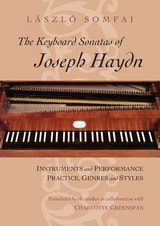
The Keyboard Sonatas of Joseph Haydn
Instruments and Performance Practice, Genres and StylesLászló Somfai
University of Chicago Press, 1995
Laszlo Somfai begins with a thorough study of Haydn's keyboard instruments and their development. After recommending instruments appropriate for modern use, he discusses performance practice and style, explains the peculiarities of Haydn's manuscripts in the context of eighteenth-century notation, and provides specific suggestions for playing ornaments, improvising, slurring, and dynamics. He also investigates Haydn's sonata genres within their historical context and discusses the problems of establishing a chronology of their composition. Finally, Somfai analyzes the organization and style of each musical form. The book includes an index listing the sonatas by date of first publication, and an extensive bibliography.