Results by title
16 books match the query 'Pictures'
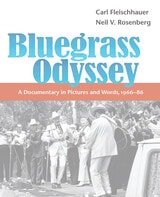
Bluegrass Odyssey
A Documentary in Pictures and Words, 1966-86Carl Fleischhauer and Neil V. Rosenberg
University of Illinois Press, 2006
Image Science
Iconology, Visual Culture, and Media AestheticsW. J. T. Mitchell
University of Chicago Press, 2015
Continuing with this influential line of thought, Image Science gathers Mitchell’s most recent essays on media aesthetics, visual culture, and artistic symbolism. The chapters delve into such topics as the physics and biology of images, digital photography and realism, architecture and new media, and the occupation of space in contemporary popular uprisings. The book looks both backward at the emergence of iconology as a field and forward toward what might be possible if image science can indeed approach pictures the same way that empirical sciences approach natural phenomena.
Essential for those involved with any aspect of visual media, Image Science is a brilliant call for a method of studying images that overcomes the “two-culture split” between the natural and human sciences.
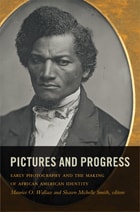
Pictures and Progress
Early Photography and the Making of African American IdentityMaurice O. Wallace and Shawn Michelle Smith, eds.
Duke University Press, 2012
Contributors. Michael A. Chaney, Cheryl Finley, P. Gabrielle Foreman, Ginger Hill, Leigh Raiford, Augusta Rohrbach, Ray Sapirstein, Suzanne N. Schneider, Shawn Michelle Smith, Laura Wexler, Maurice O. Wallace
Pictures and the Past
Media, Memory, and the Specter of Fascism in Postmodern ArtAlexander Bigman
University of Chicago Press, 2024
A fresh take on the group of artists known as the Pictures Generation, reinterpreting their work as haunted by the history of fascism, the threat of its return, and the effects of its recurring representation in postwar American culture.
The artists of the Pictures Generation, converging on New York City in the late 1970s, indelibly changed the shape of American art. Rebelling against abstraction, they borrowed liberally from the aesthetics of mass media and sometimes the work of other artists. It has long been thought that the group’s main contribution was to upend received conceptions of authorial originality. In Pictures and the Past, however, art critic and historian Alexander Bigman shows that there is more to this moment than just the advent of appropriation art. He presents us with a bold new interpretation of the Pictures group’s most significant work, in particular its recurring evocations of fascist iconography.
In the wake of the original Pictures show, curated by Douglas Crimp in 1977, artists such as Sarah Charlesworth, Jack Goldstein, Troy Brauntuch, Robert Longo, and Gretchen Bender raised pressing questions about what it means to perceive the world historically in a society saturated by images. Bigman argues that their references to past cataclysms—to the violence wrought by authoritarianism and totalitarianism—represent not only a coded form of political commentary about the 1980s but also a piercing reflection on the nature of collective memory. Throughout, Bigman situates their work within a larger cultural context including parallel trends in music, fashion, cinema, and literature. Pictures and the Past probes the shifting relationships between art, popular culture, memory, and politics in the 1970s and ’80s, examining how the specter of fascism loomed for artists then—and the ways it still looms for us today.
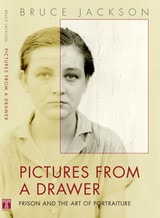
Pictures from a Drawer
Prison and the Art of PortraitureBruce Jackson
Temple University Press, 2009
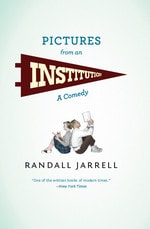
Pictures from an Institution
A ComedyRandall Jarrell
University of Chicago Press, 1952
A finalist for the National Book Award, this classic novel of midcentury campus life is demonically funny and brutally cutting
Beneath the unassuming surface of a progressive women’s college lurks a world of intellectual pride and pomposity awaiting devastation by the pens of two brilliant and appalling wits. Randall Jarrell’s classic novel was originally published to overwhelming critical acclaim in 1954, forging a new standard for campus satire—and instantly yielding comparisons to Dorothy Parker’s razor-sharp barbs. Like his fictional nemesis, Jarrell cuts through the earnest conversations at Benton College—mischievously, but with mischief nowhere more wicked than when crusading against the vitriolic heroine herself.
“A most literate account of a group of most literate people by a writer of power. . . . A delight of true understanding.”—Wallace Stevens
“I’m greatly impressed by the real fun, the incisive satire, the closeness of observation, and in the end by a kind of sympathy and human warmth. It’s a remarkable book.”—Robert Penn Warren
“Move over Dorothy Parker. Pictures . . . is less a novel than a series of poisonous portraits, set pieces, and endlessly quotable put-downs. Read it less for plot than sharp satire, Jarrell’s forte.”—Mary Welp
“One of the wittiest books of modern times.”—New York Times
“[T]he father of the modern campus novel, and the wittiest of them all. Extraordinary to think that ‘political correctness’ was so deliciously dissected 50 years ago.”—Noel Malcolm, Sunday Telegraph
“A sustained exhibition of wit in the great tradition. . . . Immensely and very devastatingly shrewd.”—Edmund Fuller, Saturday Review
“[A] work of fiction, and a dizzying and brilliant work of social and literary criticism. Not only ‘a unique and serious joke-book,’ as Lowell called it, but also a meditation made up of epigrams.”—Michael Wood
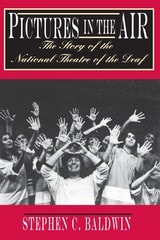
Pictures in the Air
The Story of the National Theatre of the DeafStephen C. Baldwin
Gallaudet University Press, 1994

Pictures of Romance
Form against Context in Painting and LiteratureWendy Steiner
University of Chicago Press, 1988
Romances violate the casual, temporal, and logical cohesiveness of realist novels, and they do so in part by depicting love as a state of suspension, a condition outside of time. Steiner argues that because Renaissance and post-Renaissance painting also represents a suspended moment of perception with "unnatural" clarity and compression of meaning, it readily serves the romance as a symbol of antirealism. Yet the atemporality of stopped-action painting was actually an attempt to achieve pictorial realism—the way things "really" look. It is this paradox that interests Steiner: to signal their departure from realism, romances evoke the symbol of "realistic" visual artwork. Steiner explores this problem through analyses of Keats, Hawthorne, Joyce, and Picasso. She then examines a return to narrative conventions in visual art in the twentieth century, in the work of Lichtenstein and Warhol, and speculates on the fate of pictorial storytelling and the romance in postmodern art. An aesthetic fantasia of sorts, this study combines theory and analysis to illuminate an unexpected interconnection between literature and the visual arts.
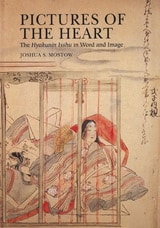
Pictures of the Heart
The <em>Hyakunin Isshu</em> in Word and ImageJoshua S. Mostow
University of Michigan Press, 2015
Pictures, Quotations, and Distinctions
Fourteen Essays in PhenomenologyRobert Sokolowski
Catholic University of America Press, 2022
Please Pass the Biscuits, Pappy
Pictures of Governor W. Lee "Pappy" O'DanielBy Bill Crawford
University of Texas Press, 2004
Long before movie stars Ronald Reagan and Arnold Schwarzenegger became governors of California, a popular radio personality with no previous political experience—who wasn't even registered to vote—swept into the governor's office of Texas. W. Lee "Pappy" O'Daniel was a 1930s businessman who discovered the power of radio to sell flour. His musical shows with the Light Crust Doughboys (which launched the career of Bob Wills) and his radio homilies extolling family and Christian values found a vast, enthusiastic audience in Depression-era Texas. When Pappy decided to run for governor in 1938 as a way to sell more flour—a fact he proudly proclaimed throughout the campaign—the people of Texas voted for him in record numbers. And despite the ineptitude for politics he displayed once in office, Texans returned him to the governorship in 1940 and then elected him to the U.S. Senate in 1941 in a special election in which he defeated Lyndon Johnson, as well as to a full term as senator in 1942.
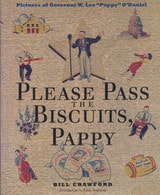
While the hit film O Brother, Where Art Thou? celebrated a fictional "Please Pass the Biscuits, Pappy" O'Daniel, this book captures the essence of the real man through photographs taken by employees of the Texas Department of Public Safety, most of which are previously unpublished. Reminiscent of the work of WPA photographers such as Russell Lee and Dorothea Lange, these photos record the last unscripted era of politics when a charismatic candidate could still address a crowd from an unpainted front porch or a mobile bandstand in the back of a truck. They strikingly confirm that Pappy O'Daniel's ability to connect with people was as great in person as on the radio.
To set the photos in context, Bill Crawford has written an entertaining text that discusses the political landscape in Texas and the United States in the 1930s, as well as the rise of radio as mass medium for advertising and entertainment. He also provides extensive captions for each picture. John Anderson, Photo Archivist of the Texas State Archives, discusses the work of Joel Tisdale and the other DPS photographers who left this extraordinary record of the greatest vote-getter in Texas history, who became one of America's first celebrities to cross the line from entertainment to political office.
Poetry, Pictures, and Popular Publishing
The Illustrated Gift Book and Victorian Visual Culture, 1855–1875Lorraine Janzen Kooistra
Ohio University Press, 2011
In Poetry, Pictures, and Popular Publishing eminent Rossetti scholar Lorraine Janzen Kooistra demonstrates the cultural centrality of a neglected artifact: the Victorian illustrated gift book. Turning a critical lens on “drawing-room books” as both material objects and historical events, Kooistra reveals how the gift book’s visual/verbal form mediated “high” and popular art as well as book and periodical publication.
A composite text produced by many makers, the poetic gift book was designed for domestic space and a female audience; its mode of publication marks a significant moment in the history of authorship, reading, and publishing. With rigorous attention to the gift book’s aesthetic and ideological features, Kooistra analyzes the contributions of poets, artists, engravers, publishers, and readers and shows how its material form moved poetry into popular culture. Drawing on archival and periodical research, she offers new readings of Eliza Cook, Adelaide Procter, and Jean Ingelow and shows the transatlantic reach of their verses. Boldly resituating Tennyson’s works within the gift-book economy he dominated, Kooistra demonstrates how the conditions of corporate authorship shaped the production and receptionof the laureate’s verses at the peak of his popularity.
Poetry, Pictures, and Popular Publishing changes the map of poetry’s place—in all its senses—in Victorian everyday life and consumer culture.

Shooting the Works
On Poetry and PicturesW. Simone Di Piero
Northwestern University Press, 1996
The Last Flower
A Parable in PicturesJames Thurber
University of Iowa Press, 2007
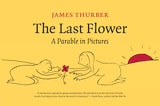
Civilization has collapsed after World War XII, dogs have deserted their masters, all the groves and gardens have been destroyed, and love has vanished from the earth. Then one day, "a young girl who had never seen a flower chanced to come upon the last one in the world." Written among the sorrow and chaos of war, dedicated to this only child " in the wistful hope that her world will be better than mine." The new printing will feature new scans of Thurber's original 1939 drawings.
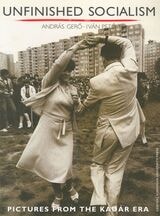
Unfinished Socialism
Pictures from the Kádár EraAndrás Gero
Central European University Press, 1999
This extraordinary book provides a snapshot of socialism throughout the Kádár regime in Hungary (1956-1989) and captures the essence of the world behind the ‘iron curtain’ in a stunning, and often stark, collection of photographs.
Unfinished Socialism is a visually stunning anthropological study containing 450 photographs, many previously unpublished, which portray life in Hungary from every angle: from the May Day March to pop music and from the homeless to sport.
With an introduction that will help the reader understand and appreciate the true meaning of the photographs, this political, social and cultural study of the Kádár years transports the reader back to a time of great significance in Hungary’s long and turbulent history.

Visual Literacy for Libraries
A Practical, Standards-Based GuideNicole E. Brown
American Library Association, 2016