Results by title
3 books match the query 'Piglia, Ricardo'
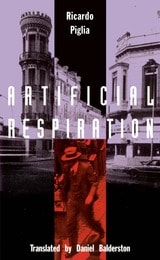
Artificial Respiration
Ricardo Piglia
Duke University Press, 1994
Acclaimed as one of the most important Latin American novels in recent decades, Artificial Respiration is a stunning introduction for English readers to the fiction of Ricardo Piglia. Published in Argentina in 1981, it was written at a time when thousands of Argentine citizens "disappeared" during the government’s attempt to create an authoritarian state. In part a reflection on one of the most repressive and tragic times in Argentine history, this is one of those rare works of fiction in which multiple philosophical, political, and narrative dimensions are all powerfully and equally matched.
As a prize winning detective novel, Artificial Respiration reaches through many levels of mystery to explore the forces that have been at play in Argentina throughout its violent history. The narrator, a writer named Renzi, begins to look for an uncle who has vanished, a man he knows only through a web of contradictory family stories and an exchange of letters. Through these letters he learns about his uncle’s research into the life of Enrique Ossario, secretary to the 19th-century Argentine dictator Rosas and spy for the dictator’s enemy. As Renzi’s search leads further into his uncle’s work and to conversations with his literary and chess-playing friends, the reader is led by Piglia to consider the nature of Argentine identity, its literature and history, and its relation, for example, to Europe, exile, and democracy. Finally, and made most vividly appreciable by the retelling of a story in which Kafka meets Hitler, it is the encounter between literature and history that is explored.
As a prize winning detective novel, Artificial Respiration reaches through many levels of mystery to explore the forces that have been at play in Argentina throughout its violent history. The narrator, a writer named Renzi, begins to look for an uncle who has vanished, a man he knows only through a web of contradictory family stories and an exchange of letters. Through these letters he learns about his uncle’s research into the life of Enrique Ossario, secretary to the 19th-century Argentine dictator Rosas and spy for the dictator’s enemy. As Renzi’s search leads further into his uncle’s work and to conversations with his literary and chess-playing friends, the reader is led by Piglia to consider the nature of Argentine identity, its literature and history, and its relation, for example, to Europe, exile, and democracy. Finally, and made most vividly appreciable by the retelling of a story in which Kafka meets Hitler, it is the encounter between literature and history that is explored.
[more]
Postmodernity in Latin America
The Argentine ParadigmSantiago Colás
Duke University Press, 1994
Postmodernity in Latin America contests the prevailing understanding of the relationship between postmodernity and Latin America by focusing on recent developments in Latin American, and particularly Argentine, political and literary culture. While European and North American theorists of postmodernity generally view Latin American fiction without regard for its political and cultural context, Latin Americanists often either uncritically apply the concept of postmodernity to Latin American literature and society or reject it in an equally uncritical fashion. The result has been both a limited understanding of the literature and an impoverished notion of postmodernity. Santiago Colás challenges both of these approaches and corrects their consequent distortions by locating Argentine postmodernity in the cultural dynamics of resistance as it operates within and against local expressions of late capitalism.
Focusing on literature, Colás uses Julio Cortázar’s Hopscotch to characterize modernity for Latin America as a whole, Manuel Puig’s Kiss of the Spider Woman to identify the transition to a more localized postmodernity, and Ricardo Piglia’s Artificial Respiration to exemplify the cultural coordinates of postmodernity in Argentina. Informed by the cycle of political transformation beginning with the Cuban Revolution, including its effects on Peronism, to the period of dictatorship, and finally to redemocratization, Colás’s examination of this literary progression leads to the reconstruction of three significant moments in the history of Argentina. His analysis provokes both a revised understanding of that history and the recognition that multiple meanings of postmodernity must be understood in ways that incorporate the complexity of regional differences.
Offering a new voice in the debate over postmodernity, one that challenges that debate’s leading thinkers, Postmodernity in Latin America will be of particular interest to students of Latin American literature and to scholars in all disciplines concerned with theories of the postmodern.
[more]
The Absent City
Ricardo Piglia
Duke University Press, 2000
Widely acclaimed throughout Latin America after its 1992 release in Argentina, The Absent City takes the form of a futuristic detective novel. In the end, however, it is a meditation on the nature of totalitarian regimes, on the transition to democracy after the end of such regimes, and on the power of language to create and define reality. Ricardo Piglia combines his trademark avant-garde aesthetics with astute cultural and political insights into Argentina’s history and contemporary condition in this conceptually daring and entertaining work.
The novel follows Junior, a reporter for a daily Buenos Aires newspaper, as he attempts to locate a secret machine that contains the mind and the memory of a woman named Elena. While Elena produces stories that reflect on actual events in Argentina, the police are seeking her destruction because of the revelations of atrocities that she—the machine—is disseminating through texts and taped recordings. The book thus portrays the race to recover the history and memory of a city and a country where history has largely been obliterated by political repression. Its narratives—all part of a detective story, all part of something more—multiply as they intersect with each other, like the streets and avenues of Buenos Aires itself.
The second of Piglia’s novels to be translated by Duke University Press—the first was Artifical Respiration—this book continues the author’s quest to portray the abuses and atrocities that characterize dictatorships as well as the difficulties associated with making the transition to democracy. Translated and with an introduction by Sergio Waisman, it includes a new afterword by the author.
[more]