Results by title
7 books match the query 'Pilkey Sr., Orrin H.'
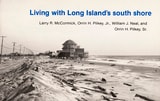
Living with Long Island's South Shore
Larry McCormick, William Neal, Orrin Pilkey Jr., and Orrin Pilkey, Sr.
Duke University Press, 1984
The south shore of Long Island, one of New York's greatest recreational assets, is receding at the rate of up to six feet per year. In many cases, efforts to halt this erosion actually have increased it. Buildings cone thought safely constructed back from high tidemarks today protrude far into the water.
Even more, the number of homes an facilities built too close to the sea's edge has dramatically increased, making the south shore probably less ready to withstand a major storm than at the time of the cataclysmic hurricane of 1938.
Thus, the question of what to do now to overcome and avoid these hazards takes on real urgency. Pointing to past mistakes, many Long Islanders insist that only by acting in an informed reasonable way can safe and environmentally sound development be possible for everyone.
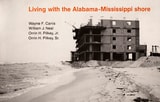
Living with the Alabama/Mississippi Shore
Wayne F. Canis, William F. Neal, Orrin H. Pilkey Jr. and Orrin H. Pilkey Sr.
Duke University Press, 1985
Yet this same serene shoreline has been ravaged by seven major hurricanes during this century. Several years more than one fearful storm has come hurtling in during a single "season." Loss of life an property damage have been devastating. And newcomers seem almost unaware of the potential dangers.
The authors of this book offer a vivid, historical overview for understanding the environment of the Alabama-Mississippi shore. They describe the risks faced by new residents, and they point the way toward safe and sane coastal development.

Living with the Chesapeake Bay and Virginia's Ocean Shores
Larry G. Ward, Peter S. Rosen, William J. Neal. Orrin H. Pilkey Jr., Orrin H. Pilkey Sr., Gary L. Anderson, and Stephen J. Howie
Duke University Press, 1989
Living with the East Florida Shore
Orrin H. Pilkey, Dinesh Sharma, Harold Wanless, Larry Doyle, Orrin H. Pilkey Sr., William J. Neal, and Barbara Gruver
Duke University Press, 1984
More than one transplanted Floridian has paid $150,000 for a beautiful condominium with a sea view only to learn that, to keep the building from becoming part of the view, considerable additional money must be spent to build and repair seawalls or to pump up new beaches by dredging sand from offshore.
Most of Florida's beachfront property lies on narrow strips of sand called barrier islands, which are low in elevation and subject to flooding during storms and hurricanes. Some of the construction is poor, adding to the problems facing homeowners, most whom came from other parts of the country with little awareness of the hazards of beaches. In Living with the East Florida Shore, Orrin H. Pilkey, Jr., of Duke University, along with his co-authors, has described the varied problems that confront the east shore of Florida today.
Living with the Georgia Shore
Tonya D. Clayton, Lewis A. Taylor Jr., William J. Cleary, Paul Hosier, Peter H.F. Graber, and Orrin H. Pilkey Sr.
Duke University Press, 1992
Recounting the human and natural history of the islands, the authors look in particular at the phenomenon of coastal erosion and the implications of various responses to this process. In Georgia, as elsewhere in the United States, the future of the shore is in doubt as recreational and residential development demands increase. This book provides guidelines for living with the shore, as opposed to simply living on it. The former requires planning and a wise choice of property or house site. The latter ignores the potential hazards unique to coastal life and may make inadequate allowance for the dramatic changes that can occur on any sandy ocean shore.
Living with the Georgia Shore includes an introduction to each of the Georgia isles, an overview of federal and state coastal land-use regulations, pointers on buying and building at the shore, a hurricane preparation checklist, a history of recent hurricanes in Georgia, an extensive annotated bibliography, and a guide to government agencies and private groups involved in issues of coastal development.
Living with the Louisiana Shore
Joseph T. Kelley, Alice R. Kelley, Orrin Pilkey Sr., and Albert Clark
Duke University Press, 1984
But the most striking feature of Louisiana's coastline is rapidly accelerating change, which means (1) some coastal parishes may literally disappear by the year 2000; (2) the loss of marshland will damage the prolific seafood industry; (3) a retreating coastline could cost the state hundreds of millions of dollars in tax revenues from offshore oil facilities; (4) present and potential shoreline residents will face many new problems and possibilities.
Living with the New Jersey Shore
Karl Nordstrom, Paul A. Garés, Norbert P. Psuty, Orrin H. Pilkey Jr., William Neal, and Orrin H. Pilkey Sr.
Duke University Press, 1986