Results by title
29 books match the query 'Place (Philosophy) in literature'

An Errant Eye
Poetry and Topography in Early Modern FranceTom Conley
University of Minnesota Press, 2010
This tension, Conley demonstrates, cuts through literature and graphic matter of various shapes and forms-hybrid genres that include the comic novel, the emblem-book, the eclogue, sonnets, and the personal essay. An Errant Eye differs from historical treatments of spatial invention through Conley's argument that the topographic sensibility is one in which the ocular faculty, vital to the description of locale, is endowed with tact and touch.
Detailed close readings of Apian, Rabelais, Montaigne, and others empower the reader with a lively sense of the topographical impulse, deriving from Conley's own "errant eye," which is singularly discerning in attentiveness to the ambiguities of charted territory, the contours of woodcut images, and the complex combinations of word and figure in French Renaissance poetry, emblem, and politics.
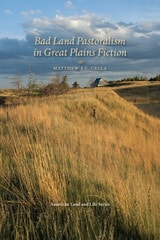
Bad Land Pastoralism in Great Plains Fiction
Matthew J. C. Cella
University of Iowa Press, 2010
At the core of this nuanced book is the question that ecocritics have been debating for decades: what is the relationship between aesthetics and activism, between art and community? By using a pastoral lens to examine ten fictional narratives that chronicle the dialogue between human culture and nonhuman nature on the Great Plains, Matthew Cella explores literary treatments of a succession of abrupt cultural transitions from the Euroamerican conquest of the “Indian wilderness” in the nineteenth century to the Buffalo Commons phenomenon in the twentieth. By charting the shifting meaning of land use and biocultural change in the region, he posits this bad land—the arid West—as a crucible for the development of the human imagination.
Each chapter deals closely with two novels that chronicle the same crisis within the Plains community. Cella highlights, for example, how Willa Cather reconciles her persistent romanticism with a growing disillusionment about the future of rural Nebraska, how Tillie Olsen and Frederick Manfred approach the tragedy of the Dust Bowl with strikingly similar visions, and how Annie Proulx and Thomas King use the return of the buffalo as the centerpiece of a revised mythology of the Plains as a palimpsest defined by layers of change and response. By illuminating these fictional quests for wholeness on the Great Plains, Cella leads us to understand the intricate interdependency of people and the places they inhabit.
Cella uses the term “pastoralism” in its broadest sense to mean a mode of thinking that probes the relationship between nature and culture: a discourse concerned with human engagement—material and nonmaterial—with the nonhuman community. In all ten novels discussed in this book, pastoral experience—the encounter with the Beautiful—leads to a renewed understanding of the integral connection between human and nonhuman communities. Propelling this tradition of bad land pastoralism are an underlying faith in the beauty of wholeness that comes from inhabiting a continuously changing biocultural landscape and a recognition of the inevitability of change. The power of story and language to shape the direction of that change gives literary pastoralism the potential to support an alternative series of ideals based not on escape but on stewardship: community, continuity, and commitment.
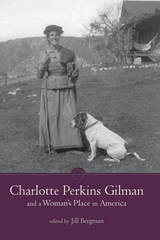
Charlotte Perkins Gilman and a Woman's Place in America
Edited by Jill Bergman
University of Alabama Press, 2017
Charlotte Perkins Gilman and a Woman’s Place in America is a pioneering collection that probes how depictions of space, confinement, and liberation establish both the difficulty and necessity of female empowerment. Turning Victorian notions of propriety and a woman’s place on its ear, this finely crafted essay collection studies Gilman’s writings and the manner in which they push back against societal norms and reject male-dominated confines of space.
The contributors present fascinating and innovative readings of some of Gilman’s most significant works. By examining the settings in “The Yellow Wallpaper” and Herland, for example, the volume analyzes Gilman’s construction of place, her representations of male dominance and female subjugation, and her analysis of the rules and obligations that women feel in conforming to their assigned place: the home.
Additionally, this volume delineates female resistance to this conformity. Contributors highlight how Gilman’s narrators often choose resistance over obedient captivity, breaking free of the spaces imposed upon them in order to seek or create their own habitats. Through biographical interpretations of Gilman’s work that focus on the author’s own renouncement of her “natural” role of wife and mother, contributors trace her relocation to the American West in an attempt to appropriate the masculinized spaces of work and social organization.
Engaging, well-researched, and deftly written, the essays in this collection will appeal to scholars of Gilman, literature, and gender issues alike.
Decolonial Topophilia
Nature, Place, and History in Puerto Rican PoetryVíctor Figueroa
Bucknell University Press, 2026
Decolonial Topophilia: Nature, Place, and History in Puerto Rican Poetry examines how four major poets—Luis Lloréns Torres, Luis Palés Matos, Juan Antonio Corretjer, and Julia de Burgos—address the ecological and human consequences of colonial domination in early twentieth-century Puerto Rico. Their poetry raises questions about the capitalist transformation of land through monocultures like sugarcane, the reduction of nature to exploitable resources, and the ties between attachment to place and nationalism. In tracing these connections, this pathbreaking book reveals how poetic visions of place can challenge colonial histories and imagine more reciprocal ways of inhabiting the world.
Published by Bucknell University Press. Distributed worldwide by Rutgers University Press.
Dwelling in Fiction
Poetics of Place and the Experimental Novel in Latin AmericaAshley R. Brock
Northwestern University Press, 2023
The radical formal experiments undertaken by writers across Latin America in the mid-twentieth century introduced friction, opacity, and self-reflexivity to the very act of reading. Dwelling in Fiction: Poetics of Place and the Experimental Novel in Latin America explores the limitations and the possibilities of literature for conveying place-specific forms of life. Focusing on authors such as José María Arguedas, João Guimarães Rosa, and Juan José Saer, who are often celebrated for universalizing regional themes, Ashley R. Brock brings a new critical lens to Latin American writers who were ambivalent toward their era’s “boom.”
Beyond mere resistance to or critique of the commodification and political instrumentalization of rural topics and types, this countertrend of critical regionalism positions readers themselves as outsiders, pushing them to engage their senses, to train their attention, and to learn to dwell in unknown textual landscapes. Dwelling in Fiction draws on a transnational community of thinkers and writers to show how their midcentury aesthetic practices of sensorial pedagogy anticipate contemporary turns toward affect, embodiment, decoloniality, and ecological thought.
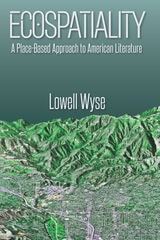
Ecospatiality
A Place-Based Approach to American LiteratureLowell Wyse
University of Iowa Press, 2021
Ecospatiality explores modern and contemporary American prose literature through the lens of place, showing how authors like William Least Heat-Moon, Willa Cather, Richard Wright, and Leslie Marmon Silko represent and reimagine real places in the world and the human-environment relationships therein. Building on the work of scholars in geography, sociology, ecocriticism, and geocriticism, this book articulates the theory of ecospatiality: an understanding of place as simultaneously spatial, ecological, and historical.
In our current historical moment, which is characterized by ongoing ecological collapse and a not-unrelated increase in social disorder, few issues are more urgent than the human relationship with our environments. Whether we characterize this new epoch as the climate change era or the Anthropocene, we can no longer ignore the fact that the places we live are rapidly changing in response to economic and environmental pressures. Rather than thinking of place as a neutral site for social interaction, we should recognize how it underpins and intertwines with human experience.
Fortunately, literature can help us think through how place operates. Lowell Wyse shows that texts can be understood as works of literary cartography. Focusing on works of nonfiction and fiction whose primary settings are on the North American continent, Ecospatiality demonstrates how these narratives rely on realistic literary geography to invoke, and sometimes retell, important aspects of environmental history within particular communities and bioregions.
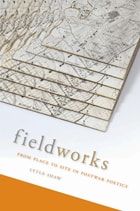
Fieldworks
From Place to Site in Postwar PoeticsLytle Shaw
University of Alabama Press, 2013
Fieldworks offers a historical account of the social, rhetorical, and material attempts to ground art and poetry in the physicality of a site.
Arguing that place-oriented inquiries allowed poets and artists to develop new, experimental models of historiography and ethnography, Lytle Shaw draws out the shifting terms of this practice from World War II to the present through a series of illuminating case studies. Beginning with the alternate national genealogies unearthed by William Carlos Williams in Paterson and Charles Olson in Gloucester, Shaw demonstrates how subsequent poets sought to ground such inquiries in concrete social formations—to in effect live the poetics of place: Gary Snyder in his back-to-the-land familial compound, Kitkitdizze; Amiri Baraka in a black nationalist community in Newark; Robert Creeley and the poets of Bolinas, California, in the capacious “now” of their poet-run town. Turning to the work of Robert Smithson—who called one of his essays an “appendix to Paterson,” and who in turn has exerted a major influence on poets since the 1970s—Shaw then traces the emergence of site-specific art in relation both to the poetics of place and to the larger linguistic turn in the humanities, considering poets including Clark Coolidge, Bernadette Mayer, and Lisa Robertson.
By putting the poetics of place into dialog with site-specificity in art, Shaw demonstrates how poets and artists became experimental explicators not just of concrete locations and their histories, but of the discourses used to interpret sites more broadly. It is this dual sense of fieldwork that organizes Shaw’s groundbreaking history of site-specific poetry.
Lingering Inland
A Literary Tour of the MidwestEdited by Andy Oler Foreword by José Olivarez
University of Illinois Press, 2025
Migrant Sites
America, Place, and Diaspora LiteraturesDalia Kandiyoti
Dartmouth College Press, 2009

No Place Else
Explorations in Utopian and Dystopian FictionEric S Rabkin
Southern Illinois University Press, 1983
Writers have created fictions of social perfection at least since Plato’s Republic. Sir Thomas More gave this thread of intellectual history a name when he called his contribution to it Utopia, Greek for noplace.
With each subsequent author cognizant of his predecessors and subject to altered real-world conditions which suggest ever-new causes for hope and alarm, “no place” changed. The fourteen essays presented in this book critically assess man’s fascination with and seeking for “no place.”
“In discussing these central fictions, the contributors see ‘no place’ from diverse perspectives: the sociological, the psychological, the political, the aesthetic. In revealing the roots of these works, the contributors cast back along the whole length of utopian thought. Each essay stands alone; together, the essays make clear what ‘no place’ means today. While it may be true that ‘no place’ has always seemed elsewhere or elsewhen, in fact all utopian fiction whirls contemporary actors through a costume dance no place else but here.”—from the Preface
The contributors are Eric S. Rabkin, B. G. Knepper, Thomas J.Remington, Gorman Beauchamp, William Matter, Ken Davis, Kenneth M. Roemer, William Steinhoff, Howard Segal, Jack Zipes, Kathleen Woodward, Merritt Abrash, and James W. Bittner.
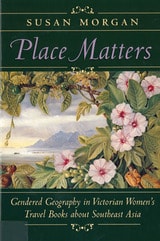
Place Matters
Morgan, Susan
Rutgers University Press, 1996
"Morgan has written an important and original work that presents a well-substantiated challenge to many recent studies of 'colonial discourse'."--Nancy L. Paxton,
Susan Morgan's study of materials and regions, previously neglected in contemporary postcolonial studies, begins with the transforming premise that "place matters." Concepts derived from writings about one area of the world cannot simply be transposed to another area, in some sort of global theoretical move. Moreover, place in the discourse of Victorian imperialism is a matter of gendered as well as geographic terms. Taking up works by Anna Forbes and Marianne North on the Malay Archipelago, by Margaret Brooke and Harriette McDougall on Sarawak, by Isabella Bird and Emily Innes on British Malaya, by Anna Leonowens on Siam, Morgan also makes extensive use of theorists whose work on imperialism in Southeast Asia is unfamiliar to most American academics.
This vivid examination of a different region and different writings emphasizes that in Victorian literature there was no monolithic imperialist location, authorial or geographic. The very notion of a ‘colony’ or an ‘imperial presence’ in Southeast Asia is problematic. Morgan is concerned with marking the intersections of particular Victorian imperial histories and constructions of subjectivity. She argues that specific places in Southeast Asia have distinctive, and differing, masculine imperial rhetorics. It is within these specific rhetorical contexts that women’s writings, including their moments of critique, can be read.
Place in American Fiction
Excursions and ExplorationsEdited by H.L. Weatherby & George Core
University of Missouri Press, 2004
Places for Dead Bodies
By Gary J. Hausladen
University of Texas Press, 2000
From Tony Hillerman's Navajo Southwest to Martin Cruz Smith's Moscow, an exotic, vividly described locale is one of the great pleasures of many murder mysteries. Indeed, the sense of place, no less than the compelling character of the detective, is often what keeps authors writing and readers reading a particular series of mystery novels.
This book investigates how "police procedural" murder mysteries have been used to convey a sense of place. Gary Hausladen delves into the work of more than thirty authors, including Tony Hillerman, Martin Cruz Smith, James Lee Burke, David Lindsey, P. D. James, and many others. Arranging the authors by their region of choice, he discusses police procedurals set in America, the United Kingdom and Ireland, Europe, Moscow, Asia, and selected locales in other parts of the world, as well as in historical places ranging from the Roman Empire to turn-of-the-century Cairo.
Places in the Making
A Cultural Geography of American PoetryJim Cocola
University of Iowa Press, 2016
Positing place as a pivotal axis of identification and heralding emplacement as a crucial model for cultural, intellectual, and political activity in a period marked and imperiled by a tendency toward dislocation, the critical vocabulary of this project centers upon the work of place-making. It attends to a poetics that extends beyond epic and lyric modes while relying simultaneously on auditory and visual effects and proceeding in the interests of environmental advocacy and social justice, often in contrast to the more orthodox concerns of literary modernism, global capitalism, and print culture. Focusing on poets of international reputation, such as Elizabeth Bishop, Pablo Neruda, Charles Olson, and William Carlos Williams, Places in the Making also considers work by more recent figures, including Kamau Brathwaite, Joy Harjo, Myung Mi Kim, and Craig Santos Perez. In its larger comparative, multiethnic, and transnational emphases, this book addresses questions of particular moment in American literary and cultural studies and aspires to serve as a catalyst for further interdisciplinary work connecting geography and the humanities.
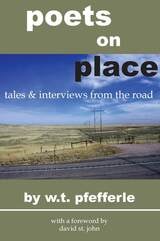
Poets On Place
W. T. Pfefferle
Utah State University Press, 2005
Out to see America and satisfy his travel bug, W. T. Pfefferle resigned from his position as director of the writing program at Johns Hopkins University and hit the road to interview sixty-two poets about the significance of place in their work. The lively conversations that resulted may surprise with the potential meanings of a seemingly simple concept. This gathering of voices and ideas is illustrated with photo and word portraits from the road and represented with suitable poems.
The poets are James Harms, David Citino, Martha Collins, Linda Gregerson, Richard Tillinghast, Orlando Ricardo Menes, Mark Strand, Karen Volkman, Lisa Samuels, Marvin Bell, Michael Dennis Browne, David Allan Evans, David Romtvedt, Sandra Alcosser, Robert Wrigley, Nance Van Winckel, Christopher Howell, Mark Halperin, Jana Harris, Sam Hamill, Barbara Drake, Floyd Skloot, Ralph Angel, Carol Muske-Dukes, David St. John, Sharon Bryan, Donald Revell, Claudia Keelan, Alberto Rios, Richard Shelton, Jane Miller, William Wenthe, Naomi Shihab Nye, Peter Cooley, Miller Williams, Beth Ann Fennelly, Natasha Trethewey, Denise Duhamel, Campbell McGrath, Terrance Hayes, Alan Shapiro, Nikki Giovanni, Charles Wright, Rita Dove, Henry Taylor, Dave Smith, Nicole Cooley, David Lehman, Lucie Brock-Broido, Michael S. Harper, C. D. Wright, Mark Wunderlich, James Cummins, Frederick Smock, Mark Jarman, Carl Phillips, Scott Cairns, Elizabeth Dodd, Jonathan Holden, Bin Ramke, Kenneth Brewer, and Paisley Rekdal.
Representing the Past
Essays in Performance HistoriographyCharlotte M. Canning
University of Iowa Press, 2010
How do historians represent the past? How do theatre historians represent performance events? The fifteen challenging essays in Representing the Past: Essays in Performance Historiography focus on the fundamental epistemological conditions and procedures that serve as the foundational ideas that guide all historians in their endeavors. Unified by their investigations into how best to understand and then represent the past, this diverse group of scholars in the field of theatre history and performance studies offers insights into the abiding issues that all historians face in the task of representing human events and actions.
Five primary ideas provide the topics as well as the intellectual parameters for this book: archive, time, space, identity, and narrative. Taking these as the conceptual framework for historical research and analysis, the essayists cover an expansive range of case studies and problems in the historical study of performance from the Americas to Africa and from Europe to India and China. Considering not only how historians think about these concepts in their research and writing but more pointedly—and historiographically—how they think with them, the essayists demonstrate the power and centrality of each of these five ideas in historical scholarship from initial research to the writing of essays and books.
Performance history has a diversity of identities, locations, sources, and narratives. This compelling engagement with the concepts essential to historical understanding is a valuable contribution to the historiography of performance—for students, teachers, and the future of the discipline itself. Expanding upon its classic predecessor, Interpreting the Theatrical Past: Essays in the Historiography of Performance, this exciting new collection illustrates the contemporary richness of historical thinking and writing in the field of performance history.
Rooted
Seven Midwest Writers of PlaceDavid R. Pichaske
University of Iowa Press, 2006
Show Me Your Environment
Essays on Poetry, Poets, and PoemsDavid Baker
University of Michigan Press, 2014
In Show Me Your Environment, a penetrating yet personable collection of critical essays, David Baker explores how a poem works, how a poet thinks, and how the art of poetry has evolved—and is still evolving as a highly diverse, spacious, and inclusive art form. The opening essays offer contemplations on the “environment” of poetry from thoughts on physical places and regions as well as the inner aesthetic environment. Next, Baker looks at the highly distinctive achievements and styles of poets ranging from George Herbert and Emily Dickinson through poets writing today. Finally, he takes joy in reading individual poems—from the canonical to the contemporary; simply and closely.
Space, Drama, and Empire
Mapping the Past in Lope de Vega's ComediaJavier Lorenzo
Bucknell University Press, 2023
Staging Place
The Geography of Modern DramaUna Chaudhuri
University of Michigan Press, 1997
Chaudhuri starts with a discussion of a "poetics of exile" in early modern drama, where the figure of home is constructed as a locus of two conflicting impulses: the desire to find a stable site for individual identity and the desire to deterritorialize the self. By mid-century, she argues, a new discourse of "failed homecoming" begins to displace this geopathic model and replace the poetics of exile with a grim anti-poetics of immigration. She then employs postmodern and postcolonial theories of place and culture to define the emerging multiculturalism as a creative reworking of the figures of home, homecoming, homelessness, immigration and exile.
"This is a book of real originality. Its treatment of space in modern drama is elegant and powerful. . . ." --William B. Worthen, Northwestern University
"Staging Place is a powerfully written book, deft in its handling of familiar and unfamiliar plays alike and eclectic in its use of theatrical sources." --Essays in Theatre/ Études théâtrales
"This sophisticated and well-written study for graduate students and their teachers explores modern drama's preoccupation with the seemingly irreconcilable discontinuities between the notions of home and homelessness, belonging and exile. . . . The readings of individual plays are fresh and invigorating. . . ." --Choice
Una Chaudhuri is Associate Professor of English, New York University.

Street Scenes
Brecht, Benjamin and BerlinNicolas Whybrow
Intellect Books, 2004
Bertolt Brecht, meanwhile, stands as one of the principal thinkers about art and politics in the 20th century. The "Street Scene" model, which was the foundation for his theory of an epic theatre, relied precisely on establishing a connection between art's functioning and everyday life. His preoccupation with the ceaselessness of change, an impulse implying rupture and movement as the key characteristics informing the development of a democratic cultural identity, correlates resonantly with the notion of an ever-evolving city.
Premised on an understanding of performance as the articulation of movement in space, Street Scenes interrogates what kind of "life" is permitted to "flow" in the "new Berlin." Central to this method is the flaneur figure, a walker of streets who provides detached observations on the revealing "detritus of modern urban existence." Walter Benjamin, himself a native of Berlin as well as friend and seminal critic of Brecht, exercised the practice in exemplary form in his portrait of the city One-Way Street.
Street Scenes offers various points of entry for the reader, including those interested in: theatre, performance, visual art, architecture, theories of everyday life and culture, and the politics of identity. Ultimately, it is an interdisciplinary book, which strives to establish the 'porosity' of areas of theory and practice rather than hard boundaries.
Sum of the Parts
The Mathematics and Politics of Region, Place, and WritingKent C Ryden
University of Iowa Press, 2011
The Midwestern Pastoral
Place and Landscape in Literature of the American HeartlandWilliam Barillas
Ohio University Press, 2006
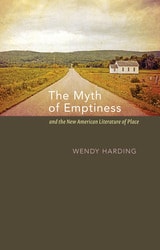
The Myth of Emptiness and the New American Literature of Place
Wendy Harding
University of Iowa Press, 2014
In The Myth of Emptiness and the New American Literature of Place, Wendy Harding identifies an important recent development in the literature of place that corrects the misperceptions resulting from these tropes. Works by Rick Bass, Charles Bowden, Ellen Meloy, Jonathan Raban, Rebecca Solnit, and Robert Sullivan move away from the tradition of nature writing, with its emphasis on the solitary individual communing with nature in uninhabited places, to recognize the interactions of human and other-than-human presences in the land. In different ways, all six writers reveal a more historically complex relationship between Americans and their environments. In this new literature of place, writers revisit abandoned, threatened, or damaged sites that were once represented as devoid of human presence and dig deeper to reveal that they are in fact full of the signs of human activity. These writers are interested in the role of social, political, and cultural relationships and the traces they leave on the landscape.
Throughout her exploration, Harding adopts a transdisciplinary perspective that draws on the theories of geographers, historians, sociologists, and philosophers to understand the reasons for the enduring perception of emptiness in the American landscape and how this new literature of place works with and against these ideas. She reminds us that by understanding and integrating human impacts into accounts of the landscape, we are better equipped to fully reckon with the natural and cultural crisis that engulfs all landscapes today.

The Noble Savage in the New World Garden
Notes toward a Syntactics of PlaceGaile McGregor
University of Wisconsin Press, 1988
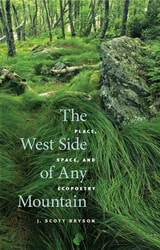
The West Side of Any Mountain
Place, Space, and EcopoetryJ. Scott Bryson
University of Iowa Press, 2005
Informed in general by current thinking in environmental theory and specifically by the work of cultural geographer Yi-Fu Tuan, The West Side of Any Mountain participates in and furthers this scholarly attention by offering an overarching theoretical framework with which to approach the field.
One area that contemporary theorists have found problematic is the dualistic civilization/wilderness binary that focuses on the divisions between culture and nature, thereby increasing the modern sense of alienation. Tuan’s place-space framework offers a succinct vocabulary for describing the attitudes of ecological poets and other nature writers in a way that avoids setting up an adversarial relationship between place and space. Scott Bryson describes the Tuanian framework and employs it to offer fresh readings of the work of four major ecopoets: Wendell Berry, Joy Harjo, Mary Oliver, and W. S. Merwin.
The West Side of Any Mountain will be of great interest to scholars and teachers working in the field of contemporary nature poetry. It is recommended for nature-writing courses as well as classes dealing with 20th-century poetry, contemporary literary criticism, and environmental theory.
Thoreaus Sense of Place
Essays in American Environmental WritingRichard J. Schneider
University of Iowa Press, 2000
The contributors to this stimulating collection address the ways in which Thoreau and his successors attempt to cope with the basic epistemological split between perceiver and place inherent in writing about nature; related discussions involve the kinds of discourse most effective for writing about place. They focus on the impact on Thoreau and his successors of culturally constructed assumptions deriving from science, politics, race, gender, history, and literary conventions. Finally, they explore the implications surrounding a writer's appropriation or even exploitation of places and objects.
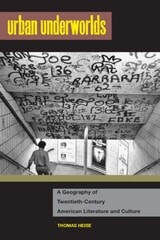
Urban Underworlds
A Geography of Twentieth-Century American Literature and CultureHeise, Thomas
Rutgers University Press, 2010
The quarantining of minority cultures helped to promote white, middle-class privilege. Following a diverse array of literary figures who differ with the assessment of the underworld as the space of the monstrous Other, Heise contends that it is a place where besieged and neglected communities are actively trying to take possession of their own neighborhoods.
Writing out of Place
Regionalism, Women, and American Literary CultureJudith Fetterley and Marjorie Pryse
University of Illinois Press, 2002
Regionalist writers such as Alice Cary, Mary E. Wilkins Freeman, Sarah Orne Jewett, Grace King, Alice Dunbar–Nelson, Sui Sin Far, and Mary Austin present narrators who serve as cultural interpreters for persons often considered "out of place" by urban readers. Critiquing the approaches to regional subjects characteristic of local color, this book gives contemporary readers a vantage point from which to approach regions and regional people in the global economy of our own time.
Reclaiming the ground of "close" reading for texts that have been insufficiently read, Fetterley and Pryse situate textual analyses within larger questions such as the ideology of form, feminist standpoint epistemology, queer theory, intersections of race and class, and narrative empathy. In its combination of the critical and the visionary, Writing out of Place proposes regionalism as a model for narrative connection between texts and readers that has the potential to transform American literary culture. Arguing the need for other models for human development than those produced in heroic stories about men and boys, the authors offer regionalism as a source of unconventional and counterhegemonic fictions that should be passed on to future generations of readers.