Results by title
9 books match the query 'Plain English'
Legal Writing in Plain English, Second Edition
A Text with ExercisesBryan A. Garner
University of Chicago Press, 2013
Admirably clear, concise, down-to-earth, and powerful—all too often, legal writing embodies none of these qualities. Its reputation for obscurity and needless legalese is widespread. Since 2001 Bryan A. Garner’s Legal Writing in Plain English has helped address this problem by providing lawyers, judges, paralegals, law students, and legal scholars with sound advice and practical tools for improving their written work. Now the leading guide to clear writing in the field, this indispensable volume encourages legal writers to challenge conventions and offers valuable insights into the writing process that will appeal to other professionals: how to organize ideas, create and refine prose, and improve editing skills.
Accessible and witty, Legal Writing in Plain English draws on real-life writing samples that Garner has gathered through decades of teaching experience. Trenchant advice covers all types of legal materials, from analytical and persuasive writing to legal drafting, and the book’s principles are reinforced by sets of basic, intermediate, and advanced exercises in each section.
In this new edition, Garner preserves the successful structure of the original while adjusting the content to make it even more classroom-friendly. He includes case examples from the past decade and addresses the widespread use of legal documents in electronic formats. His book remains the standard guide for producing the jargon-free language that clients demand and courts reward.
[more]
Legal Writing in Plain English, Third Edition
A Text with ExercisesBryan A. Garner
University of Chicago Press, 2023
The leading guide to clear writing—and clear thinking—in the legal profession for more than two decades, now newly updated.
Admirably clear, concise, down-to-earth, and powerful—all too often, legal writing embodies none of these qualities. Its reputation for obscurity and needless legalese is widespread. Since 2001, Bryan A. Garner’s Legal Writing in Plain English has helped address this problem by providing lawyers, judges, paralegals, law students, and legal scholars with sound advice and practical tools for improving their written work. Now the leading guide to clear writing in the field, this indispensable volume encourages legal writers to challenge conventions and offers valuable insights into the writing process: how to organize ideas, create and refine prose, and improve editing skills.
Accessible and witty, Legal Writing in Plain English draws on real-life writing samples that Garner has gathered through decades of teaching experience. Trenchant advice covers all types of legal materials, from analytical and persuasive writing to legal drafting, and the book’s principles are reinforced by sets of basic, intermediate, and advanced exercises in each section.
For this third edition, Garner has retained the structure of the previous versions, with updates and new material throughout. There are new sections on making your writing vivid and concrete and on using graphics to enhance your argument. The coverage and examples of key topics such as achieving parallelism, avoiding legalese, writing effective openers and summaries, and weaving quotations into your text have also been expanded. And the sample legal documents and exercises have been updated, while newly added checklists provide quick summaries of each section.
Altogether, this new edition will be the most useful yet for legal professionals and students seeking to improve their prose.
[more]
Legal Writing in Plain English
A Text with ExercisesBryan A. Garner
University of Chicago Press, 2001
Admirably clear, concise, down-to-earth, and powerful-unfortunately, these adjectives rarely describe legal writing, whether in the form of briefs, opinions, contracts, or statutes. In Legal Writing in Plain English, Bryan A. Garner provides lawyers, judges, paralegals, law students, and legal scholars sound advice and practical tools for improving their written work. The book encourages legal writers to challenge conventions and offers valuable insights into the writing process: how to organize ideas, create and refine prose, and improve editing skills. In essence, it teaches straight thinking—a skill inseparable from good writing.
Replete with common sense and wit, the book draws on real-life writing samples that Garner has gathered through more than a decade of teaching in the field. Trenchant advice covers all types of legal materials, from analytical and persuasive writing to legal drafting. Meanwhile, Garner explores important aspects of document design. Basic, intermediate, and advanced exercises in each section reinforce the book's principles. (An answer key to basic exercises is included in the book; answers to intermediate and advanced exercises are provided in a separate Instructor's Manual, free of charge to instructors.) Appendixes include a comprehensive punctuation guide with advice and examples, and four model documents.
Today more than ever before, legal professionals cannot afford to ignore the trend toward clear language shorn of jargon. Clients demand it, and courts reward it. Despite the age-old tradition of poor writing in law, Legal Writing in Plain English shows how legal writers can unshackle themselves.
Legal Writing in Plain English includes:
*Tips on generating thoughts, organizing them, and creating outlines.
*Sound advice on expressing your ideas clearly and powerfully.
*Dozens of real-life writing examples to illustrate writing problems and solutions.
*Exercises to reinforce principles of good writing (also available on the Internet).
*Helpful guidance on page layout.
*A punctuation guide that shows the correct uses of every punctuation mark.
*Model legal documents that demonstrate the power of plain English.
[more]

The Rules of Golf in Plain English
Jeffrey S. Kuhn and Bryan A. Garner
University of Chicago Press, 2004
"The cry for the simplification of the Rules of Golf is a stock-in-trade of the journalist during the winter months. Countless words on the subject have been poured out to an ever-tolerant public, but still the long-sought simplification does not come."—Henry Longhurst, 1937
The hopes of renowned writer and golfer Henry Longhurst—and millions of golfers before and after him—have finally been realized. In The Rules of Golf in Plain English, Bryan A. Garner, American English language and usage expert, and Jeffrey S. Kuhn, volunteer USGA rules official, have translated the knotty Rules with the encouragement and permission of the United States Golf Association. The result is a modern, readable version that offers, for the first time, clear guidance to both amateurs and professionals.
Based on a 338-word set of thirteen rules written in 1744, the official Rules have grown, over two and a half centuries, to 40,000 words. Numerous contributors and a complex revision process have rendered these Rules so opaque and stylistically inconsistent that a companion volume—the 600-page Decisions on the Rules of Golf—has been published to help golfers navigate them.
Both lawyers and avid golfers, Kuhn and Garner recognized the difficulties that the language of the Rules of Golf created, especially in a sport that expects players to call penalties on themselves. By reworking the Rules line by line, word by word, they have produced an accessible resource that no golfer—from the duffer to the pro—should be without.
[more]
The Rules of Golf in Plain English, Fourth Edition
Jeffrey S. Kuhn and Bryan A. Garner
University of Chicago Press, 2016
The earliest standards for the game of golf included just 338 words and thirteen rules, which included what to do if your ball had the misfortune of falling into “watery filth” and how to proceed if your ball was stopped by a horse. The official Rules of Golf have since grown to more than 40,000 words and cover everything from marking a scorecard to determining whether a club has the appropriate roughness.
Two hundred years of revisions have rendered these Rules opaque and stylistically inconsistent. Those intricacies can be intimidating for anyone hoping to pick up the game and frustrating for longtime players who just want to settle a dispute. Both lawyers and avid golfers, Jeffrey S. Kuhn and Bryan A. Garner recognized the difficulties that the language of the Rules of Golf has created, especially in a sport that expects players to call penalties on themselves. By reworking the Rules line by line, word by word, they have produced an accessible resource that no golfer—from the duffer to the pro—should be without.
This new edition of The Rules of Golf in Plain English is fully aligned with the latest United States Golf Association updates and continues to be published with their permission and encouragement. Clear and concise, this reference will allow players to spend more time playing through and less time scratching their heads.
[more]

The Rules of Golf in Plain English, Second Edition
Jeffrey S. Kuhn and Bryan A. Garner
University of Chicago Press, 2008
"The cry for the simplification of the Rules of Golf is a stock-in-trade of the journalist during the winter months. Countless words on the subject have been poured out to an ever-tolerant public, but still the long-sought simplification does not come."—Henry Longhurst, 1937
The hopes of renowned writer and golfer Henry Longhurst—and millions of golfers before and after him—have finally been realized. In The Rules of Golf in Plain English, Bryan A. Garner, American English language and usage expert, and Jeffrey S. Kuhn, volunteer USGA rules official, have translated the knotty Rules with the encouragement and permission of the United States Golf Association. The result is a modern, readable version that offers, for the first time, clear guidance to both amateurs and professionals.
Based on a 338-word set of thirteen rules written in 1744, the official Rules have grown, over two and a half centuries, to 40,000 words. Numerous contributors and a complex revision process have rendered these Rules so opaque and stylistically inconsistent that a companion volume—the 600-page Decisions on the Rules of Golf—has been published to help golfers navigate them.
Both lawyers and avid golfers, Kuhn and Garner recognized the difficulties that the language of the Rules of Golf created, especially in a sport that expects players to call penalties on themselves. By reworking the Rules line by line, word by word, they have produced an accessible resource that no golfer—from the duffer to the pro—should be without.
The hopes of renowned writer and golfer Henry Longhurst—and millions of golfers before and after him—have finally been realized. In The Rules of Golf in Plain English, Bryan A. Garner, American English language and usage expert, and Jeffrey S. Kuhn, volunteer USGA rules official, have translated the knotty Rules with the encouragement and permission of the United States Golf Association. The result is a modern, readable version that offers, for the first time, clear guidance to both amateurs and professionals.
Based on a 338-word set of thirteen rules written in 1744, the official Rules have grown, over two and a half centuries, to 40,000 words. Numerous contributors and a complex revision process have rendered these Rules so opaque and stylistically inconsistent that a companion volume—the 600-page Decisions on the Rules of Golf—has been published to help golfers navigate them.
Both lawyers and avid golfers, Kuhn and Garner recognized the difficulties that the language of the Rules of Golf created, especially in a sport that expects players to call penalties on themselves. By reworking the Rules line by line, word by word, they have produced an accessible resource that no golfer—from the duffer to the pro—should be without.
[more]
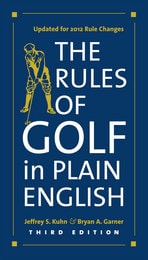
The Rules of Golf in Plain English, Third Edition
Jeffrey S. Kuhn and Bryan A. Garner
University of Chicago Press, 2012
"The cry for the simplification of the Rules of Golf is a stock-in-trade of the journalist during the winter months. Countless words on the subject have been poured out to an ever-tolerant public, but still the long-sought simplification does not come."—Henry Longhurst, 1937
The hopes of renowned writer and golfer Henry Longhurst—and millions of golfers before and after him—have finally been realized. In The Rules of Golf in Plain English, Bryan A. Garner, American English language and usage expert, and Jeffrey S. Kuhn, volunteer USGA rules official, have translated the knotty Rules with the encouragement and permission of the United States Golf Association. The result is a modern, readable version that offers, for the first time, clear guidance to both amateurs and professionals.
Based on a 338-word set of thirteen rules written in 1744, the official Rules have grown, over two and a half centuries, to 40,000 words. Numerous contributors and a complex revision process have rendered these Rules so opaque and stylistically inconsistent that a companion volume—the 600-page Decisions on the Rules of Golf—has been published to help golfers navigate them.
Both lawyers and avid golfers, Kuhn and Garner recognized the difficulties that the language of the Rules of Golf created, especially in a sport that expects players to call penalties on themselves. By reworking the Rules line by line, word by word, they have produced an accessible resource that no golfer—from the duffer to the pro—should be without.
The hopes of renowned writer and golfer Henry Longhurst—and millions of golfers before and after him—have finally been realized. In The Rules of Golf in Plain English, Bryan A. Garner, American English language and usage expert, and Jeffrey S. Kuhn, volunteer USGA rules official, have translated the knotty Rules with the encouragement and permission of the United States Golf Association. The result is a modern, readable version that offers, for the first time, clear guidance to both amateurs and professionals.
Based on a 338-word set of thirteen rules written in 1744, the official Rules have grown, over two and a half centuries, to 40,000 words. Numerous contributors and a complex revision process have rendered these Rules so opaque and stylistically inconsistent that a companion volume—the 600-page Decisions on the Rules of Golf—has been published to help golfers navigate them.
Both lawyers and avid golfers, Kuhn and Garner recognized the difficulties that the language of the Rules of Golf created, especially in a sport that expects players to call penalties on themselves. By reworking the Rules line by line, word by word, they have produced an accessible resource that no golfer—from the duffer to the pro—should be without.
[more]
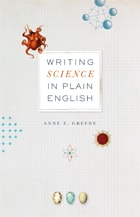
Writing Science in Plain English
Anne E. Greene
University of Chicago Press, 2013
Scientific writing is often dry, wordy, and difficult to understand. But, as Anne E. Greene shows in Writing Science in Plain English,writers from all scientific disciplines can learn to produce clear, concise prose by mastering just a few simple principles.
This short, focused guide presents a dozen such principles based on what readers need in order to understand complex information, including concrete subjects, strong verbs, consistent terms, and organized paragraphs. The author, a biologist and an experienced teacher of scientific writing, illustrates each principle with real-life examples of both good and bad writing and shows how to revise bad writing to make it clearer and more concise. She ends each chapter with practice exercises so that readers can come away with new writing skills after just one sitting.
Writing Science in Plain English can help writers at all levels of their academic and professional careers—undergraduate students working on research reports, established scientists writing articles and grant proposals, or agency employees working to follow the Plain Writing Act. This essential resource is the perfect companion for all who seek to write science effectively.
[more]
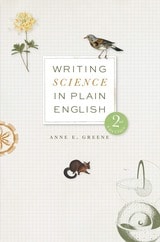
Writing Science in Plain English, Second Edition
Anne E. Greene
University of Chicago Press, 2025
An updated edition of the essential guide for all scientists—from undergraduates to senior scholars—who want to produce prose that anyone can understand.
Scientific writing is often dry, wordy, and difficult to understand. But, as biologist and experienced teacher of scientific writing Anne E. Greene shows in Writing Science in Plain English, writers from all scientific disciplines can learn to produce clear, concise prose by mastering just a few simple principles. This short, focused guide presents roughly a dozen such principles based on what readers need to understand complex information, including concrete subjects, strong verbs, consistent terms, organized paragraphs, and correct sentence structure. Greene illustrates each principle with real-life examples of both good and bad writing and shows how bad writing might be improved. She ends each chapter with revision exercises (and provides suggested answers in a separate key) so that readers can come away with new writing skills after just one sitting. To help readers understand the grammatical terms used in the book, an appendix offers a refresher course on basic grammar.
For this second edition, Greene has incorporated the latest research on what makes writing effective and engaging and has revised or replaced exercises and exercise keys where needed. She has also added new features that make it easier to navigate the book. A new resource for instructors who use Writing Science in Plain English in their classes is a free, online teacher’s guide. Drawn from Greene’s long experience teaching students how to write science clearly, the teacher’s guide provides additional lectures, assignments, and activities that will inform and enliven any class.
[more]