Results by title
13 books match the query 'Plant ecology'
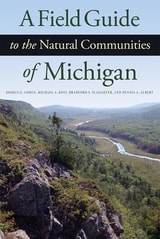
A Field Guide to the Natural Communities of Michigan
Joshua G. Cohen
Michigan State University Press, 2014
The culmination of three decades of work by Michigan Natural Features Inventory ecologists, this essential guidebook to the natural communities of Michigan introduces the diverse terrain of a unique state. Small enough to carry in a backpack, this field guide provides a system for dividing the complex natural landscape of Michigan into easily understood and describable components called natural communities. Providing a new way to explore Michigan’s many environments, this book details natural communities ranging from patterned fen to volcanic bedrock glade and beyond. The descriptions are supplemented with distribution maps, vibrant photographs, and comprehensive lists of characteristic plant species. The authors suggest places to visit to further study each type of natural community and provide a comprehensive glossary of ecological terms, as well as a dichotomous key for aiding field identification. An invaluable resource, this book is meant to serve as a tool for those seeking to understand, describe, document, conserve, and restore the diversity of natural communities native to Michigan.
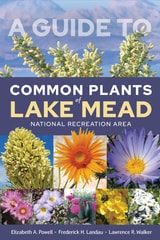
A Guide to Common Plants of Lake Mead National Recreation Area
Elizabeth A. Powell
University of Nevada Press, 2023
A Guide to Common Plants of Lake Mead National Recreation Area is the definitive book for weekend explorers and botanists alike who venture into LMNRA ready to discover the many wonders of the local flora. The authors highlight 183 plants that hikers are most likely to encounter along popular trails, washes, and surrounding hot springs, helping the area’s millions of annual visitors identify and enjoy these common plants. This guide includes photos and descriptions of each plant, along with a map of LMNRA.
The authors also provide a primer on plant ecology, including a guide to plant structures, desert adaptations and life forms, plant-to-plant interactions, and plant-animal interactions. Plants are grouped by life forms, such as tree, shrub, cactus, or grass, and by flower color within the wildflower section. The guide will encourage readers to pause and look carefully at each plant they encounter, giving them an enriched experience during their exploration.
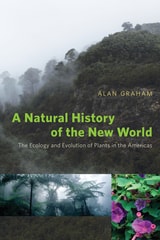
A Natural History of the New World
The Ecology and Evolution of Plants in the AmericasAlan Graham
University of Chicago Press, 2010
The paleoecological history of the Americas is as complex as the region is broad: stretching from the Arctic Circle to Tierra del Fuego, the New World features some of the most extraordinary vegetation on the planet. But until now it has lacked a complete natural history. Alan Graham remedies that with A Natural History of the New World. With plants as his scientific muse, Graham traces the evolution of ecosystems, beginning in the Late Cretaceous period (about 100 million years ago) and ending in the present, charting their responses to changes in geology and climate.
By highlighting plant communities’ roles in the environmental history of the Americas, Graham offers an overdue balance to natural histories that focus exclusively on animals. Plants are important in evolution’s splendid drama. Not only are they conspicuous and conveniently stationary components of the Earth’s ecosystems, but their extensive fossil record allows for a thorough reconstruction of the planet’s paleoenvironments. What’s more, plants provide oxygen, function as food and fuel, and provide habitat and shelter; in short, theirs is a history that can speak to many other areas of evolution.
A Natural History of the New World is an ambitious and unprecedented synthesis written by one of the world’s leading scholars of botany and geology.
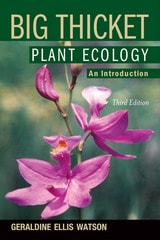
Big Thicket Plant Ecology
An Introduction, Third EditionGeraldine Ellis Watson
University of North Texas Press, 2006
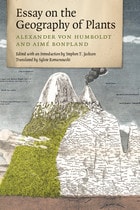
Essay on the Geography of Plants
Alexander von Humboldt and Aimé Bonpland
University of Chicago Press, 2010
The chronicles of the expedition were published in Paris after Humboldt’s return, and first among them was the 1807 “Essay on the Geography of Plants.” Among the most cited writings in natural history, after the works of Darwin and Wallace, this work appears here for the first time in a complete English-language translation. Covering far more than its title implies, it represents the first articulation of an integrative “science of the earth, ” encompassing most of today’s environmental sciences. Ecologist Stephen T. Jackson introduces the treatise and explains its enduring significance two centuries after its publication.

Foundations of Ecology II
Classic Papers with CommentariesEdited by Thomas E. Miller and Joseph Travis
University of Chicago Press, 2022
The period of 1970 to 1995 was a time of tremendous change in all areas of ecology—from an increased rigor for experimental design and analysis to the reevaluation of paradigms, new models for understanding, and theoretical advances. Edited by ecologists Thomas E. Miller and Joseph Travis, Foundations of Ecology II includes facsimiles of forty-six papers from this period alongside expert commentaries that discuss a total of fifty-three key studies, addressing topics of diversity, predation, complexity, competition, coexistence, extinction, productivity, resources, distribution, abundance, and conservation. The result is more than a catalog of historic firsts; this book offers diverse perspectives on the foundational papers that led to today’s ecological work. Like this book’s 1991 predecessor, Foundations of Ecology edited by Leslie A. Real and James H. Brown, Foundations of Ecology II promises to be the essential primer for graduate students and practicing ecologists for decades to come.
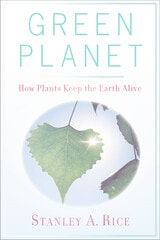
Green Planet
How Plants Keep the Earth AliveRice, Stanley A
Rutgers University Press, 2012
Beginning with an overview of how human civilization has altered the face of the Earth, particularly by the destruction of forests, the book details the startling consequences of these actions. Rice provides compelling reasons for government officials, economic leaders, and the public to support efforts to save threatened and endangered plants. Global campaigns to solve environmental problems with plants, such as the development of green roofs and the Green Belt Movement—a women's organization in Kenya that empowers communities worldwide to protect the environment—show readers that efforts to save wild plants can be successful and beneficial to the economic well-being of nations.
Through current scientific evidence, readers see that plants are vital to the ecological health of our planet and understand what can be done to lead to a better—and greener—future
Benefits of plants:
- Help modulate greenhouse gases
- Produce almost all oxygen in the air
- Create cool shade that reduces energy costs
- Prevent floods, droughts, and soil erosion
- Produce all of the food in the world
- Create and preserve soil
- Create natural habitats
- Heal the landscape after natural and human disasters
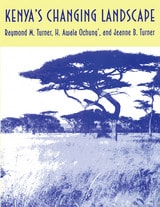
Kenya's Changing Landscape
Raymond M. Turner
University of Arizona Press, 1998
Turner's discussions of the photographs and the conclusions he draws provide an important reference for ecologists, geographers, botanists, and other researchers attempting similar studies. By documenting vegetation change in a region broadly similar climatically to North America's subtropical deserts and grasslands but different in its wildlife and its human culture, the book shows that the endpoints of landscape status are similar despite the vastly different histories of these two regions of the world.
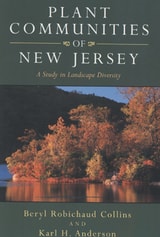
Plant Communities of New Jersey
A Study in Landscape DiversityCollins, Beryl Robichaud
Rutgers University Press, 1994
From the ridgetops of the north to the Pinelands of the south, New Jersey’s natural areas display an astonishing variety of plant life. This book--a completely revised edition of the classic Vegetation of New Jersey--enables readers to understand why the vegetation of New Jersey is what it is today and what it may become.
The book portrays New Jersey as an ecosystem--its geology, topography and soil, climate, plant-plant and plant-animal relationships, and the human impact on the environment. The authors describe in detail the twelve types of plant habitats distinguished in New Jersey and suggest places to observe good examples of them.
The book is amply illustrated with photographs of plant communities and individual species and maps. The appendixes provide a cross reference between the common and scientific names of native plants of New Jersey, and hints for plant identification.
Scientifically accurate yet written in a lively style, Plant Communities of New Jersey belongs on the bookshelf of every New Jerseyan who cares about the environment.
Plant Sensing and Communication
Richard Karban
University of Chicago Press, 2015
In Plant Sensing and Communication, Richard Karban provides the first comprehensive overview of what is known about how plants perceive their environments, communicate those perceptions, and learn. Facing many of the same challenges as animals, plants have developed many similar capabilities: they sense light, chemicals, mechanical stimulation, temperature, electricity, and sound. Moreover, prior experiences have lasting impacts on sensitivity and response to cues; plants, in essence, have memory. Nor are their senses limited to the processes of an individual plant: plants eavesdrop on the cues and behaviors of neighbors and—for example, through flowers and fruits—exchange information with other types of organisms. Far from inanimate organisms limited by their stationary existence, plants, this book makes unquestionably clear, are in constant and lively discourse.
The Rose's Kiss
A Natural History of FlowersPeter Bernhardt
University of Chicago Press, 2002
In The Rose's Kiss, Peter Bernhardt presents a fascinating and wide-ranging look at the natural history of flowers—how they look, what they do, and their often hidden interactions with the surrounding environment and other living organisms upon which they depend for their survival. You'll discover why flowers are so colorful, how they evolved, and how insects exploit them for their nectar. This is a book for all flower lovers, from naturalists and gardeners to poets and botanists.
The Unruly Wild
Embracing Ecological Change in the SouthwestJuliet C. Stromberg
University of Arizona Press, 2026
Challenging the traditional invasion biology paradigm, Juliet C. Stromberg invites readers to reconsider the “alien invader” narrative and explore the beneficial roles that newly arrived plants can play in our ecosystems. Drawing from her extensive experience as a plant and restoration ecologist, Stromberg introduces a cast of plant characters that includes longtimers as well as newcomers.
Through compelling stories and scientific insights, Stromberg explains why some plants are thriving while others are in decline. Stromberg’s engaging narrative, enriched with personal anecdotes and detailed vignettes, encourages readers to pause, reflect, and deepen their relationship with the plant world. By promoting a more nuanced and respectful dialogue about our natural surroundings, this book offers valuable insights into biodiversity, climate resilience, and ecosystem restoration. This book is a call to embrace a more inclusive and adaptive approach to wild plants.
The Vegetation of Wisconsin
An Ordination of Plant CommunitiesJohn T. Curtis
University of Wisconsin Press, 1959