Results by title
3 books match the query 'Plant shutdowns'
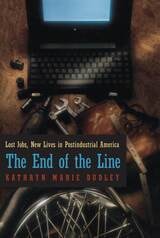
The End of the Line
Lost Jobs, New Lives in Postindustrial AmericaKathryn Marie Dudley
University of Chicago Press, 1994
The End of the Line tells the story of the 1988 closing of the Chrysler assembly plant in Kenosha, Wisconsin. Kathryn Marie Dudley uses interviews with residents to chart the often confusing process of change that deindustrialization forced on every corner of the community. This honest, moving portrait of one town's radical shift from a manufacturing to a postindustrial economy will redefine the way Americans think about our families, communities, and future.
"An excellent study not only of the cultural disruptions caused by the shutdown of Chrysler's operations in Kenosha, Wisconsin, but also of the ideology of progress that abetted the shutdown."—Stephen Amberg, Industrial and Labor Relations Review
"With the eye of an anthropologist, [Dudley] examines the tensions between the 'culture of hands' and the 'culture of mind.' Her account is especially instructive because, by many measures, Kenosha has successfully recovered, yet for many the pain still remains."—Booklist
"Exceptional. . . . Should be widely read."—Douglas Harper, Contemporary Sociology
"Make[s] clear what a tenuous concept economic security is, especially when the rules for achieving security are in flux."—Barbara Presley Noble, New York Times
[more]
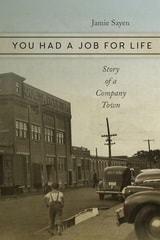
You Had a Job for Life
Story of a Company TownJamie Sayen
University Press of New England, 2017
Absentee owners. Single-minded concern for the bottom line. Friction between workers and management. Hostile takeovers at the hands of avaricious and unaccountable multinational interests. The story of America’s industrial decline is all too familiar—and yet, somehow, still hard to fathom. Jamie Sayen spent years interviewing residents of Groveton, New Hampshire, about the century-long saga of their company town. The community’s paper mill had been its economic engine since the early twentieth century. Purchased and revived by local owners in the postwar decades, the mill merged with Diamond International in 1968. It fell victim to Anglo-French financier James Goldsmith’s hostile takeover in 1982, then suffered through a series of owners with no roots in the community until its eventual demise in 2007. Drawing on conversations with scores of former mill workers, Sayen reconstructs the mill’s human history: the smells of pulp and wood, the injuries and deaths, the struggles of women for equal pay and fair treatment, and the devastating impact of global capitalism on a small New England town. This is a heartbreaking story of the decimation of industrial America.
[more]
You Had a Job for Life
Story of a Company TownJamie Sayen
Brandeis University Press, 2023
A local story with profound national implications, now available as a paperback with a new preface by the author.
Absentee owners. Single-minded concern for the bottom line. Friction between workers and management. Hostile takeovers at the hands of avaricious and unaccountable multinational interests. The story of America’s industrial decline is all too familiar—and yet, somehow, still hard to fathom. Jamie Sayen spent years interviewing residents of Groveton, New Hampshire, about the century-long saga of their company town. The community’s paper mill had been its economic engine since the early twentieth century. Purchased and revived by local owners in the postwar decades, the mill merged with Diamond International in 1968. It fell victim to Anglo-French financier James Goldsmith’s hostile takeover in 1982, then suffered through a series of owners with no roots in the community until its eventual demise in 2007. Drawing on conversations with scores of former mill workers, Sayen reconstructs the mill’s human history: the smells of pulp and wood, the injuries and deaths, the struggles of women for equal pay and fair treatment, and the devastating impact of global capitalism on a small New England town. This is a heartbreaking story of the decimation of industrial America.
Absentee owners. Single-minded concern for the bottom line. Friction between workers and management. Hostile takeovers at the hands of avaricious and unaccountable multinational interests. The story of America’s industrial decline is all too familiar—and yet, somehow, still hard to fathom. Jamie Sayen spent years interviewing residents of Groveton, New Hampshire, about the century-long saga of their company town. The community’s paper mill had been its economic engine since the early twentieth century. Purchased and revived by local owners in the postwar decades, the mill merged with Diamond International in 1968. It fell victim to Anglo-French financier James Goldsmith’s hostile takeover in 1982, then suffered through a series of owners with no roots in the community until its eventual demise in 2007. Drawing on conversations with scores of former mill workers, Sayen reconstructs the mill’s human history: the smells of pulp and wood, the injuries and deaths, the struggles of women for equal pay and fair treatment, and the devastating impact of global capitalism on a small New England town. This is a heartbreaking story of the decimation of industrial America.
[more]