Results by title
23 books match the query 'Plantation life'
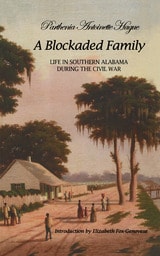
A Blockaded Family
Life in Southern Alabama During the Civil WarParthenia Hague
University of Alabama Press, 2005
Parthenia Hague experienced the Civil War while employed as a schoolteacher on a plantation near Eufaula, Alabama. This book recounts how a frightened and war-weary household dealt with privations during the blockade imposed on the South by the federal navy. The memoir of Parthenia Hague is a detailed look at the ingenious industry and self-sufficiency employed by anxious citizens as the northern army closed in.
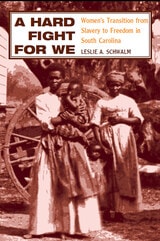
A Hard Fight for We
Women's Transition from Slavery to Freedom in South CarolinaLeslie A. Schwalm
University of Illinois Press, 1997
African-American women fought for their freedom with courage and vigor during and after the Civil War. Leslie Schwalm explores the vital roles of enslaved and formerly enslaved women on the rice plantations of lowcountry South Carolina, both in antebellum plantation life and in the wartime collapse of slavery. From there, she chronicles their efforts as freedwomen to recover from the impact of the war while redefining their lives and labor.
Freedwomen asserted their own ideas of what freedom meant and insisted on important changes in the work they performed both for white employers and in their own homes. As Schwalm shows, these women rejected the most unpleasant or demeaning tasks, guarded the prerogatives they gained under the South's slave economy, and defended their hard-won freedoms against unwanted intervention by Northern whites and the efforts of former owners to restore slavery's social and economic relations during Reconstruction. A bold challenge to entrenched notions, A Hard Fight for We places African American women at the center of the South's transition from a slave society.
A Remembrance of Eden
Harriet Bailey Bullock Daniel's Memories of a Frontier Plantation in Arkansas, 1849–1872Margaret Jones Bolsterli
University of Arkansas Press, 1993
Archaeology below the Cliff
Race, Class, and Redlegs in Barbadian Sugar SocietyMatthew C. Reilly
University of Alabama Press, 2019
Archaeology below the Cliff: Race, Class, and Redlegs in Barbadian Sugar Society is the first archaeological study of the poor whites of Barbados, the descendants of seventeenth-century European indentured servants and small farmers. “Redlegs” is a pejorative to describe the marginalized group who remained after the island transitioned to a sugar monoculture economy dependent on the labor of enslaved Africans. A sizable portion of the “white” minority, the Redlegs largely existed on the peripheries of the plantation landscape in an area called “Below Cliff,” which was deemed unsuitable for profitable agricultural production. Just as the land on which they resided was cast as marginal, so too have the poor whites historically and contemporarily been derided as peripheral and isolated as well as idle, alcoholic, degenerate, inbred, and irrelevant to a functional island society and economy.
Using archaeological, historical, and oral sources, Matthew C. Reilly shows how the precarious existence of the Barbadian Redlegs challenged elite hypercapitalistic notions of economics, race, and class as they were developing in colonial society. Experiencing pronounced economic hardship, similar to that of the enslaved, albeit under very different circumstances, Barbadian Redlegs developed strategies to live in a harsh environment. Reilly’s investigations reveal that what developed in Below Cliff was a moral economy, based on community needs rather than free-market prices.
Reilly extensively excavated households from the tenantry area on the boundaries of the Clifton Hall Plantation, which was abandoned in the 1960s, to explore the daily lives of poor white tenants and investigate their relationships with island economic processes and networks. Despite misconceptions of strict racial isolation, evidence also highlights the importance of poor white encounters and relationships with Afro-Barbadians. Historical data are also incorporated to address how an underrepresented demographic experienced the plantation landscape. Ultimately, Reilly’s narrative situates the Redlegs within island history, privileging inclusion and embeddedness over exclusion and isolation.
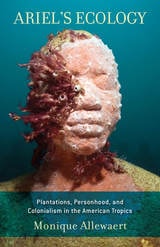
Ariel's Ecology
Plantations, Personhood, and Colonialism in the American TropicsMonique Allewaert
University of Minnesota Press, 2013
What happens if we abandon the assumption that a person is a discrete, world-making agent who acts on and creates place? This, Monique Allewaert contends, is precisely what occurred on eighteenth-century American plantations, where labor practices and ecological particularities threatened the literal and conceptual boundaries that separated persons from the natural world.
Integrating political philosophy and ecocriticism with literary analysis, Ariel’s Ecology explores the forms of personhood that developed out of New World plantations, from Georgia and Florida through Jamaica to Haiti and extending into colonial metropoles such as Philadelphia. Allewaert’s examination of the writings of naturalists, novelists, and poets; the oral stories of Africans in the diaspora; and Afro-American fetish artifacts shows that persons in American plantation spaces were pulled into a web of environmental stresses, ranging from humidity to the demand for sugar. This in turn gave rise to modes of personhood explicitly attuned to human beings’ interrelation with nonhuman forces in a process we might call ecological.
Certainly the possibility that colonial life revokes human agency haunts works from Shakespeare’s Tempest and Montesquieu’s Spirit of the Laws to Spivak’s theories of subalternity. In Allewaert’s interpretation, the transformation of colonial subjectivity into ecological personhood is not a nightmare; it is, rather, a mode of existence until now only glimmering in Che Guevara’s dictum that postcolonial resistance is synonymous with “perfect knowledge of the ground.”
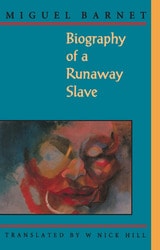
Biography of a Runaway Slave
Miguel Barnet
Northwestern University Press, 2002
In this remarkable testimony, Cuban novelist and anthropologist Miguel Barnet presents the narrative of 105-year-old Esteban Montejo, who lived as a slave, as fugitive in the wilderness, and as a soldier in the Cuban War of Independence. Honest, blunt, compassionate, shrewd, and engaging, his voice provides an extraordinary insight into the African culture that took root in the Caribbean.
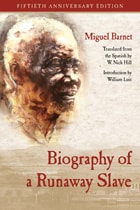
Biography of a Runaway Slave
Fiftieth Anniversary EditionMiguel Barnet; Translated from the Spanish by W. Nick Hill; Introduction by William Luis
Northwestern University Press, 2016
Fiftieth Anniversary Edition
Originally published in 1966, Miguel Barnet’s Biography of a Runaway Slave provides the written history of the life of Esteban Montejo, who lived as a slave, as a fugitive in the wilderness, and as a soldier fighting against Spain in the Cuban War of Independence. A new introduction by one of the most preeminent Afro-Hispanic scholars, William Luis, situates Barnet’s ethnographic strategy and lyrical narrative style as foundational for the tradition of testimonial fiction in Latin American literature. Barnet recorded his interviews with the 103-year-old Montejo at the onset of the Cuban Revolution. This insurgent’s history allows the reader into the folklore and cultural history of Afro-Cubans before and after the abolition of slavery. The book serves as an important contribution to the archive of black experience in Cuba and as a reminder of the many ways that the present continues to echo the past.
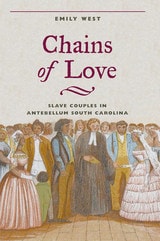
Chains of Love
Slave Couples in Antebellum South CarolinaEmily West
University of Illinois Press, 2004
Focusing on South Carolina, West deals directly with the most intimate areas of the slave experience including courtship, love and affection between spouses, the abuse of slave women by white men, and the devastating consequences of forced separations. Slaves fought these separations through cross-gender bonding and cross-plantation marriages, illustrating West's thesis about slave marriage as a fierce source of resistance to the oppression of slavery in general.
Making expert use of sources such as the Works Progress Administration narratives, slave autobiographies, slave owner records, and church records, this book-length study is the first to focus on the primacy of spousal support as a means for facing oppression. Chains of Love provides telling insights into the nature of the slave family that emerged from these tensions, celebrates its strength, and reveals new dimensions to the slaves' struggle for freedom.
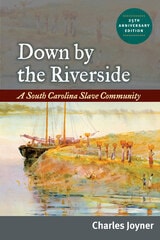
Down by the Riverside
A South Carolina Slave CommunityCharles Joyner
University of Illinois Press, 2009
Joyner recovers an entire lost society and way of life from the letters, diaries, and memoirs of the plantation whites and their guests, from quantitative analysis of census and probate records, and above all from the folklore and oral history of the enslaved Americans. His classic reconstruction of daily life in All Saints Parish is an inspiring testimony to the ingenuity and solidarity of a people.
This anniversary edition of Joyner's landmark study includes a new introduction in which the author recounts his process of writing the book, reflects on its critical and popular reception, and surveys the past three decades of scholarship on the history of enslaved people in the United States.
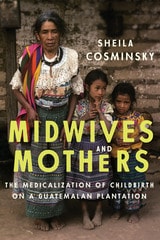
Midwives and Mothers
The Medicalization of Childbirth on a Guatemalan PlantationBy Sheila Cosminsky
University of Texas Press, 2016
The World Health Organization is currently promoting a policy of replacing traditional or lay midwives in countries around the world. As part of an effort to record the knowledge of local midwives before it is lost, Midwives and Mothers explores birth, illness, death, and survival on a Guatemalan sugar and coffee plantation, or finca, through the lives of two local midwives, Doña Maria and her daughter Doña Siriaca, and the women they have served over a forty-year period.
By comparing the practices and beliefs of the mother and daughter, Sheila Cosminsky shows the dynamics of the medicalization process and the contestation between the midwives and biomedical personnel, as the latter try to impose their system as the authoritative one. She discusses how the midwives syncretize, integrate, or reject elements from Mayan, Spanish, and biomedical systems. The midwives’ story becomes a lens for understanding the impact of medicalization on people’s lives and the ways in which women’s bodies have become contested terrain between traditional and contemporary medical practices. Cosminsky also makes recommendations for how ethno-obstetric and biomedical systems may be accommodated, articulated, or integrated. Finally, she places the changes in the birthing system in the larger context of changes in the plantation system, including the elimination of coffee growing, which has made women, traditionally the primary harvesters of coffee beans, more economically dependent on men.

Mistresses and Slaves
Plantation Women in South Carolina, 1830-80Marli F. Weiner
University of Illinois Press, 1998
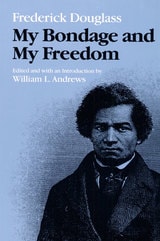
My Bondage and My Freedom
Frederick Douglass
University of Illinois Press, 1988
Out of Many, One People
The Historical Archaeology of Colonial JamaicaEdited by James A. Delle, Mark W. Hauser, and Douglas W. Armstrong
University of Alabama Press, 2011
Normal0falsefalsefalseEN-USX-NONEX-NONEMicrosoftInternetExplorer4
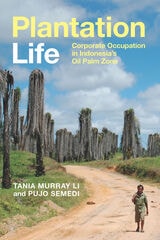
Plantation Life
Corporate Occupation in Indonesia's Oil Palm ZoneTania Murray Li and Pujo Semedi
Duke University Press, 2021
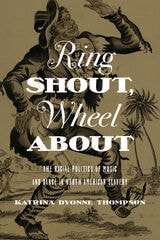
Ring Shout, Wheel About
The Racial Politics of Music and Dance in North American SlaveryKatrina D. Thompson
University of Illinois Press, 2014
In this ambitious project, historian Katrina Thompson examines the conceptualization and staging of race through the performance, sometimes coerced, of black dance from the slave ship to the minstrel stage. Drawing on a rich variety of sources, Thompson explicates how black musical performance was used by white Europeans and Americans to justify enslavement, perpetuate the existing racial hierarchy, and mask the brutality of the domestic slave trade. Whether on slave ships, at the auction block, or on plantations, whites often used coerced performances to oppress and demean the enslaved.
As Thompson shows, however, blacks' "backstage" use of musical performance often served quite a different purpose. Through creolization and other means, enslaved people preserved some native musical and dance traditions and invented or adopted new traditions that built community and even aided rebellion.
Thompson shows how these traditions evolved into nineteenth-century minstrelsy and, ultimately, raises the question of whether today's mass media performances and depictions of African Americans are so very far removed from their troublesome roots.
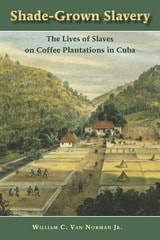
Shade-Grown Slavery
The Lives of Slaves on Coffee Plantations in CubaWilliam C. Van Norman
Vanderbilt University Press, 2013
In this broad, interdisciplinary study, William Van Norman describes how each type of plantation and the amount of manual labor it required directly influenced the nature of slave life in that community. Slaves on coffee plantations lived in a unique context in comparison to that of their fellow slaves on sugar plantations, one that gave them greater flexibility in cultural and artistic creativity. To gain a deeper understanding of plantation slavery in Cuba, Van Norman explores what life and labor was like for coffee slaves and how it was different from what sugar slaves experienced. Shade-Grown Slavery reconstructs their world and in turn deconstructs the picture we now have of Cuba in the late eighteenth and early nineteenth centuries.
Ultimately, Shade-Grown Slavery reveals the lives of enslaved Africans on Cuban coffee plantations and shows how they were able to maintain and transform their cultural traditions in spite of slavery.
Shared Traditions
SOUTHERN HISTORY AND FOLK CULTURECharles Joyner
University of Illinois Press, 1999
By examining the mutual influence of history and folk culture, Shared Traditions reveals the essence of southern culture in the complex and dynamic interactions of descendants of Europeans, Africans, and Native Americans. The book covers a broad spectrum of southern folk groups, folklore expressions, and major themes of southern history, including antebellum society, slavery, the coming of the Civil War, economic modernization in the Appalachians and the Sea Islands, immigration, the civil rights movement, and the effects of cultural tourism.
Joyner addresses the convergence of African and European elements in the Old South and explores how specific environmental and demographic features shaped the acculturation process. He discusses divergent practices in worship services, funeral and burial services, and other religious ceremonies. He examines links between speech patterns and cultural patterns, the influence of Irish folk culture in the American South, and the southern Jewish experience. He also investigates points of intersection between history and legend and relations between the new social history and folklore.
Ranging from rites of power and resistance on the slave plantation to the creolization of language to the musical brew of blues, country, jazz, and rock, Shared Traditions reveals the distinctive culture born of a sharing by black and white southerners of their deep-rooted and diverse traditions.
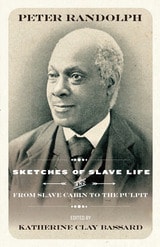
Sketches of Slave Life and From and From Slave Cabin to the Pulpit
Peter Randolph
West Virginia University Press, 2016
This book is the first anthology of the autobiographical writings of Peter Randolph, a prominent nineteenth-century former slave who became a black abolitionist, pastor, and community leader.
Randolph’s story is unique because he was freed and relocated from Virginia to Boston, along with his entire plantation cohort. A lawsuit launched by Randolph against his former master’s estate left legal documents that corroborate his autobiographies.
Randolph's writings give us a window into a different experience of slavery and freedom than other narratives currently available and will be of interest to students and scholars of African American literature, history, and religious studies, as well as those with an interest in Virginia history and mid-Atlantic slavery.
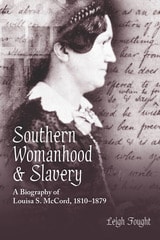
Southern Womanhood and Slavery
A Biography of Louisa S. McCord, 1810-1879Leigh Fought
University of Missouri Press, 2018
Southern Womanhood and Slavery is the first full-length biography of Louisa S. McCord, one of the most intriguing intellectuals in antebellum America. The daughter of South Carolina planter and politician Langdon Cheves, and an essayist in her own right, McCord supported unregulated free trade and the perpetuation of slavery and opposed the advancement of women’s rights. This study examines the origins of her ideas.
Leigh Fought constructs an exciting narrative that follows McCord from her childhood as the daughter of a state representative and president of the Bank of the United States through her efforts to accept her position as wife and mother, her career as an author and plantation mistress, and the Union invasion of South Carolina during the Civil War, to the end of her life in the emerging New South. Fought analyzes McCord’s poetry, letters, and essays in an effort to comprehend her acceptance of slavery and the submission of women. Fought concludes that McCord came to a defense of slavery through her experience with free labor in the North, which also reinforced her faith in the paternalist model for preserving social order.
McCord’s life as a writer on “unfeminine” subjects, her reputation as strong-minded and masculine, her late marriage, her continued ownership of her plantation after marriage, and her position as the matron of a Civil War hospital contradicted her own philosophy that women should remain the quiet force behind their husbands. She lived during a time of social flux in which free labor, slavery, and the role of women underwent dramatic changes, as well as a time that enabled her to discover and pursue her intellectual ambitions. Fought examines the conflict that resulted when those ambitions clashed with McCord’s role as a woman in the society of the South.
McCord’s voice was an interesting, articulate, and necessary feminine addition to antebellum white ideology. Moreover, her story demonstrates the ways in which southern women negotiated through patriarchy without surrendering their sense of self or disrupting the social order. Engaging and very readable, Southern Womanhood and Slavery will be of special interest to students of southern history and women’s studies, as well as to the general reader.
The Archaeology of Slavery
A Comparative Approach to Captivity and CoercionEdited by Lydia Wilson Marshall
Southern Illinois University Press, 2014
Plantation sites, especially those in the southeastern United States, have long dominated the archaeological study of slavery. These antebellum estates, however, are not representative of the range of geographic locations and time periods in which slavery has occurred. As archaeologists have begun to investigate slavery in more diverse settings, the need for a broader interpretive framework is now clear.
The Archaeology of Slavery: A Comparative Approach to Captivity and Coercion, edited by Lydia Wilson Marshall, develops an interregional and cross-temporal framework for the interpretation of slavery. Contributors consider how to define slavery, identify it in the archaeological record, and study it as a diachronic process from enslavement to emancipation and beyond.
Essays cover the potential material representations of slavery, slave owners’ strategies of coercion and enslaved people’s methods of resisting this coercion, and the legacies of slavery as confronted by formerly enslaved people and their descendants. Among the peoples, sites, and periods examined are a late nineteenth-century Chinese laborer population in Carlin, Nevada; a castle slave habitation at San Domingo and a more elite trading center at nearby Juffure in the Gambia; two eighteenth-century plantations in Dominica; Benin’s Hueda Kingdom in the seventeenth and eighteenth centuries; plantations in Zanzibar; and three fugitive slave sites on Mauritius—an underground lava tunnel, a mountain, and a karst cave.
This essay collection seeks to analyze slavery as a process organized by larger economic and social forces with effects that can be both durable and wide-ranging. It presents a comparative approach that significantly enriches our understanding of slavery.
The Journal of Sarah Haynsworth Gayle, 1827–1835
A Substitute for Social IntercourseEdited by Sarah Woolfolk Wiggins with Ruth Smith Truss
University of Alabama Press, 2013
The remarkable journal of the young wife of early Alabama governor John Gayle and a primary source of our knowledge about early Alabama and the antebellum American South
Astonishing, tragic, and remarkable, the journal of Sarah Haynsworth Gayle, wife of early Alabama governor John Gayle, is among the most widely studied and seminal accounts of antebellum life in the American South. This is the first complete edition of the journal in print.
Bereft of the companionship of her often-absent husband, Sarah considered her journal “a substitute for social intercourse” during the period from 1827 to 1835. It became the social and intellectual companion to which she confided stories that reflected her personal life and the world of early Alabama. Sarah speaks directly to us of her loneliness, the challenges of child rearing, her fear of and frustration with the management of slaves, and the difficulty of balancing the responsibilities of a socially prominent woman with her family’s slender finances.
The poor condition of the journal and its transcripts, sometimes disintegrated or reassembled in the wrong order, has led historians to misinterpret Gayle’s words. Gayle’s descendants, Alabama’s famed Gorgases, deliberately obscured or defaced many passages. Using archival techniques to recover the text and restore the correct order, Sarah Wiggins and Ruth Truss reveal the unknown story of Sarah’s economic hardships, the question of her husband’s “temperance,” and her opium use.
The only reliable and unexpurgated edition of Sarah Gayle’s journal, now enhanced with a fascinating introduction and inset notes, The Journal of Sarah Haynsworth Gayle, 1827–1835, is a robust and gripping account and will be of inestimable value to our understanding of antebellum society, religion, intellectual culture, and slavery.
Published in cooperation with the University Libraries, The University of Alabama, with further financial support from the Library Leadership Board, the University Libraries, The University of Alabama.
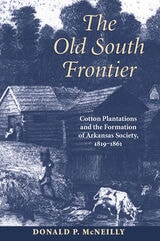
The Old South Frontier
Cotton Plantations and the Formation of Arkansas Society, 1819–1861Donald P. Mcneilly
University of Arkansas Press, 2000

View from the Fazenda
A Tale of the Brazilian HeartlandsEllen Bromfield Geld
Ohio University Press, 2012
“I imagine everyone has a center of gravity,” says Ellen Bromfield Geld. “Something which binds one to the earth and gives sense and direction to what one does.” For Ellen, this center is a writing table before a window that looks out upon groves of pecan trees and mahogany-colored cattle in seas of grass. The place is Fazenda Pau D’Alho, Brazil, where she and her husband, Carson, have lived and farmed since 1961.
Healing the ravaged coffee plantation, rearing five children, exploring the outposts, the Gelds have created a dynamic yet peaceful life far from Ellen’s native Ohio. Their practice of sustainable agriculture, and Ellen’s plea for the preservation of Brazil’s remaining wilderness areas, reflect the legacy of her father, the novelist and farm visionary Louis Bromfield. Their shared vision is crystallized in her account of a cattle drive across the Pantanal, the vast flood plain on Brazil’s side of the Paraguay River. She describes a two-hundred year symbiosis between ranchers and a fragile ecosystem that is being threatened by development.
View from the Fazenda is distilled from fifty years of living in Brazil, weaving daily life on the farm into her quest to understand a nation. It portrays a true melting pot of people who—as conquerers, immigrants, or slaves, their blood and history mingled with those of native Indians—have created the character of Brazil. This huge, diverse county, living in several eras at the same time, is ever changing through its people’s amazing ability to “find a way.”
Ellen Bromfield Geld evokes the land and people of Brazil and offers readers an invigorating glimpse into a soulful life. “It seems to me that being a bit of a poet is perhaps the only way one can survive as a farmer,” she explains. “For in the end, more than anything, farming is a way of life you either love or become bitter enduring.”