95 books match the query 'Plato' and 5 start with a
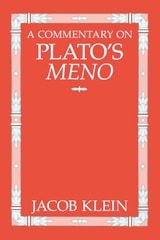
cover of A Commentary on Plato's Meno

A Commentary on Plato's Meno

Jacob Klein

University of Chicago Press, 1989

The Meno, one of the most widely read of the Platonic dialogues, is seen afresh in this original interpretation that explores the dialogue as a theatrical presentation. Just as Socrates's listeners would have questioned and examined their own thinking in response to the presentation, so, Klein shows, should modern readers become involved in the drama of the dialogue. Klein offers a line-by-line commentary on the text of the Meno itself that animates the characters and conversation and carefully probes each significant turn of the argument.

"A major addition to the literature on the Meno and necessary reading for every student of the dialogue."—Alexander Seasonske, Philosophical Review

"There exists no other commentary on Meno which is so thorough, sound, and enlightening."—Choice

Jacob Klein (1899-1978) was a student of Martin Heidegger and a tutor at St. John's College from 1937 until his death. His other works include Plato's Trilogy: Theaetetus, the Sophist, and the Statesman, also published by the University of Chicago Press.

[more]
cover of A Friendly Companion to Plato's Gorgias

A Friendly Companion to Plato's Gorgias

George Kimball Plochmann and Franklin E. Robinson

Southern Illinois University Press, 1987

A comprehensive study of “one of the most elusive and subtle” of all the Platonic dialogues.

The Gorgias begins with a discussion of the nature and value of rhetoric and develops into an impassioned argument for the primacy of absolute right (as expressed by conscience) in the regulation of both public and private life. Plochmann and Robinson closely analyze this great dialogue in the first two-thirds of their book, turning in the final four chapters to a broader discussion of its unity, sweep, and philosophic implications.
[more]
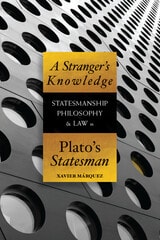
cover of A Stranger's Knowledge: Statesmanship, Philosophy, and Law in Plato's Statesman

A Stranger's Knowledge

Statesmanship, Philosophy, and Law in Plato's Statesman

Xavier Márquez

Parmenides Publishing, 2012

The Statesman is a difficult and puzzling Platonic dialogue. In A Stranger's Knowledge Marquez argues that Plato abandons here the classic idea, prominent in the Republic, that the philosopher, qua philosopher, is qualified to rule. Instead, the dialogue presents the statesman as different from the philosopher, the possessor of a specialist expertise that cannot be reduced to philosophy. The expertise is of how to make a city resilient against internal and external conflict in light of the imperfect sociality of human beings and the poverty of their reason. This expertise, however, cannot be produced on demand: one cannot train statesmen like one might train carpenters. Worse, it cannot be made acceptable to the citizens, or operate in ways that are not deeply destructive to the city’s stability. Even as the political community requires his knowledge for its preservation, the genuine statesman must remain a stranger to the city.

Marquez shows how this impasse is the key to understanding the ambiguous reevaluation of the rule of law that is the most striking feature of the political philosophy of the Statesman. The law appears here as a mere approximation of the expertise of the inevitably absent statesman, dim images and static snapshots of the clear and dynamic expertise required to steer the ship of state across the storms of the political world. Yet such laws, even when they are not created by genuine statesmen, can often provide the city with a limited form of cognitive capital that enables it to preserve itself in the long run, so long as citizens, and especially leaders, retain a “philosophical” attitude towards them. It is only when rulers know that they do not know better than the laws what is just or good (and yet want to know what is just and good) that the city can be preserved. The dialogue is thus, in a sense, the vindication of the philosopher-king in the absence of genuine political knowledge. 
 
[more]
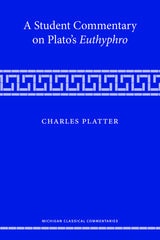
cover of A Student Commentary on Plato’s Euthyphro

A Student Commentary on Plato’s Euthyphro

Charles Platter

University of Michigan Press, 2019

The Euthyphro is crucially important for understanding Plato’s presentation of the last days of Socrates, dramatized in four brief dialogues: Euthyphro, Apology, Crito, and Phaedo. In addition to narrating this evocative series of events in the life of Plato’s philosophical hero, the texts also can be read as reflecting how a wise man faces death. This particular dialogue contains Socrates’ vivid examination of the intentions of Euthyphro to prosecute his own father for murder and culminates in an attempt to understand holiness—a topic central both to Euthyphro’s justification of his actions and to the charge of impiety that Socrates faces before the Athenian court.
 
This accessible student commentary by Charles Platter presents an introduction to the Euthyphro, the full Greek text, and a commentary designed for undergraduates and selected graduate students. As part of the series Michigan Classical Commentaries, now edited by Josiah Osgood and Alexander Sens at Georgetown University, and K. Sara Myers at the University of Virginia, the volume is sized and priced for student use.
 
[more]
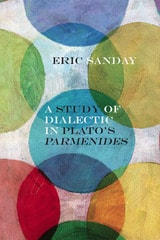
cover of A Study of Dialectic in Plato's Parmenides

A Study of Dialectic in Plato's Parmenides

Eric Sanday

Northwestern University Press, 2014

In this book, Eric Sanday boldly demonstrates that Plato’s “theory of forms” is true, easy to understand, and relatively intuitive. Sanday argues that our chief obstacle to understanding the theory of forms is the distorting effect of the tacit metaphysical privileging of individual things in our everyday understanding. For Plato, this privileging of things that we can own, produce, exchange, and through which we gain mastery of our surroundings is a significant obstacle to philosophical education. The dialogue’s chief philosophical work, then, is to destabilize this false privileging and, in Parmenides, to provide the initial framework for a newly oriented account of participation. Once we do this, Sanday argues, we more easily can grasp and see the truth of the theory of forms.
[more]