Results by title
5 books match the query 'Plato's Republic'
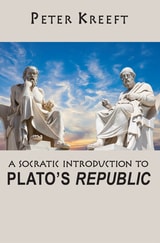
A Socratic Introduction to Plato's Republic
Peter Kreeft
St. Augustine's Press, 2026
This book is designed for three classes of people:
Peter Kreeft has taught philosophy for over 50 years, including one section of a course for beginners every semester. He has tried just about everything possible, and a few new things that are impossible. He has experimented with every one of the many alternative methods available for teaching beginners. (He has A.D.D., so he easily gets bored and likes to try new things all the time.) But he has never found anything nearly as successful as Plato.
Plato is the best writer in the history of philosophy. Most philosophers are dull, undramatic, abstract writers. (There are a few other exceptions besides Plato: Augustine, Pascal, Nietzsche, Kierkegaard.) But Plato wrote dramatic dialogues, in which Socrates, his famous teacher, interacts with a great variety of fools. These dialogues are like intellectual swordfights, and even though you know Socrates is going to win, they are exciting because you see his ideas come alive, like a sword in the handoff a master. Plato is a great dramatist, a great poet, and a great psychologist as well as a great philosopher. Nobody else who ever lived combined those four talents as well as Plato did.
Apprenticeship to a great master is the best way to learn any art. The student will understand what philosophy is better by watching a master do it than by reading abstract definitions of it from a second-rate philosopher, or by a mere scholar. Concrete examples are always the easiest way to learn things. Plato’s dialogues are the world’s first, and still the best, concrete example of philosophizing.
Kreeft introduces his students to this love affair through a great matchmaker, Plato, who is a better teacher than the student will ever meet in the land of the living.
In fact, Plato still is in the land of the living. He’s still alive and kicking in his dialogues. He rubs off on those who are wise and humble enough to become a student.
- Beginners who want an introduction to philosophy;
- Those who have already had an introduction to philosophy and who would like to see it in action now applied to a great book written by a great philosophy, but who have never read Plato’s Republic, the most famous and influential philosophy book ever written;
- Those who have read Plato’s Republic before but did not understand its deepest significance.
Peter Kreeft has taught philosophy for over 50 years, including one section of a course for beginners every semester. He has tried just about everything possible, and a few new things that are impossible. He has experimented with every one of the many alternative methods available for teaching beginners. (He has A.D.D., so he easily gets bored and likes to try new things all the time.) But he has never found anything nearly as successful as Plato.
Plato is the best writer in the history of philosophy. Most philosophers are dull, undramatic, abstract writers. (There are a few other exceptions besides Plato: Augustine, Pascal, Nietzsche, Kierkegaard.) But Plato wrote dramatic dialogues, in which Socrates, his famous teacher, interacts with a great variety of fools. These dialogues are like intellectual swordfights, and even though you know Socrates is going to win, they are exciting because you see his ideas come alive, like a sword in the handoff a master. Plato is a great dramatist, a great poet, and a great psychologist as well as a great philosopher. Nobody else who ever lived combined those four talents as well as Plato did.
Apprenticeship to a great master is the best way to learn any art. The student will understand what philosophy is better by watching a master do it than by reading abstract definitions of it from a second-rate philosopher, or by a mere scholar. Concrete examples are always the easiest way to learn things. Plato’s dialogues are the world’s first, and still the best, concrete example of philosophizing.
Kreeft introduces his students to this love affair through a great matchmaker, Plato, who is a better teacher than the student will ever meet in the land of the living.
In fact, Plato still is in the land of the living. He’s still alive and kicking in his dialogues. He rubs off on those who are wise and humble enough to become a student.
[more]
City and Soul in Plato's Republic
G. R. F. Ferrari
University of Chicago Press, 2005
Tracing a central theme of Plato's Republic, G. R. F. Ferrari reconsiders in this study the nature and purpose of the comparison between the structure of society and that of the individual soul. In four chapters, Ferrari examines the personalities and social status of the brothers Glaucon and Adeimantus, Plato's notion of justice, coherence in Plato's description of the decline of states, and the tyrant and the philosopher king—a pair who, in their different ways, break with the terms of the city-soul analogy.
In addition to acknowledging familiar themes in the interpretation of the Republic—the sincerity of its utopianism, the justice of the philosopher's return to the Cave—Ferrari provocatively engages secondary literature by Leo Strauss, Bernard Williams, and Jonathan Lear. With admirable clarity and insight, Ferrari conveys the relation between the city and the soul and the choice between tyranny and philosophy. City and Soul in Plato's Republic will be of value to students of classics, philosophy, and political theory alike.
In addition to acknowledging familiar themes in the interpretation of the Republic—the sincerity of its utopianism, the justice of the philosopher's return to the Cave—Ferrari provocatively engages secondary literature by Leo Strauss, Bernard Williams, and Jonathan Lear. With admirable clarity and insight, Ferrari conveys the relation between the city and the soul and the choice between tyranny and philosophy. City and Soul in Plato's Republic will be of value to students of classics, philosophy, and political theory alike.
[more]
Exiling the Poets
The Production of Censorship in Plato's RepublicRamona A. Naddaff
University of Chicago Press, 2002
The question of why Plato censored poetry in his Republic has bedeviled scholars for centuries. In Exiling the Poets, Ramona A. Naddaff offers a strikingly original interpretation of this ancient quarrel between poetry and philosophy. Underscoring not only the repressive but also the productive dimension of literary censorship, Naddaff brings to light Plato's fundamental ambivalence about the value of poetic discourse in philosophical investigation.
Censorship, Nadaff argues, is not merely a mechanism of silencing but also provokes new ways of speaking about controversial and crucial cultural and artistic events. It functions philosophically in the Republic to subvert Plato's most crucial arguments about politics, epistemology, metaphysics, and ethics. Naddaff develops this stunning argument through an extraordinary reading of Plato's work. In books 2 and 3, the first censorship of poetry, she finds that Plato constitutes the poet as a rival with whom the philosopher must vie agonistically. In other words, philosophy does not replace poetry, as most commentators have suggested; rather, the philosopher becomes a worthy and ultimately victorious poetic competitor. In book 10's second censorship, Plato exiles the poets as a mode of self-subversion, rethinking and revising his theory of mimesis, of the immortality of the soul, and, most important, the first censorship of poetry. Finally, in a subtle and sophisticated analysis of the myth of Er, Naddaff explains how Plato himself censors his own censorships of poetry, thus producing the unexpected result of a poetically animated and open-ended dialectical philosophy.
Censorship, Nadaff argues, is not merely a mechanism of silencing but also provokes new ways of speaking about controversial and crucial cultural and artistic events. It functions philosophically in the Republic to subvert Plato's most crucial arguments about politics, epistemology, metaphysics, and ethics. Naddaff develops this stunning argument through an extraordinary reading of Plato's work. In books 2 and 3, the first censorship of poetry, she finds that Plato constitutes the poet as a rival with whom the philosopher must vie agonistically. In other words, philosophy does not replace poetry, as most commentators have suggested; rather, the philosopher becomes a worthy and ultimately victorious poetic competitor. In book 10's second censorship, Plato exiles the poets as a mode of self-subversion, rethinking and revising his theory of mimesis, of the immortality of the soul, and, most important, the first censorship of poetry. Finally, in a subtle and sophisticated analysis of the myth of Er, Naddaff explains how Plato himself censors his own censorships of poetry, thus producing the unexpected result of a poetically animated and open-ended dialectical philosophy.
[more]
Socrates' Second Sailing
On Plato's RepublicSeth Benardete
University of Chicago Press, 1989
A penetrating close account of the ideas found in Plato's most important work
When the winds fall, the sailor picks up his oars, no longer relying on help outside his own power. This “second sailing,” according to the distinguished classicist Seth Benardete, is the essence of Socratic philosophizing
In this section-by-section commentary on Plato's most important dialogue, Benardete argues that the Republic is such a self-powered, holistic analysis of the beautiful, the good, and the just. This book provides a fresh interpretation of the Republic and a new understanding of philosophy as practiced by Plato and Socrates.
[more]
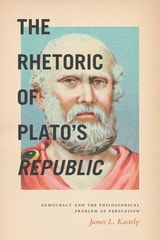
The Rhetoric of Plato's Republic
Democracy and the Philosophical Problem of PersuasionJames L. Kastely
University of Chicago Press, 2015
Plato isn’t exactly thought of as a champion of democracy, and perhaps even less as an important rhetorical theorist. In this book, James L. Kastely recasts Plato in just these lights, offering a vivid new reading of one of Plato’s most important works: the Republic. At heart, Kastely demonstrates, the Republic is a democratic epic poem and pioneering work in rhetorical theory. Examining issues of justice, communication, persuasion, and audience, he uncovers a seedbed of theoretical ideas that resonate all the way up to our contemporary democratic practices.
As Kastely shows, the Republic begins with two interrelated crises: one rhetorical, one philosophical. In the first, democracy is defended by a discourse of justice, but no one can take this discourse seriously because no one can see—in a world where the powerful dominate the weak—how justice is a value in itself. That value must be found philosophically, but philosophy, as Plato and Socrates understand it, can reach only the very few. In order to reach its larger political audience, it must become rhetoric; it must become a persuasive part of the larger culture—which, at that time, meant epic poetry. Tracing how Plato and Socrates formulate this transformation in the Republic, Kastely isolates a crucial theory of persuasion that is central to how we talk together about justice and organize ourselves according to democratic principles.
As Kastely shows, the Republic begins with two interrelated crises: one rhetorical, one philosophical. In the first, democracy is defended by a discourse of justice, but no one can take this discourse seriously because no one can see—in a world where the powerful dominate the weak—how justice is a value in itself. That value must be found philosophically, but philosophy, as Plato and Socrates understand it, can reach only the very few. In order to reach its larger political audience, it must become rhetoric; it must become a persuasive part of the larger culture—which, at that time, meant epic poetry. Tracing how Plato and Socrates formulate this transformation in the Republic, Kastely isolates a crucial theory of persuasion that is central to how we talk together about justice and organize ourselves according to democratic principles.
[more]