Results by title
9 books match the query 'Poetry, Medieval'
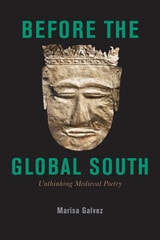
Before the Global South
Unthinking Medieval PoetryMarisa Galvez
University of Chicago Press, 2026
A bold approach to the work of contemporary, Indigenous, and other emergent artists as revisionist adaptations of medieval lyric poetry.
In this book, Marisa Galvez gathers an eclectic array of contemporary poets, artists, writers, and translators—from Brazilian poet Augusto de Campos and Irish painter Louis le Brocquy, to Occitanists Gérard Zuchetto and Jean-Louis Séverac, to Martinican writer Édouard Glissant, poet Rosanna Warren, and essayist Eliot Weinberg—to explore how they reimagine medieval European lyric forms. Galvez calls these adaptations unthought medievalism, and in Before the Global South, she argues that we should understand them as a mode of inquiry that is at once scholarly, critical, and creative. In these modern innovations, Galvez finds an expression of the medieval that challenges popular and scholarly dogmas alike, one she believes can inspire us to create a more shared, global world.
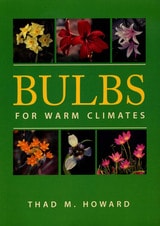
Bulbs for Warm Climates
By Thad M. Howard
University of Texas Press, 2001
Bulb gardening in the southwestern and southern United States presents challenges unknown in cooler climates. Bulbs that turn Holland into a kaleidoscope of color droop and fade in our mild winters, hot summers, and uncertain rainfall. Yet hundreds of native and naturalized species of bulbs thrive in these same conditions and offer as many colors, shapes, and fragrances as even the most demanding gardener desires. These are the bulbs that Thad Howard describes in this comprehensive guide to bulbs that will grow in USDA gardening zones 8 and 9.
Writing from more than forty-five years' experience in collecting and cultivating bulbs, Howard offers expert advice about hundreds of little-known, hybrid, and common species and varieties that grow well in warm climates. His species accounts, which are grouped by family, describe each plant and its growing requirements and often include interesting stories from his collecting expeditions. Lovely color photos illustrate many of the species.
Howard also gives reliable information about refrigerating bulbs, using them in the landscape and in containers, choosing scented ones, making potpourri, buying, collecting, cultivating, and hybridizing bulbs, and dealing with pests and diseases. He concludes with lists of plant societies and suppliers and a helpful glossary and bibliography.

Continental England
Form, Translation, and Chaucer in the Hundred Years’ WarElizaveta Strakhov
The Ohio State University Press, 2022
Genesis in Late Antique Poetry
Andrew Faulkner
Catholic University of America Press, 2022
Harmful Eloquence
Ovid's Amores from Antiquity to ShakespeareM. L. Stapleton
University of Michigan Press, 1996
Shards of Love
Exile and the Origins of the LyricMaría Rosa Menocal
Duke University Press, 1994
It is in exile that Menocal locates the founding conditions for philology--as a discipline that loves origins--and for the genre of love songs that philology reveres. She crosses the boundaries, both temporal and geographical, of 1492 to recover the "original" medieval culture, with its Mediterranean mix of European, Arabic, and Hebrew poetics. The result is a form of literary history more lyrical than narrative and, Menocal persuasively demonstrates, more appropriate to the Middle Ages than to the revisionary legacy of the Renaissance. In discussions ranging from Eric Clapton's adaption of Nizami's Layla and Majnun, to the uncanny ties between Jim Morrison and Petrarch, Shards of Love deepens our sense of how the Middle Ages is tied to our own age as it expands the history and meaning of what we call Romance philology.
Songbook
How Lyrics Became Poetry in Medieval EuropeMarisa Galvez
University of Chicago Press, 2012
Today we usually think of a book of poems as composed by a poet, rather than assembled or adapted by a network of poets and readers. But the earliest European vernacular poetries challenge these assumptions. Medieval songbooks remind us how lyric poetry was once communally produced and received—a collaboration of artists, performers, live audiences, and readers stretching across languages and societies.
The only comparative study of its kind, Songbook treats what poetry was before the emergence of the modern category “poetry”: that is, how vernacular songbooks of the thirteenth to fifteenth centuries shaped our modern understanding of poetry by establishing expectations of what is a poem, what is a poet, and what is lyric poetry itself. Marisa Galvez analyzes the seminal songbooks representing the vernacular traditions of Occitan, Middle High German, and Castilian, and tracks the process by which the songbook emerged from the original performance contexts of oral publication, into a medium for preservation, and, finally, into an established literary object. Galvez reveals that songbooks—in ways that resonate with our modern practice of curated archives and playlists—contain lyric, music, images, and other nonlyric texts selected and ordered to reflect the local values and preferences of their readers. At a time when medievalists are reassessing the historical foundations of their field and especially the national literary canons established in the nineteenth century, a new examination of the songbook’s role in several vernacular traditions is more relevant than ever.
Strange Footing
Poetic Form and Dance in the Late Middle AgesSeeta Chaganti
University of Chicago Press, 2018
Exploring the complex relationship between medieval dance and medieval poetry, Strange Footing argues that the intersection of texts and dance produced an experience of poetic form based in disorientation, asymmetry, and even misstep. Medieval dance guided audiences to approach poetry not in terms of the body’s regular marking of time and space, but rather in the irregular and surprising forces of virtual motion around, ahead of, and behind the dancing body. Reading medieval poems through artworks, paintings, and sculptures depicting dance, Seeta Chaganti illuminates texts that have long eluded our full understanding, inviting us to inhabit their strange footings askew of conventional space and time.
Strange Footing deploys the motion of dance to change how we read medieval poetry, generating a new theory of poetic form for medieval studies and beyond.
The Subject of Crusade
Lyric, Romance, and Materials, 1150 to 1500Marisa Galvez
University of Chicago Press, 2020
In The Subject of Crusade, Marisa Galvez offers a nuanced view of holy war and crusade poetry, reading these lyric works within a wider conversation with religion and culture. Arguing for an interdisciplinary treatment of crusade lyric, she shows how such poems are crucial for understanding the crusades as a complex cultural and historical phenomenon. Placing them in conversation with chronicles, knightly handbooks, artworks, and confessional and pastoral texts, she identifies a particular “crusade idiom” that emerged out of the conflict between pious and earthly duties. Galvez fashions an expanded understanding of the creative works made by crusaders to reveal their experiences, desires, ideologies, and reasons for taking up the cross.