Results by title
21 books match the query 'Police brutality'
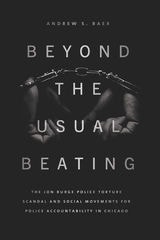
Beyond the Usual Beating
The Jon Burge Police Torture Scandal and Social Movements for Police Accountability in ChicagoAndrew S. Baer
University of Chicago Press, 2020
A story of institutionalized police brutality and how Chicago's public outcry led to long-lasting criminal justice reforms.
The malign and long-lasting influence of Chicago police commander Jon Burge cannot be overestimated, particularly as fresh examples of local and national criminal-justice abuse continue to surface with dismaying frequency. Burge’s decades-long tenure on the Chicago police force was marked by racist and barbaric interrogation methods, including psychological torture, burnings, and mock executions—techniques that went far “beyond the usual beating.” After being exposed in 1989, he became a symbol of police brutality and the unequal treatment of nonwhite people, and the persistent outcry against him led to reforms such as the abolition of the death penalty in Illinois.
But Burge hardly developed or operated in a vacuum, as Andrew S. Baer explores to stark effect here. He identifies the darkness of the Burge era as a product of local social forces, arising from a specific milieu beyond the nationwide racialized reactionary fever of the 1960s and 1970s. Similarly, the popular resistance movements that rallied in his wake actually predated Burge’s exposure but cohered with unexpected power due to the galvanizing focus on his crimes and abuses. For more than thirty years, a shifting coalition including torture survivors, their families, civil rights attorneys, and journalists helped to corroborate allegations of violence, free the wrongfully convicted, have Burge fired and incarcerated, and win passage of a municipal reparations package, among other victories. Beyond the Usual Beating reveals that though the Burge scandal underscores the relationship between personal bigotry and structural racism in the criminal justice system, it also shows how ordinary people held perpetrators accountable in the face of intransigent local power.
Black Life Matter
Blackness, Religion, and the SubjectBiko Mandela Gray
Duke University Press, 2022
Blackhood Against the Police Power
Punishment and Disavowal in the "Post-Racial" EraTryon P. Woods
Michigan State University Press, 2019
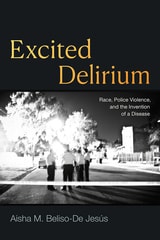
Excited Delirium
Race, Police Violence, and the Invention of a DiseaseAisha M. Beliso-De Jesús
Duke University Press, 2024
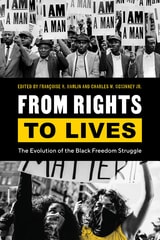
From Rights to Lives
The Evolution of the Black Freedom StruggleEdited by Françoise N. Hamlin and Charles W. McKinney Jr.
Vanderbilt University Press, 2024
From Rights to Lives critically engages the dynamic relationship between these two moments of liberatory possibility on the Black Freedom Struggle timeline. The book’s contributors explore what we can learn when we place these moments of struggle in dialogue with each other. They grapple with how our understanding of the postwar moment shapes our analysis of #BLM and wherein lie the discontinuities, in order to glean lessons for future moments of insurgency.
How to Lose the Hounds
Maroon Geographies and a World beyond PolicingCeleste Winston
Duke University Press, 2023
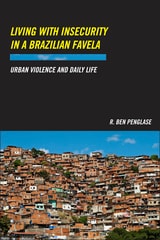
Living with Insecurity in a Brazilian Favela
Urban Violence and Daily LifePenglase, R. Ben
Rutgers University Press, 2015
Loving Black Boys
A Black Feminist Bible on Racism and Revolutionary MotheringTamura Lomax
Duke University Press, 2026
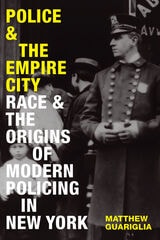
Police and the Empire City
Race and the Origins of Modern Policing in New YorkMatthew Guariglia
Duke University Press, 2023
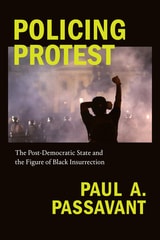
Policing Protest
The Post-Democratic State and the Figure of Black InsurrectionPaul A. Passavant
Duke University Press, 2021

The Global Police State
William I Robinson
Pluto Press, 2020
"Karl Marx aspired to a world in which our animal needs would be satisfied and our human needs could be addressed. It is a realistic possibility now, as William Robinson outlines—or the alternative that is taking shape before our eyes: a 'global police state' controlled by narrowly concentrated capital with 'surplus humanity' left to survive somehow on its own. The choice is in our hands."
—Noam Chomsky, author of Who Rules the World?
As the world becomes ever more unequal, people become ever more “disposable.” Today, governments systematically exclude sections of their populations from society through heavy-handed policing. But it doesn't always go to plan.
William I. Robinson exposes the nature and dynamics of this out-of-control system, arguing for the urgency of creating a movement capable of overthrowing it. The global police state uses a variety of ingenious methods of control, including mass incarceration, police violence, US-led wars, the persecution of immigrants and refugees, and the repression of environmental activists.
He writes in his Introduction, “I offer a ‘big picture” of the emerging global police state in a short book that is eminently readable. The pages to follow may startle many readers and make them angry. I trust the work will serve as a warning of the dystopic future that is upon us. More importantly, by exposing the nature and dynamic of this out-of-control system, I hope it will contribute to the struggles to bring about an alternative future based on human freedom and liberation.”
Movements have emerged to combat the increasing militarization, surveillance and social cleansing; however, many of them appeal to a moral sense of social justice rather than addressing its root: global capitalism.
Using shocking data which reveals how far capitalism has become a system of repression, Robinson argues that the emerging megacities of the world are becoming the battlegrounds where the excluded and the oppressed face off against the global police state.
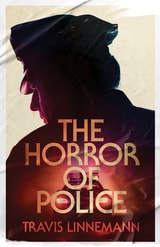
The Horror of Police
Travis Linnemann
University of Minnesota Press, 2022
Unmasks the horrors of a social order reproduced and maintained by the violence of police
Year after year the crisis churns: graft and corruption, violence and murder, riot cops and armored vehicles claim city streets. Despite promises of reform, police operate with impunity, unaccountable to law. In The Horror of Police, Travis Linnemann asks why, with this open record of violence and corruption, policing remains for so many the best, perhaps only means of security in an insecure world.
Drawing on the language and texts of horror fiction, Linnemann recasts the police not only as self-proclaimed “monster fighters” but as monsters themselves, a terrifying force set loose in the world. Purposefully misreading a collection of everyday police stories (TV cop dramas, detective fiction, news media accounts, the direct words of police) not as morality tales of innocence avenged and order restored but as horror, Linnemann reveals the monstrous violence at the heart of liberal social order.
The Horror of Police shows that police violence is not a deviation but rather a deliberate and permanent fixture of U.S. “law and order.” Only when viewed through the refracted motif of horror stories, Linnemann argues, can we begin to reckon the limits of police and imagine a world without them.
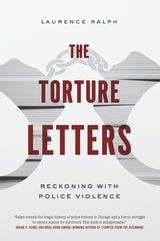
The Torture Letters
Reckoning with Police ViolenceLaurence Ralph
University of Chicago Press, 2019
In The Torture Letters, Laurence Ralph chronicles the history of torture in Chicago, the burgeoning activist movement against police violence, and the American public’s complicity in perpetuating torture at home and abroad. Engaging with a long tradition of epistolary meditations on racism in the United States, from James Baldwin’s The Fire Next Time to Ta-Nehisi Coates’s Between the World and Me, Ralph offers in this book a collection of open letters written to protesters, victims, students, and others. Through these moving, questing, enraged letters, Ralph bears witness to police violence that began in Burge’s Area Two and follows the city’s networks of torture to the global War on Terror. From Vietnam to Geneva to Guantanamo Bay—Ralph’s story extends as far as the legacy of American imperialism. Combining insights from fourteen years of research on torture with testimonies of victims of police violence, retired officers, lawyers, and protesters, this is a powerful indictment of police violence and a fierce challenge to all Americans to demand an end to the systems that support it.
With compassion and careful skill, Ralph uncovers the tangled connections among law enforcement, the political machine, and the courts in Chicago, amplifying the voices of torture victims who are still with us—and lending a voice to those long deceased.

The Torture Letters
Reckoning with Police ViolenceLaurence Ralph
University of Chicago Press, 2020
In The Torture Letters, Laurence Ralph chronicles the history of torture in Chicago, the burgeoning activist movement against police violence, and the American public’s complicity in perpetuating torture at home and abroad. Engaging with a long tradition of epistolary meditations on racism in the United States, from James Baldwin’s The Fire Next Time to Ta-Nehisi Coates’s Between the World and Me, Ralph offers in this book a collection of open letters written to protesters, victims, students, and others. Through these moving, questing, enraged letters, Ralph bears witness to police violence that began in Burge’s Area Two and follows the city’s networks of torture to the global War on Terror. From Vietnam to Geneva to Guantanamo Bay—Ralph’s story extends as far as the legacy of American imperialism. Combining insights from fourteen years of research on torture with testimonies of victims of police violence, retired officers, lawyers, and protesters, this is a powerful indictment of police violence and a fierce challenge to all Americans to demand an end to the systems that support it.
With compassion and careful skill, Ralph uncovers the tangled connections among law enforcement, the political machine, and the courts in Chicago, amplifying the voices of torture victims who are still with us—and lending a voice to those long deceased.

The Visual Afterlife of Abdelkader Bennahar
Robert Desjarlais
Duke University Press, 2025
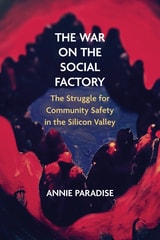
The War on the Social Factory
The Struggle for Community Safety in the Silicon ValleyAnnie Paradise
Northwestern University Press, 2024
A collective ethnography of grassroots mobilizations for community safety across the Silicon Valley
This is a narrative of struggle and solidarity and a collective toolkit for grassroots opposition to militarization, policing, and ongoing conditions of war in the current conjuncture of racial patriarchal capitalism. Grassroots researcher Annie Paradise presents here a collective ethnography of the mothers and community matriarchs whose children have been murdered by police across the San Francisco Bay Area as they develop and practice autonomous, creative forms of resistance.
The War on the Social Factory: The Struggle for Community Safety in the Silicon Valley maps local families’ struggles to reclaim their households and their communities—to create a social infrastructure of care, justice, and safety outside state- and market-determined modes of “security.” Practices such as sustained vigil, testimony, and the production and circulation of insurgent knowledges are shown here to be part of interconnected justice efforts to demilitarize and decarcerate communities in the face of the multiple forms of violence enacted under late racial patriarchal capitalism. Paradise examines the expanding carceral processes of enclosure, criminalization, dispossession, expropriation, and disposability that mark the neoliberal "security” regime across the Silicon Valley and offers counter-counterinsurgent strategies and practices of co-generative, dynamic resistance.
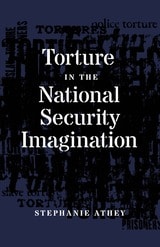
Torture in the National Security Imagination
Stephanie Athey
University of Minnesota Press, 2023
Reassessing the role of torture in the context of police violence, mass incarceration, and racial capitalism
At the midpoint of a century of imperial expansion, marked on one end by the Philippine–American War of 1899–1902 and on the other by post–9/11 debates over waterboarding, the United States embraced a vision of “national security torture,” one contrived to cut ties with domestic torture and mass racial terror and to promote torture instead as a minimalist interrogation tool. Torture in the National Security Imagination argues that dispelling this vision requires a new set of questions about the everyday work that torture does for U.S. society.
Stephanie Athey describes the role of torture in the proliferation of a U.S. national security stance and imagination: as U.S. domestic tortures were refined in the Philippines at the turn of the twentieth century, then in mid-century counterinsurgency theory and the networks that brought it home in the form of law-and-order policing and mass incarceration.
Drawing on examples from news to military reports, legal writing, and activist media, Athey shows that torture must be seen as a colonial legacy with a corporate future, highlighting the centrality of torture to the American empire—including its role in colonial settlement, American Indian boarding schools, and police violence. She brings to the fore the spectators and commentators, the communal energy of violence, and the teams and target groups necessary to a mass undertaking (equipment suppliers, contractors, bureaucrats, university researchers, and profiteers) to demonstrate that, at base, torture is propelled by local social functions, conducted by networked professional collaborations, and publicly supported by a durable social imaginary.
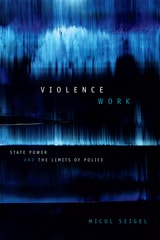
Violence Work
State Power and the Limits of PoliceMicol Seigel
Duke University Press, 2018
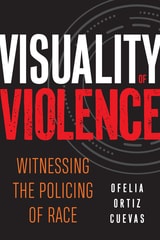
Visuality of Violence
Witnessing the Policing of RaceOfelia Ortiz Cuevas
Temple University Press, 2025
Addressing the frequently ignored experiences of Asian and Native Americans, among others, in its comparative undertaking, Visuality of Violence exceeds intersectional mapping to uniquely charge the spectacle of racial violence as a foundational practice in its continued presence in contemporary society. Cuevas argues that the visual presentations of the racial body throughout history requires a reckoning and acknowledgement of the material and legal effects of the images, narratives, and practices used to maintain hegemonic racial order and inequality.
In holding a theoretical mirror to history, Visuality of Violence reveals liberal mythical reliance on the ideals of western law and its rationalities as the location of justice and freedom, thereby presenting its readers with a new understanding in the quest for peace and liberation.
In the series Critical Race, Indigeneity, and Relationality
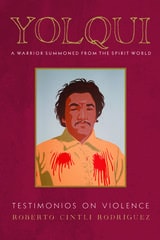
Yolqui, a Warrior Summoned from the Spirit World
Testimonios on ViolenceRoberto Cintli Rodríguez; Foreword by Patrisia Gonzales
University of Arizona Press, 2019
Framed by Rodríguez’s personal testimony of police violence, this book offers a historia profunda of the culture of extralegal violence against Red-Black-Brown communities in the United States. In addition to Rodríguez’s story, this book includes several short essays from victims and survivors that bring together personal accounts of police brutality and state-sponsored violence. This wide-ranging work touches on historical and current events, including the Watts rebellion, the Zoot Suit Riots, Operation Streamline, Standing Rock, and much more.
From the eyewitness accounts of Bartolomé de las Casas to the protestors and allies at Standing Rock, this book makes evident the links between colonial violence against Red-Black-Brown bodies to police violence in our communities today. Grounded in the stories of the lives of victims and survivors of police violence, Yolqui, a Warrior Summoned from the Spirit World illuminates the physical, spiritual, and epistemic depths and consequences of racialized dehumanization.
Rodríguez offers us an urgent, poignant, and personal call to end violence and the philosophies that permit such violence to flourish. Like the Nahuatl yolqui, this book is intended as a means of healing, offering a footprint going back to the origins of violence, and, more important, a way forward.
With contributions by Raúl Alcaraz-Ochoa, Citalli Álvarez, Tanya Alvarez, Rebekah Barber, Juvenal Caporale, David Cid, Arianna Martinez Reyna, Carlos Montes, Travis Morales, Simon Moya Smith, Cesar Noriega, Kimberly Phillips, Christian Ramirez, Michelle Rascon Canales, Carolyn Torres, Jerry Tello, Tara Trudell, and Laurie Valdez.