Results by title

3 books match the query 'Policy Change'
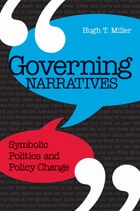
cover of Governing Narratives: Symbolic Politics and Policy Change

Governing Narratives

Symbolic Politics and Policy Change

Hugh T. Miller

University of Alabama Press, 2012
By highlighting the degree to which meaning making in public policy is more a cultural struggle than a rational and analytical project, Governing Narratives brings public administration back into a political context.
 
In Governing Narratives, Hugh T. Miller takes a narrative approach in conceptualizing the politics of public policy. In this approach, signs and ideographs—that is, constellations of images, feelings, values, and conceptualization—are woven into policy narratives through the use of story lines. For example, the ideograph “acid rain” is part of an environmental narrative that links dead trees to industrial air pollution. The struggle for meaning capture is a political struggle, most in evidence during times of change or when status quo practices are questioned.
 
Public policy is often considered to be the end result of empirical studies, quantitative analyses, and objective evaluation. But the empirical norms of science and rationality that have informed public policy research have also hidden from view those vexing aspects of public policy discourse outside of methodological rigor.
 
Phrases such as “three strikes and you’re out” or “flood of immigrants” or “don’t ask, don’t tell” or “crack baby” or “the death tax” have come to play crucial roles in public policy, not because of the reality they are purported to reflect, but because the meanings, emotions, and imagery connoted by these symbolizations resonate in our culture.
 
Social practices, the very material of social order and cultural stability, are inextricably linked to the policy discourse that accompanies social change. Eventually a winning narrative dominates and becomes institutionalized into practice and implemented via public administration. Policy is symbiotically associated with these winning narratives. Practices might change again, but this inevitably entails renewed political contestation. The competition among symbolizations does not imply that the best narrative wins, only that a narrative has won for the time being. However, unsettling the established narrative is a difficult political task, particularly when the narrative has evolved into habitual institutionalized practice.
 
Governing Narratives convincingly links public policy to the discourse and rhetoric of deliberative politics.
[more]
cover of Lobbying and Policy Change: Who Wins, Who Loses, and Why

Lobbying and Policy Change

Who Wins, Who Loses, and Why

Frank R. Baumgartner, Jeffrey M. Berry, Marie Hojnacki, David C. Kimball, and Beth L. Leech

University of Chicago Press, 2009

During the 2008 election season, politicians from both sides of the aisle promised to rid government of lobbyists’ undue influence. For the authors of Lobbying and Policy Change, the most extensive study ever done on the topic, these promises ring hollow—not because politicians fail to keep them but because lobbies are far less influential than political rhetoric suggests.

Based on a comprehensive examination of ninety-eight issues, this volume demonstrates that sixty percent of recent lobbying campaigns failed to change policy despite millions of dollars spent trying. Why? The authors find that resources explain less than five percent of the difference between successful and unsuccessful efforts. Moreover, they show, these attempts must overcome an entrenched Washington system with a tremendous bias in favor of the status quo.

Though elected officials and existing policies carry more weight, lobbies have an impact too, and when advocates for a given issue finally succeed, policy tends to change significantly. The authors argue, however, that the lobbying community so strongly reflects elite interests that it will not fundamentally alter the balance of power unless its makeup shifts dramatically in favor of average Americans’ concerns.
[more]
cover of The Structure of Policy Change

The Structure of Policy Change

Derek A. Epp

University of Chicago Press, 2018

When the Soviet Union launched Sputnik, the Red Scare seized the American public. While President Eisenhower cautioned restraint, his hand was forced, and NASA’s budget had increased five thousand percent over its pre-Sputnik levels by the time President Kennedy proposed landing a man on the moon. Spending on the space race is in no way unique; Almost every policy area has its own Sputnik-type story, where waves of popular support for an idea (or disillusionment with a previous one) created new political priorities, resulting in dramatic changes to the budget or compelling agencies to respond quickly with little knowledge or preparation. Is this instability an inherent feature of the policy process, or is it possible for an agency to deal with problems in a way that insulates it from swings in public opinion and thus imposes some stability on the decision making process?
           
Derek A. Epp argues that some agencies can indeed do that and that instability is at least partially a function of poor institutional design. While it is inherently more challenging to maintain stability around complex problems like immigration or climate change, the deliberative process itself can affect the degree of stability around an issue. Epp looks at whether agencies follow a deliberative model for decision making, in which policies are developed by means of debate among a small group of policymakers, or a collective model, in which the opinions of many people are aggregated, as with the stock market. He argues that, in many instances, the collective model produces more informed and stable policy outcomes that can be adapted more readily to new information and changing public priorities.
 
[more]