Results by title
19 books match the query 'Polish Americans'
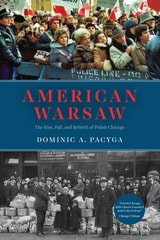
American Warsaw
The Rise, Fall, and Rebirth of Polish ChicagoDominic A. Pacyga
University of Chicago Press, 2019
Every May, a sea of 250,000 people decked out in red and white head to Chicago’s Loop to celebrate the Polish Constitution Day Parade. In the city, you can tune in to not one but four different Polish-language radio stations or jam out to the Polkaholics. You can have lunch at pierogi food trucks or pick up pączkis at the grocery store. And if you’re lucky, you get to take off work for Casimir Pulaski Day. For more than a century, Chicago has been home to one of the largest Polish populations outside of Poland, and the group has had an enormous influence on the city’s culture and politics. Yet, until now, there has not been a comprehensive history of the Chicago Polonia.
With American Warsaw, award-winning historian and Polish American Dominic A. Pacyga chronicles more than a century of immigration, and later emigration back to Poland, showing how the community has continually redefined what it means to be Polish in Chicago. He takes us from the Civil War era until today, focusing on how three major waves of immigrants, refugees, and fortune seekers shaped and then redefined the Polonia. Pacyga also traces the movement of Polish immigrants from the peasantry to the middle class and from urban working-class districts dominated by major industries to suburbia. He documents Polish Chicago’s alignments and divisions: with other Chicago ethnic groups; with the Catholic Church; with unions, politicians, and city hall; and even among its own members. And he explores the ever-shifting sense of Polskość, or “Polishness.”
Today Chicago is slowly being eclipsed by other Polish immigrant centers, but it remains a vibrant—and sometimes contentious—heart of the Polish American experience. American Warsaw is a sweeping story that expertly depicts a people who are deeply connected to their historical home and, at the same time, fiercely proud of their adopted city. As Pacyga writes, “While we were Americans, we also considered ourselves to be Poles. In that strange Chicago ethnic way, there was no real difference between the two.”
Illuminating the Particular
Photographs of Milwaukee's Polish South SideChristel T. Maass
Wisconsin Historical Society Press, 2003
While Kwasniewski's camera captured the sights and sounds of Milwaukee at the turn of the century from the perspective of a single ethnic group in a single neighborhood, his photographs resonate far beyond Milwaukee's Polish South Side. They illuminate the particulars of American life during the early decades of the twentieth century. "What we see, reflected in the distant mirror," says John Gurda, "is ourselves."
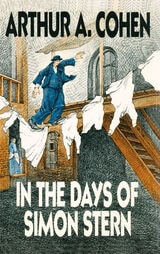
In the Days of Simon Stern
Arthur A. Cohen
University of Chicago Press, 1987
"A majestic work of fiction that should stand world literature's test of time, to be read and reread. A masterpiece."—Commonweal
"This book ensnares one of the most extraordinarily daring ideas to inhabit an American novel in a number of years. For one thing, it is that risky devising, dreamed of only by the Thomas Manns of the world, a serious and vastly conceived fiction bled out of the theological imagination. For another, it is clearly an 'American' novel—altogether American, despite its Jewish particularity: it is not so much about the history of the Jews as it is about the idea of the New World as haven. . . . In its teeming particularity every vein of this book runs with a brilliance of Jewish insight and erudition to be found in no other novelist. Arthur Cohen is the first writer of any American generation to compose a profoundly Jewish fiction on a profoundly Western theme."—Cynthia Ozick, New York Times Book Review
"This stately, ambitious amalgam of Jewish myth, history, theology, and speculations on the Jewish soul is like an enormous Judaic archeological ruin—often hard for the uninitiated to interpret, but impressive. . . . Intelligent, inventive, fascinating."—New Yorker
Lives of Their Own
Blacks, Italians, and Poles in Pittsburgh, 1900-1960John Bodnar, Roger Simon, and Michael P. Weber
University of Illinois Press, 1982
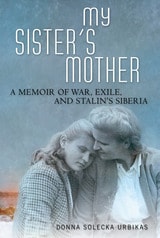
My Sister's Mother
A Memoir of War, Exile, and Stalin’s SiberiaDonna Solecka Urbikas
University of Wisconsin Press, 2019
In 1940, Janina Ślarzynska and her five-year-old daughter Mira were taken by Soviet secret police (NKVD) from their small family farm in eastern Poland and sent to Siberia with hundreds of thousands of others. So began their odyssey of hunger, disease, cunning survival, desperate escape across a continent, and new love amidst terrible circumstances.
But in the 1950s, baby boomer Donna yearns for a “normal” American family while Janina and Mira are haunted by the past. In this unforgettable memoir, Donna recounts her family history and her own survivor’s story, finally understanding the damaged mother who had saved her sister.
Finalist, Best Traditional Non-Fiction Book, Chicago Writers Association
Poles in Illinois
John Radzilowski and Ann Hetzel Gunkel
Southern Illinois University Press, 2020
Authors John Radzilowski and Ann Hetzel Gunkel look at family life among Polish immigrants, their role in the economic development of the state, the working conditions they experienced, and the development of their labor activism. Close-knit Polish American communities were often centered on parish churches but also focused on fraternal and social groups and cultural organizations. Polish Americans, including waves of political refugees during World War II and the Cold War, helped shape the history and culture of not only Chicago, the “capital” of Polish America, but also the rest of Illinois with their music, theater, literature, food.
With forty-seven photographs and an ample number of extensive excerpts from first-person accounts and Polish newspaper articles, this captivating, highly readable book illustrates important and often overlooked stories of this ethnic group in Illinois and the changing nature of Polish ethnicity in the state over the past two hundred years. Illinoisans and Midwesterners celebrating their connections to Poland will treasure this rich and important part of the state’s history.
Poles in Michigan
Dennis Badaczewski
Michigan State University Press, 2002
One of the most vibrant and influential ethnic groups in Michigan, Poles have a long history of migration and settlement in the Great Lakes State. From Michigan’s earliest Polish marriage (in 1762) to the most recent post-Cold War migrations, each successive wave of settlement has enriched and enlivened Michigan culture. Yet, Paczki Day and Polish festivals represent a relatively small portion of the Polish experience. Commitments both to religious and ethnic identity, and a belief in the American vision of landownership and success, have combined to create a mainstream ethnic community abundant in ethnic pride. Poles’ success in Michigan continues to attract Polish immigrants from Europe, just as Polonia continues to make its mark on Michigan’s culture.
Poles in Wisconsin
Susan Gibson Mikos
Wisconsin Historical Society Press, 2012
In this all-new addition to the People of Wisconsin series, author Susan Mikos traces the history of Polish immigrants as they settled in America’s northern heartland. The second largest immigrant population after Germans, Poles put down roots in all corners of the state, from the industrial center of Milwaukee to the farmland around Stevens Point, in the Cutover, and beyond. In each locale, they brought with them a hunger to own land, a willingness to work hard, and a passion for building churches.
Included is a first person memoir from Polish immigrant Maciej Wojda, translated for the first time into English, and historical photographs of Polish settlements around our state.
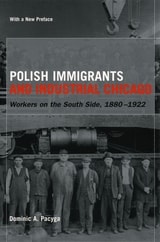
Polish Immigrants and Industrial Chicago
Workers on the South Side, 1880-1922Dominic A. Pacyga
University of Chicago Press, 2003

Polish-American Folklore
Deborah Anders Silverman
University of Illinois Press, 2000
Silverman surveys rituals of courtship, marriage, coming of age, and funerals, also noting those customs that have been rediscovered after falling into disuse. She follows the trail of folk stories and delves into folk music and dance, particularly the polka, providing a detailed discussion of texts, contexts, and performance practices. She also describes birthing practices, home remedies, superstitions, folk blessings, and miracle cures. In addition, she offers a wealth of information on foodways and on the origins and celebration of holy days, from Christmas Eve vigils to the Dyngus Day festivals of the Easter season.
Polish-American Folklore reveals a community that preserves distinctive traditions even though geographically dispersed in a new homeland. Polish Americans retain ties to their ethnicity though ethnic media, social clubs, churches, group events, and the Internet. This "Polonia without walls" is united by a resilient, dynamic, family-oriented culture that attracts not only Polish immigrants and their descendants but also newcomers from other ethnic and racial groups.
By including first-person commentary from a wide range of Polish American individuals and families, from first-generation immigrants to non-Polish in-laws who embrace Polish foods, music, and traditions, Silverman brings to life a thriving ethnic subculture that values equally its Polish roots and its American harvest.
Polish-American Politics in Chicago, 1880-1940
Edward R. Kantowicz
University of Chicago Press, 1975
Kantowicz examines such questions as why Chicago, with the largest Polish population of any city outside of Poland, has never elected a Polish mayor. The author also examines the origins of the heavily Democratic allegiance of Polish voters. Kantowicz demonstrates that Chicago Poles were voting Democratic long before Al Smith, Franklin Roosevelt, or the New Deal.
Kantowicz has made extensive use of registration lists and voting records to construct a statistical picture of Polish-American voting behavior in Chicago. He draws on church records and census records to provide a detailed description of Chicago's many Polish neighborhoods. He also has studied the city's Polish-language press as well as the few manuscript collections left by Polish-American politicians. These collections, together with data gleaned from interviews with individuals who were acquainted with these figures, are used to sketch profiles of the political leaders of Polonia's capital.
Kantowicz focuses on the goals which the Polish-American community pursued in politics, the issues they deemed important, and the functions which politics served for them. He links this analysis to observations on the homeland and the reasons for which the Poles emigrated. In this context he is able to draw conclusions about the nature of the ethnic politics in general. His work will appeal to a variety of readers: urban and twentieth-century historians, political scientists, and sociologists.
The Blondes of Wisconsin
Anthony Bukoski
University of Wisconsin Press, 2021
In Bukoski’s interconnected tales, the heart seeks its due despite familial conflict, the challenges of maritime work, and the slow yet inexorable decline of dementia. Beautiful vignettes express transformative moments: tenderness that can turn a cardboard crown into gold and the faint ghosts of memories long forgotten. A tour-de-force, The Blondes of Wisconsin knows what love is—and what it means to lose it.
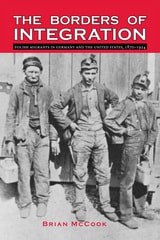
The Borders of Integration
Polish Migrants in Germany and the United States, 1870–1924Brian McCook
Ohio University Press, 2011
The issues of immigration and integration are at the forefront of contemporary politics. Yet debates over foreign workers and the desirability of their incorporation into European and American societies too often are discussed without a sense of history. McCook’s examination questions static assumptions about race and white immigrant assimilation a hundred years ago, highlighting how the Polish immigrant experience is relevant to present-day immigration debates on both sides of the Atlantic. Further, his research shows the complexity of attitudes toward immigration in Germany and the United States, challenging historical myths surrounding German national identity and the American “melting pot.”
In a comparative study of Polish migrants who settled in the Ruhr Valley and northeastern Pennsylvania, McCook shows that in both regions, Poles become active citizens within their host societies through engagement in social conflict within the public sphere to defend their ethnic, class, gender, and religious interests. While adapting to the Ruhr and northeastern Pennsylvania, Poles simultaneously retained strong bonds with Poland, through remittances, the exchange of letters, newspapers, and frequent return migration. In this analysis of migration in a globalizing world, McCook highlights the multifaceted ways in which immigrants integrate into society, focusing in particular on how Poles created and utilized transnational spaces to mobilize and attain authentic and more permanent identities grounded in newer broadly conceived notions of citizenship.
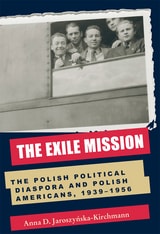
The Exile Mission
The Polish Political Diaspora and Polish Americans, 1939–1956Anna D. Jaroszynska-Kirchmann
Ohio University Press, 2009
At midcentury, two distinct Polish immigrant groups—those Polish Americans who were descendants of economic immigrants from the turn of the twentieth century and the Polish political refugees who chose exile after World War II and the communist takeover in Poland—faced an uneasy challenge to reconcile their concepts of responsibility toward the homeland.
The new arrivals did not consider themselves simply as immigrants, but rather as members of the special category of political refugees. They defined their identity within the framework of the exile mission, an unwritten set of beliefs, goals, and responsibilities, placing patriotic work for Poland at the center of Polish immigrant duties.
In The Exile Mission, an intriguing look at the interplay between the established Polish community and the refugee community, Anna Jaroszyńska–Kirchmann presents a tale of Polish Americans and Polish refugees who, like postwar Polish exile communities all over the world, worked out their own ways to implement the mission’s main goals. Between the outbreak of World War II and 1956, as Professor Jaroszyńska–Kirchmann demonstrates, the exile mission in its most intense form remained at the core of relationships between these two groups.
The Exile Mission is a compelling analysis of the vigorous debate about ethnic identity and immigrant responsibility toward the homeland. It is the first full–length examination of the construction and impact of the exile mission on the interactions between political refugees and established ethnic communities.
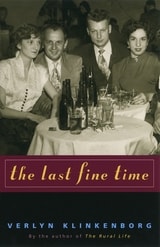
The Last Fine Time
Verlyn Klinkenborg
University of Chicago Press, 2004
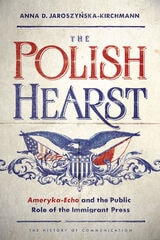
The Polish Hearst
Ameryka-Echo and the Public Role of the Immigrant PressAnna D. Jaroszynska-Kirchmann
University of Illinois Press, 2015
Anna D. Jaroszyńska-Kirchmann mines seven decades' worth of thoughts expressed by Ameryka-Echo readers to chronicle the ethnic press's role in the immigrant experience. Open and unedited debate harkened back to homegrown journalistic traditions, and Jaroszyńska-Kirchmann opens up the nuances of an editorial philosophy that cultivated readers as content creators. As she shows, ethnic publications in the process forged immigrant social networks and pushed notions of education and self-improvement throughout Polonia. Paryski, meanwhile, built a publishing empire that earned him the nickname ""The Polish Hearst.""
Detailed and incisive, The Polish Hearst opens the door on the long-overlooked world of ethnic publishing and the amazing life of one of its towering figures.
The Polish Peasant in Europe and America
A CLASSIC WORK IN IMMIGRATION HISTORYWilliam I. Thomas and Florian Znaniecki
University of Illinois Press, 1984
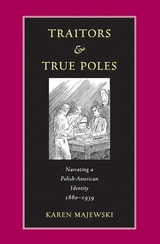
Traitors and True Poles
Narrating a Polish-American Identity, 1880–1939Karen Majewski
Ohio University Press, 2003
During Poland’s century-long partition and in the interwar period of Poland’s reemergence as a state, Polish writers on both sides of the ocean shared a preoccupation with national identity. Polish-American immigrant writers revealed their persistent, passionate engagement with these issues, as they used their work to define and consolidate an essentially transnational ethnic identity that was both tied to Poland and independent of it.
By introducing these varied and forgotten works into the scholarly discussion, Traitors and True Poles recasts the literary landscape to include the immigrant community’s own competing visions of itself. The conversation between Polonia’s creative voices illustrates how immigrants manipulated often difficult economic, social, and political realities to provide a place for and a sense of themselves. What emerges is a fuller picture of American literature, one vital to the creation of an ethnic consciousness.
This is the first extended look at Polish-language fiction written by turn-of-the-century immigrants, a forgotten body of American ethnic literature. Addressing a blind spot in our understanding of immigrant and ethnic identity and culture, Traitors and True Poles challenges perceptions of a silent and passive Polish immigration by giving back its literary voice.
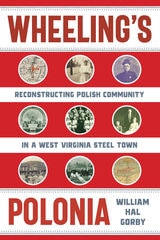
Wheeling's Polonia
Reconstructing Polish Community in a West Virginia Steel TownWilliam Hal Gorby
West Virginia University Press, 2020
Wheeling was a center of West Virginia’s labor movement, and Polish immigrants became a crucial element within the city’s active working-class culture. Arriving at what was also the center of the state’s Roman Catholic Diocese, Poles built religious and fraternal institutions to support new arrivals and to seek solace in times of economic strain and family hardship. The city’s history of crime and organized vice also affected new immigrants, who often lived in neighborhoods targeted for selective enforcement of Prohibition.
At once a deeply textured evocation of the city’s ethnic institutions and an engagement with larger questions about belonging, change, and justice, Wheeling’s Polonia is an inspiring account of a diverse working-class culture and the immigrants who built it.