Results by title
2 books match the query 'Political Fictions'

Political Fictions
Jean-Paul Sartre
Seagull Books, 2021
A collection of pieces on politically engaged fiction of Sartre’s day, including works by André Gorz and Paul Nizan.
Iconic French novelist, playwright, and essayist Jean-Paul Sartre is widely recognized as one of the most important philosophers of the twentieth century, and his work has remained relevant and thought-provoking through the decades. The Seagull Sartre Library now presents some of his most incisive philosophical, cultural, and literary critical essays in twelve newly designed and affordable editions.
Political Fictions includes Sartre’s long foreword to André Gorz’s The Traitor, which has often been called the most intimate and profound book to emerge from the existentialist movement. Sartre also presents a detailed portrait of his friend and fellow writer Paul Nizan (1905–1940), once a committed communist, who died fighting the Nazis at the Battle of Dunkirk. Also featured here is Sartre’s famous foreword to Nizan’s novel The Conspiracy, which made the novel famous on its republication in the 1960s, when it was adopted as an iconic text during the events of May ’68.
[more]
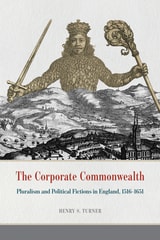
The Corporate Commonwealth
Pluralism and Political Fictions in England, 1516-1651Henry S. Turner
University of Chicago Press, 2016
The Corporate Commonwealth traces the evolution of corporations during the English Renaissance and explores the many types of corporations that once flourished. Along the way, the book offers important insights into our own definitions of fiction, politics, and value.
Henry S. Turner uses the resources of economic and political history, literary analysis, and political philosophy to demonstrate how a number of English institutions with corporate associations—including universities, guilds, towns and cities, and religious groups—were gradually narrowed to the commercial, for-profit corporation we know today, and how the joint-stock corporation, in turn, became both a template for the modern state and a political force that the state could no longer contain. Through innovative readings of works by Thomas More, William Shakespeare, Francis Bacon, and Thomas Hobbes, among others, Turner tracks the corporation from the courts to the stage, from commonwealth to colony, and from the object of utopian fiction to the subject of tragic violence. A provocative look at the corporation’s peculiar character as both an institution and a person, The Corporate Commonwealth uses the past to suggest ways in which today’s corporations might be refashioned into a source of progressive and collective public action.
Henry S. Turner uses the resources of economic and political history, literary analysis, and political philosophy to demonstrate how a number of English institutions with corporate associations—including universities, guilds, towns and cities, and religious groups—were gradually narrowed to the commercial, for-profit corporation we know today, and how the joint-stock corporation, in turn, became both a template for the modern state and a political force that the state could no longer contain. Through innovative readings of works by Thomas More, William Shakespeare, Francis Bacon, and Thomas Hobbes, among others, Turner tracks the corporation from the courts to the stage, from commonwealth to colony, and from the object of utopian fiction to the subject of tragic violence. A provocative look at the corporation’s peculiar character as both an institution and a person, The Corporate Commonwealth uses the past to suggest ways in which today’s corporations might be refashioned into a source of progressive and collective public action.
[more]