Results by title
9 books match the query 'Political Identity'

Doña María's Story
Life History, Memory, and Political IdentityDaniel James
Duke University Press, 2000
Doña María’s testimony is grounded in both the local context (based on the author’s thirteen years of historical and ethnographic research in Berisso) and a broader national narrative. In this way, it differs from the dominant genre of women’s testimonial literature, and much recent ethnographic work in Latin America, which have often neglected historical and communal contextualization in order to celebrate individual agency and self-construction. James examines in particular the ways that gender influences Doña María’s representation of her story. He is careful to acknowledge that oral history challenges the historian to sort through complicated sets of motivations and desires—the historian’s own wish to uncover “the truth” of an informant’s life and the interviewee’s hope to make sense of her or his past and encode it with myths of the self. This work is thus James’s effort to present his research and his relationship with Doña María with both theoretical sophistication and recognition of their mutual affection.
While written by a historian, Doña María’s Story also engages with concerns drawn from such disciplines as anthropology, cultural studies, and literary criticism. It will be especially appreciated by those involved in oral, Latin American, and working-class history.
Enemy Within
Culture Wars and Political Identity in Novels of the French Third RepublicGilbert D. Chaitin
The Ohio State University Press, 2008
Federalism
Political Identity and Tragic CompromiseMalcolm M. Feeley and Edward Rubin
University of Michigan Press, 2011
Federalism is one of the most influential concepts in modern political discourse as well as the focus of immense controversy resulting from the lack of a single coherent definition. Malcolm M. Feeley and Edward Rubin expose the ambiguities of modern federalism, offering a powerful but generous treatise on the modern salience of the term.
—Sanford Levinson, University of Texas at Austin
“At last, an insightful examination of federalism stripped of its romance. An absolutely splendid book, rigorous but still accessible.”
—Larry Yackle, Boston University
“Professors Feeley and Rubin clearly define what is and is not federal system. This book should be required for serious students of comparative government and American government.”
—G. Ross Stephens, University of Missouri, Kansas City
“Feeley and Rubin have written a brilliant book that looks at federalism from many different perspectives—historical, political, and constitutional. Significantly expanding on their earlier pathbreaking work, they have explained the need for a theory of federalism and provided one. This is a must read book for all who are interested in the Constitution.”
—Erwin Chemerinsky, Duke University School of Law
Hegel on Political Identity
Patriotism, Nationality, CosmopolitanismLydia L. Moland
Northwestern University Press, 2012
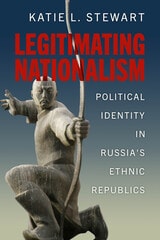
Legitimating Nationalism
Political Identity in Russia's Ethnic RepublicsKatie L. Stewart
University of Wisconsin Press, 2024
Even in the current autocratic system, however, Russia’s multiethnic nature and fractured political history mean that not all political symbols work the same way everywhere; not every story finds the same audience in the same way. The message may emanate from Moscow, but regional actors—including local governments, civic organizations, and cultural institutions—have some agency in how they spread the message: some regionalization of identity work is permitted to ensure that Russian national symbols and narratives resonate with people, and to avoid protest. This book investigates how nation building works on the ground through close studies of three of Russia’s ethnic republics: Karelia, Tatarstan, and Buryatia. Understanding how the project of legitimating nationalism, in support of a unified country and specifically Putin’s regime, works in practice offers crucial context in understanding the shape and story of contemporary Russia.

Metaracial
Hegel, Antiblackness, and Political IdentityRei Terada
University of Chicago Press, 2023
Exploring anxieties raised by Atlantic slavery in radical enlightenment literature concerned about political unfreedom in Europe, Metaracial argues that Hegel's philosophy assuages these anxieties for the left. Interpreting Hegel beside Rousseau, Kant, Mary Shelley, and Marx, Terada traces Hegel's transposition of racial hierarchy into a hierarchy of stances toward reality. By doing so, she argues, Hegel is simultaneously antiracist and antiblack. In dialogue with Black Studies, psychoanalysis, and critical theory, Metaracial offers a genealogy of the limits of antiracism.
Political Identity & Arch
T Cuddy
University Press of Colorado, 2007
Puerto Rican Citizen
History and Political Identity in Twentieth-Century New York CityLorrin Thomas
University of Chicago Press, 2010
Building its incisive narrative from a wide range of archival sources, interviews, and first-person accounts of Puerto Rican life in New York, this book illuminates the rich history of a group that is still largely invisible to many scholars. At the center of Puerto Rican Citizen are Puerto Ricans’ own formulations about political identity, the responses of activists and ordinary migrants to the failed promises of American citizenship, and their expectations of how the American state should address those failures. Complicating our understanding of the discontents of modern liberalism, of race relations beyond black and white, and of the diverse conceptions of rights and identity in American life, Thomas’s book transforms the way we understand this community’s integral role in shaping our sense of citizenship in twentieth-century America.

Understanding Torture
Law, Violence, and Political IdentityJohn T. Parry
University of Michigan Press, 2010
"John Parry's Understanding Torture is an important contribution to our understanding of how torture fits within the practices and beliefs of the modern state. His juxtaposition of the often indeterminate nature of the law of torture with the very specific state practices of torture is both startling and revealing."
---Paul W. Kahn is Robert W. Winner Professor of Law and the Humanities at Yale Law School and author of Sacred Violence
"Parry is effective in building, deploying, and supporting his argument . . . that the law does not provide effective protections against torture, but also that the law is in itself constitutive of a political order in which torture is employed to create---and to destroy or re-create---political identities.”
---Margaret Satterthwaite, Faculty Director of the Center for Human Rights and Global Justice and Associate Professor of Clinical Law, NYU School of Law
"A beautifully crafted, convincingly argued book that does not shy away from addressing the legal and ethical complexities of torture in the modern world. In a field that all too often produces simple or superficial responses to what has become an increasingly challenging issue, Understanding Torture stands out as a sophisticated and intellectually responsible work."
---Ruth Miller, Associate Professor of History, University of Massachusetts, Boston
Creating a separate category for an intentionally narrow set of practices labeled and banned as torture, Parry argues, serves to normalize and legitimate the remaining practices that are "not torture." Consequently, we must question the hope that law can play an important role in regulating state violence.