Results by title
1148 books match the query 'Political Ideologies' and 91 start with a
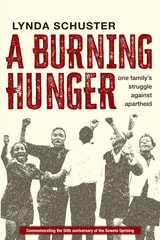
A Burning Hunger
One Family’s Struggle Against ApartheidLynda Schuster
Ohio University Press, 2006
Reissued for the 50th anniversary of the Soweto Uprising, A Burning Hunger reveals how one family’s courage ignited resistance and forever changed South Africa.
If the Mandelas were the generals in the fight for black liberation, the Mashininis were the foot soldiers. Theirs is a story of exile, imprisonment, torture, and loss, but also of dignity, courage, and strength in the face of appalling adversity. Originally published in Great Britain to critical acclaim, A Burning Hunger: One Family’s Struggle Against Apartheid tells a deeply moving human story and is one of the seminal books about the struggle against apartheid.
This family, Joseph and Nomkhitha Mashinini and their thirteen children, became immersed in almost every facet of the liberation struggle—from guerrilla warfare to urban insurrection. Although Joseph and Nomkhitha were peaceful citizens who had never been involved in politics, five of their sons became leaders in the antiapartheid movement. When the students of Soweto rose up in 1976 to protest a new rule making Afrikaans the language of instruction, they were led by charismatic young Tsietsi Mashinini. Scores of students were shot down and hundreds were injured. Tsietsi’s actions on that day set in motion a chain of events that would forever change South Africa, define his family, and transform their lives.
A Burning Hunger shows the human catastrophe that plagued generations of black Africans in the powerful story of one religious and law-abiding Soweto family. Basing her narrative on extensive research and interviews, Lynda Schuster richly portrays this remarkable family and in so doing reveals black South Africa during a time of momentous change.

A Cardboard Castle?
An Inside History of the Warsaw Pact, 1955-1991The National Security Archive Mastny
Central European University Press, 2005

A Century of Populist Demagogues
Eighteen European Portraits, 1918–2018Ivan T. Berend
Central European University Press, 2020
The renowned historian Ivan T. Berend discusses populist demagoguery through the presentation of eighteen politicians from twelve European countries spanning World War I to the present. Berend defines demagoguery, reflects on its connections with populism, and examines the common features and differences in the demagogues’ programs and language.
Mussolini and Hitler, the “model demagogues,” are only briefly discussed, as is the election of Donald Trump in the United States and its impact on Europe. The eighteen detailed portraits include two communists, two fascists, and several right-wing and anti-EU politicians, extending across the full range of demagoguery. The author covers Béla Kun, the leader of the Hungarian Soviet Republic in 1919, weaving through Codreanu and Gömbös from the 1930s, on to Stahremberg and Haider in Austria, and then more broadly throughout Europe from Ceaușescu, Milošević, Tuđjman, Izetbegović, Berlusconi, Wilders, to the two Le Pens, Farage, and Boris Johnson, Orbán and the two Kaczyńskis. Each case includes an analysis of the time and place and is illustrated with quotations from the demagogues’ speeches.
This book is a warning about the continuing threat of populist demagogues both for their subjects and for history itself. Berend insists on the crucial importance for Europe to understand the reality behind their promises and persuasive language as imperative to impeding their success.

A Certain Amount of Madness
The Life Politics and Legacies of Thomas SankaraAmber Murrey
Pluto Press, 2018
This book looks at Sankara's political philosophies and legacies and their relevance today. Analyses of his synthesis of Pan-Africanism and humanist Marxist politics, as well as his approach to gender, development, ecology and decolonisation offer new insights to Sankarist political philosophies. Critical evaluations of the limitations of the revolution examine his relationship with labour unions and other aspects of his leadership style. His legacy is revealed by looking at contemporary activists, artists and politicians who draw inspiration from Sankarist thought in social movement struggles today, from South Africa to Burkina Faso.
In the 30th anniversary of his assassination, this book illustrates how Sankara's political praxis continues to provide lessons and hope for decolonisation struggles today.
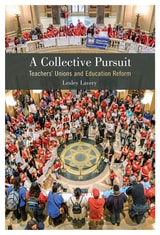
A Collective Pursuit
Teachers' Unions and Education ReformLesley Lavery
Temple University Press, 2020
Teachers’ unions are the organizations responsible for safeguarding the conditions of teachers’ employment. Union supporters claim strong synergies between teachers’ interests and students’ interests, but critics of unions insist that the stance of teachers in collective bargaining may disadvantage students as unions reduce the power of administrators to manage, remove, reward or retain excellent teachers.
In A Collective Pursuit, Lesley Laveryunpacks how teachers’ unions today are fighting for contracts that allow them to earn a decent living and build “schools all students deserve.” She explains the form and function of the nation’s largest teachers’ unions. Lavery then explores unionization campaigns in the Twin Cities charter schools. A Collective Pursuit also examines teacher strikes and contract negotiations, school finance and finance reform, and district and union attempts to address racial achievement gaps, to provide a context for understanding the economic, political, and demographic forces that inspire teachers to improve conditions for students.
A Collective Pursuit emphasizes that while teachers’ unions serve a traditional, economic role, they also provide a vast array of valuable services to students, educators, parents, and community members.
A Communist Odyssey
The life of József Pogány/John PepperThomas Sakmyster
Central European University Press, 2012
A Concise Field Guide to Post-Communist Regimes
Actors, Institutions, and DynamicsBálint Madlovics
Central European University Press, 2022
While the literature of hybrid regimes has given up the presumption that post-communist countries must democratize, its language and concepts still mostly relate to Western democracies. Magyar and Madlovics strongly argue for a vocabulary and grammar tailored to the specifics of the region. In 120 theses they unfold a conceptual framework with (1) a typology of post-communist regimes and (2) a detailed presentation of ideal-type actors and the political, economic, and social phenomena in these regimes. The book is a more digestible companion to the 800-page The Anatomy of Post-Communist Regimes (CEU Press, 2020), which was a detailed theoretical study with plenty of empirical illustrations.
Each of the 120 theses contains a statement and its concise discussion supported by illustrative tables, figures, and QR-codes that connect the interested reader to the more detailed analysis in the Anatomy. In a condensed variety, this book has kept the holistic approach of the Anatomy and treats the spheres of political, market, and communal action as parts of a single, coherent whole. The endeavor to synthesize a vast range of ideas does not, however, result in a too complicated text. On the contrary, freed from the implicit presumptions of democracy theory, the new terminology yields a readily usable toolkit of unambiguous means of expression to speak about post-communism.

A Conspiratorial Life
Robert Welch, the John Birch Society, and the Revolution of American ConservatismEdward H. Miller
University of Chicago Press, 2021
Though you may not know his name, Robert Welch (1899-1985)—founder of the John Birch Society—is easily one of the most significant architects of our current political moment. In A Conspiratorial Life, the first full-scale biography of Welch, Edward H. Miller delves deep into the life of an overlooked figure whose ideas nevertheless reshaped the American right.
A child prodigy who entered college at age 12, Welch became an unlikely candy magnate, founding the company that created Sugar Daddies, Junior Mints, and other famed confections. In 1958, he funneled his wealth into establishing the organization that would define his legacy and change the face of American politics: the John Birch Society. Though the group’s paranoiac right-wing nativism was dismissed by conservative thinkers like William F. Buckley, its ideas gradually moved from the far-right fringe into the mainstream. By exploring the development of Welch’s political worldview, A Conspiratorial Life shows how the John Birch Society’s rabid libertarianism—and its highly effective grassroots networking—became a profound, yet often ignored or derided influence on the modern Republican Party. Miller convincingly connects the accusatory conservatism of the midcentury John Birch Society to the inflammatory rhetoric of the Tea Party, the Trump administration, Q, and more. As this book makes clear, whether or not you know his name or what he accomplished, it’s hard to deny that we’re living in Robert Welch’s America.

A Conspiratorial Life
Robert Welch, the John Birch Society, and the Revolution of American ConservatismEdward H. Miller
University of Chicago Press, 2021
This is an auto-narrated audiobook edition of this book.
The first full-scale biography of Robert Welch, who founded the John Birch Society and planted some of modern conservatism’s most insidious seeds.
Though you may not know his name, Robert Welch (1899-1985)—founder of the John Birch Society—is easily one of the most significant architects of our current political moment. In A Conspiratorial Life, the first full-scale biography of Welch, Edward H. Miller delves deep into the life of an overlooked figure whose ideas nevertheless reshaped the American right.
A child prodigy who entered college at age 12, Welch became an unlikely candy magnate, founding the company that created Sugar Daddies, Junior Mints, and other famed confections. In 1958, he funneled his wealth into establishing the organization that would define his legacy and change the face of American politics: the John Birch Society. Though the group’s paranoiac right-wing nativism was dismissed by conservative thinkers like William F. Buckley, its ideas gradually moved from the far-right fringe into the mainstream. By exploring the development of Welch’s political worldview, A Conspiratorial Life shows how the John Birch Society’s rabid libertarianism—and its highly effective grassroots networking—became a profound, yet often ignored or derided influence on the modern Republican Party. Miller convincingly connects the accusatory conservatism of the midcentury John Birch Society to the inflammatory rhetoric of the Tea Party, the Trump administration, Q, and more. As this book makes clear, whether or not you know his name or what he accomplished, it’s hard to deny that we’re living in Robert Welch’s America.
A Culture of Corruption?
Coping with Government in Post-communist EuropeWilliam L. Miller
Central European University Press, 2001
A Documentary History of Communism and the World
From Revolution to CollapseEdited by Robert V. Daniels
Brandeis University Press, 1994

A Documentary History of Communism in Russia
From Lenin to GorbachevEdited by Robert V. Daniels
University Press of New England, 2001
A Free and Responsible Press
A General Report on Mass Communication: Newspapers, Radio, Motion Pictures, Magazines, and BooksEdited by Robert D. Leigh
University of Chicago Press, 1974
The Commission on Freedom of the Press began with the premise that freedom of the press is essential to political liberty; it is unique among the freedoms, for it promotes and protects all the rest. At the same time, the commission feared the concentration of media control into fewer and fewer hands, stating, "It [is] imperative that the great agencies of mass communication show hospitality to ideas which their owners do not share." The commission concluded that any regulation of the media must come from within, not from the government.
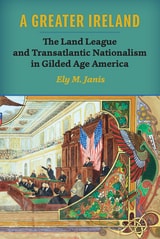
A Greater Ireland
The Land League and Transatlantic Nationalism in Gilded Age AmericaEly M. Janis
University of Wisconsin Press, 2014
As this "Greater Ireland" flourished, new opportunities arose for women and working-class men to contribute within Irish-American society. Exploring the complex interplay of ethnicity, class, and gender, Janis demonstrates the broad range of ideological, social, and political opinion held by Irish Americans in the 1880s. Participation in the Land League deeply influenced a generation that replaced their old county and class allegiances with a common cause, shaping the future of Irish-American nationalism.

A History of Fascism, 1914–1945
Stanley G. Payne
University of Wisconsin Press, 1996
“A History of Fascism is an invaluable sourcebook, offering a rare combination of detailed information and thoughtful analysis. It is a masterpiece of comparative history, for the comparisons enhance our understanding of each part of the whole. The term ‘fascist,’ used so freely these days as a pejorative epithet that has nearly lost its meaning, is precisely defined, carefully applied and skillfully explained. The analysis effectively restores the dimension of evil.”—Susan Zuccotti, The Nation
“A magisterial, wholly accessible, engaging study. . . . Payne defines fascism as a form of ultranationalism espousing a myth of national rebirth and marked by extreme elitism, mobilization of the masses, exaltation of hierarchy and subordination, oppression of women and an embrace of violence and war as virtues.”—Publishers Weekly
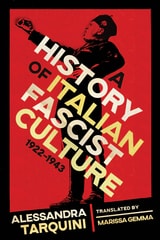
A History of Italian Fascist Culture, 1922–1943
Alessandra Tarquini, Translated by Marissa Gemma
University of Wisconsin Press, 2022
Tarquini sketches the universe of Italian fascism in three broad directions: the regime’s cultural policies, the condition of various art forms and scholarly disciplines, and the ideology underpinning the totalitarian state. She details the choices the ruling class made between 1922 and 1943, revealing how cultural policies shaped the country and how intellectuals and artists contributed to those decisions. The result is a view of fascist ideology as a system of visions, ideals, and, above all, myths capable of orienting political action and promoting a precise worldview.
Building on George L. Mosse’s foundational research, Tarquini provides the best single-volume work available to fully understand a complex and challenging subject. It reveals how the fascists used culture—art, cinema, music, theater, and literature—to build a conservative revolution that purported to protect the traditional social fabric while presenting itself as maximally oriented toward the future.
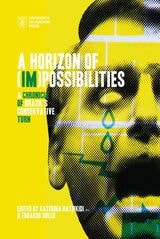
A Horizon of (Im)possibilities
A Chronicle of Brazil’s Conservative TurnEdited by Katerina Hatzikidi and Eduardo Dullo
University of London Press, 2021
Since the shocking 2018 presidential election in Brazil, a growing body of scholarship has attempted to understand the country’s so-called “conservative turn.” A gripping in-depth account of politics and society in Brazil today, this new volume brings together a myriad of different perspectives to help us better understand the political events that have shaken the country in recent years.
Combining ethnographic insights with political science, history, sociology, and anthropology, the interdisciplinary analyses included in A Horizon of (Im)possibilities offer a panoramic view on social and political change in Brazil, spanning temporal and spatial dimensions. Starting with the 2018 presidential election, the contributors discuss the country’s recent—and more distant—past in relation to the present. Pointing to the continuities and disruptions during those years, this volume is an invaluable guide to understanding the limits of political democracy.

A Life for Belarus
The Fall and Postmortal Rise of the USSRStanislau Shushkevich
Central European University Press, 2025
This memoir of the first president of an independent Belarus (1991-1994) tells about the revival of independent Belarus, the difficulties in establishing a democracy and a market economy, a hardened Soviet mentality, and the political immaturity of the intelligentsia and obduracy of the old nomenklatura.
Stanislau Shushkevich, born in 1934, narrates his path from a son of an “enemy of the people” to a doctorate in physics, and then to be the first head of independent Belarus. A series of entertaining essays discuss some major events as well as some minor ones that are barely known. The book describes Shushkevich’s role in hosting the Belavezha Accords, which brought about the end of the Soviet Union, and explores the motivation behind the decision for the de jure dissolution of the empire at a time when the major world leaders were categorically against the division of the USSR into independent states. The author draws particular attention to the role of the Baltic States in the late perestroika period. He also addresses the political passivity of the Soviet intelligentsia and the reasons for the revival of the Soviet Union in Russia and Belarus.
Shushkevich, who lives in Minsk, also provides valuable insights into contemporary Belarus, including an assessment of Lukashenka’s controversial role in recent events.

A Milwaukee Woman's Life on the Left
The Autobiography of Meta BergerMeta Berger
Wisconsin Historical Society Press, 2001

A Nation of Politicians
Gender, Patriotism, and Political Culture in Late Eighteenth-Century IrelandPadhraig Higgins
University of Wisconsin Press, 2009
In A Nation of Politicians, Padhraig Higgins argues that the development of Volunteer-initiated activities—associating, petitioning, subscribing, shopping, and attending celebrations—expanded the scope of political participation. Using a wide range of literary, archival, and visual sources, Higgins examines how ubiquitous forms of communication—sermons, songs and ballads, handbills, toasts, graffiti, theater, rumors, and gossip—encouraged ordinary Irish citizens to engage in the politics of a more inclusive society and consider the broader questions of civil liberties and the British Empire. A Nation of Politicians presents a fascinating tale of the beginnings of Ireland’s richly vocal political tradition at this important intersection of cultural, intellectual, social, and public history.

A Nation of Takers
America’s Entitlement EpidemicNicholas Eberstadt
Templeton Press, 2012

A New Scotland
Building an Equal, Fair and Sustainable SocietyGregor Gall
Pluto Press, 2022
In A New Scotland, leading activists and academics lay out the blueprints for radical reform, showing how society can be transformed by embedding values of democracy, social justice and environmental sustainability into a coherent set of policy ideas.
Structured in two parts, the book takes to task the challenges to affect radical change, before exploring new approaches to key questions such as healthcare, education, public ownership, race, gender and human rights.

A Noble Fight
African American Freemasonry and the Struggle for Democracy in AmericaCorey D. B. Walker
University of Illinois Press, 2008
With great care and detail, Walker argues that African American freemasonry provides a critical theoretical lens for understanding the distinctive ways African Americans have constructed a radically democratic political imaginary through racial solidarity and political nationalism, forcing us to reconsider much more circumspectly the complex relationship between voluntary associations and democratic politics.
Mapping the discursive logics of the language of freemasonry as a metaphoric rendering of American democracy, this study interrogates the concrete forms of an associational culture, revealing how paradoxical aspects of freemasonry such as secrecy and public association inform the production of particular ideas and expressions of democracy in America.

A Not So Foreign Affair
Fascism, Sexuality, and the Cultural Rhetoric of American DemocracyAndrea Slane
Duke University Press, 2001
World War II marked a turning point in the cultural rhetoric of democracy, Slane claims, because it intensified a preoccupation with the political role of private life and pushed sexuality to the center of democratic discourse. Having created tremendous anxiety—and fascination—in American culture, Nazism became associated with promiscuity, sexual perversionand the destruction of the family. Slane reveals how this particular imprint of fascism is used in progressive as well as conservative imagery and language to further their domestic agendas and shows how our cultural engagement with Nazism reflects the inherent tension in democracy between the value of diversity, individual freedoms national identity, and notions of the common good. Finally, she applies her analysis of wartime narratives to contemporary texts, examining anti-abortion, anti-gay, and anti-federal rhetoric, as well as the psychic life of skinheads, censorship debates, and the contemporary fascination with incest.
An invaluable resource for understanding the language we use—both visual and narrative—to describe and debate democracy in the United States today, A Not So Foreign Affair will appeal to those interested in cultural studies, film and video studies, American studies, twentieth century history, German studies, rhetoric, and sexuality studies.
A People's History of the Russian Revolution
Neil Faulkner
Pluto Press, 2017
Faulkner rejects caricatures of Lenin and the Bolsheviks as authoritarian conspirators or the progenitors of Stalinist dictatorship, and forcefully argues that the Russian Revolution was an explosion of democracy and creativity—and that it was crushed by bloody counter-revolution and replaced with a form of bureaucratic state-capitalism.
Grounded by powerful first-hand testimony, this history marks the centenary of the Revolution by restoring the democratic essence of the revolution, offering a perfect primer for the modern reader.
A Pragmatic Alliance
Jewish-Lithuanian political cooperation at the beginning of the 20th centuryVladas Sirutavicius
Central European University Press, 2011
A Preface to Democratic Theory
Robert A. Dahl
University of Chicago Press, 1963
"A Preface to Democratic Theory is well worth the devoted attention of anyone who cares about democracy. For it will have an important influence on both theory about democracy and on actual practice in democracies round the world."—Bernard Barber, Political Science Quarterly
"The book is a must for democratic theorists."—J. Roland Pennock, Journal of Politics

A Preface to Democratic Theory, Expanded Edition
Robert A. Dahl
University of Chicago Press, 2006
For this fiftieth-anniversary edition, Dahl has written an extensive new afterword that reevaluates Madisonian theory in light of recent research. And in a new foreword, he reflects back on his influential volume and the ways his views have evolved since he wrote it. For any student or scholar of political science, this new material is an essential update on a gold standard in the evolving field of democratic theory.
“A Preface to Democratic Theory is well worth the devoted attention of anyone who cares about democracy.”—Political Science Quarterly
A Radical Convergence
Latter-day Saints and Their Utopian Socialist OriginsErik J. Freeman
University of Illinois Press, 2026
Erik J. Freeman uses the lives of radical converts to explore the international socialist politics that permeated the early Church. These energetic newcomers fueled LDS expansion even as they laid the foundation for a global religion. At the same time, utopian socialists within the Church helped lay the groundwork for later political and social movements and progressive ideas. The Church in the United States pivoted toward capitalism after the turn of the century, but socialist thought remained—and remain—an important thread throughout LDS communities around the world.
Provocative and sweeping, A Radical Convergence tells the surprising story of utopian socialism's place in Church history.
A Radical History of the World
Neil Faulkner
Pluto Press, 2018
“Staggeringly ambitious.”―New Internationalist
“One of the finest historians on the left.”—John Newsinger, author, The Blood Never Dried
Rejecting the top-down approach of conventional history, Neil Faulkner contends that it is the mass action of ordinary people that drives the transformative events of our many histories. This is a history of power, abuse, and greed, but also one of liberation, progress, and solidarity.
From the hunter-gatherers two million years ago to the ancient empires of Persia and China, and from the Russian Revolution to modern imperialism, humans have always struggled to create a better society than what came before. All over the world at numerous points in the past, a different way of life has become an absolute necessity, over and over again. This is a history of the humans in these struggles—the hominid and the hunter, the emperor and the slave, the dictator and the revolutionary.
Reading against the grain of mainstream histories, Neil Faulkner reveals that what happened in the past has never been predetermined. From antiquity to feudalism, and from fascism to our precarious political present, choices have always been numerous and complex, and the possible outcomes have ranged broadly between liberation and barbarism. His chapters include:
*Hunters and Farmers
*The First Class Societies
*Ancient Empires
*The Medieval World
*European Feudalism
*The First Wave of Bourgeois Revolutions
*Absolutist Europe and Capitalist Globalization
*The Rise of Industrial Capitalism
*The Revolutionary Wave
*The Great Depression and the Rise of Fascism
*World War and Cold War
*The New World Disorder
*Capitalism’s Greatest Crisis? The Early Twenty-First Century
In our fraught political present—as we face the loss of civil liberties and environmental protections, the rise of ethnonationalism, and the looming threat of nuclear war—we need the perspective of these histories now more than ever. The lesson of A Radical History of the World is that, if we created our past, we can also create a better future.
A Radical Spirit
The History and Potential of the Latter Day Saint TraditionEdited by Andrew Bolton, Taunalyn Ford, and Patrick Q. Mason
University of Illinois Press, 2027
Early followers of Joseph Smith believed their new faith could organize society from the ground up and create a religious community shaped by justice, equality, and spiritual transformation. The essayists look at the movement’s diverse influences—religious, philosophical, and cultural—alongside the economic, gender, and racial issues that informed its radicalism. They also trace the competing pressures inside and outside the movement that helped determine which radical ideas survived and which faded or were later enhanced.
Eye-opening and expansive, A Radical Spirit rediscovers implications of the original heart of the Restoration tradition that thrived among the marginalized poor in the USA, Canada and in Europe—a radical Spirit of Jesus that offers possibilities for our times.
Contributors: Andrew Bolton, Gerard Charmley, Rebekah Clark, Taunalyn Ford, Russell Arben Fox, Erik J. Freeman, David J. Howlett, Brad A. Martell, Lori Martell, Patrick Q. Mason, Michael Ratcliffe, Jennifer Reeder, Joseph M. Spencer, Jordan T. Watkins, Walker Wright

A Red Family
Junius, Gladys, and Barbara ScalesMickey Friedman. Afterword by Barbara Scales. Historical Essay by Gail O'Brien.
University of Illinois Press, 2008
Through the distinct perspectives of Junius, his wife Gladys, and his daughter Barbara, this book deepens and personalizes the story of American radicalism. Conversational, intimate, and exceptionally accessible, A Red Family offers a unique look at the American communist experience from the inside out.
A Second Look at First Things
A Case for Conservative Politics: The Hadley Arkes FestschriftFrancis J. Beckwith
St. Augustine's Press, 2013

A Social Ecology of Capital
Éric Pineault
Pluto Press, 2022
An original theory of contemporary capitalist growth and its socio-ecological contradictions
Capital is pushing into motion ever larger global material flows. In doing so it has come to depend on massive expenditures of energy, putting to work fossil fuels and the machines they animate to transform the world, accumulate power and grow the economy. The ecological relations and crises of today’s societies are driven by the processes of extraction of the elements that come together as a throughput of material and energy flows controlled by capital and shaped by its imperative of valorization.
In A Social Ecology of Capital, Éric Pineault proposes an original model of the fossil social metabolism that has sustained the growth of advanced capitalism in the last century.
Drawing on ecological economics and critical political economy, the book analyses how the social structures of accumulation, production, consumption and waste determine and regulate the material flow and the accumulation of material artifacts. Showing how social relations shape the ecology of capital, the book highlights the contradictions humanity now faces.
A Social Laboratory for Modern France
The Musée Social and the Rise of the Welfare StateJanet R. Horne
Duke University Press, 2001
Horne explains how Musée founders believed—and convinced others to believe—that the Third Republic would carry out the social mission of the French Revolution and create a new social contract for modern France, one based on the rights of citizenship and that assumed collective responsibility for the victims of social change. Challenging the persistent notion of the Third Republic as the stagnant backwater of European social reform, Horne instead depicts the intellectually sophisticated and progressive political culture of a generation that laid the groundwork for the rise of a hybrid welfare system, characterized by a partnership between private agencies and government. With a focus on the cultural origins of turn-of-the-century thought—including religion, republicanism, liberalism, solidarism, and early sociology—A Social Laboratory for Modern France demonstrates how French reformers grappled with social problems that are still of the utmost relevance today and how they initiated a process that gave the welfare state the task of achieving social cohesion within an industrializing republic.
A Socialist History of the French Revolution
Jean Jaurés
Pluto Press, 2021
Jean Jaurès was the celebrated French Socialist Party leader, assassinated in 1914 for trying to use diplomacy and industrial action to prevent the outbreak of war. Published just a few years before his death, his magisterial A Socialist History of the French Revolution has endured for over a century.
Written in the midst of his activities as leader of the Socialist Party and editor of its newspaper, L'Humanite, Jaurès intended the book to serve as both a guide and an inspiration to political activity; even now it can serve to do just that.
Jaurès's verve, originality, and willingness to criticize all players in this epic drama make this a truly moving addition to the shelf of great books on the French Revolution. Mitchell Abidor's abridged translation of Jaurès's original six volumes makes this exceptional work truly accessible to an Anglophone audience.
A Suburb of Europe
Nineteenth-Century Polish Approaches to Western CivilizationJerzy Jedlicki
Central European University Press, 2000
In this lively and original book, the distinguished Polish historian Jerzy Jedlicki tells the story of a century-long Polish dispute over the merits and demerits of the Western model of liberal progress and industrial civilization.
As in several countries of Europe, also in Poland, intellectuals--conservatives, liberals, and (later) socialists--quarrelled about whether such a model would suit and benefit their nation, or whether it would spell the ruin of its distinctive cultural features.
This heated debate revolved around several pairs of opposing ideas: native cultures v. cosmopolitan civilization; natural v. artificial ways of economic development; Christian morals v. capitalist laissez-faire; traditional customs v. mobile society; romanticism v. scientism, and so on. It is these various aspects of the main issue which the author analyzes and links together here. He describes how difficult and painful the process of modernization was in a nation deprived of its political independence and cultural autonomy.

A Tale of Two Villages
Coerced Modernization in the East European CountrysideAlina Mungiu-Pippidi
Central European University Press, 2010

Abbie Hoffman
American RebelJezer, Marty
Rutgers University Press, 1993
"... Abbie, more than any other radical, showed potheads how to demonstrate and radicals how to dance." -- Chicago Tribune
"... deeply sympathetic and scrupulously detached-a triumph of judicious empathy." -- MARTIN DUBERMAN, Distinguished Professor of History, Lehman/The Graduate School, C.U.N.Y.
"... details Hoffman's humor, manic energy, depressive spells, political skills, and above all, his Incurable and still contagious optimism." -- Entertainment Weekly
"Here's the Abbie I knew and loved! Marty Jezer has captured him in all his complexity, dedication, humor, and heart." -- ANITA HOFFMAN

Abiding by Sri Lanka
On Peace, Place, and PostcolonialityQadri Ismail
University of Minnesota Press, 2005
Abiding by Sri Lanka examines how the disciplines of anthropology, history, and literature treat the Sri Lankan ethnic conflict. Anthropology, Ismail contends, approaches Sri Lanka as an object from an “outside” and western point of view. History, addressing the conflict from the “inside,” abides by the place and so promotes change that is nationalist and exclusive. Neither of these fields imagines an inclusive community. Literature, Ismail argues, can.
With close readings of texts that “abide” by Sri Lanka, texts that have a commitment to it, Ismail demonstrates that the problems in Sri Lanka raise fundamental concerns for us all regarding the relationship between democracies and minorities. Recognizing the structural as well as political tendencies of representative democracies to suppress minorities, Ismail rethinks democracy by redefining the concept of the minority perspective, not as a subject-position of numerical insignificance, but as a conceptual space that opens up the possibility for distinction without domination and, ultimately, peace.
Qadri Ismail is associate professor of English at the University of Minnesota. He has also been a journalist in Sri Lanka.
Abolition Of White Democracy
Joel Olson
University of Minnesota Press, 2004
Offers a new way of understanding the tortured relationship between race and democracy in the United States
Racial discrimination embodies inequality, exclusion, and injustice and as such has no place in a democratic society. And yet racial matters pervade nearly every aspect of American life, influencing where we live, what schools we attend, the friends we make, the votes we cast, the opportunities we enjoy, and even the television shows we watch.
Joel Olson contends that, given the history of slavery and segregation in the United States, American citizenship is a form of racial privilege in which whites are equal to each other but superior to everyone else. In Olson’s analysis we see how the tension in this equation produces a passive form of democracy that discourages extensive participation in politics because it treats citizenship as an identity to possess rather than as a source of empowerment. Olson traces this tension and its disenfranchising effects from the colonial era to our own, demonstrating how, after the civil rights movement, whiteness has become less a form of standing and more a norm that cements white advantages in the ordinary operations of modern society. To break this pattern, Olson suggests an “abolitionist-democratic” political theory that makes the fight against racial discrimination a prerequisite for expanding democratic participation.
Accountability in State Legislatures
Steven Rogers
University of Chicago Press, 2023
A troubling portrait of democracy in US state legislatures.
State legislatures hold tremendous authority over key facets of our lives, ranging from healthcare to marriage to immigration policy. In theory, elections create incentives for state legislators to produce good policies. But do they?
Drawing on wide-ranging quantitative and qualitative evidence, Steven Rogers offers the most comprehensive assessment of this question to date, testing different potential mechanisms of accountability. His findings are sobering: almost ninety percent of American voters do not know who their state legislator is; over one-third of incumbent legislators run unchallenged in both primary and general elections; and election outcomes have little relationship with legislators’ own behavior.
Rogers’s analysis of state legislatures highlights the costs of our highly nationalized politics, challenging theories of democratic accountability and providing a troubling picture of democracy in the states.
Activism, Majority Rule, and Local Democracy
Rethinking Public InfluenceBrian E. Adams
Temple University Press, 2026
Local democracy doesn’t work as it should, declares Brian Adams in Activism, Majority Rule, and Local Democracy. Local politics is where citizens have the most opportunity for direct participation, control, and influence, but that activism doesn’t necessarily translate into majority rule.
While greater local engagement can produce policy that better reflects activists’ strong preferences, Adams explains that activists are not representative of the public-at-large and states that a reconceptualization of how the public should be able to influence local officials is required. Based on interviews with activists in San Diego, California, Adams concludes that activism can be beneficial, but we need to view it as distinct from majority rule, with a focus on managing the tension between the two.
Improving local democracy is not just a matter of generating more activism. It requires articulating when we want policy to reflect majority preferences and when we want activists to hold sway.
Aesthetics and Marxism
Chinese Aesthetic Marxists and Their Western ContemporariesKang Liu
Duke University Press, 2000
Far from being secondary considerations in Chinese Marxism, aesthetics and culture are in fact principal concerns. In this respect, such Marxists are similar to their Western counterparts, although Europeans have had little understanding of the Chinese experience. Liu traces the genealogy of aesthetic discourse in both modern China and the West since the era of classical German thought, showing where conceptual modifications and divergences have occurred in the two traditions. He examines the work of Mao Zedong, Lu Xun, Li Zehou, Qu Qiubai, and others in China, and from the West he discusses Kant, Schiller, Schopenhauer, and Marxist theorists including Horkheimer, Adorno, Benjamin, and Marcuse. While stressing the diversity of Marxist positions within China as well as in the West, Liu explains how ideas of culture and aesthetics have offered a constructive vision for a postrevolutionary society and have affected a wide field of issues involving the problems of modernity.
Forcefully argued and theoretically sophisticated, this book will appeal to students and scholars of contemporary Marxism, cultural studies, aesthetics, and modern Chinese culture, politics, and ideology.
After Authority
Global Art Cinema and Political TransitionKalling Heck
Rutgers University Press, 2020
After Communism
Perspectives on DemocracyDonald R. Kelley
University of Arkansas Press, 2003
After Independence
Making and Protecting the Nation in Postcolonial and Postcommunist StatesLowell W. Barrington, Ed.
University of Michigan Press, 2006
"Where do nationalists go once they get what they want? We know rather little about how nationalist movements transform themselves into the governments of new states, or how they can become opponents of new regimes that, in their view, have not taken the self-determination drive far enough. This stellar collection contributes not only to comparative theorizing on nationalist movements, but also deepens our understanding of the contentious politics of nationalism's ultimate product--new countries."
--Charles King, Chair of the Faculty and Ion Ratiu Associate Professor, Georgetown University School of Foreign Service
"This well-integrated volume analyzes two important variants of nationalism-postcolonial and postcommunist-in a sober, lucid way and will benefit students and scholars alike."
--Zvi Gitelman, University of Michigan
Lowell W. Barrington is Associate Professor of Political Science, Marquette University.
After the Imperial Turn
Thinking with and through the NationAntoinette Burton, ed.
Duke University Press, 2003
While most of the contributors discuss British imperialism and its repercussions, the volume also includes, as counterpoints, essays on the history and historiography of France, Germany, Spain, and the United States. Whether looking at the history of the passport or the teaching of history from a postnational perspective, this collection explores such vexed issues as how historians might resist the seduction of national narratives, what—if anything—might replace the nation’s hegemony, and how even history-writing that interrogates the idea of the nation remains ideologically and methodologically indebted to national narratives. Placing nation-based studies in international and interdisciplinary contexts, After the Imperial Turn points toward ways of writing history and analyzing culture attentive both to the inadequacies and endurance of the nation as an organizing rubric.
Contributors. Tony Ballantyne, Antoinette Burton, Ann Curthoys, Augusto Espiritu, Karen Fang, Ian Christopher Fletcher, Robert Gregg, Terri Hasseler, Clement Hawes, Douglas M. Haynes, Kristin Hoganson, Paula Krebs, Lara Kriegel, Radhika Viyas Mongia, Susan Pennybacker, John Plotz, Christopher Schmidt-Nowara, Heather Streets, Hsu-Ming Teo, Stuart Ward, Lora Wildenthal, Gary Wilder

After the Thrill Is Gone
A Decade of Post-Apartheid South Africa, Volume 103Grant Farred and Rita Barnard, eds.
Duke University Press, 0
In a range of politically inflected essays by philosophers, community activists, political scientists, sociologists, literary scholars, and cultural and postcolonial theorists—many of whom are diasporic or resident South Africans—this special issue of SAQ provides a critical look at the realities of black majority governance, at the African National Congress, and at the costs of ANC rule to the populace. One essay draws a condemning sketch of poverty and violence in the townships and the growing communities of squatters that continue despite the emergence of democracy. A philosophical piece contemplates the practice of human rights in a South African society grappling with the memory of apartheid abuses. The fiction and poetry in the collection explore sexual identity, including issues created by the AIDS epidemic, and offer critiques of government policies. Using comic strips, another contributor demonstrates the ability of South African popular culture to satirize the nation’s political status quo. Taken together, the essays in After the Thrill Is Gone open a sobering perspective on South Africa’s recent history, its present, and its future.
Contributors. Rita Barnard, Patrick Bond, Ashwin Desai, Emmanuel Chukwudi Eze, Grant Fared, Michiel Heyns, Shaun Irlam, Neil Lazarus, Michael MacDonald, Zine Magubane, Richard Pithouse, Lesego Rampolokeng, Adam Sitze
Afterimage of the Revolution
Cumann na nGaedheal and Irish Politics, 1922–1932Jason Knirck
University of Wisconsin Press, 2014