Results by title

21 books match the query 'Political Philosophy'
cover of America and the Political Philosophy of Common Sense

America and the Political Philosophy of Common Sense

Scott Philip Segrest

University of Missouri Press, 2009
From Aristotle to Thomas Jefferson, seminal thinkers have declared “common sense” essential for moral discernment and civilized living. Yet the story of commonsense philosophy is not well known today.
 
            In America and the Political Philosophy of Common Sense, Scott Segrest traces the history and explores the personal and social meaning of common sense as understood especially in American thought and as reflected specifically in the writings of three paradigmatic thinkers: John Witherspoon, James McCosh, and William James. The first two represent Scottish Common Sense and the third, Pragmatism, the schools that together dominated American higher thought for nearly two centuries.
 
Educated Americans of the founding period warmly received Scottish Common Sense, Segrest writes, because it reflected so well what they already thought, and he uncovers the basic elements of American common sense in examining the thought of Witherspoon, who introduced that philosophy to them. With McCosh, he shows the furthest development and limits of the philosophy, and with it of American common sense in its Scottish realist phase. With James, he shows other dimensions of common sense that Americans had long embraced but that had never been examined philosophically.
 
            Clearly, Segrest’s work is much more than an intellectual history. It is a study of the American mind and of common sense itself—its essential character and its human significance, both moral and political. It was common sense, he affirms, that underlay the Declaration of Independence and the founders’ ideas of right and obligation that are still with us today. Segrest suggests that understanding this foundation and James’s refreshing of it could be the key to maintaining America’s vital moral core against a growing alienation from common sense across the Western world.
 
Stressing the urgency of understanding and preserving common sense, Segrest’s work sheds new light on an undervalued aspect of American thought and experience, helping us to perceive the ramifications of commonsense philosophy for dignified living.
[more]
cover of Antigone as Political Philosophy

Antigone as Political Philosophy

Gregor Moder, Tanja Dominko

Northwestern University Press, 2026

Offering a new perspective on Sophocles’s Antigone as a model for reimagining humanity’s future—and its end

Why read Antigone today? The premise of this accessible, essayistic work is that humanity finds itself at a crossroads, where it must reinvent itself or perish—a condition similar to Antigone’s own. Rereading Antigone via Hegel’s engagement with the text can help us understand what it means for a human age to come to an end: that is, to think of our age as an episode whose collapse is also an engine of historical change.

Gregor Moder argues that the task of humanity today may not be to defend the minimal remnants of our civilization but to say farewell to it—to give it a proper burial. As Moder explicates, the central problem of this foundational tragedy lies in the positions of brother and sister, man and woman, representing human and divine law and the institutions of the state and the family. Through a fresh reading of both Sophocles’s play and Hegel’s productive reworking of the Greek myth, Moder’s analysis shows that sometimes the only way through deep social contradictions is in unraveling the framework that has constructed them.
 

[more]
cover of At the Limits of Political Philosophy: From "Brilliant Errors" to Things of Uncommon Importance

At the Limits of Political Philosophy

From "Brilliant Errors" to Things of Uncommon Importance

James V. Schall

Catholic University of America Press, 1996
James V. Schall presents, in a convincing and articulate manner, the revelational contribution to political philosophy, particularly that which comes out of the Roman Catholic tradition.
[more]
cover of Black Minded: The Political Philosophy of Malcolm X

Black Minded

The Political Philosophy of Malcolm X

Michael E. Sawyer

Pluto Press, 2020

Known as 'the angriest black man in America', Malcolm X was one of the most famous activists to ever live. Going beyond biography, Black Minded examines Malcolm X's philosophical system, restoring his thinking to the pantheon of Black Radical Thought.

Michael Sawyer argues that the foundational concepts of Malcolm X's political philosophy - economic and social justice, strident opposition to white supremacy and Black internationalism - are often obscured by an emphasis on biography. The text demonstrates the way in which Malcolm X's philosophy lies at the intersection of the thought of W.E.B. Du Bois and Frantz Fanon and is an integral part of the revolutionary politics formed to alleviate the plight of people of African descent globally.

Exploring themes of ontology, the body, geographic space and revolution, Black Minded provides a much-needed appraisal of Malcolm X's political philosophy.
[more]
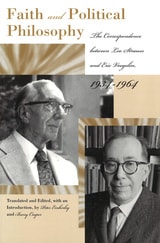
cover of Faith and Political Philosophy: The Correspondence Between Leo Strauss and Eric Voegelin, 1934-1964

Faith and Political Philosophy

The Correspondence Between Leo Strauss and Eric Voegelin, 1934-1964

Edited & Intro by Peter Emberley & Barry Cooper

University of Missouri Press, 2004

Faith and Political Philosophy consists of fifty-three letters between Leo Strauss and Eric Voegelin, two of the most important political theorists of the twentieth century. In this correspondence, Strauss and Voegelin explore the nature of their similarities and differences, offering insightful observations about one another's work, about the state of the discipline, and about the influences working on them. The letters shed light on many assumptions made in their published writings, often with an openness that removes all vestiges of uncertainty.
[more]
cover of History of Political Philosophy

History of Political Philosophy

Edited by Leo Strauss and Joseph Cropsey

University of Chicago Press, 2001
This volume provides an unequaled introduction to the thought of chief contributors to the Western tradition of political philosophy from classical Greek antiquity to the twentieth century. Written by specialists on the various philosophers, this third edition has been expanded significantly to include both new and revised essays.
[more]
cover of Law and the Good Life: On the Political Philosophy of Aristotle

Law and the Good Life

On the Political Philosophy of Aristotle

Robert C. Bartlett

University of Chicago Press, 2026

A fresh reading of the relationship between moral and political philosophy in Aristotle’s thought.

Our democracies promise the rights to life, liberty, and the pursuit of happiness—at least, within the confines of the law. Yet the law is an ineffective guide to the good life; laws can be arbitrary, even immoral. What other limit, then, should direct us as we pursue our own fulfillment? 

In Law and the Good Life, philosopher Robert C. Bartlett examines Aristotle’s consideration of this question. Rather than defer to authority, Aristotle invites us to ground ourselves in moral virtue and intellectual fulfillment, an argument he develops in both Politics and Nicomachean Ethics. As political creatures, Aristotle tells us, we are capable of moral action and therefore must embrace that capacity; at the same time, as rational creatures, we must understand what is true, even without regard to action. In taking these insights together, Bartlett offers a new reading of Aristotle’s political philosophy, one he hopes might serve as a prudent lodestar in our own turbulent times.
[more]
cover of Leo Strauss and the Problem of Political Philosophy

Leo Strauss and the Problem of Political Philosophy

Michael P. Zuckert and Catherine H. Zuckert

University of Chicago Press, 2014
Leo Strauss and his alleged political influence regarding the Iraq War have in recent years been the subject of significant media attention, including stories in the Wall Street Journal and New York Times.Time magazine even called him “one of the most influential men in American politics.” With The Truth about Leo Strauss, Michael and Catherine Zuckert challenged the many claims and speculations about this notoriously complex thinker. Now, with Leo Strauss and the Problem of Political Philosophy, they turn their attention to a searching and more comprehensive interpretation of Strauss’s thought as a whole, using the many manifestations of the “problem of political philosophy” as their touchstone.
 
For Strauss, political philosophy presented a “problem” to which there have been a variety of solutions proposed over the course of Western history. Strauss’s work, they show, revolved around recovering—and restoring—political philosophy to its original Socratic form. Since positivism and historicism represented two intellectual currents that undermined the possibility of a Socratic political philosophy, the first part of the book is devoted to Strauss’s critique of these two positions. Then, the authors explore Strauss’s interpretation of the history of philosophy and both ancient and modern canonical political philosophers, including Plato, Aristotle, Machiavelli, and Locke. Strauss’s often-unconventional readings of these philosophers, they argue, pointed to solutions to the problem of political philosophy. Finally, the authors examine Strauss’s thought in the context of the twentieth century, when his chief interlocutors were Schmitt, Husserl, Heidegger, and Nietzsche.
 
The most penetrating and capacious treatment of the political philosophy of this complex and often misunderstood thinker, from his early years to his last works, Leo Strauss and the Problem of Political Philosophy reveals Strauss’s writings as an attempt to show that the distinctive characteristics of ancient and modern thought derive from different modes of solving the problem of political philosophy and reveal why he considered the ancient solution both philosophically and politically superior.
[more]
cover of Leo Strauss on Political Philosophy: Responding to the Challenge of Positivism and Historicism

Leo Strauss on Political Philosophy

Responding to the Challenge of Positivism and Historicism

Leo Strauss

University of Chicago Press, 2018

Leo Strauss is known primarily for reviving classical political philosophy through careful analyses of works by ancient thinkers. As with his published writings, Strauss’s seminars devoted to specific philosophers were notoriously dense, accessible only to graduate students and scholars with a good command of the subject. In 1965, however, Strauss offered an introductory course on political philosophy at the University of Chicago. Using a conversational style, he sought to make political philosophy, as well as his own ideas and methods, understandable to those with little background on the subject.
           
Leo Strauss on Political Philosophy brings together the lectures that comprise Strauss’s “Introduction to Political Philosophy.” Strauss begins by emphasizing the importance of political philosophy in determining the common good of society and critically examining the two most powerful contemporary challenges to the possibility of using political theory to learn about and develop the best political order: positivism and historicism. In seeking the common good, classical political philosophers like Plato and Aristotle did not distinguish between political philosophy and political science. Today, however, political philosophy must contend with the contemporary belief that it is impossible to know what the good society really is. Strauss emphasizes the need to study the history of political philosophy to see whether the changes in the understanding of nature and conceptions of justice that gradually led people to believe that it is not possible to determine what the best political society is are either necessary or valid. In doing so, he ranges across the entire history of political philosophy, providing a valuable, thematically coherent foundation, including explications of many canonical thinkers, such as Auguste Comte and Immanuel Kant, about whom Strauss did not write extensively in his published writings.
 
[more]
cover of Political Philosophy and Revelation

Political Philosophy and Revelation

James V. Schall, SJ

Catholic University of America Press, 2013
A collection of Fr. James Schall's recent essays, Political Philosophy and Revelation offers a learned, erudite, and coherent statement on the relationship between reason and revelation in the modern world. It addresses political philosophy in the context of an awareness of other humane and practical sciences, including history, literature, economics, theology, ethics and metaphysics.
[more]
cover of Political Philosophy and the Challenge of Revealed Religion

Political Philosophy and the Challenge of Revealed Religion

Heinrich Meier

University of Chicago Press, 2017

Heinrich Meier’s guiding insight in Political Philosophy and the Challenge of Revealed Religion is that philosophy must prove its right and its necessity in the face of the claim to truth and demand obedience of its most powerful opponent, revealed religion. Philosophy must rationally justify and politically defend its free and unreserved questioning, and, in doing so, turns decisively to political philosophy.

In the first of three chapters, Meier determines four intertwined moments constituting the concept of political philosophy as an articulated and internally dynamic whole. The following two chapters develop the concept through the interpretation of two masterpieces of political philosophy that have occupied Meier’s attention for more than thirty years: Leo Strauss’s Thoughts on Machiavelli and Jean-Jacques Rousseau’s Social Contract. Meier provides a detailed investigation of Thoughts on Machiavelli, with an appendix containing Strauss’s original manuscript headings for each of his paragraphs. Linking the problem of Socrates (the origin of political philosophy) with the problem of Machiavelli (the beginning of modern political philosophy), while placing between them the political and theological claims opposed to philosophy, Strauss’s most complex and controversial book proves to be, as Meier shows, the most astonishing treatise on the challenge of revealed religion. The final chapter, which offers a new interpretation of the Social Contract, demonstrates that Rousseau’s most famous work can be adequately understood only as a coherent political-philosophic response to theocracy in all its forms.
[more]
cover of Political Philosophy: From Plato to Mao

Political Philosophy

From Plato to Mao

Martin Cohen

Pluto Press, 2008

Guiding the reader through the key arguments of the classic figures of Western political philosophy, from Plato through to the modern era, this revised edition includes new essays on Aristotle's 'Politics', Confucianism, Islamic social philosophy and Nazism, as well as additional material on 'Roman Law', Anarchism and 'anti-capitalism'.

Cohen moves chronologically through the development of political philosophy. He presents key texts in their own terms, before offering short, precise analyses of their strengths, weaknesses and influence. The book finishes with a discussion of modern liberalism and conservatism.

Providing both a broad overview and precise summaries of key ideas, this is an invaluable guide for all students of political thought.

[more]
cover of Social and Political Philosophy

Social and Political Philosophy

Peter A. French, Theodore E. Uehling Jr., and Howard K. Wettstein, Editors

University of Minnesota Press, 1982

Social and Political Philosophy was first published in 1982. Minnesota Archive Editions uses digital technology to make long-unavailable books once again accessible, and are published unaltered from the original University of Minnesota Press editions.
[more]
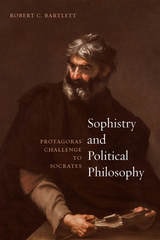
cover of Sophistry and Political Philosophy: Protagoras' Challenge to Socrates

Sophistry and Political Philosophy

Protagoras' Challenge to Socrates

Robert C. Bartlett

University of Chicago Press, 2016

One of the central challenges to contemporary political philosophy is the apparent impossibility of arriving at any commonly agreed upon “truths.” As Nietzsche observed in his Will to Power, the currents of relativism that have come to characterize modern thought can be said to have been born with ancient sophistry. If we seek to understand the strengths and weaknesses of contemporary radical relativism, we must therefore look first to the sophists of antiquity—the most famous and challenging of whom is Protagoras.

With Sophistry and Political Philosophy, Robert C. Bartlett provides the first close reading of Plato’s two-part presentation of Protagoras. In the “Protagoras,” Plato sets out the sophist’s moral and political teachings, while the “Theaetetus,” offers a distillation of his theoretical and epistemological arguments. Taken together, the two dialogues demonstrate that Protagoras is attracted to one aspect of conventional morality—the nobility of courage, which in turn is connected to piety. This insight leads Bartlett to a consideration of the similarities and differences in the relationship of political philosophy and sophistry to pious faith. Bartlett’s superb exegesis offers a significant tool for understanding the history of philosophy, but, in tracing Socrates’s response to Protagoras’ teachings, Bartlett also builds toward a richer understanding of both ancient sophistry and what Socrates meant by “political philosophy.”
 
[more]
cover of Terrorism for Humanity: Inquiries in Political Philosophy

Terrorism for Humanity

Inquiries in Political Philosophy

Ted Honderich

Pluto Press, 2003

Ted Honderich is one of the world's foremost philosophers of the Left. This is a revised edition of his classic text, Violence for Equality, which became a benchmark in political philosophy when it was first published over twenty years ago. Now extensively revised and updated by Honderich, Terrorism for Humanity raises important questions about the uses and ethics of political violence -- questions that are all the more pertinent in the light of recent events & the 'war on terror'. What can be said for & against terrorism and political violence? When is such terrorism right, if it ever is, & when is it wrong? In six lucid essays, Honderich challenges the presuppositions, inconsistencies and prejudices of liberal-democratic thinking. He tackles such emotive subjects as the IRA, the PLO and the ANC, arguing the importance of understanding the justification for political violence in all manifestations. Exploring the moral issues that lie at the heart of these difficult questions, Honderich reminds us that political philosophy should be an attempt to inquire with an open mind -- & that to open one's mind is not necessarily to lose one's convictions. This remarkable book should be of interest to all teachers & students of philosophy & politics, & anyone who is curious to explore the theoretical framework of the morality of 'terrorism'.
[more]
cover of The Common Good of Constitutional Democracy: Essays in Political Philosophy and on Catholic Social Teaching

The Common Good of Constitutional Democracy

Essays in Political Philosophy and on Catholic Social Teaching

Martin Rhonheimer

Catholic University of America Press, 2013
The Common Good of Constitutional Democracy offers a rich collection of essays in political philosophy by Swiss philosopher Martin Rhonheimer. Like his other books in both ethical theory and applied ethics, which have recently been published in English, the essays included are distinguished by the philosophical rigor and meticulous attention to the primary and secondary literature of the various topics discussed
[more]
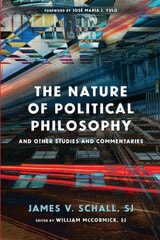
cover of The Nature of Political Philosophy: And Other Studies and Commentaries

The Nature of Political Philosophy

And Other Studies and Commentaries

James V. Schall

Catholic University of America Press, 2022
In his final collection of essays, Father Schall explores the life of faith across a dazzling array of subjects, from Martin Luther to bioethics. With his characteristic patience, brilliance, and careful tenacity, Father Schall interrogates profoundly what it means to try to be a citizen of the Kingdom of God in the city of Man. Never shying away from controversy, across 14 articles and 4 book reviews Father Schall investigates the critical themes of his life and scholarship: reason and revelation; the nature of modernity; literature and salvation; metaphysics and politics; and much more. Whether the reader is new to Father Schall or a longtime student, this posthumously-published collection of essays offers a profound meditation on the nature of political philosophy, and particularly what it would mean for Catholicism to offer a political philosophy. From such fundamental considerations, Schall explores ethical, literary and legal themes, displaying his typical breadth and depth of engagement with all that is real. Ultimately, Father Schall leads one on a Socratic enterprise, an education whereby one comes to question for oneself basic assumptions, and to dig deeper into the first principles as they are recalled in the orders of knowledge and being. While Father Schall has passed on to his reward, this collection of essays helps ensure that his lessons continue to guide, challenge and enrich students for generations to come.
[more]
cover of The Political Philosophy of Hobbes: Its Basis and Its Genesis

The Political Philosophy of Hobbes

Its Basis and Its Genesis

Leo Strauss

University of Chicago Press, 1996
In this classic analysis, Leo Strauss pinpoints what is original and innovative in the political philosophy of Thomas Hobbes. He argues that Hobbes's ideas arose not from tradition or science but from his own deep knowledge and experience of human nature. Tracing the development of Hobbes's moral doctrine from his early writings to his major work The Leviathan, Strauss explains contradictions in the body of Hobbes's work and discovers startling connections between Hobbes and the thought of Plato, Thucydides, Aristotle, Descartes, Spinoza, and Hegel.
[more]
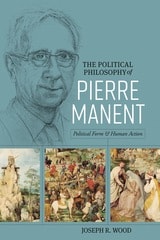
cover of The Political Philosophy of Pierre Manent: Political Form and Human Action

The Political Philosophy of Pierre Manent

Political Form and Human Action

Joseph Wood

Catholic University of America Press, 2024
This book presents and evaluates the understanding of political form in the work of Pierre Manent. The study of political form is Manent’s central philosophical task. He is interested in the nature of man, in the action that makes us human, and thus in politics and political action as privileged windows into human nature and what it is to be human. Manent places himself in the classical political tradition, with its foundations in human nature and in a politics that accords with nature. He also situates himself within a triangle of faith, philosophy, and politics, all of which interest him as part of the reality of things even as he avoids an exclusive commitment to any one vertex in his investigation. The book first examines the major influences on Manent; the overarching questions that guide his work on political form, the “theologico-political question” and the question of the “modern difference” with the ancient view of man and politics; and his two intertwined paths of inquiry into political events and political thought. Manent describes political forms as “the modes of human association that no science has taken as its specific object.” City, empire, Church, national monarchy or nation-state, and modern state are the principal forms that he examines. The book discusses Manent’s thinking on each form in turn together with the tensions that propel the changes or motion in political form that Manent sees as driving and revealing the course of European political development. Using the work of Alasdair MacIntyre, Russell Hittinger, Étienne Gilson, Robert Sokolowski, and Francis Slade, the book evaluates Manent’s insights into the modern state and political condition, which he judges to be exhausted, as well as his call for the preservation of the form of the “nation marked by Christianity.”
[more]
cover of The Truth about Leo Strauss: Political Philosophy and American Democracy

The Truth about Leo Strauss

Political Philosophy and American Democracy

Catherine H. Zuckert and Michael P. Zuckert

University of Chicago Press, 2006

Is  Leo Strauss truly an intellectual forebear of neoconservatism and a powerful force in shaping Bush administration foreign policy? The Truth about Leo Strauss puts this question to rest, revealing for the first time how the popular media came to perpetuate such an oversimplified view of such a complex and wide-ranging philosopher. More important, it corrects our perception of Strauss, providing the best general introduction available to the political thought of this misunderstood figure. 

Catherine and Michael Zuckert—both former students of Strauss—guide readers here to a nuanced understanding of how Strauss’s political thought fits into his broader philosophy. Challenging the ideas that Strauss was an inflexible conservative who followed in the footsteps of Nietzsche, Heidegger, and Carl Schmitt, the Zuckerts contend that Strauss’s signature idea was the need for a return to the ancients. This idea, they show, stemmed from Strauss’s belief that modern thought, with its relativism and nihilism, undermines healthy politics and even the possibility of real philosophy. Identifying this view as one of Strauss’s three core propositions—America is modern, modernity is bad, and America is good—they conclude that Strauss was a sober defender of liberal democracy, aware of both its strengths and its weaknesses. 

The Zuckerts finish, appropriately, by examining the varied work of Strauss’s numerous students and followers, revealing the origins—rooted in the tensions within his own thought—oftheir split into opposing camps. Balanced and accessible, The Truth about Leo Strauss is a must-read for anyone who wants to more fully comprehend this enigmatic philosopher and his much-disputed legacy.
[more]
cover of Varro the Agronomist: Political Philosophy, Satire, and Agriculture in the Late Republic

Varro the Agronomist

Political Philosophy, Satire, and Agriculture in the Late Republic

Grant A. Nelsestuen

The Ohio State University Press, 2015

Some six years after his narrow escape from proscription in 43 bce, Marcus Terentius Varro, the “most learned” of the Romans, wrote a technical treatise on farming in the form of a satirico-philosophical dialogue. Grant A. Nelsestuen argues that far from simply being just another encyclopedic entry of a seemingly aloof antiquarian or offering an escapist’s retreat into rustication, Varro’s De Re Rustica uses the model of the farm to craft an implicitly political treatise that grapples with multifarious challenges facing the contemporary Roman world.
 
On one level, Varro’s treatise presents an innovative account of the Roman farm, which rationalizes new agricultural and pastoral opportunities for contemporary elite owners of large-scale estates. But on another level, this bold agronomical vision associates the farm’s different spheres with distinct areas under Roman control, thereby allegorizing Rome’s empire on the model of a farm. Nelsestuen argues that Varro’s treatise thus provides his contemporaries with a model for governing the Roman state, anticipates Augustus’ subsequent transformation of Roman dominion into a coherent territorial state, and offers an ancient theory of imperialism.
 
Shedding new light on the only completely extant work of a much-celebrated but ill-understood figure, Varro the Agronomist has much to offer to those interested in Latin literature—especially, Cicero and Vergil—as well as on the political dimensions of intellectual life in first-century bce Rome, ancient imperialism, and Roman political philosophy.
[more]