Results by title

7 books match the query 'Political Power'
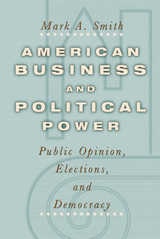
cover of American Business and Political Power: Public Opinion, Elections, and Democracy

American Business and Political Power

Public Opinion, Elections, and Democracy

Mark A. Smith

University of Chicago Press, 2000

Most people believe that large corporations wield enormous political power when they lobby for policies as a cohesive bloc. With this controversial book, Mark A. Smith sets conventional wisdom on its head. In a systematic analysis of postwar lawmaking, Smith reveals that business loses in legislative battles unless it has public backing. This surprising conclusion holds because the types of issues that lead businesses to band together—such as tax rates, air pollution, and product liability—also receive the most media attention. The ensuing debates give citizens the information they need to hold their representatives accountable and make elections a choice between contrasting policy programs.

Rather than succumbing to corporate America, Smith argues, representatives paradoxically become more responsive to their constituents when facing a united corporate front. Corporations gain the most influence over legislation when they work with organizations such as think tanks to shape Americans' beliefs about what government should and should not do.
[more]
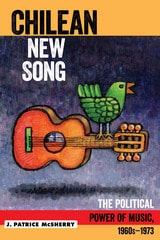
cover of Chilean New Song: The Political Power of Music, 1960s - 1973

Chilean New Song

The Political Power of Music, 1960s - 1973

J Patrice McSherry

Temple University Press, 2015

Chilean New Song (la Nueva Canción chilena) entranced and uplifted a country that struggled for social change during the turbulent 1960s and early 1970s, until the 1973 coup that overthrew democratic socialist president Salvador Allende. This powerful musical style—with its poetic lyrics and haunting blend of traditional indigenous wind and stringed instruments—was born of and expressed the aspirations of rising classes. It promised a socially just future as it forged social bonding.  
 
In Chilean New Song, J. Patrice McSherry deftly combines a political-historical view of Chile with a narrative of its cultural development. She examines the democratizing power of this music and, through interviews with key protagonists, the social roles of politically committed artists who participated in a movement for change. McSherry explores the impact of Chilean New Song and the way this artistic/cultural phenomenon related to contemporary politics to capture the passion, pain, and hope of millions of Chileans. 
[more]
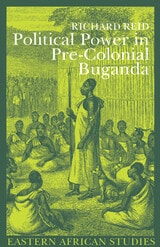
cover of Political Power in Pre-Colonial Buganda: Economy, Society, and Warfare in the Nineteenth Century

Political Power in Pre-Colonial Buganda

Economy, Society, and Warfare in the Nineteenth Century

Richard Reid

Ohio University Press, 2002

Blessed with fertile and well-watered soil, East Africa’s kingdom of Buganda supported a relatively dense population and became a major regional power by the mid-nineteenth century. This complex and fascinating state has also long been in need of a thorough study that cuts through the image of autocracy and military might.

Political Power in Pre-Colonial Buganda explores the material basis of Ganda political power, gives us a new understanding of what Ganda power meant in real terms, and relates the story of how the kingdom used the resources at its disposal to meet the challenges that confronted it. Reid further explains how these same challenges ultimately limited Buganda’s dominance of the East African great lakes region.
[more]
cover of Social Movements and Political Power: Emerging Forms of Radicalism in the West

Social Movements and Political Power

Emerging Forms of Radicalism in the West

Carl Boggs

Temple University Press, 1989

[more]
cover of Sound System: The Political Power of Music

Sound System

The Political Power of Music

Dave Randall

Pluto Press, 2017

Musicians have often wanted to change the world. From underground innovators to pop icons many have believed in the political power of music. Rulers recognise it too. Music has been used to challenge the political and social order - and to prop up the status quo.

Sound System is the story of one musician's journey to discover what makes music so powerful. Dave Randall uses his insider's knowledge of the industry to shed light on the secrets of celebrity, commodification and culture.

This is a book of raves, riots and revolution. From the Glastonbury Festival to the Arab Spring, Pop Idol to Trinidadian Carnival, Randall finds political inspiration across the musical spectrum and poses the question: how can we make music serve the interests of the many, rather than the few?

Published in partnership with the Left Book Club.

[more]
cover of The Political Power of the Word: Press and Oratory in Nineteenth-century Latin America

The Political Power of the Word

Press and Oratory in Nineteenth-century Latin America

Edited by Ivan Jaksic

University of London Press, 2002
This volume includes seven essays on the development of the press and the significance of political oratory in nineteenth-century Latin America. The authors discuss developments in Mexico, Guatemala, Colombia, Venezuela, Peru, Chile and Agentina, while paying attention to influences and comparisons with the United States and Europe. Four essays concentrate on the periodical press and the wider spectrum of print, and three others on oratory, but all posit and explore a significant overlap between written and oral cultures. The findings and theoretical issues discussed in this volume provide fresh evidence on largely unknown areas of nineteenth-century history and invite further research on a rich new topic of study. Contributors include: Charles A. Hale, University of Iowa; Rebecca Earle, University of Warwick; Carmen McEvoy, University of the South, Sewanee; Carlos Malamud, Universidad Nacional de Educacion a Distancia, Spain; Eduardo Posada-Carbo, University of Warwick; Sol Serrano, Pontifica Universidad Catolica de Chile; Douglass Sullivan Gonzalez, University of Mississippi.
[more]
cover of When the Press Fails: Political Power and the News Media from Iraq to Katrina

When the Press Fails

Political Power and the News Media from Iraq to Katrina

W. Lance Bennett, Regina G. Lawrence, and Steven Livingston

University of Chicago Press, 2007

A sobering look at the intimate relationship between political power and the news media, When the Press Fails argues the dependence of reporters on official sources disastrously thwarts coverage of dissenting voices from outside the Beltway.
 
The result is both an indictment of official spin and an urgent call to action that questions why the mainstream press failed to challenge the Bush administration’s arguments for an invasion of Iraq or to illuminate administration policies underlying the Abu Ghraib controversy. Drawing on revealing interviews with Washington insiders and analysis of content from major news outlets, the authors illustrate the media’s unilateral surrender to White House spin whenever oppositional voices elsewhere in government fall silent.  Contrasting these grave failures with the refreshingly critical reporting on Hurricane Katrina—a rare event that caught officials off guard, enabling journalists to enter a no-spin zone—When the Press Fails concludes by proposing new practices to reduce reporters’ dependence on power.
 
“The hand-in-glove relationship of the U.S. media with the White House is mercilessly exposed in this determined and disheartening study that repeatedly reveals how the press has toed the official line at those moments when its independence was most needed.”—George Pendle, Financial Times
 
“Bennett, Lawrence, and Livingston are indisputably right about the news media’s dereliction in covering the administration’s campaign to take the nation to war against Iraq.”—Don Wycliff, Chicago Tribune
 
“[This] analysis of the weaknesses of Washington journalism deserves close attention.”—Russell Baker, New York Review of Books
[more]