Results by title

8 books match the query 'Political Thought'
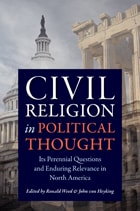
cover of Civil Religion in Political Thought

Civil Religion in Political Thought

Ronald Weed

Catholic University of America Press, 2010
The essays in this volume blend historical and philosophical reflection with concern for contemporary political problems. They show that the causes and motivations of civil religion are a permanent fixture of the human condition, though some of its manifestations and proximate causes have shifted in an age of multiculturalism, religious toleration, and secularization
[more]
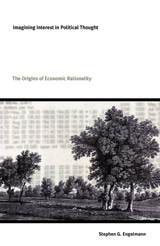
cover of Imagining Interest in Political Thought: Origins of Economic Rationality

Imagining Interest in Political Thought

Origins of Economic Rationality

Stephen G. Engelmann

Duke University Press, 2003

Imagining Interest in Political Thought argues that monistic interest—or the shaping and coordination of different pursuits through imagined economies of self and public interest—constitutes the end and means of contemporary liberal government. The paradigmatic theorist of monistic interest is the English political philosopher Jeremy Bentham (1748–1832), whose concept of utilitarianism calls for maximization of pleasure by both individuals and the state. Stephen G. Engelmann contends that commentators have too quickly dismissed Bentham’s philosophy as a crude materialism with antiliberal tendencies. He places Benthamite utilitarianism at the center of his account and, in so doing, reclaims Bentham for liberal political theory.

Tracing the development of monistic interest from its origins in Reformation political theory and theology through late-twentieth-century neoliberalism, Engelmann reconceptualizes the history of liberalism as consisting of phases in the history of monistic interest or economic government. He describes how monistic interest, as formulated by Bentham, is made up of the individual’s imagined expectations, which are constructed by the very regime that maximizes them. He asserts that this construction of interests is not the work of a self-serving manipulative state. Rather, the state, which is itself subject to strict economic regulation, is only one cluster of myriad "public" and "private" agencies that produce and coordinate expectations. In place of a liberal vision in which government appears only as a protector of the free pursuit of interest, Engelmann posits that the free pursuit of interest is itself a mode of government, one that deploys individual imagination and choice as its agents.
[more]
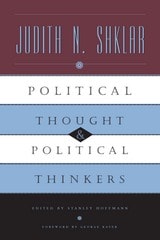
cover of Political Thought and Political Thinkers

Political Thought and Political Thinkers

Judith N. Shklar

University of Chicago Press, 1998

Ethics described Judith Shklar as "a towering presence" at Harvard for decades, an "influential teacher and mentor to many of the best known political theorists working today in the United States." One of this century's most important liberal scholars, she is remembered for her "sharp intellect, forceful personality, and passionate intellectual honesty and curiosity." Political Thought and Political Thinkers makes startlingly clear her role in the reinvigoration of liberal theory that has been taking place over the last two decades.

This second volume of Shklar's work—which follows the 1997 publication of Redeeming American Political Thought—brings together heretofore uncollected (and several unpublished) essays on a number of themes, including the place of the intellect in the modern political world and the dangers of identity politics. While many of these essays have been previously published, they remain far from accessible. In collecting the work scattered over the past forty years in journals and other publications, noted political theorist Stanley Hoffmann provides an essential guide to Shklar's thought, complemented by George Kateb's comprehensive introduction to her work. Hoffmann's selection, which includes Shklar's classic essay "The Liberalism of Fear," showcases her distinctive defense of liberalism and follows her explorations in this history of moral and political thought as she engages with Bergson, Arendt, and Rousseau.

Political Thought and Political Thinkers displays one of the century's most compelling and flexible intellects in action and is the definitive collection of her work on European history and thinkers.

"Shklar's legacy is an inspiring example of liberal thought at its arresting best, unflinchingly courageous and unmoved by the dreary and unmeaning harmonies conjured up by theories of justice and rights."—John Gray, Times Literary Supplement

Judith N. Shklar (1928-1992) was Cowles Professor of Government at Harvard University and the author of nine books in political theory.
[more]
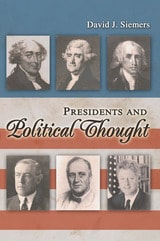
cover of Presidents and Political Thought

Presidents and Political Thought

David J. Siemers

University of Missouri Press, 2009
“What did the president know and when did he know it?” takes on a whole new meaning in Presidents and Political Thought. Though political philosophy is sometimes considered to be dry and abstract, many of our presidents have found usable ideas embedded within it. In this first comparative study of presidents and political theory, David Siemers examines how some of them have applied this specialized knowledge to their job.
 
Presidents and Political Thought explores the connection between philosophy and practical politics through a study of six American chief executives: John Adams, Thomas Jefferson, James Madison, Woodrow Wilson, Franklin D. Roosevelt, and Bill Clinton. Writing at the intersection of politics, history, and philosophy, Siemers combines his extensive understanding of political philosophy with careful research and analysis of individual presidents to produce provocative and astute judgments about how their understanding of political theory affected their performance.
 
Each chapter examines a particular president’s attitude about political theory, the political theorists he read and admired, and the ways in which he applied theory in his activities as president. Viewing presidents through the lens of political theory enables Siemers to conclude that Madison and Adams have been significantly underrated. Wilson is thought to have abandoned his theoretical viewpoint as president, but actually, he just possessed an unorthodox interpretation of his favorite thinker, Edmund Burke. Often thought to be so pragmatic or opportunistic that they lacked any convictions, FDR and Clinton gained their orientations to politics from political theory. These and other insights suggest that we cannot understand these presidencies without being more aware of the ideas the presidents brought to the office.
 
Siemers’s study takes on special relevance as the United States experiences regime change and a possible party realignment because, as he notes, Barack Obama has read and learned from political theory, too.
 
Avoiding much of the jargon that often accompanies political theory, this book demonstrates the relevance of political theory in the real world, chronicling both the challenges and potentially rich payoffs when presidents conceive of politics not just as a way to reward friends and punish enemies, but as a means to realize principles.
[more]
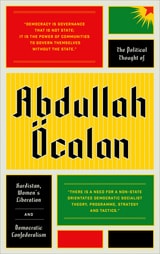
cover of The Political Thought of Abdullah Öcalan: Kurdistan, Women's Revolution and Democratic Confederalism

The Political Thought of Abdullah Öcalan

Kurdistan, Women's Revolution and Democratic Confederalism

Abdullah Öcalan

Pluto Press, 2017

Abdullah Öcalan actively led the Kurdish liberation struggle as the head of the PKK from its foundation in 1978 until his abduction on February 15, 1999. Now, writing from isolation in Turkey’s Imrali Island Prison, he has shaped a new political movement in the Middle East called Democratic Confederalism, which is rapidly developing and spreading across the Middle East because it combats powerful religious sectarianism while also providing the blueprints for a burgeoning democratic society.
 
Bringing together Öcalan’s ideas in one slim volume for the first time, The Political Thought of Abdullah Öcalan contains a selection of his most influential writings over his lifetime. These ideas can be read in light of Öcalan’s continuing legacy during the ongoing revolution and the battle against conservatism and religious extremism. As the political situation in Syria intensifies, this book offers a timely and essential introduction for anyone wanting to come to grips with his political ideas on the Kurdish question, gender, Democratic Confederalism, and nationalism.
 
[more]
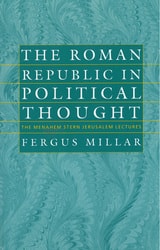
cover of The Roman Republic in Political Thought

The Roman Republic in Political Thought

Fergus Millar

Brandeis University Press, 2002
It is a fact that the very long-lived Roman Republic has consistently played a surprisingly slight role in political theory and discussions about the nature of democracy, forms of government, and other matters, particularly when compared to the enormous attention paid to fifth-century BCE Athenian democracy. Fergus Millar re-opens the issue of how the Roman Republic was understood and used by political thinkers from the Ancient World to the present. Describing both the reality of the late Roman Republic and showing how its nature was distorted even by contemporary sources, he tracks its treatment (or absence) in political discourse from Thomas Aquinas, Machiavelli, Montesquieu, and Rousseau, and in debates surrounding the creation of the American constitution, particularly in the Federalist papers. In brief, clear prose, with quotations in English from important works, and economical use of endnotes, he reinforces his unconventional thesis about the significance of direct democracy in the late Roman Republic. In the process, he also provides an unprecedented tour through 2000 years of Western political theory from the point of view of the Roman Republic, in general, and theories of direct democracy and the balance of power, in particular.
[more]
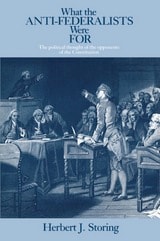
cover of What the Anti-Federalists Were For: The Political Thought of the Opponents of the Constitution

What the Anti-Federalists Were For

The Political Thought of the Opponents of the Constitution

Herbert J. Storing

University of Chicago Press, 1981

The Anti-Federalists, in Herbert J. Storing's view, are somewhat paradoxically entitled to be counted among the Founding Fathers and to share in the honor and study devoted to the founding. "If the foundations of the American polity was laid by the Federalists," he writes, "the Anti-Federalist reservations echo through American history; and it is in the dialogue, not merely in the Federalist victory, that the country's principles are to be discovered." It was largely through their efforts, he reminds us, that the Constitution was so quickly amended to include a bill of rights.

Storing here offers a brilliant introduction to the thought and principles of the Anti-Federalists as they were understood by themselves and by other men and women of their time. His comprehensive exposition restores to our understanding the Anti-Federalist share in the founding its effect on some of the enduring themes and tensions of American political life. The concern with big government and infringement of personal liberty one finds in the writings of these neglected Founders strikes a remarkably timely note.

[more]
cover of What the Anti-Federalists Were For: The Political Thought of the Opponents of the Constitution

What the Anti-Federalists Were For

The Political Thought of the Opponents of the Constitution

Herbert J. Storing

University of Chicago Press, 1981

This is an auto-narrated audiobook version of this book. 

The Anti-Federalists, in Herbert J. Storing's view, are somewhat paradoxically entitled to be counted among the Founding Fathers and to share in the honor and study devoted to the founding. "If the foundations of the American polity was laid by the Federalists," he writes, "the Anti-Federalist reservations echo through American history; and it is in the dialogue, not merely in the Federalist victory, that the country's principles are to be discovered." It was largely through their efforts, he reminds us, that the Constitution was so quickly amended to include a bill of rights.

Storing here offers a brilliant introduction to the thought and principles of the Anti-Federalists as they were understood by themselves and by other men and women of their time. His comprehensive exposition restores to our understanding the Anti-Federalist share in the founding its effect on some of the enduring themes and tensions of American political life. The concern with big government and infringement of personal liberty one finds in the writings of these neglected Founders strikes a remarkably timely note.
[more]