Results by title
24 books match the query 'Political refugees'
African Asylum at a Crossroads
Activism, Expert Testimony, and Refugee RightsIris Berger
Ohio University Press, 2015
African Asylum at a Crossroads: Activism, Expert Testimony, and Refugee Rights examines the emerging trend of requests for expert opinions in asylum hearings or refugee status determinations. This is the first book to explore the role of court-based expertise in relation to African asylum cases and the first to establish a rigorous analytical framework for interpreting the effects of this new reliance on expert testimony.
Over the past two decades, courts in Western countries and beyond have begun demanding expert reports tailored to the experience of the individual claimant. As courts increasingly draw upon such testimony in their deliberations, expertise in matters of asylum and refugee status is emerging as an academic area with its own standards, protocols, and guidelines. This deeply thoughtful book explores these developments and their effects on both asylum seekers and the experts whose influence may determine their fate.
Contributors: Iris Berger, Carol Bohmer, John Campbell, Katherine Luongo, E. Ann McDougall, Karen Musalo, Tricia Redeker Hepner, Amy Shuman, Joanna T. Tague, Meredith Terretta, and Charlotte Walker-Said.

Bad News for Refugees
Greg Philo, Emma Briant, and Pauline Donald
Pluto Press, 2013
Bad News for Refugees analyses the political, economic and environmental contexts of migration and looks specifically at how refugees and asylum seekers have been stigmatised in political rhetoric and in media coverage.
Through forensic research it shows how hysterical and inaccurate media accounts act to legitimise political action which can have terrible consequences both on the lives of refugees and also on established migrant communities.
Based on new research by the renowned Glasgow Media Group, Bad News for Refugees is essential reading for those concerned with the negative effects of media on public understanding and for the safety of vulnerable groups and communities in our society.

Behind the Bamboo Hedge
The Impact of the Homeland Politics in the Parisian Vietnamese CommunityGisele L. Bousquet
University of Michigan Press, 1991
Cold War Exiles in Mexico
U.S. Dissidents and the Culture of Critical ResistanceRebecca M. Schreiber
University of Minnesota Press, 2008
As Schreiber recounts, the first exiles to arrive in Mexico after World War II were visual artists, many of them African-American, including Elizabeth Catlett, Charles White, and John Wilson. Individuals who were blacklisted from the Hollywood film industry, such as Dalton Trumbo and Hugo Butler, followed these artists, as did writers, including Willard Motley. Schreiber examines the artists’ work with the printmaking collective Taller de Gráfica Popular and the screenwriters’ collaborations with filmmakers such as Luis Buñuel, as well as the influence of the U.S. exiles on artistic and political movements.
The Cold War culture of political exile challenged American exceptionalist ideology and, as Schreiber reveals, demonstrated the resilience of oppositional art, literature, and film in response to state repression.
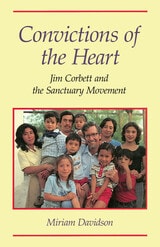
Convictions of the Heart
Jim Corbett and the Sanctuary MovementMiriam Davidson
University of Arizona Press, 1988
Corbett first worked within the law to help refugees process applications for asylum, but the U.S. Immigration and Naturalization Service soon began a program of arrests; then he began to smuggle refugees from the Mexican border to the homes of citizens willing to provide shelter, making hundreds of trips over the next two years; finally he enlisted the support of the Tucson Ecumenical Council and persuaded John Fife, pastor of the Southside Presbyterian Church, to open that building as a refuge. When legal action against Corbett and the others seemed imminent, Southside became, on March 24, 1982, the first of two hundred churches in the country to declare itself a sanctuary.
Convictions of the Heart takes readers inside the santuary movement to reveal its founders' motives and underlying beliefs, and inside the courtroom to describe the government's efforts to stop it. Although the book addresses many points of view, its primary focus is on the philosophy of Jim Corbett. Rooted in the nonviolence of Gandhi, the Society of Friends, and Martin Luther King, Corbett's beliefs challenged individuals and communities of faith across the country to examine the strength of their commitment to the needs and rights of others.

Cuban Miami
Robert M Levine
Rutgers University Press, 2000
For two centuries, Cuban exiles have found their way to the United States, especially to Florida. But since Castro's victory in 1959, Miami has seen almost one million Cubans arrive by sea and air. The impact on this area has been enormous. Miami---known as the "Exile Capital"---has a greater cultural affinity to Havana and the rest of Latin America than to Tallahassee, Florida's capital.
Cuban Miami is the first analytical, photographic record of Cuban migration to south Florida. Robert M. Levine and Moises Asis have interviewed members of every sector of the Cuban exile community, from the first pioneers to the mass waves in the early 1960s to those who arrived by raft during the late 1990s. In their wide-ranging investigation of Cuban-U.S. history, they touch upon all aspects of Cuban influence: politics, cuisine, music, assimilation, discrimination, and institution buildings. Miami has more Cuban food establishments than the nearby island does. The city has been fertile ground for germinating a unique synthesis of Cuban and Americans are the most prosperous immigrant group in the United States today, this success has come at a price---living in exile can exact a personal toll.
Cuban Miami is a feast for the eyes, including 180 photographs and original cartoons drawn for the book by Jose M. Varela, a well-known member of the Cuban-American community.
Destination Detroit
Discourses on the Refugee in a Post-Industrial CityRashmi Luthra
University of Michigan Press, 2024
Few U.S. locations provide a more vivid case study of this fight than Metro Detroit, where competing interest groups are waging war over the meaning of the figure of the refugee. This book dives deeply into the discourse on refugees occurring among various institutions in Metro Detroit. The way in which local institutions talk about refugees gives us vital clues as to how they are negotiating competing pressures and how the city overall is negotiating competing imperatives. Indeed, this local discourse gives us a crucial glimpse into how U.S. cities are defining and redefining themselves today. The figure of the refugee becomes a slate on which groups with varied interests write their stories, aspirations, and fears. Consequently, we can figure out from local refugee discourses the ongoing question of what it means to be a Metro Detroiter—and by extension, what it means to be a revitalizing U.S. city in this age.

Escape Via Berlin
Eluding Franco In Hitler's EuropeJose Antonio Aguirre
University of Nevada Press, 1991
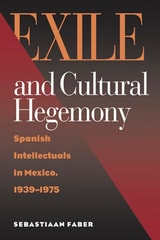
Exile and Cultural Hegemony
Spanish Intellectuals in Mexico, 1939-1975Sebastiaan Faber
Vanderbilt University Press, 2002
The first study of its kind to place the exiles' ideological evolution in a broad historical context, Exile and Cultural Hegemony takes into account developments in both Spanish and Mexican politics from the early 1930s through the 1970s. Faber pays particular attention to the intellectuals' persistent nationalism and misplaced illusions of pan-Hispanist grandeur, which included awkward and ironic overlaps with the rhetoric employed by their enemies on the Francoist right. This embrace of nationalism, together with the intellectuals' dependence on the increasingly authoritarian Mexican regime and the international climate of the Cold War, eventually caused them to abandon the Gramscian ideal of the intellectual as political activist in favor of a more liberal, apolitical stance preferred by, among others, the Spanish philosopher Jose Ortega y Gasset.
With its comprehensive approach to topics integral to Spanish culture, both students of and those with a general interest in twentieth-century Spanish literature, history, or culture will find Exile and Cultural Hegemony a fascinating and groundbreaking work.
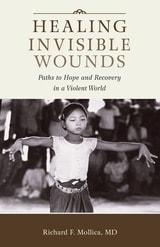
Healing Invisible Wounds
Paths to Hope and Recovery in a Violent WorldRichard F. Mollica
Vanderbilt University Press, 2006
Here is how Neil Boothby, Director of the Program on Forced Migration and Health at the Mailman School of Public Health, Columbia University, describes the book:
"Mollica provides a wealth of ethnographic and clinical evidence that suggests the human capacity to heal is innate--that the 'survival instinct' extends beyond the physical to include the psychological as well. He enables us to see how recovery from 'traumatic life events' needs to be viewed primarily as a 'mystery' to be listened to and explored, rather than solely as a 'problem' to be identified and solved. Healing involves a quest for meaning--with all of its emotional, cultural, religious, spiritual and existential attendants--even when bio-chemical reactions are also operative."
Healing Invisible Wounds reveals how trauma survivors, through the telling of their stories, teach all of us how to deal with the tragic events of everyday life. Mollica's important discovery that humiliation--an instrument of violence that also leads to anger and despair--can be transformed through his therapeutic project into solace and redemption is a remarkable new contribution to survivors and clinicians.
This book reveals how in every society we have to move away from viewing trauma survivors as "broken people" and "outcasts" to seeing them as courageous people actively contributing to larger social goals. When violence occurs, there is damage not only to individuals but to entire societies, and to the world. Through the journey of self-healing that survivors make, they enable the rest of us not only as individuals but as entire communities to recover from injury in a violent world.
Iranians in Texas
Migration, Politics, and Ethnic IdentityBy Mohsen M. Mobasher
University of Texas Press, 2012
Thousands of Iranians fled their homeland when the 1978–1979 revolution ended the fifty-year reign of the Pahlavi Dynasty. Some fled to Europe and Canada, while others settled in the United States, where anti-Iranian sentiment flared as the hostage crisis unfolded. For those who chose America, Texas became the fourth-largest settlement area, ultimately proving to be a place of paradox for any Middle Easterner in exile. Iranians in Texas culls data, interviews, and participant observations in Iranian communities in Houston, Dallas, and Austin to reveal the difficult, private world of cultural pride, religious experience, marginality, culture clashes, and other aspects of the lives of these immigrants.
Examining the political nature of immigration and how the originating and receiving countries shape the prospects of integration, Mohsen Mobasher incorporates his own experience as a Texas scholar born in Iran. Tracing current anti-Muslim sentiment to the Iranian hostage crisis, two decades before 9/11, he observes a radically negative shift in American public opinion that forced thousands of Iranians in the United States to suddenly be subjected to stigmatization and viewed as enemies. The book also sheds light on the transformation of the Iranian family in exile and some of the major challenges that second-generation Iranians face in their interactions with their parents.
Bringing to life a unique population in the context of global politics, Iranians in Texas overturns stereotypes while echoing diverse voices.
Love In A Time Of Hate
Hollander, Nancy Caro
Rutgers University Press, 1997
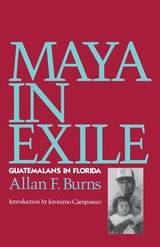
Maya In Exile
Guatemalans in FloridaAllan F. Burns, introduction by Jerónimo Camposeco
Temple University Press, 1993
The Maya are the single largest group of indigenous people living in North and Central America. Beginning in the early 1980s, hundreds of thousands of Maya fled the terror of Guatemalan civil strife to safety in Mexico and the U.S. This ethnography of Mayan immigrants who settled in Indiatown, a small agricultural community in south central Florida, presents the experiences of these traditional people, their adaptations to life in the U.S., and the ways they preserve their ancestral culture. For more than a decade, Allan F. Burns has been researching and doing advocacy work for these immigrant Maya, who speak Kanjobal, Quiche, Mamanâ, and several other of the more than thirty distinct languages in southern Mexico and Guatemala. In this fist book on the Guatemalan Maya in the U.S, he uses their many voices to communicate the experience of the Maya in Florida and describes the advantages and results of applied anthropology in refugee studies and cultural adaptation.
Burns describes the political and social background of the Guatemalan immigrants to the U.S. and includes personal accounts of individual strategies for leaving Guatemala and traveling to Florida. Examining how they interact with the community and recreate a Maya society in the U.S., he considers how low-wage labor influences the social structure of Maya immigrant society and discusses the effects of U.S. immigration policy on these refugees.
Pregnant on Arrival
Making the Illegal ImmigrantEithne Luibhéid
University of Minnesota Press, 2013
“State alert as pregnant asylum seekers aim for Ireland.” “Country Being Held Hostage by Con Men, Spongers, and Those Taking Advantage of the Maternity Residency Policy.” From 1997 to 2004, headlines such as these dominated Ireland’s mainstream media as pregnant immigrants were recast as “illegals” entering the country to gain legal residency through childbirth. As immigration soared, Irish media and politicians began to equate this phenomenon with illegal immigration that threatened to destroy the country’s social, cultural, and economic fabric.
Pregnant on Arrival explores how pregnant immigrants were made into paradigmatic figures of illegal immigration, as well as the measures this characterization set into motion and the consequences for immigrants and citizens. While focusing on Ireland, Eithne Luibhéid’s analysis illuminates global struggles over the citizenship status of children born to immigrant parents in countries as diverse as the United States, Hong Kong, and elsewhere. Scholarship on the social construction of the illegal immigrant calls on histories of colonialism, global capitalism, racism, and exclusionary nation building but has been largely silent on the role of nationalist sexual regimes in determining legal status. Eithne Luibhéid turns to queer theory to understand how pregnancy, sexuality, and immigrants’ relationships to prevailing sexual norms affect their chances of being designated as legal or illegal.
Pregnant on Arrival offers unvarnished insight into how categories of immigrant legal status emerge and change, how sexual regimes figure prominently in these processes, and how efforts to prevent illegal immigration ultimately redefine nationalist sexual norms and associated racial, gender, economic, and geopolitical hierarchies.
Purity and Exile
Violence, Memory, and National Cosmology among Hutu Refugees in TanzaniaLiisa H. Malkki
University of Chicago Press, 1995
Through extensive fieldwork in two refugee communities, Malkki finds that the refugees' current circumstances significantly influence these constructions. Those living in organized camps created an elaborate "mythico-history" of the Hutu people, which gave significance to exile, and envisioned a collective return to the homeland of Burundi. Other refugees, who had assimilated in a more urban setting, crafted identities in response to the practical circumstances of their day to day lives. Malkki reveals how such things as national identity, historical consciousness, and the social imagination of "enemies" get constructed in the process of everyday life. The book closes with an epilogue looking at the recent violence between Hutu and Tutsi in Rwanda and Burundi, and showing how the movement of large refugee populations across national borders has shaped patterns of violence in the region.
Salvadorans in Costa Rica
Displaced LivesBridget Hayden
University of Arizona Press, 2003
Salvadorans in Costa Rica: Displaced Lives introduces readers to people from a wide range of class and educational backgrounds who had come to Costa Rica from all over El Salvador. All shared the experience of having become refugees and having settled in a new country under the same circumstances, and when the war in their own country ended, they shared a concern about the issues involved in deciding whether to return there. Their diversity allows Hayden to examine the ways in which the language of national identity played out in different contexts and sometimes contradictory ways.
Drawing on contemporary theories of migration and space, Hayden identifies the discourses, narratives, and concepts that Salvadorans in Costa Rica had in common and then analyzes the ways in which their experiences and their uses of those discourses varied. She focuses on key spatial concepts that Salvadorans used in talking about displacement and re-emplacement in order to show how they constructed the experience of settlement and how such variables as gender and age influenced their experiences. Because "nationality" was an idiom they used to relate their experiences, she pays particular attention to the role of national belonging and national difference—in terms of both the ways in which the Salvadorans were received by Costa Ricans and their reactions to their new lives in Costa Rica. A concluding chapter compares them with Salvadorans who emigrated to other countries.
The story of these displaced Salvadorans, focusing on the lives of real people, can give us a new understanding of how individuals feel a sense of belonging to a sociocultural space. By exploring many meanings of the nation and national belonging for different people under varying conditions, Hayden's study provides fresh insights into the dynamics of migration, gender, and nationalism.
Songs of the Caged, Songs of the Free
Music and the Vietnamese Refugee ExperienceAdelaida Reyes
Temple University Press, 1999
The Vietnamese refugee experience calls attention to issues commonly raised by migration: the redefinition of group relations, the reformulation of identity, and the reconstruction of social and musical life in resettlement. Fifteen years ago, Adelaida Reyes began doing fieldwork on the musical activities of Vietnamese refugees. She entered the emotion-driven world of forced migrants through expressive culture; learned to see the lives of refugee-resettlers through the music they made and enjoyed; and, in turn, gained a deeper understanding of their music through knowledge of their lives.
In Songs of the Caged, Songs of the Free, Reyes brings history, politics, and decades of research to her study of four resettlement communities, including refugee centers in Palawan and Bataan; the early refugee community in New Jersey; and the largest of all Vietnamese communities -- Little Saigon, in southern California's Orange County.
Looking closely at diasporic Vietnamese in each location, Reyes demonstrates that expressive culture provides a valuable window into the refugee experience. Showing that Vietnamese immigrants deal with more than simply a new country and culture in these communities, Reyes considers such issues as ethnicity, socio-economic class, and differing generations. She considers in her study music of all kinds -- performed and recorded, public and private -- and looks at music as listened to and performed by all age groups, including church music, club music, and music used in cultural festivals. Moving from traditional folk music to elite and modern music and from the recording industry to pirated tapes. Reyes looks at how Vietnamese in exile struggled, in different ways, to hold onto a part of their home culture and to assimilate into their new, most frequently American, culture.
Songs of the Caged, Songs of the Free will attract the attention of readers in Asian American studies, Asian studies, music, and ethnomusicology.
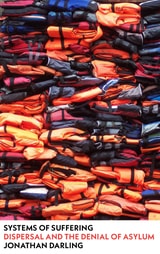
Systems of Suffering
Dispersal and the Denial of AsylumJonathan Darling
Pluto Press, 2021
Of the many state-enacted cruelties to which refugees and asylum seekers are subjected, detention and deportation loom largest in popular consciousness. But there is a third practice, perpetrating a slower violence, that remains hidden: dispersal.
Jonathan Darling provides the first detailed account of how dispersal - the system of accommodation and support for asylum seekers and refugees in Britain - both sustains and produces patterns of violence, suffering and social abjection. He explores the evolution of dispersal as a privatized process, from the first outsourced asylum accommodation contracts in 2012 to the renewed wave of outsourcing pursued by the Home Office today.
Drawing on six years of research into Britain's dispersal system, and foregrounding the voices and experiences of refugees and asylum seekers, Darling argues that dispersal has played a central role in the erasure of asylum from public concern. Systems of Suffering is a vital tool in the arsenal of those fighting to hold the government to account for the violence of its asylum policy and practice.
Technologies of Suspicion and the Ethics of Obligation in Political Asylum
Bridget M. Haas
Ohio University Press, 2019
Across the globe, migration has been met with intensifying modes of criminalization and securitization, and claims for political asylum are increasingly met with suspicion. Asylum seekers have become the focus of global debates surrounding humanitarian obligations, on the one hand, and concerns surrounding national security and border control, on the other. In Technologies of Suspicion and the Ethics of Obligation in Political Asylum, contributors provide fine-tuned analyses of political asylum systems and the adjudication of asylum claims across a range of sociocultural and geopolitical contexts.
The contributors to this timely volume, drawing on a variety of theoretical perspectives, offer critical insights into the processes by which tensions between humanitarianism and security are negotiated at the local level, often with negative consequences for asylum seekers. By investigating how a politics of suspicion within asylum systems is enacted in everyday practices and interactions, the authors illustrate how asylum seekers are often produced as suspicious subjects by the very systems to which they appeal for protection.
Contributors: Ilil Benjamin, Carol Bohmer, Nadia El-Shaarawi, Bridget M. Haas, John Beard Haviland, Marco Jacquemet, Benjamin N. Lawrance, Rachel Lewis, Sara McKinnon, Amy Shuman, Charles Watters
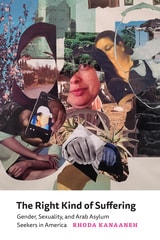
The Right Kind of Suffering
Gender, Sexuality, and Arab Asylum Seekers in AmericaRhoda Kanaaneh
University of Texas Press, 2023
2024 Evelyn Shakir Non-Fiction Academic Award, The Arab American National Museum
An examination of Arab asylum seekers who feel compelled to package their tales of disenfranchisement and suffering to satisfy a deeply reluctant immigration system.
From the overloaded courts with their constantly changing dates and appointments to the need to prove oneself the “right” kind of victim, the asylum system in the United States is an exacting and drawn-out immigration process that itself results in suffering. When anthropologist Rhoda Kanaaneh became a volunteer interpreter for Arab asylum seekers, she learned how applicants were pushed to craft specific narratives to satisfy the system’s requirements.
Kanaaneh tells the stories of four Arab asylum seekers who sought protection in the United States on the basis of their gender or sexuality: Saud, who relived painful memories of her circumcision and police harassment in Sudan and then learned to number and sequence these recollections; Fatima, who visited doctors and therapists in order to document years of spousal abuse without over-emphasizing her resulting mental illness; Fadi, who highlighted the homophobic motivations that provoked his arrest and torture in Jordan, all the while sidelining connected issues of class and racism; and Marwa, who showcased her private hardships as a lesbian in a Shiite family in Lebanon and downplayed her environmental activism. The Right Kind of Suffering is a compelling portrait of Arab asylum seekers whose success stories stand in contrast with those whom the system failed.
The Tempest
William Shakespeare
Arizona Center for Medieval and Renaissance Studies, 2021
Cavander’s translation of The Tempest, which premiered at the Alabama Shakespeare Festival in 2017, was written as part of the Play On! Shakespeare project, an ambitious undertaking from the Oregon Shakespeare Festival that commissioned new translations of 39 Shakespeare plays. These translations present the Bard’s work in language accessible to modern audiences while never losing the beauty of Shakespeare’s verse. Enlisting the talents of a diverse group of contemporary playwrights, screenwriters, and dramaturges from diverse backgrounds, this project reenvisions Shakespeare for the twenty-first century. These volumes make these works available for the first time in print—a new First Folio for a new era.
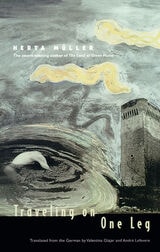
Traveling on One Leg
Herta Muller
Northwestern University Press, 2010
Winner, 2009 Nobel Prize in Literature
Irene is a fragile woman born to a German family in Romania, who has recently emigrated from her native country to West Germany. Politically and socially isolated, Irene moves within the orbit of three troubled men, while simultaneously embarking on an inner exploration of exile, homeland, and identity.

Twelfth Night
William Shakespeare
Arizona Center for Medieval and Renaissance Studies, 2023
Shakespeare’s Twelfth Night centers on power and love. One of the most perennially produced of Shakespeare’s comedies, it talks about shipwrecked twins, gender-bending romance, and a bumper crop of fools, from the wise to the ridiculous. Modernizing the language of the play, Alison Carey’s translation revives the joy of this comedy, taking the archaic humor and renewing it for a contemporary audience.
This translation of Twelfth Night was written as part of the Oregon Shakespeare Festival’s Play On! project, which commissioned new translations of thirty-nine Shakespeare plays. These translations present the work of “The Bard” in language accessible to modern audiences while never losing the beauty of Shakespeare’s verse. Enlisting the talents of a diverse group of contemporary playwrights, screenwriters, and dramaturges from diverse backgrounds, this project reenvisions Shakespeare for the twenty-first century. These volumes make these works available for the first time in print—a new First Folio for a new era.
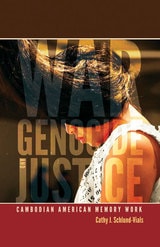
War, Genocide, and Justice
Cambodian American Memory WorkCathy J. Schlund-Vials
University of Minnesota Press, 2012
In the three years, eight months, and twenty days of the Khmer Rouge’s deadly reign over Cambodia, an estimated 1.7 million Cambodians perished as a result of forced labor, execution, starvation, and disease. Despite the passage of more than thirty years, two regime shifts, and a contested U.N. intervention, only one former Khmer Rouge official has been successfully tried and sentenced for crimes against humanity in an international court of law to date. It is against this background of war, genocide, and denied justice that Cathy J. Schlund-Vials explores the work of 1.5-generation Cambodian American artists and writers.
Drawing on what James Young labels “memory work”—the collected articulation of large-scale human loss—War, Genocide, and Justice investigates the remembrance work of Cambodian American cultural producers through film, memoir, and music. Schlund-Vials includes interviews with artists such as Anida Yoeu Ali, praCh Ly, Sambath Hy, and Socheata Poeuv. Alongside the enduring legacy of the Killing Fields and post-9/11 deportations of Cambodian American youth, artists potently reimagine alternative sites for memorialization, reclamation, and justice. Traversing borders, these artists generate forms of genocidal remembrance that combat amnesic politics and revise citizenship practices in the United States and Cambodia.
Engaged in politicized acts of resistance, individually produced and communally consumed, Cambodian American memory work represents a significant and previously unexamined site of Asian American critique.