Results by title

18 books match the query 'Political theology'

cover of A Political Theology of Negative Sovereignty

A Political Theology of Negative Sovereignty

Claudio Lomnitz

Duke University Press, 2027
Claudio Lomnitz excavates the metaphysical foundations of violence in contemporary Mexico by exploring the theological imaginaries that emerge from the decay of state sovereignty and the rise of criminal syndicates. Accelerated economic and political changes have sparked deep changes in public morality, and Lomnitz identifies and defines “negative sovereignty” as the core phenomenon driving a deeply unsettling moral revolt. Negative sovereignty arises where the state has ceded or forfeited its authority to govern to illegal organizations that thrive on violence and extraction. Lomnitz explores the political theology that has emerged alongside this phenomenon, a moral cosmology in which Death, not God, is the metaphysical sovereign of choice. A Political Theology of Negative Sovereignty dissects the relationship between violence and public morality; in the process, Lomnitz challenges the theoretical assumptions underlying dominant views of contemporary governmentality.
[more]
cover of Citizen-Saints: Shakespeare and Political Theology

Citizen-Saints

Shakespeare and Political Theology

Julia Reinhard Lupton

University of Chicago Press, 2005

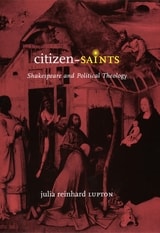
Turning to the potent idea of political theology to recover the strange mix of political and religious thinking during the Renaissance, this bracing study reveals in the works of Shakespeare and his sources the figure of the citizen-saint, who represents at once divine messenger and civil servant, both norm and exception. Embodied by such diverse personages as Antigone, Paul, Barabbas, Shylock, Othello, Caliban, Isabella, and Samson, the citizen-saint is a sacrificial figure: a model of moral and aesthetic extremity who inspires new regimes of citizenship with his or her death and martyrdom.

Among the many questions Julia Reinhard Lupton attempts to answer under the rubric of the citizen-saint are: how did states of emergency, acts of sovereign exception, and Messianic anticipations lead to new forms of religious and political law? What styles of universality were implied by the abject state of the pure creature, at sea in a creation abandoned by its creator? And how did circumcision operate as both a marker of ethnicity and a means of conversion and civic naturalization?

Written with clarity and grace, Citizen-Saints will be of enormous interest to students of English literature, religion, and early modern culture.
[more]
cover of Kant's International Relations: The Political Theology of Perpetual Peace

Kant's International Relations

The Political Theology of Perpetual Peace

Seán Molloy

University of Michigan Press, 2017
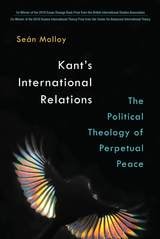
Why does Immanuel Kant (1724–1804) consistently invoke God and Providence in his most prominent texts relating to international politics? In this wide-ranging study, Seán Molloy proposes that texts such as Idea for a Universal History with Cosmopolitan Intent and Toward Perpetual Peace cannot be fully understood without reference to Kant’s wider philosophical projects, and in particular the role that belief in God plays within critical philosophy and Kant’s inquiries into anthropology, politics, and theology. Molloy’s broader view reveals the political-theological dimensions of Kant’s thought as directly related to his attempts to find a new basis for metaphysics in the sacrifice of knowledge to make room for faith.This book is certain to generate controversy. Kant is hailed as “the greatest of all theorists” in the field of International Relations (IR); in particular, he has been acknowledged as the forefather of Cosmopolitanism and Democratic Peace Theory. Yet, Molloy charges that this understanding of Kant is based on misinterpretation, neglect of particular texts, and failure to recognize Kant’s ambivalences and ambiguities. Molloy’s return to Kant’s texts forces devotees of Cosmopolitanism and other ‘Kantian’ schools of thought in IR to critically assess their relationship with their supposed forebear: ultimately, they will be compelled to seek different philosophical origins or to find some way to accommodate the complexity and the decisively nonsecular aspects of Kant’s ideas.
[more]
cover of Political Philosophy and the Challenge of Revealed Religion

Political Philosophy and the Challenge of Revealed Religion

Heinrich Meier

University of Chicago Press, 2017

Heinrich Meier’s guiding insight in Political Philosophy and the Challenge of Revealed Religion is that philosophy must prove its right and its necessity in the face of the claim to truth and demand obedience of its most powerful opponent, revealed religion. Philosophy must rationally justify and politically defend its free and unreserved questioning, and, in doing so, turns decisively to political philosophy.

In the first of three chapters, Meier determines four intertwined moments constituting the concept of political philosophy as an articulated and internally dynamic whole. The following two chapters develop the concept through the interpretation of two masterpieces of political philosophy that have occupied Meier’s attention for more than thirty years: Leo Strauss’s Thoughts on Machiavelli and Jean-Jacques Rousseau’s Social Contract. Meier provides a detailed investigation of Thoughts on Machiavelli, with an appendix containing Strauss’s original manuscript headings for each of his paragraphs. Linking the problem of Socrates (the origin of political philosophy) with the problem of Machiavelli (the beginning of modern political philosophy), while placing between them the political and theological claims opposed to philosophy, Strauss’s most complex and controversial book proves to be, as Meier shows, the most astonishing treatise on the challenge of revealed religion. The final chapter, which offers a new interpretation of the Social Contract, demonstrates that Rousseau’s most famous work can be adequately understood only as a coherent political-philosophic response to theocracy in all its forms.
[more]
cover of Political Theology Reimagined

Political Theology Reimagined

Alex Dubilet and Vincent W. Lloyd, editors

Duke University Press, 2025

Political theology has emerged as an enormously energetic, creative way of exploring the complex relationships between religion, politics, and culture around the world. Political Theology Reimagined centers decolonial, Black, queer, feminist, and Marxist modes of critical practice to offer a cutting-edge vision of the field that foregrounds a political theology animated by both a fascination with and a suspicion of the secular. Among other things, contributors explore how religious ideas, practices, and imaginations are inflected by anti-Blackness, patriarchy, and colonial histories; theorize anew the status of secularization narratives; probe the universality and translatability of conceptual abstractions; and experiment with the powers of genealogy and speculation. In short, they grapple with religion and critique in all their complexity, opening new itineraries in political theology by transforming its fundamental theoretical coordinates. Traversing diverse sites, from South Asia to the Middle East to Indigenous North America, and working across diverse scales, from the national to the planetary to the cosmic, this volume models the future of political theology by pairing rigorous critique with a commitment to collective liberation.

Contributors. Prathama Banerjee, Agata Bielik-Robson, Kirill Chepurin, Alex Dubilet, James Edward Ford III, Lucia Hulsether, Basit Kareem Iqbal, Ada S. Jaarsma, Siobhan Kelly, David Kline, Adam Kotsko, Dana Lloyd, Vincent W. Lloyd, Beatrice Marovich, Aseel Najib, Milad Odabaei, Inese Radzins, George Shulman, Martin Shuster, Rafael Vizcaíno
[more]
cover of Political Theology and Early Modernity

Political Theology and Early Modernity

Edited by Graham Hammill and Julia Reinhard Lupton

University of Chicago Press, 2012
Political theology is a distinctly modern problem, one that takes shape in some of the most important theoretical writings of the twentieth and twenty-first centuries. But its origins stem from the early modern period, in medieval iconographies of sacred kinship and the critique of traditional sovereignty mounted by Hobbes and Spinoza. In this book, Graham Hammill and Julia Reinhard Lupton assemble established and emerging scholars in early modern studies to examine the role played by sixteenth- and seventeenth-century literature and thought in modern conceptions of political theology.
 
Political Theology and Early Modernity explores texts by Shakespeare, Machiavelli, Milton, and others that have served as points of departure for such thinkers as Schmitt, Strauss, Benjamin, and Arendt. Written from a spectrum of positions ranging from renewed defenses of secularism to attempts to reconceive the religious character of collective life and literary experience, these essays probe moments of productive conflict, disavowal, and entanglement in politics and religion as they pass between early modern and modern scenes of thought. This stimulating collection is the first to answer not only how Renaissance and baroque literature help explain the persistence of political theology in modernity and postmodernity, but also how the reemergence of political theology as an intellectual and political problem deepens our understanding of the early modern period.
[more]
cover of Political Theology: Four Chapters on the Concept of Sovereignty

Political Theology

Four Chapters on the Concept of Sovereignty

Carl Schmitt

University of Chicago Press, 2005

Written in the intense political and intellectual tumult of the early years of the Weimar Republic, Political Theology develops the distinctive theory of sovereignty that made Carl Schmitt one of the most significant and controversial political theorists of the twentieth century.

Focusing on the relationships among political leadership, the norms of the legal order, and the state of political emergency, Schmitt argues in Political Theology that legal order ultimately rests upon the decisions of the sovereign. According to Schmitt, only the sovereign can meet the needs of an "exceptional" time and transcend legal order so that order can then be reestablished. Convinced that the state is governed by the ever-present possibility of conflict, Schmitt theorizes that the state exists only to maintain its integrity in order to ensure order and stability. Suggesting that all concepts of modern political thought are secularized theological concepts, Schmitt concludes Political Theology with a critique of liberalism and its attempt to depoliticize political thought by avoiding fundamental political decisions.
[more]
cover of Politics Reformed: The Anglo-American Legacy of Covenant Theology

Politics Reformed

The Anglo-American Legacy of Covenant Theology

Glenn A. Moots

University of Missouri Press, 2022
Many studies have considered the Bible’s relationship to politics, but almost all have ignored the heart of its narrative and theology: the covenant. In this book, Glenn Moots explores the political meaning of covenants past and present by focusing on the theory and application of covenantal politics from the sixteenth through the eighteenth centuries. Moots demands that we revisit political theology because it served as the most important school of politics in early modern Europe and America. He describes the strengths of the covenant tradition while also presenting its limitations and dangers. Contemporary political scientists such as Eric Voegelin, Daniel Elazar, and David Novak are called on to provide insight into both the covenant’s history and its relevance today.
Moots’s work chronicles and critiques the covenant tradition while warning against both political ideology and religious enthusiasm. It provides an inclusive and objective outline of covenantal politics by considering the variations of Reformed theology and their respective consequences for political practice. This includes a careful account of how covenant theology took root on the European continent in the sixteenth century and then inspired ecclesiastical and civil politics in England, Scotland, and America. Moots goes beyond the usual categories of Calvinism or Puritanism to consider the larger movement of which both were a part. By integrating philosophy, theology, and history, Moots also invites investigation of broader political traditions such as natural law and natural right.
Politics Reformed demonstrates how the application of political theology over three centuries has important lessons for our own dilemmas about church and state. It makes a provocative contribution to understanding foundational questions in an era of rising fundamentalism and emboldened secularism, inspiring readers to rethink the importance of religion in political theory and practice, and the role of the covenant tradition in particular.
[more]
cover of The Body in Mystery: The Political Theology of the Corpus Mysticum in the Literature of Reformation England

The Body in Mystery

The Political Theology of the Corpus Mysticum in the Literature of Reformation England

Jennifer R. Rust

Northwestern University Press, 2013
In The Body in Mystery, Jennifer R. Rust engages the political concept of the mystical body of the commonwealth, the corpus mysticum of the medieval church. Rust argues that the communitarian ideal of sacramental sociality had a far longer afterlife than has been previously assumed. Reviving a critical discussion of the German historian Ernst Kantorowicz’s 1957 masterwork, The King’s Two Bodies: A Study in Mediaeval Political Theology, Rust brings to bear the latest scholarship. Her book expands the representation of the corpus mysticum through a range of literary genres as well as religious polemics and political discourses. Rust reclaims the concept as an essential category of social value and historical understanding for the imaginative life of literature from Reformation England. The Body in Mystery provides new ways of appreciating the always rich and sometimes difficult continuities between the secular and sacred in early modern England, and between the premodern and early modern periods.
[more]
cover of The Future of Illusion: Political Theology and Early Modern Texts

The Future of Illusion

Political Theology and Early Modern Texts

Victoria Kahn

University of Chicago Press, 2013

In recent years, the rise of fundamentalism and a related turn to religion in the humanities have led to a powerful resurgence of interest in the problem of political theology. In a critique of this contemporary fascination with the theological underpinnings of modern politics, Victoria Kahn proposes a return to secularism—whose origins she locates in the art, literature, and political theory of the early modern period—and argues in defense of literature and art as a force for secular liberal culture.

Kahn draws on theorists such as Carl Schmitt, Leo Strauss, Walter Benjamin, and Hannah Arendt and their readings of Shakespeare, Hobbes, Machiavelli, and Spinoza to illustrate that the dialogue between these modern and early modern figures can help us rethink the contemporary problem of political theology. Twentieth-century critics, she shows, saw the early modern period as a break from the older form of political theology that entailed the theological legitimization of the state. Rather, the period signaled a new emphasis on a secular notion of human agency and a new preoccupation with the ways art and fiction intersected the terrain of religion. 
[more]
cover of The Lesson of Carl Schmitt: Four Chapters on the Distinction between Political Theology and Political Philosophy

The Lesson of Carl Schmitt

Four Chapters on the Distinction between Political Theology and Political Philosophy

Heinrich Meier

University of Chicago Press, 1998

This book is the culmination of Heinrich Meier's acclaimed analyses of the controversial thought of Carl Schmitt. Meier identifies the core of Schmitt's thought as political theology—that is, political theorizing that claims to have its ultimate ground in the revelation of a mysterious or supra-rational God. This radical, but half-hidden, theological foundation unifies the whole of Schmitt's often difficult and complex oeuvre, cutting through the intentional deceptions and unintentional obfuscations that have eluded previous commentators.

Relating this religious dimension to Schmitt's support for National Socialism and his continuing anti-Semitism, Meier compels the reader to come to terms with the irreconcilable differences between political theology and political philosophy. His book will give pause to those who have tended to gloss over the troubling aspects of some of Schmitt's ideas.

With editions in German, French, Italian, and now English, Meier's two books on Schmitt have dramatically reoriented the international debate about Carl Schmitt and his significance for twentieth-century political thought.

"Standing far above the rest . . . is Heinrich Meier's new study, Die Lehre Carl Schmitts, which covers all of Schmitt's writings. . . . Meier's work has forced everyone to take a second look at the assumptions underlying Schmitt's better-known writings and reconsider some that have been ignored."—Mark Lilla, reviewing the German edition in The New York Review of Books
[more]
cover of The Mosaic Constitution: Political Theology and Imagination from Machiavelli to Milton

The Mosaic Constitution

Political Theology and Imagination from Machiavelli to Milton

Graham Hammill

University of Chicago Press, 2012

It is a common belief that scripture has no place in modern, secular politics. Graham Hammill challenges this notion in The Mosaic Constitution, arguing that Moses’s constitution of Israel, which created people bound by the rule of law, was central to early modern writings about government and state.
Hammill shows how political writers from Machiavelli to Spinoza drew on Mosaic narrative to imagine constitutional forms of government. At the same time, literary writers like Christopher Marlowe, Michael Drayton, and John Milton turned to Hebrew scripture to probe such fundamental divisions as those between populace and multitude, citizenship and race, and obedience and individual choice. As these writers used biblical narrative to fuse politics with the creative resources of language, Mosaic narrative also gave them a means for exploring divine authority as a product of literary imagination. The first book to place Hebrew scripture at the cutting edge of seventeenth-century literary and political innovation, The Mosaic Constitution offers a fresh perspective on political theology and the relations between literary representation and the founding of political communities.
[more]
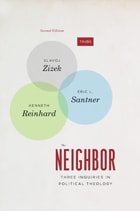
cover of The Neighbor: Three Inquiries in Political Theology

The Neighbor

Three Inquiries in Political Theology

Slavoj Žižek, Eric L. Santner, and Kenneth Reinhard

University of Chicago Press, 2005

In Civilization and Its Discontents, Freud made abundantly clear what he thought about the biblical injunction, first articulated in Leviticus 19:18 and then elaborated in Christian teachings, to love one's neighbor as oneself. "Let us adopt a naive attitude towards it," he proposed, "as though we were hearing it for the first time; we shall be unable then to suppress a feeling of surprise and bewilderment." After the horrors of World War II, the Holocaust, Stalinism, and Yugoslavia, Leviticus 19:18 seems even less conceivable—but all the more urgent now—than Freud imagined.

In The Neighbor, three of the most significant intellectuals working in psychoanalysis and critical theory collaborate to show how this problem of neighbor-love opens questions that are fundamental to ethical inquiry and that suggest a new theological configuration of political theory. Their three extended essays explore today's central historical problem: the persistence of the theological in the political. In "Towards a Political Theology of the Neighbor," Kenneth Reinhard supplements Carl Schmitt's political theology of the enemy and friend with a political theology of the neighbor based in psychoanalysis. In "Miracles Happen," Eric L. Santner extends the book's exploration of neighbor-love through a bracing reassessment of Benjamin and Rosenzweig. And in an impassioned plea for ethical violence, Slavoj Žižek's "Neighbors and Other Monsters" reconsiders the idea of excess to rehabilitate a positive sense of the inhuman and challenge the influence of Levinas on contemporary ethical thought.

A rich and suggestive account of the interplay between love and hate, self and other, personal and political, The Neighbor will prove to be a touchstone across the humanities and a crucial text for understanding the persistence of political theology in secular modernity.
[more]
cover of The Neighbor: Three Inquiries in Political Theology, with a new Preface

The Neighbor

Three Inquiries in Political Theology, with a new Preface

Slavoj Žižek, Eric L. Santner, and Kenneth Reinhard

University of Chicago Press, 2013

In Civilization and Its Discontents, Freud made abundantly clear what he thought about the biblical injunction, first articulated in Leviticus 19:18 and then elaborated in Christian teachings, to love one's neighbor as oneself. “Let us adopt a naive attitude towards it,” he proposed, “as though we were hearing it for the first time; we shall be unable then to suppress a feeling of surprise and bewilderment.” After the horrors of World War II, the Holocaust, and Stalinism, Leviticus 19:18 seems even less conceivable—but all the more urgent now—than Freud imagined.

In The Neighbor, three of the most significant intellectuals working in psychoanalysis and critical theory collaborate to show how this problem of neighbor-love opens questions that are fundamental to ethical inquiry and that suggest a new theological configuration of political theory. Their three extended essays explore today's central historical problem: the persistence of the theological in the political. In “Toward a Political Theology of the Neighbor,” Kenneth Reinhard supplements Carl Schmitt’s political theology of the enemy and friend with a political theology of the neighbor based in psychoanalysis. In “Miracles Happen,” Eric L. Santner extends the book's exploration of neighbor-love through a bracing reassessment of Benjamin and Rosenzweig. And in an impassioned plea for ethical violence, Slavoj Žižek’s “Neighbors and Other Monsters” reconsiders the idea of excess to rehabilitate a positive sense of the inhuman and challenge the influence of Levinas on contemporary ethical thought.

A rich and suggestive account of the interplay between love and hate, self and other, personal and political, The Neighbor has proven to be a touchstone across the humanities and a crucial text for understanding the persistence of political theology in secular modernity. This new edition contains a new preface by the authors.
[more]
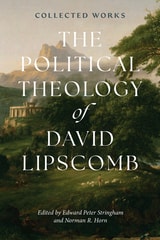
cover of The Political Theology of David Lipscomb: Collected Works

The Political Theology of David Lipscomb

Collected Works

David Lipscomb; Edited by Edward Peter Stringham and Norman R. Horn

Vanderbilt University Press, 2026

Few figures shaped the Stone-Campbell Restoration movement more than David Lipscomb, whose influence on its theology and practice rivaled that of any of his contemporaries. Yet the writings in this volume have long been unavailable to general readers, and most people are no longer familiar with his ideas, including his belief that Christians should not participate in secular politics.

In the early decades of the Stone-Campbell movement, adherents argued their positions in person and in print, and the direction of the movement was decided by these wide-ranging theological discussions. Dissent was built into the discourse and considered a part of the spiritual well-being of the movement. Followers were expected to read and have opinions on all these discussions. And now most of these books and articles have all but vanished from circulation—not just Lipscomb’s but many of the nineteenth-century Campbellite theologians’ writings.

This volume comprises three of Lipscomb’s most important works regarding Christians’ relationship to civil government, along with an introduction by Edward Peter Stringham and Norman R. Horn that explains how Lipscomb’s political writings receded from view within the movement he once shaped.
[more]
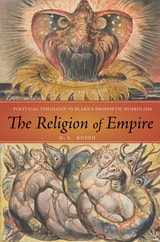
cover of The Religion of Empire: Political Theology in Blake's Prophetic Symbolism

The Religion of Empire

Political Theology in Blake's Prophetic Symbolism

G. A. Rosso

The Ohio State University Press, 2016

The Religion of Empire: Political Theology in Blake’s Prophetic Symbolism is the first full-length study devoted to interpreting Blake’s three long poems, showing the ways in which the Bible, myth, and politics merge in his prophetic symbolism. In this book, G. A. Rosso examines the themes of empire and religion through the lens of one of Blake’s most distinctive and puzzling images, Rahab, a figure that anchors an account of the development of Blake’s political theology in the latter half of his career. Through the Rahab figure, Rosso argues, Blake interweaves the histories of religion and empire in a wide-ranging attack on the conceptual bases of British globalism in the long eighteenth century. This approach reveals the vast potential that the question of religion offers to a reconsideration of Blake’s attitude to empire.

The Religion of Empire also reevaluates Blake’s relationship with Milton, whose influence Blake both affirms and contests in a unique appropriation of Milton’s prophetic legacy. In this context, Rosso challenges recent views of Blake as complicit with the nationalism and sexism of his time, expanding the religion-empire nexus to include Blake’s esoteric understanding of gender. Foregrounding the role of female characters in the longer prophecies, Rosso discloses the variegated and progressive nature of Blake’s apocalyptic humanism.
 
[more]
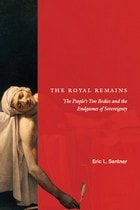
cover of The Royal Remains: The People's Two Bodies and the Endgames of Sovereignty

The Royal Remains

The People's Two Bodies and the Endgames of Sovereignty

Eric L. Santner

University of Chicago Press, 2011

"The king is dead. Long live the king!" In early modern Europe, the king's body was literally sovereign—and the right to rule was immediately transferrable to the next monarch in line upon the king's death. In The Royal Remains, Eric L. Santner argues that the "carnal" dimension of the structures and dynamics of sovereignty hasn't disappeared from politics. Instead, it migrated to a new location—the life of the people—where something royal continues to linger in the way we obsessively track and measure the vicissitudes of our flesh.
 
Santner demonstrates the ways in which democratic societies have continued many of the rituals and practices associated with kingship in displaced, distorted, and usually, unrecognizable forms. He proposes that those strange mental activities Freud first lumped under the category of the unconscious—which often manifest themselves in peculiar physical ways—are really the uncanny second life of these "royal remains," now animated in the body politic of modern neurotic subjects. Pairing Freud with Kafka, Carl Schmitt with Hugo von Hofmannsthal,and Ernst Kantorowicz with Rainer Maria Rilke, Santner generates brilliant readings of multiple texts and traditions of thought en route to reconsidering the sovereign imaginary. Ultimately, The Royal Remains locates much of modernity—from biopolitical controversies to modernist literary experiments—in this transition from subjecthood to secular citizenship.
 
This major new work will make a bold and original contribution to discussions of politics, psychoanalysis, and modern art and literature.
[more]
cover of The Theological-Political Origins of the Modern State: The Controversy between James I of England and Cardinal Bellarmine

The Theological-Political Origins of the Modern State

The Controversy between James I of England and Cardinal Bellarmine

Bernard Bourdin

Catholic University of America Press, 2010

In this work, Bernard Bourdin clearly sets forth the political thought and theology of James I as an early intellectual foundation for the modern state
[more]