Results by title
102 books match the query 'Poor' and 7 start with a
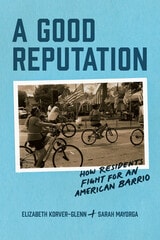
A Good Reputation
How Residents Fight for an American BarrioElizabeth Korver-Glenn and Sarah Mayorga
University of Chicago Press, 2024
Neighborhoods have the power to form significant parts of our worlds and identities. A neighborhood’s reputation, however, doesn’t always match up to how residents see themselves or wish to be seen. The distance between residents’ desires and their environment can profoundly shape neighborhood life.
In A Good Reputation, sociologists Elizabeth Korver-Glenn and Sarah Mayorga delve into the development and transformation of the reputation of Northside, a predominantly Latinx barrio in Houston. Drawing on two years of ethnographic research and in-depth interviews with residents, developers, and other neighborhood stakeholders, the authors show that people’s perceptions of their neighborhoods are essential to understanding urban inequality and poverty. Korver-Glenn and Mayorga’s empirically detailed account of disputes over neighborhood reputation helps readers understand the complexity of high-poverty urban neighborhoods, demonstrating that gentrification is a more complicated and irregular process than existing accounts of urban inequality would suggest. Offering insightful theoretical analysis and compelling narrative threads from understudied communities, A Good Reputation will yield insights for scholars of race and ethnicity, urban planning, and beyond.
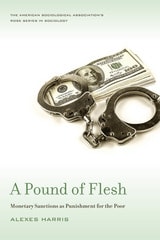
A Pound of Flesh
Monetary Sanctions as Punishment for the PoorAlexes Harris
Russell Sage Foundation, 2016
Over seven million Americans are either incarcerated, on probation, or on parole, with their criminal records often following them for life and affecting access to higher education, jobs, and housing. Court-ordered monetary sanctions that compel criminal defendants to pay fines, fees, surcharges, and restitution further inhibit their ability to reenter society. In A Pound of Flesh, sociologist Alexes Harris analyzes the rise of monetary sanctions in the criminal justice system and shows how they permanently penalize and marginalize the poor. She exposes the damaging effects of a little-understood component of criminal sentencing and shows how it further perpetuates racial and economic inequality.
Harris draws from extensive sentencing data, legal documents, observations of court hearings, and interviews with defendants, judges, prosecutors, and other court officials. She documents how low-income defendants are affected by monetary sanctions, which include fees for public defenders and a variety of processing charges. Until these debts are paid in full, individuals remain under judicial supervision, subject to court summons, warrants, and jail stays. As a result of interest and surcharges that accumulate on unpaid financial penalties, these monetary sanctions often become insurmountable legal debts which many offenders carry for the remainder of their lives. Harris finds that such fiscal sentences, which are imposed disproportionately on low-income minorities, help create a permanent economic underclass and deepen social stratification.
A Pound of Flesh delves into the court practices of five counties in Washington State to illustrate the ways in which subjective sentencing shapes the practice of monetary sanctions. Judges and court clerks hold a considerable degree of discretion in the sentencing and monitoring of monetary sanctions and rely on individual values—such as personal responsibility, meritocracy, and paternalism—to determine how much and when offenders should pay. Harris shows that monetary sanctions are imposed at different rates across jurisdictions, with little or no state government oversight. Local officials’ reliance on their own values and beliefs can also push offenders further into debt—for example, when judges charge defendants who lack the means to pay their fines with contempt of court and penalize them with additional fines or jail time.
A Pound of Flesh provides a timely examination of how monetary sanctions permanently bind poor offenders to the judicial system. Harris concludes that in letting monetary sanctions go unchecked, we have created a two-tiered legal system that imposes additional burdens on already-marginalized groups.
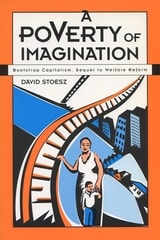
A Poverty of Imagination
Bootstrap Capitalism, Sequel to Welfare ReformDavid Stoesz
University of Wisconsin Press, 2000
Welfare reform was supposed to end welfare as we know it. And it has. The welfare poor have been largely transformed into the working poor, but their poverty persists. This hard-hitting book takes a close look at where we’ve gone wrong—and where we might go next if we truly want to improve the lot of America’s underclass.
Tracing the roots of recent reforms to the early days of the war on poverty, A Poverty of Imagination describes a social welfare system grown increasingly inept, corrupt, and susceptible to conservative redesign. Investigating the causes of the ongoing failure of welfare assistance, Stoesz focuses on the economic barriers that impede movement out of poverty into the American mainstream. He explores such issues as the heterogeneity of welfare families, generational welfare, inadequate benefits, the negative effects of time limits on welfare recipients, a fringe banking industry that exploits low-income families, the limited capacity of low-wage markets, and the unavailability of credit.
Stoesz suggests that a form of "bootstrap capitalism" would allow individuals and families to participate more fully in American society and achieve upward economic mobility and stability. This proposal, emphasizing wage supplements, asset building, and community capitalism, sets the stage for the next act in poverty policy in the United States. With its valuable insights on the American welfare system and its positive agenda for change, this book makes a significant intervention in our ongoing struggle to come to terms with widespread poverty in the wealthiest nation on earth.
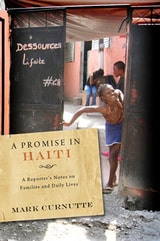
A Promise in Haiti
A Reporter's Notes on Families and Daily LivesMark Curnutte
Vanderbilt University Press, 2011
A Promise in Haiti is Curnutte's story of his time, spanning the last decade, living among several families in Gonaives, a city of 200,000 people a hundred kilometers north of Port-au-Prince. He began traveling to Haiti as a volunteer with the aid organization Hands Together, eventually building trust and credibility with many Haitians. Curnutte introduces the reader to the Cenecharles family, strained by entrenched unemployment and the need to continually travel for work. He is invited into the home of the Henrisma family, and is forced to reconcile journalistic detachment with basic compassion as he contributes financially to help them. The reader is confronted with a complicated, conflicted written and photographic record of a worldview that evolves right on the page. As a reporter, Curnutte found parallels between the lives he encountered in Gonaives and the world of the Great Depression recounted in James Agee and Walker Evans's Let Us Now Praise Famous Men. Agee and Evans loom large as a challenge and inspiration to Curnutte.
The result is equal parts homage to that historic chronicle, on-the-ground reporting, and introspective narrative on the lessons Gonaives taught Curnutte about his own life and family. In late February 2010, Curnutte went back to Haiti on assignment, but conditions made it impossible for him to return to Gonaives. The resulting frustration provoked a meditation on the monumental challenges that face Haiti -- and on the destructive cycle of international attention that constantly moves on to "The Next Big Story."
Andean Lives
Gregorio Condori Mamani and Asunta Quispe HuamánRicardo Valderrama Fernández and Carmen Escalante Gutiérrez, Original Editors
University of Texas Press, 1996
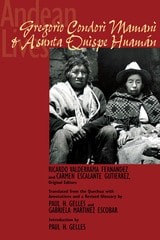
Gregorio Condori Mamani and Asunta Quispe Huamán were runakuna, a Quechua word that means "people" and refers to the millions of indigenous inhabitants neglected, reviled, and silenced by the dominant society in Peru and other Andean countries. For Gregorio and Asunta, however, that silence was broken when Peruvian anthropologists Ricardo Valderrama Fernández and Carmen Escalante Gutiérrez recorded their life stories. The resulting Spanish-Quechua narrative, published in the mid-1970s and since translated into many languages, has become a classic introduction to the lives and struggles of the "people" of the Andes.
Andean Lives is the first English translation of this important book. Working directly from the Quechua, Paul H. Gelles and Gabriela Martínez Escobar have produced an English version that will be easily accessible to general readers and students, while retaining the poetic intensity of the original Quechua. It brings to vivid life the words of Gregorio and Asunta, giving readers fascinating and sometimes troubling glimpses of life among Cuzco's urban poor, with reflections on rural village life, factory work, haciendas, indigenous religion, and marriage and family relationships.
Architecture for the Poor
An Experiment in Rural EgyptHassan Fathy
University of Chicago Press, 1976
Assets for the Poor
The Benefits of Spreading Asset OwnershipThomas M. Shapiro
Russell Sage Foundation, 2001