Results by title
3 books match the query 'Popular Science'
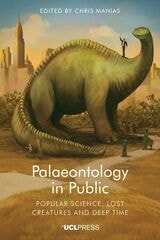
Palaeontology in Public
Popular Science, Lost Creatures and Deep TimeEdited by Chris Manias
University College London, 2025
An excavation of everything from Victorian fossil hunters to Jurassic Park, Chris Manias explores how paleontology’s greatest discoveries have always been entangled with popular culture.
From towering dinosaurs to early human ancestors, paleontology has long captured the public imagination, yet its scientific standing has often been precarious. Palaeontology in Public studies how paleontology’s public presence has shaped both the field itself and broader cultural understandings of science and nature. Through case studies spanning two centuries, this book explores the deep entanglement between vertebrate paleontology and popular culture, from early fossil discoveries to modern cinematic depictions.
Dinosaurs naturally take center stage, taking Spinosaurus, Jurassic Park, and Winsor McCay’s Gertie the Dinosaur, for instance. However, equally important are the stories of Glyptodons, Mesozoic mammals, and early human fossils like Neanderthals and Australopithecus. The book draws from history, art, literature, archaeology, and science communication to depict how public fascination has fueled scientific discovery while also shaping our collective vision of life’s ancient past.
A compelling read for historians of science, paleontologists, and those with a special interest in prehistoric creatures, Palaeontology in Public highlights the enduring power of fossils also as cultural icons that continue to inspire and spark debate.
[more]
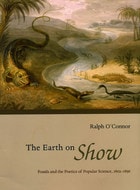
The Earth on Show
Fossils and the Poetics of Popular Science, 1802-1856Ralph O'Connor
University of Chicago Press, 2007
At the turn of the nineteenth century, geology—and its claims that the earth had a long and colorful prehuman history—was widely dismissedasdangerous nonsense. But just fifty years later, it was the most celebrated of Victorian sciences. Ralph O’Connor tracks the astonishing growth of geology’s prestige in Britain, exploring how a new geohistory far more alluring than the standard six days of Creation was assembled and sold to the wider Bible-reading public.
Shrewd science-writers, O’Connor shows, marketed spectacular visions of past worlds, piquing the public imagination with glimpses of man-eating mammoths, talking dinosaurs, and sea-dragons spawned by Satan himself. These authors—including men of science, women, clergymen, biblical literalists, hack writers, blackmailers, and prophets—borrowed freely from the Bible, modern poetry, and the urban entertainment industry, creating new forms of literature in order to transport their readers into a vanished and alien past.
In exploring the use of poetry and spectacle in the promotion of popular science, O’Connor proves that geology’s success owed much to the literary techniques of its authors. An innovative blend of the history of science, literary criticism, book history, and visual culture, The Earth on Show rethinks the relationship between science and literature in the nineteenth century.
[more]
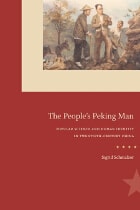
The People's Peking Man
Popular Science and Human Identity in Twentieth-Century ChinaSigrid Schmalzer
University of Chicago Press, 2008
In the 1920s an international team of scientists and miners unearthed the richest evidence of human evolution the world had ever seen: Peking Man. After the communist revolution of 1949, Peking Man became a prominent figure in the movement to bring science to the people. In a new state with twin goals of crushing “superstition” and establishing a socialist society, the story of human evolution was the first lesson in Marxist philosophy offered to the masses. At the same time, even Mao’s populist commitment to mass participation in science failed to account for the power of popular culture—represented most strikingly in legends about the Bigfoot-like Wild Man—to reshape ideas about human nature.
The People’s Peking Man is a skilled social history of twentieth-century Chinese paleoanthropology and a compelling cultural—and at times comparative—history of assumptions and debates about what it means to be human. By focusing on issues that push against the boundaries of science and politics, The People’s Peking Man offers an innovative approach to modern Chinese history and the history of science.
[more]