Results by title
13 books match the query 'Post-apartheid era'
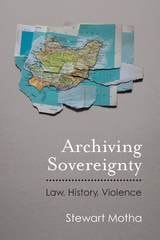
Archiving Sovereignty
Law, History, ViolenceStewart Motha
University of Michigan Press, 2018
Sovereignty is often cast as a limit-concept, constituent force, determining the boundary of law. Archiving Sovereignty reverses this to explain how judicial pronouncements inscribe and sustain extravagant claims to exceptionality and sovereign solitude. This wide-ranging, critical work distinguishes between myths that sustain neocolonial orders and fictions that generate new forms of political and ethical life.
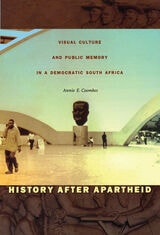
History after Apartheid
Visual Culture and Public Memory in a Democratic South AfricaAnnie E. Coombes
Duke University Press, 2003
History after Apartheid explores the dilemmas posed by a wide range of visual and material culture including key South African heritage sites. How prominent should Nelson Mandela and the African National Congress be in the museum at the infamous political prison on Robben Island? How should the postapartheid government deal with the Voortrekker Monument mythologizing the Boer Trek of 1838? Coombes highlights the contradictory investment in these sites among competing constituencies and the tensions involved in the rush to produce new histories for the “new” South Africa.
She reveals how artists and museum officials struggled to adequately represent painful and difficult histories ignored or disavowed under apartheid, including slavery, homelessness, and the attempted destruction of KhoiSan hunter-gatherers. Describing how contemporary South African artists address historical memory and the ambiguities uncovered by the Truth and Reconciliation Commission, Coombes illuminates a body of work dedicated to the struggle to simultaneously remember the past and move forward into the future.
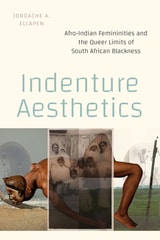
Indenture Aesthetics
Afro-Indian Femininities and the Queer Limits of South African BlacknessJordache A. Ellapen
Duke University Press, 2025
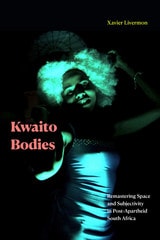
Kwaito Bodies
Remastering Space and Subjectivity in Post-Apartheid South AfricaXavier Livermon
Duke University Press, 2020
New South African Keywords
Nick Shepherd
Ohio University Press, 2008
Prismatic Performances
Queer South Africa and the Fragmentation of the Rainbow NationApril Sizemore-Barber
University of Michigan Press, 2021
Listed as one of Lambda Literary's Most Anticipated LGBTQ Books for September 2020
At his 1994 inauguration, South African president Nelson Mandela announced the “Rainbow Nation, at peace with itself and the world.” This national rainbow notably extended beyond the bounds of racial coexistence and reconciliation to include “sexual orientation” as a protected category in the Bill of Rights. Yet despite the promise of equality and dignity, the new government’s alliance with neoliberal interests and the devastation of the AIDS epidemic left South Africa an increasingly unequal society.
Prismatic Performances focuses on the queer embodiments that both reveal and animate the gaps between South Africa’s self-image and its lived realities. It argues that performance has become a key location where contradictions inherent to South Africa’s post-apartheid identity are negotiated. The book spans 30 years of cultural production and numerous social locations and includes: a team of black lesbian soccer players who reveal and redefine the gendered and sexed limitations of racialized “Africanness;” white gay performers who use drag and gender subversion to work through questions of racial and societal transformation; black artists across the arts who have developed aesthetics that place on display their audiences’ complicity in the problem of sexual violence; and a primarily heterosexual panAfrican online soap opera fandom community who, by combining new virtual spaces with old melodramatic tropes allow for extended deliberation and new paradigms through which African same-sex relationships are acceptable.
Prismatic Performances contends that when explicitly queer bodies emerge onto public stages, audiences are made intimately aware of their own bodies’ identifications and desires. As the sheen of the New South Africa began to fade, these performances revealed the inadequacy and, indeed, the violence, of the Rainbow Nation as an aspirational metaphor. Simultaneously they created space for imagining new radical configurations of belonging.
Projecting Nation
South African Cinemas after 1994Cara Moyer-Duncan
Michigan State University Press, 2020

Short-Changed?
South Africa since ApartheidColin Bundy
Ohio University Press, 2015
What have been the most significant developments—political, social, economic—in South Africa since 1994? How much has changed since the demise of apartheid, and how much remains stubbornly the same? Should one celebrate a robust democracy now two decades old, or lament the corrosive effects of factionalism, greed, and corruption on political life? Colin Bundy tries to answer such questions, while avoiding simplistic or one-sided assessments of life under Mandela, Mbeki, and Zuma. He recognizes real advances under ANC rule but also identifies the limits and contradictions of such progress. Bundy demonstrates, too, how the country’s past permeates the present, complicating and constraining the politics of transition, so that genuine transformation has been short-changed.
South Africa’s Suspended Revolution
Hopes and ProspectsAdam Habib
Ohio University Press, 2013
South Africa’s Suspended Revolution tells the story of South Africa’s democratic transition and the prospects for the country to develop a truly inclusive political system. Beginning with an account of the transition in the leadership of the African National Congress from Thabo Mbeki to Jacob Zuma, the book then broadens its lens to examine the relationship of South Africa’s political elite to its citizens. It also examines the evolution of economic and social policies through the democratic transition, as well as the development of a postapartheid business community and a foreign policy designed to re-engage South Africa with the world community.
Written by one of South Africa’s leading scholars and political commentators, the book combines historical and contemporary analysis with strategies for an alternative political agenda. Adam Habib connects the lessons of the South African experience with theories of democratic transition, social change, and conflict resolution. Political leaders, scholars, students, and activists will all find material here to deepen their understanding of the challenges and opportunities of contemporary South Africa.
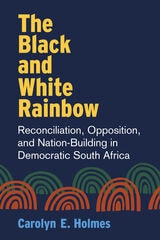
The Black and White Rainbow
Reconciliation, Opposition, and Nation-Building in Democratic South AfricaCarolyn E. Holmes
University of Michigan Press, 2020
Based on ethnographic and interview-based fieldwork conducted in 2012–13, The Black and White Rainbow: Reconciliation, Opposition, and Nation-Building in Democratic South Africa explores various themes of nation- and democracy-building, including the emotional and banal content of symbols of the post-apartheid state, the ways that gender and race condition nascent nationalism, the public performance of nationalism and other group-based identities, integration and sharing of space, language diversity, and the role of democratic functioning including party politics and modes of opposition. Each of these thematic chapters aims to explicate a feature of the multifaceted nature of identity-building, and link the South African case to broader literatures on both nationalism and democracy.
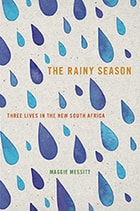
The Rainy Season
Three Lives in the New South AfricaMaggie Messitt
University of Iowa Press, 2015
The Rainy Season tells the stories of three generations in the Rainbow Nation one decade after its first democratic elections. This multi-threaded narrative follows Regina, a tapestry weaver in her sixties, standing at the crossroads where her Catholic faith and the AIDS pandemic crash; Thoko, a middle-aged sangoma (traditional healer) taking steps to turn her shebeen into a fully licensed tavern; and Dankie, a young man taking his matriculation exams, coming of age as one of Mandela’s Children, the first academic class educated entirely under democratic governance.
Home to Shangaan, Sotho, and Mozambican Tsonga families, Rooiboklaagte sits in a village where an outdoor butchery occupies an old petrol station and a funeral parlor sits in the attached garage. It’s a place where an AIDS education center sits across the street from a West African doctor selling cures for the pandemic. It’s where BMWs park outside of crumbling cement homes, and the availability of water changes with the day of the week. As the land shifts from dusty winter blond to lush summer green and back again, the duration of northeastern South Africa’s rainy season, Regina, Thoko, and Dankie all face the challenges and possibilities of the new South Africa.
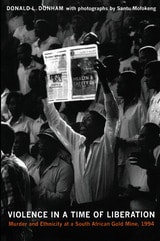
Violence in a Time of Liberation
Murder and Ethnicity at a South African Gold Mine, 1994Donald L. Donham
Duke University Press, 2011
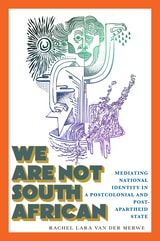
We Are Not South African
Mediating National Identity in a Postcolonial and Postapartheid StateRachel Lara van der Merwe
Rutgers University Press, 2026
We Are Not South African explores how national identity functions as a colonial tool of communication, control, and power. Author Rachel Lara van der Merwe examines how humans and the planet are integrally shaped by the idea of the nation and speculates on how different sociopolitical imaginaries, instead of the nation, could inform ways of being-together in the world.
Linking national identity to colonialism, the book broadens the idea of the nation to include its impact on all forms of life, human and more-than-human. Van der Merwe builds her argument on three central observations: that nations are made up of conflicting and fractured imaginaries, not unified, cohesive ones; the nation is divisive by nature, tracing back to its colonial origins; and the nation, along with the state, exploits both humans and more-than-humans. In order to build a more just and sustainable planetary society, she argues, liberation from such colonial formations is vital. In response, the book asks, How could we reimagine how we organize our societies through values of relationality and mutual care rather than rigid borders? What sociopolitical imaginaries do we need, or already possess, that might inform new configurations of community?