Results by title
3 books match the query 'Postwar Britain'
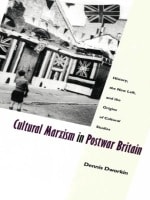
Cultural Marxism in Postwar Britain
History, the New Left, and the Origins of Cultural StudiesDennis Dworkin
Duke University Press, 1997
In this intellectual history of British cultural Marxism, Dennis Dworkin explores one of the most influential bodies of contemporary thought. Tracing its development from beginnings in postwar Britain, through its various transformations in the 1960s and 1970s, to the emergence of British cultural studies at Birmingham, and up to the advent of Thatcherism, Dworkin shows this history to be one of a coherent intellectual tradition, a tradition that represents an implicit and explicit theoretical effort to resolve the crisis of the postwar British Left.
Limited to neither a single discipline nor a particular intellectual figure, this book comprehensively views British cultural Marxism in terms of the dialogue between historians and the originators of cultural studies and in its relationship to the new left and feminist movements. From the contributions of Eric Hobsbawm, Christopher Hill, Rodney Hilton, Sheila Rowbotham, Catherine Hall, and E. P. Thompson to those of Perry Anderson, Barbara Taylor, Raymond Williams, Dick Hebdige, and Stuart Hall, Dworkin examines the debates over issues of culture and society, structure and agency, experience and ideology, and theory and practice. The rise, demise, and reorganization of journals such as The Reasoner, The New Reasoner, Universities and Left Review, New Left Review, Past and Present, are also part of the history told in this volume. In every instance, the focus of Dworkin’s attention is the intellectual work seen in its political context. Cultural Marxism in Postwar Britain captures the excitement and commitment that more than one generation of historians, literary critics, art historians, philosophers, and cultural theorists have felt about an unorthodox and critical tradition of Marxist theory.
Limited to neither a single discipline nor a particular intellectual figure, this book comprehensively views British cultural Marxism in terms of the dialogue between historians and the originators of cultural studies and in its relationship to the new left and feminist movements. From the contributions of Eric Hobsbawm, Christopher Hill, Rodney Hilton, Sheila Rowbotham, Catherine Hall, and E. P. Thompson to those of Perry Anderson, Barbara Taylor, Raymond Williams, Dick Hebdige, and Stuart Hall, Dworkin examines the debates over issues of culture and society, structure and agency, experience and ideology, and theory and practice. The rise, demise, and reorganization of journals such as The Reasoner, The New Reasoner, Universities and Left Review, New Left Review, Past and Present, are also part of the history told in this volume. In every instance, the focus of Dworkin’s attention is the intellectual work seen in its political context. Cultural Marxism in Postwar Britain captures the excitement and commitment that more than one generation of historians, literary critics, art historians, philosophers, and cultural theorists have felt about an unorthodox and critical tradition of Marxist theory.
[more]
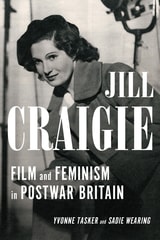
Jill Craigie
Film and Feminism in Postwar BritainYvonne Tasker and Sadie Wearing
University of Illinois Press, 2026
The career and craft of a woman filmmaker in a male-dominated industry
From the mid-1940s to the late 1950s, Jill Craigie wrote, produced, and directed the innovative films that stood at the center of her diverse career in British cinema, radio, television, and print journalism. Yvonne Tasker and Sadie Wearing analyze Craigie’s oeuvre while delving into the filmmaker’s use of the medium as the space for her distinctive feminist engagement with key cultural, social, and political questions.
Tasker and Wearing reconsider Craigie’s place and reputation in the history of British Cinema. Craigie created work that showed a strong critical voice and at the same time challenged contemporary modes of filmmaking with both documentary and drama. Tasker and Wearing examine her feminist and working-class influences and also emphasize the democratic impulse that drove Craigie to include her subjects’ participation, and her commitment to representing them on screen. Throughout, Tasker and Wearing analyze Craigie’s work against the backdrop of postwar concerns and preoccupations.
Distinctive and nuanced, Jill Craigie reconsiders the career of a groundbreaking woman director.
[more]
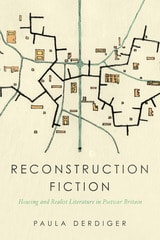
Reconstruction Fiction
Housing and Realist Literature in Postwar BritainPaula Derdiger
The Ohio State University Press, 2020
Reconstruction Fiction: Housing and Realist Literature in Postwar Britain by Paula Derdiger assesses the impact of World War II and the welfare state on literary fiction by focusing on one of the defining issues of the postwar period: housing. Through compelling close readings and lively historical and cultural analysis, Derdiger argues that literary realism was a necessary, generative response to the war and welfare state since they impacted the built environment and landscape. Wartime decimation of buildings and streets called for reconstruction, and reconstruction called not just for bricks and mortar, architectural drawings, town plans, preservation schemes, and new policies but also for fiction that invited particular ways of inhabiting an environment that had been irrevocably changed. Derdiger argues that fiction, like actual buildings, creates a sheltered space for the mediation between individual subjects and the social and geographical environments that they encounter. Realist fiction, specifically, insists that such mediation is possible and that it is socially valuable. Covering writers spanning various social positions and aesthetic tendencies—including Elizabeth Bowen, Graham Greene, Patrick Hamilton, Doris Lessing, Colin MacInnes, and Elizabeth Taylor—Derdiger shows how these authors responded to the war with realistic technique, investing in external conditions just as much as or more than their characters’ interior lives. In doing so, their reconstruction fiction helped to shape postwar life.
[more]