Results by title
7 books match the query 'Potters'

Ceramic Figures
A Directory of ArtistsFlynn, Michael
Rutgers University Press, 2002
Figurative ceramics is one of the most exciting and innovative areas of art today. Though ceramics has been unfashionable in the past, the last twenty-five years have seen a worldwide resurgence of interest in this art form among artists, galleries, and the public.
In this book, Michael Flynn looks back at the last twenty-five years and selects over one hundred of the most important artists working with ceramic figures. He also includes ceramicists from earlier in the century whose work has had an influence on the subject. The work ranges from porcelain to raku and from the small to the monumental.
Ceramic Figures is arranged alphabetically by last name, giving a thumbnail sketch of the artist and showing a variety of the artist’s work. Major galleries and collections where the pieces appear are also included. The result is a spectacular international survey of this most captivating of subjects.
Living In The Country Growing Weird
A Deep Rural AdventureDennis Parks
University of Nevada Press, 2001
Parks created a pottery school that attracts students from around the world and developed for himself an international reputation as the creator of powerful, innovative works in clay. Meanwhile, he and his family had to master the skills required of those who choose to live in the back country--growing and hunting their own food, renovating or building from scratch the structures they needed for residences or studios, resolving conflicts with neighbors, inventing their own amusements. The transformation from middle-class urbanity to small-town simplicity is, as Parks reveals, a lurching and sometimes hilarious process, and the achievement of self-sufficiency is similarly fraught with unexpected challenges.
Maya Potters' Indigenous Knowledge
Cognition, Engagement, and PracticeDean E. Arnold
University Press of Colorado, 2017
Based on fieldwork and reflection over a period of almost fifty years, Maya Potters’ Indigenous Knowledge utilizes engagement theory to describe the indigenous knowledge of traditional Maya potters in Ticul, Yucatán, Mexico. In this heavily illustrated narrative account, Dean E. Arnold examines craftspeople’s knowledge and skills, their engagement with their natural and social environments, the raw materials they use for their craft, and their process for making pottery.
Following Lambros Malafouris, Tim Ingold, and Colin Renfrew, Arnold argues that potters’ indigenous knowledge is not just in their minds but extends to their engagement with the environment, raw materials, and the pottery-making process itself and is recursively affected by visual and tactile feedback. Pottery is not just an expression of a mental template but also involves the interaction of cognitive categories, embodied muscular patterns, and the engagement of those categories and skills with the production process. Indigenous knowledge is thus a product of the interaction of mind and material, of mental categories and action, and of cognition and sensory engagement—the interaction of both human and material agency.
Engagement theory has become an important theoretical approach and “indigenous knowledge” (as cultural heritage) is the focus of much current research in anthropology, archaeology, and cultural resource management. While Dean Arnold’s previous work has been significant in ceramic ethnoarchaeology, Maya Potters' Indigenous Knowledge goes further, providing new evidence and opening up different concepts and approaches to understanding practical processes. It will be of interest to a wide variety of researchers in Maya studies, material culture, material sciences, ceramic ecology, and ethnoarchaeology.
Of Mules and Mud
The Story of Alabama Folk Potter Jerry BrownJerry Brown, edited and with an introduction by Joey Brackner
University of Alabama Press, 2022
The life and times of Alabama folk potter Jerry Brown, as told in his own words
Born in 1942, Jerry Brown helped out in his father’s pottery shop as a young boy. There he learned the methods and techniques for making pottery in a family tradition dating back to the 1830s. His responsibilities included tending the mule that drove the mill that was used to mix clay (called “mud” by traditional potters). Business suffered as demand for stoneware churns, jugs, and chamber pots waned in the postwar years, and manufacture ceased following the deaths of Brown’s father and brother in the mid-1960s. Brown turned to logging for his livelihood, his skill with mules proving useful in working difficult and otherwise inaccessible terrain. In the early 1980s, he returned to the family trade and opened a new shop that relied on the same methods of production with which he had grown up, including a mule-powered mill for mixing clay and the use of a wood-fired rather than gas-fueled kiln.
Folklorist Joey Brackner met Brown in 1983, and the two quickly became close friends who collaborated together on a variety of documentary and educational projects in succeeding years—efforts that led to greater exposure, commercial success, and Brown’s recognition as a National Heritage Fellow by the National Endowment for the Arts. For years, Brown spoke of the urge to write his life story, but he never set pen to paper. In 2015, Brackner took the initiative and interviewed Brown, recording his life story over the course of a weekend at Brown’s home. Of Mules and Mud is the result of that marathon interview session, conducted one year before Brown passed away.
Brackner has captured Jerry Brown’s life in his own words as recounted that weekend, lightly edited and elaborated. Of Mules and Mud is illustrated with photos from all phases of Brown’s life, including a color gallery of 28 photos of vessel forms made by Brown throughout his career that collectors of folk pottery will find invaluable.
Portraits of Clay
Potters of Mata OrtízSandra S. Smith
University of Arizona Press, 1998
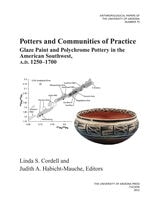
Potters and Communities of Practice
Glaze Paint and Polychrome Pottery in the American Southwest, AD 1250 to 1700Edited by Linda S. Cordell and Judith A. Habicht-Mauche
University of Arizona Press, 2012
The peoples of the American Southwest during the 13th through the 17th centuries witnessed dramatic changes in settlement size, exchange relationships, ideology, social organization, and migrations that included those of the first European settlers. Concomitant with these world-shaking events, communities of potters began producing new kinds of wares—particularly polychrome and glaze-paint decorated pottery—that entailed new technologies and new materials. The contributors to this volume present results of their collaborative research into the production and distribution of these new wares, including cutting-edge chemical and petrographic analyses. They use the insights gained to reflect on the changing nature of communities of potters as they participated in the dynamic social conditions of their world.
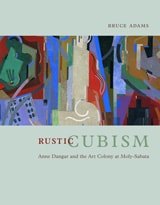
Rustic Cubism
Anne Dangar and the Art Colony at Moly-SabataBruce Adams
University of Chicago Press, 2004
In part a gripping biography of this Australian expatriate, Rustic Cubism chronicles Dangar's personal battles and the tumult of the World War II era during her tempestuous tenure at Moly-Sabata. Dangar dedicated herself to the colony's aims by working in the region's village potteries, combining their vernacular elements with Gleizes' design methods to arrive at a type of rustic Cubism. Her work there would ultimately be rewarded; her pieces can today be found in the Musée des Arts Décoratifs in Paris, the Musée d'Art Moderne de la Ville de Paris, the Museo Internazionale delle Ceramiche in Faenza, the National Gallery of Australia, Canberra, and many other museums.
Rustic Cubism places Dangar at the heart of Moly-Sabata's alternative art movement—one that, in its nostalgic present, attempted to construct a culture based on the distant past. Generously illustrated with photographs of the art and social milieu of the period, this captivating and original narrative makes a considerable contribution to our understanding of French modernism and early twentieth-century cultural politics as well as of the life of a most talented and intriguing female artist.