Results by title
9 books match the query 'Practical Reason'
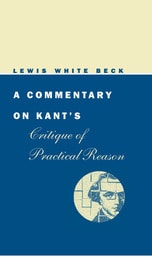
A Commentary on Kant's Critique of Practical Reason
Lewis White Beck
University of Chicago Press, 1996
This Critique is the only writing in which Kant weaves his thoughts on practical reason into a unified argument. Lewis White Beck offers a classic examination of this argument and expertly places it in the context of Kant's philosophy and of the moral philosophy of the eighteenth century.
Aquinas on Imitation of Nature
Source of Principles of Moral ActionWojciech Golubiewski
Catholic University of America Press, 2022
Casuistry and Modern Ethics
A Poetics of Practical ReasoningRichard B. Miller
University of Chicago Press, 1996
Rejecting the packaging of moral experience within simple descriptions and inflexible principles, Miller argues instead for identifying and making sense of the ethically salient features of individual cases. Because this practical approach must cope with a diverse array of experiences, Miller draws on a wide variety of diagnostic tools from such fields as philosophy of science, legal reasoning, theology, literary theory, hermeneutics, and moral philosophy.
Opening new avenues for practical reasoning, Miller's interdisciplinary work will challenge scholars who are interested in the intersections of ethics and political philosophy, cultural criticism, and debates about method in religion and morality.
Culture and Practical Reason
Marshall Sahlins
University of Chicago Press, 1978
Intention, Plans and Practical Reason
Michael E. Bratman
CSLI, 1987

Practical Reason, Aristotle, and Weakness of the Will
Norman O. Dahl
University of Minnesota Press, 1984
Practical Reason, Aristotle, and Weakness of the Will was first published in 1984. Minnesota Archive Editions uses digital technology to make long-unavailable books once again accessible, and are published unaltered from the original University of Minnesota Press editions.
One of the central problems in recent moral philosophy is the apparent tension between the "practical" or "action-guiding" side of moral judgments and their objectivity. That tension would not exist if practical reason existed (if reason played a substantial role in producing motivation) and if recognition of obligation were one of the areas in which practical reason operated. In Practical Reason, Aristotle, and the Weakness of the Will,Norman Dahl argies that, despite widespread opinion to the contrary, Aristotle held a position on practical reason that both provides an objective basis for ethics and satisfies an important criterion of adequacy—that it acknowledges genuine cases of weakness of the will. In arguing for this, Dahl distinguishes Aristotle's position from that of David Hume, who denied the existence of practical reason. An important part of his argument is an account of the role that Aristotle allowed the faculty nous to play in the acquisition of general ends. Relying both on this argument and on an examination of passages from Aristotle's ethics and psychology, Dahl argues that Aristotle recognized that a genuine conflict of motives can occur in weakness of the will. This provides him with the basis for an interpretation that finds Aristotle acknowledging genuine cases of weakness of the will.
Dahl's arguments have both a philosophical and a historical point. He argues that Aristotle's position on practical reason deserves to be taken seriously, a conclusion he reinforces by comparing that position with more recent attempts, by Kant, Nagel, and Rawls, to base ethics on practical reason.
Reasoning, Rationality and Probability
Edited by Maria Carla Galavotti, Roberto Scazzieri, and Patrick Suppes
CSLI, 2008
The Possibility of Practical Reason
J. David Velleman
Michigan Publishing Services, 2015
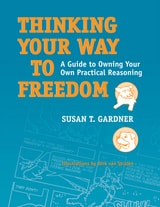
Thinking Your Way to Freedom
A Guide to Owning Your Own Practical ReasoningSusan T. Gardner
Temple University Press, 2009
Thinking Your Way to Freedom is a critical-thinking textbook with a difference. Rather than focusing exclusively on improving college students’ academic achievement, Susan Gardner seeks to dramatically change how students think through issues that are important in their lives beyond school. Gardner created 66 original and entertaining comic strips—featuring her dogs, Diva and Ben—that add a light touch as they encourage intellectual and personal autonomy. Through a clear step-by-step method of practical reasoning, students are taught how to think impartially and how to neutralize invisible biases that limit their freedom of thought and action. With the help of Diva and Ben, readers learn to evaluate the strengths of arguments and to recognize fallacies, all the while avoiding the paralyzing effects of relativism.
Thinking Your Way to Freedom includes the writing of short essays so that students can improve their critical thinking and writing at the same time. A Teacher’s Manual for this book will be available online.