Results by title

17 books match the query 'Preaching'
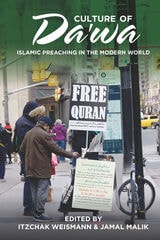
cover of Culture of Da'wa: Preaching in the Modern World

Culture of Da'wa

Preaching in the Modern World

Edited by Itzchak Weismann and Jamil Malik

University of Utah Press, 2020

This book provides the first in-depth, wide-scope treatment of da’wa. A term difficult to translate, da’wa covers a semantic field ranging from the call or invitation to Islam, to religious preaching and proselytizing, to the mission and message of Islam. Historically da’wa has been directed outward to nonbelievers, but in modern times it has turned increasingly inward to “straying” Muslims. While the media and many scholars have focused on extremism and militant groups that have raised the banner of jihad, this volume argues that da’wa, not jihad, forms the backbone of modern Islamic politics and religiosity, and that the study of da’wa is essential for understanding contemporary Islamic politics as well as jihadist activity. Contributors represent a variety of approaches and come from a range of academic, religious, and national backgrounds. In these essays, they analyze the major discourses of da’wa, their embodiment in the major Islamic movements of the twentieth century, and their transformation into new forms of activism through the media, the state, and jihadi groups—including al-Qaeda and ISIS—in the twenty-first century.
[more]
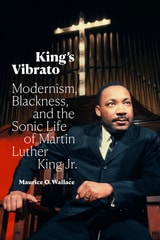
cover of King's Vibrato: Modernism, Blackness, and the Sonic Life of Martin Luther King Jr.

King's Vibrato

Modernism, Blackness, and the Sonic Life of Martin Luther King Jr.

Maurice O. Wallace

Duke University Press, 2022
In King’s Vibrato Maurice O. Wallace explores the sonic character of Martin Luther King Jr.’s voice and its power to move the world. Providing a cultural history and critical theory of the black modernist soundscapes that helped inform King’s vocal timbre, Wallace shows how the qualities of King’s voice depended on a mix of ecclesial architecture and acoustics, musical instrumentation and sound technology, audience and song. He examines the acoustical architectures of the African American churches where King spoke and the centrality of the pipe organ in these churches, offers a black feminist critique of the influence of gospel on King, and outlines how variations in natural environments and sound amplifications made each of King’s three deliveries of the “I Have a Dream” speech unique. By mapping the vocal timbre of one of the most important figures of black hope and protest in American history, Wallace presents King as the embodiment of the sound of modern black thought.
[more]
cover of Liberty and Law

Liberty and Law

Brian Tierney

Catholic University of America Press, 2014
Liberty and Law examines a previously underappreciated theme in legal history - the idea of permissive natural law. The idea is mentioned only peripherally, if at all, in modern histories of natural law. Yet it engaged the attention of jurists, philosophers, and theologians over a long period and formed an integral part of their teachings. This ensured that natural law was not conceived of as merely a set of commands and prohibitions that restricted human conduct, but also as affirming a realm of human freedom, understood as both freedom from subjection and freedom of choice. Freedom can be used in many ways, and throughout the whole period from 1100 to 1800 the idea of permissive natural law was deployed for various purposes in response to different problems that arose. It was frequently invoked to explain the origin of private property and the beginnings of civil government.
[more]
cover of Macaronic Sermons: Bilingualism and Preaching in Late-Medieval England

Macaronic Sermons

Bilingualism and Preaching in Late-Medieval England

Siegfried Wenzel

University of Michigan Press, 2010

Siegfried Wenzel's groundbreaking study seeks to describe and analyze the linguistically mixed, or macaronic, sermons in late fourteenth-century England.  Not only are these works of considerable religious interest, they provide extensive information on their literary, linguistic, and cultural milieux.
 
Macaronic Sermons begins by offering a typology of such works: those in which English words offer glosses, or offer structural functions, or offer neither of the two but yet are syntactically integrated.  This last group is then examined in detail: reasons are given for this usage and for its origins, based on the realities of fourteenth-century England.
 
Siefriend Wenzel draws valuable conclusions about the linguistic status quo of the era, together with the extent of education, the audiences' expectations, and the ways in which the authors' minds worked.
 
Obviously of interest to scholars and students of early English literature, Macaronic Sermons also contains much valuable information for specialists in language development or oral theory, and for those interested in multicultural societies.
[more]
cover of Preaching and the Rise of the American Novel

Preaching and the Rise of the American Novel

Dawn Coleman

The Ohio State University Press, 2013
Preaching and the Rise of the American Novel by Dawn Coleman recovers a crucial moment in the history of the intimate yet often contentious relationship between religion and literature. Coleman’s book highlights the intersection of two cultural trajectories in America around 1850, both often downplayed in literary histories: a boom in preaching, associated with the growth of evangelicalism and the country’s oratorical traditions, and the long struggle of the novel, still facing considerable disdain at mid-century, to achieve moral legitimacy and aesthetic autonomy.
 
Before the Civil War, the preacher in the pulpit was the culture’s paradigmatic voice of moral authority, and novelists who wished to establish the moral value of their own storytelling needed to incorporate sermons. This book explores how antebellum ministers sought to preach effective, authoritative sermons and how novelists sought to claim a similar authority through canny representations of preachers, often veiled critiques of actual ministers, and sermonic voice, or a creative reworking of the sound of preaching. Such intense engagement with sermons shaped some of the period’s most interesting and important novels, including The Scarlet Letter, The Quaker City, Moby-Dick, Uncle Tom’s Cabin, and Clotel.
 
In illuminating how novelists sought to displace traditional religious institutions, Preaching and the Rise of the American Novel reminds readers of the deep connections between Americans’ religious practices and their literature and speaks to how the processes of secularization are often less concerned with rejecting the elements of religion than reimagining them.
[more]
cover of Preaching in Arduous Times: Outline of Perspectives from the Hebrews Sermon

Preaching in Arduous Times

Outline of Perspectives from the Hebrews Sermon

Maarten Kater

Central European University Press, 2026
The overarching research question which is answered in this study by means of several different angles is: ‘What kind of perspectives could an investigation of the Hebrews sermon o er to the homiletical praxis of people living in arduous times?’. This study want to indicate and illustrate that the Hebrews sermon o ers piercing perspectives for the discipline of homiletics and, moreover, the wider field of practical theology, especially dealing with the formative aspects of worship, preaching, and attitudes. Hebrews is on the God who speaks to us ‘today’ from the very start. But what in the world does it mean when we use this language in our four-dimensional space-time as it is mediated and embodied speech? It turns out that in this canonical sermon many directions for a homiletical theory are to be considered and to process. The three dimensions of time, the value of religious spaces, the art of persuasion, preaching Christ as sacramentum and exemplum which is listener-orientated communication at the same time, the bifurcation of explanation and application, the theology of language. Moreover, Hebrews is connected with the formation and developing of attitudes in the various spheres as cognitive, affective, behavioural, interpersonal, social and political. Each time has its arduous aspects. This study aims to stimulate preaching in these times, sometimes within weary and worn -out congregations, and to encourage the fainthearted preachers and listeners by means of a sermon as a song of love. If you would like to order the book for delivery outside of the Netherlands, please email orders@aup.nl
[more]
cover of Preaching in the Age of Chaucer: Selected Sermons in Translation (Medieval Texts in Translation Series)

Preaching in the Age of Chaucer

Selected Sermons in Translation (Medieval Texts in Translation Series)

Siegfried Wenzel

Catholic University of America Press, 2008
Introducing modern readers to the riches of preaching in later medieval England, distinguished scholar Siegfried Wenzel offers translations of twenty-five Latin sermons written between 1350 and 1450. T
[more]
cover of Preaching to Convert: Evangelical Outreach and Performance Activism in a Secular Age

Preaching to Convert

Evangelical Outreach and Performance Activism in a Secular Age

John Fletcher

University of Michigan Press, 2015

Preaching to Convert offers an intriguing new perspective on the outreach strategies of U.S. evangelicals, framing them as examples of activist performance, broadly defined as acts performed before an audience in the hopes of changing hearts and minds. Most writing about activist performance has focused on left-progressive causes, events, and actors. Preaching to Convert argues against such a constricted view of activism and for a more nuanced understanding of U.S. evangelicalism as a movement defined by its desire to win converts and spread the gospel.
 
The book positions evangelicals as a diverse, complicated group confronting the loss of conservative Christianity’s default status in 21st-century U.S. culture. In the face of an increasingly secular age, evangelicals have been reassessing models of outreach. In acts like handing out Bible tracts to strangers on the street or going door-to-door with a Bible in hand, in elaborately staged horror-themed morality plays or multimillion-dollar creationist discovery centers, in megachurch services beamed to dozens of satellite campuses, and in controversial “ex-gay” ministries striving to return gays and lesbians to the straight and narrow, evangelicals are redefining what it means to be deeply committed in a pluralist world. The book’s engaging style and careful argumentation make it accessible and appealing to scholars and students across a range of fields.
[more]
cover of Preaching to Latinos: Welcoming the Hispanic Moment in the U.S. Church

Preaching to Latinos

Welcoming the Hispanic Moment in the U.S. Church

Michael Kueber

Catholic University of America Press, 2022
There is a wide and growing gap in the Catholic Church in the United States between the clergy, who are mostly of European descent, and the large percentages of Catholics who identify as Latinos. While the US Church has made a concerted effort to build Hispanic ministries, many clergy and lay ministers are still ill-equipped to understand the cultural background of their parishioners, especially the large numbers who are foreign born. Because of this disconnect, the Church risks missing "the Hispanic Moment" in the US Church, in which the faith and traditions of these newest waves of US immigration could not just exist in parallel to English-language congregations, but enrich and enliven the faith of the whole community while passing on the faith to subsequent generations. Learning Spanish--while helpful--is not enough. There are intercultural competencies that can only be developed through practice, but it also helps already-busy clergy to have a concise guide. In addition to knowing the scholarly literature on cross-cultural preaching and Hispanic culture, Father Michael Kueber has twenty years of experience serving first generation Hispanic immigrants and their second generation children. In Preaching to Latinos, Kueber provides the readers with best practices for preaching to and leading their churches. As a member of an ecumenical community, he is able to speak to members of all Christian denominations.
[more]
cover of Predestination and Preaching in Genevan Theology from Calvin to Pictet

Predestination and Preaching in Genevan Theology from Calvin to Pictet

Pieter Rouwendal

Central European University Press, 2026
Given the conclusions of recent research, that predestination was no central dogma to, and did not affect the method of reformed theology, this study investigates the question if and how the doctrine of predestination affected the ideas and the practise of preaching. The relation of predestination and covenant, congregation, atonement, faith etc. are researched in the theology and sermons of John Calvin, Theodore Beza, John Diodati and Theodore Tronchin, Francis Turretin, and Benedict Pictet. This study shows that in Genevan Reformed theology from Calvin to Pictet, predestination and the external call were inseparably connected, but that the doctrine of predestination neither dominated the content nor restricted the address of the external call. “…a detailed and finely argued study…” Donald K. McKim – Journal of Reformed Theology 12-2 (2018) If you would like to order the book for delivery outside of the Netherlands, please email orders@aup.nl
[more]
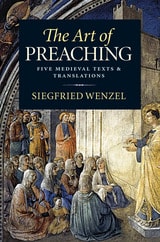
cover of The Art of Preaching

The Art of Preaching

Siegfried Wenzel

Catholic University of America Press, 2013
Based on his wide-ranging knowledge of late-medieval Latin sermons from England as well as his editorial experience with medieval Latin texts, Siegfried Wenzel offers critical editions of five instruction manuals on the "art of preaching" dating from 1230 to the fifteenth century. Four of the texts are edited and translated for the first time; the fifth is re-edited from all extant manuscripts. Each of the five sermons is accompanied by a facing-page translation into English. The book aims to stimulate interest and new research in a field that still awaits closer analysis of the relationships among existing treatises and of their historical development.
[more]
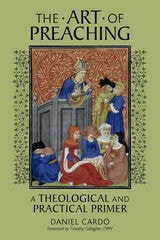
cover of The Art of Preaching: A Theological and Practical Primer

The Art of Preaching

A Theological and Practical Primer

Daniel Cardo

Catholic University of America Press, 2021
The growing awareness of the importance of preaching is a sign of our times. In the past decades, conscious that a renewal of preaching is essential for a renewed evangelization, many seminaries have implemented homiletic courses. However, there is still a real limitation of good and systematic resources in order to learn the theological depth and practical elements of the art of preaching. The Art of Preaching: A Theological and Practical Primer aims to fill that gap. It explores the theological understanding of the homily, lessons from classical and contemporary rhetoric, the relevance of preaching for the life of the Church, highlighting recent teachings of the Magisterium, and it presents the incarnation as the foundation for preaching, understood as an essential aspect of the priestly life and mission. This primer also offers a simple and effective method for the preparation and delivery of homilies, illustrating this by the example of brilliant preachers and exploring the idea of preaching as locus theologicus, i.e., the privileged place for the exercise of theology today. It is in deepening in the value and importance of preaching that theology can be renewed as a living and essential part of the daily life of priests. Seeing the homily not as a burden but as an occasion to fulfill the priestly identity will offer the opportunity to embrace the preparation for preaching as a key for unity among the many tasks and demands of pastoral life. In the homily prayer, study, and work come together. The Art of Preaching will also provide a selection of homilies from the great preachers of the Church, organized chronologically, with brief introductions and commentaries that highlight what those homilies teach us for our preaching today. Only learning from the best preachers can we hope to preach effectively in our times.
[more]
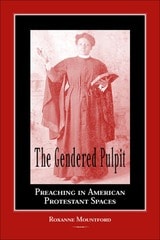
cover of The Gendered Pulpit: Preaching in American Protestant Spaces

The Gendered Pulpit

Preaching in American Protestant Spaces

Roxanne Mountford

Southern Illinois University Press, 2005

In this feminist investigation into the art of preaching—one of the oldest and least studied rhetorical traditions—Roxanne Mountford explores the relationship between bodies, space, race, and gender in rhetorical performance and American Protestant culture. Refiguring delivery and physicality as significant components of the rhetorical situation, The Gendered Pulpit: Preaching in American Protestant Spaces examines the strategies of three contemporary women preachers who have transgressed traditions, rearranged rhetorical space, and conquered gender bias to establish greater intimacy with their congregations.

Mountford’s examinations of the rhetoric inherent in preaching manuals from 1850 to the present provide insight into how “manliness” has remained a central concept in American preaching since the mid-nineteenth century. The manuals illustrate that the character, style, method of delivery, and theological purpose of preachers focused on white men and their cultural standing, leaving contemporary women preachers searching for ways to accommodate themselves to the physicality of preaching.

Three case studies of women preachers who have succeeded or failed in rearranging rhetorical space provide the foundation for the volume. These contemporary examples have important implications for feminist theology and also reveal the importance of gender, space, and bodies to studies of rhetoric in general. Mountford explores the geographies of St. John’s Lutheran Church and the preaching of Rev. Patricia O’Connor who reformed rhetorical space through the delivery of her sermons. At Eastside United Church of Christ, Mountford shows, Rev. Barbara Hill employed narrative style and prophetic utterance in the tradition of black preaching to address gender bias and institute change in her congregation. The final case study details the experiences of Pastor Janet Moore and her struggles at Victory Hills United Methodist Church, where the fractured congregation could not be united even with Pastor Moore’s focus on theological purpose and invention strategies.
[more]
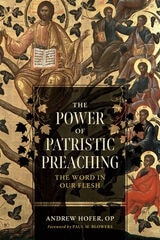
cover of The Power of Patristic Preaching: The Word in Our Flesh

The Power of Patristic Preaching

The Word in Our Flesh

Andrew Hofer, OP

Catholic University of America Press, 2023
The Word made flesh is manifested in the lives of those dedicated to his proclamation. The Power of Patristic Preaching: The Word in Our Flesh presents seven early preachers who show, by life and speech, the divine Word’s power at work in weak human life. The book is inspired by this question preached by Origen, “For what does it profit if I should say that Jesus has come in that flesh alone which he received from Mary and I should not show also that he has come in this flesh of mine?” In seven chapters, The Power of Patristic Preaching studies the exemplars of Origen for holiness, Ephrem for the humility of repentance, Gregory of Nazianzus for purification and faith, John Chrysostom for the hope of salvation, Augustine for love, Leo the Great for love of the poor and the weak, and Gregory the Great for accepting our own weakness.  With an emphasis on the incarnation, deification through the virtues, and proclamation, The Power of Patristic Preaching serves as a resource for those dedicated to the ministry of the Word (clerical, religious, and lay), and as a text for students of early Christian theology and practices. A Catholic work for a broad ecumenical audience, the book gives a cry from the heart in a suffering Church traveling through a world that is passing away.
[more]
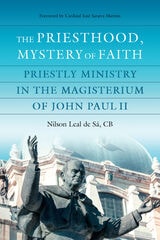
cover of The Priesthood, Mystery of Faith: Priestly Ministry in the Magisterium of John Paul II

The Priesthood, Mystery of Faith

Priestly Ministry in the Magisterium of John Paul II

Nilson Leal de Sa, CB

Catholic University of America Press, 2022
After almost twenty-seven years of his pontificate, what was John Paul II’s legacy regarding the ministerial priesthood? What answers did he give to the questions still surrounding this reality today? Nilson Leal de Sá, CB, examines the pontiff’s twenty-seven letters of Holy Thursday addressed annually to the priests. Unlike some papal documents, which are drafted by many hands, these letters to priests were born of a personal initiative, wherein the pope spoke ab imo pectore (from the depths of his heart), giving a little of himself and his thought. Cardinal Georges-Marie Cottier, theologian emeritus of the Pontifical House and a connoisseur of the texts of the Holy Father, has confirmed that “the Letters of Holy Thursday were written by John Paul II himself.” Leal de Sá has sought in the diversity of the letters of Holy Thursday the major points of the thought of John Paul II on this important topic. The first chapter dwells on the sources of his teaching and emphasizes his use of the Word of God, Tradition, and the conciliar Magisterium. These foundations are the basis of the second chapter, which highlights the priestly identity in the life of the Church. Finally, the third chapter elucidates the specific mission of the priest. The Priesthood, Mystery of Faith presents itself as a real and stimulating synthesis of John Paul II’s thought about the ministerial priesthood in a systematic way. It renews us in the appreciation of the inestimable gift that God makes to the whole Church through the sacrament of the Holy Orders.
[more]
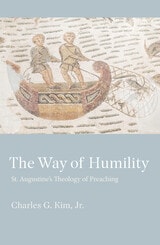
cover of The Way of Humility: St. Augustine's Theology of Preaching

The Way of Humility

St. Augustine's Theology of Preaching

Charles J. Kim

Catholic University of America Press, 2023
For Augustine, that the Word became flesh transformed a merely human understanding of the virtues and grounds all virtue in humility. The Way of Humility: Augustine’s Theology of Preaching explores how this truth became a new paradigm for understanding the scriptures and thus, how Augustine embodied the virtue in the preaching of the scriptures. One of Augustine’s most devoted students, Possidius, said that anyone can learn from reading Augustine, but “those were able to profit still more who could hear him speak in church and see him with their own eyes. Truly, he was indeed one of those of whom it is written, ‘speak this way and act the same way.’” The Way of Humility searches for evidence of the virtue of humility in action through the preaching of the humble Word in the sermons of Augustine. Many know of Augustine through his more famous treatises but few have encountered the Doctor of Grace where he had his most immediate impact, preaching. The Way of Humility follows the sermons through several traditional theological loci, ecclesiology, Christology, soteriology to uncover what can be learned about Augustine’s theology through the way he preached to a mixed audience of urbanites and rustics, many of whom did not have the benefit of a formal education. Throughout the book, we see the interplay between Augustine’s action in speech and Augustine’s more direct statements on his theology of Preaching. Through handing over Christ in his sermons, he became himself an example of humility for the congregation on their journey toward the final end for all people, the Beatific Vision.
[more]
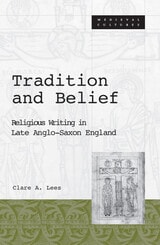
cover of Tradition And Belief: Religious Writing in Late Anglo-Saxon England

Tradition And Belief

Religious Writing in Late Anglo-Saxon England

Clara A. Lees

University of Minnesota Press, 1999

Looks at early religious texts and their influence on medieval literature and culture.

Looks at early religious texts and their influence on medieval literature and culture.

In this major study of Anglo-Saxon religious texts-sermons, homilies, and saints’ lives written in Old English-Clare A. Lees reveals how the invention of preaching transformed the early medieval church, and thus the culture of medieval England. By placing Anglo-Saxon prose within a social matrix, her work offers a new way of seeing medieval literature through the lens of culture.To show how the preaching mission of the later Anglo-Saxon church was constructed and received, Lees explores the emergence of preaching from the traditional structures of the early medieval church-its institutional knowledge, genres, and beliefs. Understood as a powerful rhetorical, social, and epistemological process, preaching is shown to have helped define the sociocultural concerns specific to late Anglo-Saxon England.The first detailed study of traditionality in medieval culture, Tradition and Belief is also a case study of one cultural phenomenon from the past. As such-and by concentrating on the theoretically problematic areas of history, religious belief, and aesthetics-the book contributes to debates about the evolving meaning of culture.ISBN 0-8166-3002-X Cloth £34.50 $49.95xxISBN 0-8166-3003-8 Paper £14.00 $19.95x232 Pages 5 7/8 x 9 NovemberMedieval Cultures Series, volume 19Translation inquiries: University of Minnesota Press
[more]