Results by title
7 books match the query 'Preface'
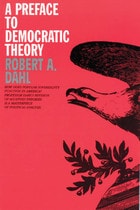
A Preface to Democratic Theory
Robert A. Dahl
University of Chicago Press, 1963
A Preface to Democratic Theory explores some problems left unsolved by traditional democratic theory, Professor Dahl examines two influential "model" theories—the Madisonian, representing the prevailing American doctrine, and its recurring challenger, the populistic theory—and argues that they no longer explain how modern democracies operate. He then constructs a model more consistent with modern political science, and, in doing so, develops some unique views of popular sovereignty and the American constitutional system.
"A Preface to Democratic Theory is well worth the devoted attention of anyone who cares about democracy. For it will have an important influence on both theory about democracy and on actual practice in democracies round the world."—Bernard Barber, Political Science Quarterly
"The book is a must for democratic theorists."—J. Roland Pennock, Journal of Politics
[more]
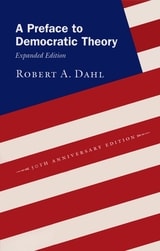
A Preface to Democratic Theory, Expanded Edition
Robert A. Dahl
University of Chicago Press, 2006
Robert Dahl’s Preface helped launch democratic theory fifty years ago as a new area of study in political science, and it remains the standard introduction to the field. Exploring problems that had been left unsolved by traditional thought on democracy, Dahl here examines two influential models—the Madisonian, which represents prevailing American doctrine, and its recurring challenger, populist theory—arguing that they do not accurately portray how modern democracies operate. He then constructs a model more consistent with how contemporary democracies actually function, and, in doing so, develops some original views of popular sovereignty and the American constitutional system.
For this fiftieth-anniversary edition, Dahl has written an extensive new afterword that reevaluates Madisonian theory in light of recent research. And in a new foreword, he reflects back on his influential volume and the ways his views have evolved since he wrote it. For any student or scholar of political science, this new material is an essential update on a gold standard in the evolving field of democratic theory.
“A Preface to Democratic Theory is well worth the devoted attention of anyone who cares about democracy.”—Political Science Quarterly
[more]

A Preface to Theology
W. Clark Gilpin
University of Chicago Press, 1996
At a time of widespread perplexity about the social role of humanistic scholarship, few disciplines are as anxious about their nature and purposes as academic theology. In this important work, W. Clark Gilpin, dean of the University of Chicago Divinity School, proposes that American theological scholarship become responsible to a threefold public: the churches, the academic community, and civil society.
Gilpin approaches this goal indirectly, by investigating the historic social roles of Protestant theologians and the educational institutions in which they have pursued their scholarship and teaching. Ranging from analyses of the New England Puritan Cotton Mather to contemporary theologians as "public intellectuals," Gilpin proposes that we find out what theology is by asking what theologians do.
By showing how particular cultural problems have always shaped the work of theologians, Gilpin's work profoundly illuminates the foundations of American academic theology, providing insights that will help guide its future.
[more]
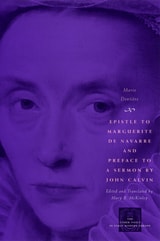
Epistle to Marguerite de Navarre and Preface to a Sermon by John Calvin
Marie Dentière
University of Chicago Press, 2004
Born to a noble family in Tournai, Marie Dentière (1495-1561) left her convent in the 1520s to work for religious reform. She married a former priest and with her husband went to Switzerland, where she was active in the Reformation's takeover of Geneva.
Dentière's Very Useful Epistle (1539) is the first explicit statement of reformed theology by a woman to appear in French. Addressed to Queen Marguerite of Navarre, sister of the French king Francis I, the Epistle asks the queen to help those persecuted for their religious beliefs. Dentière offers a stirring defense of women and asserts their right to teach the word of God in public. She defends John Calvin against his enemies and attacks the hierarchy of the Roman Catholic Church. Her Preface (1561) to one of Calvin's sermons criticizes immodesty and extravagance in clothing and warns the faithful to be vigilant. Undaunted in the face of suppression and ridicule, this outspoken woman persisted as an active voice in the Reformation.
Dentière's Very Useful Epistle (1539) is the first explicit statement of reformed theology by a woman to appear in French. Addressed to Queen Marguerite of Navarre, sister of the French king Francis I, the Epistle asks the queen to help those persecuted for their religious beliefs. Dentière offers a stirring defense of women and asserts their right to teach the word of God in public. She defends John Calvin against his enemies and attacks the hierarchy of the Roman Catholic Church. Her Preface (1561) to one of Calvin's sermons criticizes immodesty and extravagance in clothing and warns the faithful to be vigilant. Undaunted in the face of suppression and ridicule, this outspoken woman persisted as an active voice in the Reformation.
[more]
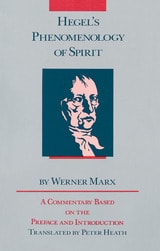
Hegel's Phenomenology of Spirit
A Commentary Based on the Preface and IntroductionWerner Marx
University of Chicago Press, 1988
Hegel's classic Phenomenology of Spirit is considered by many to be the most difficult text in all of philosophical literature. In interpreting the work, scholars have often used the Phenomenology to justify the ideology that has tempered their approach to it, whether existential, ontological, or, particularly, Marxist. Werner Marx deftly avoids this trap of misinterpretation by rendering lucid the objectives that Hegel delineates in the Preface and Introduction and using these to examine the whole of the Phenomenology. Marx considers selected materials from Hegel's text in order both to clarify Hegel's own view of it and to set the stage for an examination of post-Hegelian philosophy.
The primary focus of Marx's book is on the account. Hegel gives of the phenomenological journey from natural consciousness to philosophical wisdom (or absolute knowledge, as Hegel calls it). In showing that Hegel's many statements concerning consciousness 'finding itself' or 'knowing itself' in its world can be understood as discovering the rationality of the conditioning world, Marx offers a solution to several sets of interrelated problems that have troubled students of Hegel. His book contains valuable analyses of the relation between Hegel's thought and that of Descartes and Kant as well as that of Karl Marx, and it also sheds considerable light on the question of the internal unity or coherence of the Phenomenology.
The primary focus of Marx's book is on the account. Hegel gives of the phenomenological journey from natural consciousness to philosophical wisdom (or absolute knowledge, as Hegel calls it). In showing that Hegel's many statements concerning consciousness 'finding itself' or 'knowing itself' in its world can be understood as discovering the rationality of the conditioning world, Marx offers a solution to several sets of interrelated problems that have troubled students of Hegel. His book contains valuable analyses of the relation between Hegel's thought and that of Descartes and Kant as well as that of Karl Marx, and it also sheds considerable light on the question of the internal unity or coherence of the Phenomenology.
[more]
Preface to Modernism
Art Berman
University of Illinois Press, 1994
Traces the conceptual lineage of modernism, examining its evolution in Western art and
literature through empiricism, idealism, and romanticism. Berman demonstrates how
modern social, political, and scientific developments -- including capitalism, socialism,
humanism, psychoanalysis, fascism, and modernism itself -- have altered attitudes toward
time, space, self, creativity, the natural world, and community. "Deserves careful study."
-- Choice
[more]
Preface to the Presidency
Selected Speeches of Bill Clinton 1974-1992Stephen Smith
University of Arkansas Press, 1996
Bill Clinton has long been touted as a master of public speaking form and political discourse. Taken from his speeches as a twenty-seven-year-old candidate for Congress though his 1992 victory speech, Preface to the Presidency reveals the power and range of his contribution to our nation's political dialogue.
[more]