Results by title
8 books match the query 'Private'
Exposed Memories
Family Pictures in Private and Collective MemoryHedvig Turai
Central European University Press, 2010
Getting It, Having It, Keeping It Up
Straight Men’s Sexuality in Public and PrivateBeth Montemurro
Rutgers University Press, 2022
Latin American Law
A History of Private Law and Institutions in Spanish AmericaBy M. C. Mirow
University of Texas Press, 2004
Private law touches every aspect of people's daily lives—landholding, inheritance, private property, marriage and family relations, contracts, employment, and business dealings—and the court records and legal documents produced under private law are a rich source of information for anyone researching social, political, economic, or environmental history. But to utilize these records fully, researchers need a fundamental understanding of how private law and legal institutions functioned in the place and time period under study.
This book offers the first comprehensive introduction in either English or Spanish to private law in Spanish Latin America from the colonial period to the present. M. C. Mirow organizes the book into three substantial sections that describe private law and legal institutions in the colonial period, the independence era and nineteenth century, and the twentieth century. Each section begins with an introduction to the nature and function of private law during the period and discusses such topics as legal education and lawyers, legal sources, courts, land, inheritance, commercial law, family law, and personal status. Each section also presents themes of special interest during its respective time period, including slavery, Indian status, codification, land reform, and development and globalization.
Private, the Public, and the Published
Reconciling Private Lives and Public Rhetoricedited by Barbara Couture & Thomas Kent
Utah State University Press, 2004
At the 2003 "Rock the Vote" debate, one of the questions posed by a student to the eight Democratic candidates for the presidential nomination was "have you ever used marijuana?" Amazingly, all but one of the candidates voluntarily answered the question. Add to this example the multiple ways in which we now see public intrusion into private lives (security cameras, electronic access to personal data, scanning and "wanding" at the airport) or private self-exposure in public forums (cell phones, web cams, confessional talk shows, voyeuristic "reality" TV). That matters so private could be treated as legitimate--in some cases even vital--for public discourse indicates how intertwined the realms of private and public have become in our era. Reverse examples exist as well. Around the world, public authorities look the other way while individual rights are abused--calling it a private matter--or officials appeal to sectarian morés to justify discrimination in public policies.
The authors of The Private, the Public, and the Published feel that scholarship needs to explore and understand this phenomenon, and needs to address it in the college classroom. There are consequences of conflating public and private, they argue--consequences that have implications especially for what is known as the public good. The changing distinctions between "private" and "public," and the various practices of private and public expression, are explored in these essays with an eye toward what they teach us about those consequences and implications.
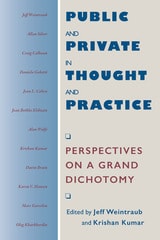
Public and Private in Thought and Practice
Perspectives on a Grand DichotomyEdited by Jeff Weintraub and Krishan Kumar
University of Chicago Press, 1997
In contexts ranging from friendship, the family, and personal life to nationalism, democratic citizenship, the role of women in social and political life, and the contrasts between western and (post-)Communist societies, this book brings out the ways the various uses of the public/private distinction are simultaneously distinct and interconnected. Public and Private in Thought and Practice will be of interest to students and scholars in disciplines including politics, law, philosophy, history, sociology, and women's studies.
Contributors include Jeff Weintraub, Allan Silver, Craig Calhoun, Daniela Gobetti, Jean L. Cohen, Jean Bethke Elshtain, Alan Wolfe, Krishan Kumar, David Brain, Karen Hansen, Marc Garcelon, and Oleg Kharkhordin.

Public and Private
Gender, Class, and the British Novel (1764-1878)Patricia McKee
University of Minnesota Press, 1997
Public and Private was first published in 1997. Minnesota Archive Editions uses digital technology to make long-unavailable books once again accessible, and are published unaltered from the original University of Minnesota Press editions.
This groundbreaking work examines the emergent and fluctuating relationship between the public and private social spheres of the late eighteenth and nineteenth centuries. By assessing novels such as Mary Shelley's Frankenstein and Jane Austen's Emma through the lens of the social theories of Jürgen Habermas and Michel Foucault, Patricia McKee presents a fresh and highly original contribution to literary studies.
McKee explores the themes of production and consumption as they relate to gender and class throughout the works of many of the most influential novels of the age including Tobias Smollett's Humphry Clinker, Horace Walpole's The Castle of Otranto, Emma, Frankenstein, Anthony Trollope's Barchester Towers, Charles Dickens's Little Dorrit and The Old Curiosity Shop, Mrs. Henry Wood's East Lynne, and Thomas Hardy's The Return of the Native.
McKee analyzes portrayals of a society in which abstract idealism belonged to knowledgeable, productive men and the realm of ignorance was left to emotional, consuming women and the uneducated. She traces the various ways British literature of the eighteenth and nineteenth centuries worked to reform this social experience. Topics include Dickens's attack on the bureaucratic use of knowledge to maintain the status quo; the function of antiprogressive depictions of knowledge in Trollope, Shelley, and Hardy; and Austen's characterization of the protagonist Emma as an exception in a society that denied women's productive use of knowledge.
Offering a sharp challenge to theorists who have charted a linear division of public and private experience, McKee highlights the unexpected configurations of the emergence of the public and private spheres and the effect of knowledge distribution across class and gender lines.
Patricia McKee is professor of English at Dartmouth College. She is the author of Heroic Commitment in Richardson, Eliot, and James (1986).
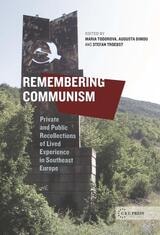
Remembering Communism
Private and Public Recollections of Lived Experience in Southeast EuropeContributors: Simina Bădica, Iskra Baeva, Tanya Boneva, Corina Cimpoieru, Liliana Deyanova, Albena Hranova, Nataliya Hristova, Petya Kabakchieva, Evgenia Kalinova, Anny Kirilova, Thomas Lindenberger, Tamás Lőnhárt, Izabella Main, Tsvetana Manova, Iliiana Marcheva, Vasil Markov, Andi Mihalache, Cătălina Mihalache, Milla Mineva, Cristina Petrescu, Dragoş Petrescu, Vania Stoyanova, Virgiliu Ţârău, Nikolai Vukov, Smaranda Vultur
Central European University Press, 2014
Remembering Communism examines the formation and transformation of the memory of communism in the post-communist period. The majority of the articles focus on memory practices in the post-Stalinist era in Bulgaria and Romania, with occasional references to the cases of Poland and the GDR. Based on an interdisciplinary approach, including history, anthropology, cultural studies and sociology, the volume examines the mechanisms and processes that influence, determine and mint the private and public memory of communism in the post-1989 era. The common denominator to all essays is the emphasis on the process of remembering in the present, and the modalities by means of which the present perspective shapes processes of remembering, including practices of commemoration and representation of the past.
The volume deals with eight major thematic blocks revisiting specific practices in communism such as popular culture and everyday life, childhood, labor, the secret police, and the perception of “the system”.
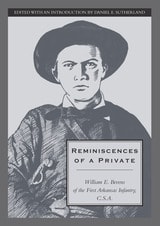
Reminiscences of a Private
William E. Bevens of the First Arkansas Infantry C.S.A.Daniel E. Sutherland
University of Arkansas Press, 1999