Results by title
18 books match the query 'Professions'
Aging and Society
Aging and the ProfessionsMatilda White Riley
Russell Sage Foundation, 1969
Doctors, Ambassadors, Secretaries
Humanism and Professions in Renaissance ItalyDouglas Biow
University of Chicago Press, 2002
Examining a wide range of treatises, poems, and other works that humanists wrote both as and about doctors, ambassadors, and secretaries, Biow shows how interactions with these professions forced humanists to make their studies relevant to their own times, uniting theory and practice in a way that strengthened humanism. His detailed analyses of writings by familiar and lesser-known figures, from Petrarch, Machiavelli, and Tasso to Maggi, Fracastoro, and Barbaro, will especially interest students of Renaissance Italy, but also anyone concerned with the rise of professionalism during the early modern period.
Medieval Callings
Edited by Jacques Le Goff
University of Chicago Press, 1990
The contributors focus on attitudes of medieval men and women toward their own society. Through a variety of techniques, from a reading of the Song of Roland to a reading of administrative records, they identify characteristic viewpoints of members of the fighting class, the clergy, and the peasantry. Along with vivid descriptions of what life was like for warrior knights, monks, high churchmen, criminals, lepers, shepherds, and prostitutes, this innovative approach offers a valuable new perspective on the complex social dynamics of feudal Europe.
"Very useful discussions of texts, both learned and literary."—Christopher Dyer, Times Literary Supplement
Contributors: Mariateresa Fumagalli Beonio Brocchieri, Franco Cardini, Enrico Castelnuovo, Giovanni Cherubini, Bronislaw Geremek, Aron Ja. Gurevich, Christiane Klapisch-Zuber, Jacques Le Goff, Giovanni Miccoli, Jacques Rossiaud, and André Vauchez.
Mobilizing Interest Groups in America
Patrons, Professions, and Social MovementsJack L. Walker
University of Michigan Press, 1991

Professional Powers
A Study of the Institutionalization of Formal KnowledgeEliot Freidson
University of Chicago Press, 1986
"As an attempt to provide a complex, wide-ranging account this book should be essential reading for specialist students, and it should act as a stimulus for the extension of both empirical research and theory."—Alex Faulkner, Sociological Review
"Freidson's book is a concise introduction to the professions, challenging specialists with its puncturing of theoretically induced misconceptions and offering general readers a clear but critical entrée to the theoretical literature concerning this central aspect of modern society."—Andrew Abbott, Science
"This is a stimulating and well-written book which opens up a new perspective on the professions as well as contributing to existing debates."—David Podmore, Times Higher Education Supplement
Professionalism Reborn
Theory, Prophecy, and PolicyEliot Freidson
University of Chicago Press, 1994
In this concise synthesis of the major debates about the professions since World War II, Eliot Freidson explores several broad questions about professionalism today—what it is, what its future is likely to be, and its value to public policy. Freidson argues that because professionalism is based on specialized knowledge, it is distinct from either bureaucratic or market-based forms of work. He predicts a rebirth of the professions during which practitioners lose some of their independence and become more accountable to standards of a professional elite. And, defending professionalism as a desirable method of providing complex, discretionary services to the public, Freidson argues that market-based or bureaucratic methods would impoverish the quality of service to consumers, and suggests ways the virtues of professionalism can be reinforced.
The most accessible survey available of almost fifty years of theory and research by the scholar whose own work helped define the field, this book will appeal to the growing international body of scholars concerned with studying and theorizing about the professions.
Professionalism, the Third Logic
On the Practice of KnowledgeEliot Freidson
University of Chicago Press, 2021
Freidson then appraises the present status of professionalism, exploring how traditional and national variations in state policy and organization are influencing the power and practice of such professions as medicine and law. Widespread attacks by neoclassical economists and populists, he contends, are obscuring the social value of credentialism and monopolies. The institutions that sustain professionalism in our world are simply too useful to both capital and state to dismiss.

Professions And The State
Expertise and Autonomy in the Soviet Union and Eastern Europeedited by Anthony Jones
Temple University Press, 1991
Unlike autonomous professionals in Western industrialized democracies, professionals in a socialist, bureaucratic setting operate as employees of the state. The change in environment has important Implications not only for the practice of professions but also for the concept of professionalism itself. This collection of nine essays is the first to survey the major professions In the USSR, Czechoslovakia, and Poland. The contributors investigate the implications of professional experience in a socialist economy as well as relating changes in professional organization and power to reform movements in general and perestroika in particular.
In the series Labor and Social Change, edited by Paula Rayman and Carmen Sirianni.

Professions in Contemporary Drama
Edited by Daniel Meyer-Dinkgräfe
Intellect Books, 1995
The Professions in Contemporary British Drama fills this extraordinary gap with a series of nine papers discussing the educational professions (Bennett, Mangan), the medical profession (Shields, Buse, ), priests (Kurdi), archaeologists (Forsyth) and artists (Di Benedetto, Meyer-Dinkgräfe, Edwards).
The book is of relevance to theatre academics and students at both undergraduate and postgraduate levels. It is based on a conference organised in conjunction with the Centre for English Studies, School of Advanced Studies, University of London, 6 March 1998.
Professions
Conversations on the Future of Literary and Cultural StudiesEdited by Donald E. Hall
University of Illinois Press, 2001
This volume bares professional concerns, relationships, ambitions, and insecurities about working in academe. Professions provides hard-to-get insider information for students contemplating an academic career. It also challenges professional scholars to retrieve the intellectual curiosity that drew them to scholarship in the first place while demonstrating how disagreement on controversial issues can be conducted with respect, good humor, and an open mind.
Professions features:
Jane Tompkins and Gerald Graff
John McGowan and Regenia Gagnier
James Phelan and James Kincaid
Marjorie Perloff and Robert von Hallberg
Judith Jackson Fossett and Kevin Gaines
Dennis W. Allen and Judith Roof
Niko Pfund, Gordon Hutner, and Martha Banta
Geoffrey Galt Harpham
Donald E. Hall and Susan S. Lanser
J. Hillis Miller, Herbert Lindenberger, Sandra Gilbert, Bonnie Zimmerman, Nellie Y. McKay, and Elaine Marks
Textual Dynamics
Historical & Contemporary Studies OfCharles Bazerman
University of Wisconsin Press, 1991
Invaluable to the new pedagogical field of “writing across the curriculum,” Textual Dynamics of the Professions is also a significant intervention into the studies of rhetoric, writing theory, and the sociology of knowledge.
The American School Counselor
A Case Study in the Sociology of ProfessionsDavid J. Armor
Russell Sage Foundation, 1969
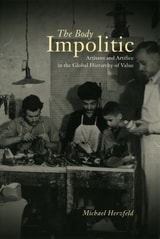
The Body Impolitic
Artisans and Artifice in the Global Hierarchy of ValueMichael Herzfeld
University of Chicago Press, 2003
Michael Herzfeld takes us inside a rich variety of small-town Cretan artisans' workshops to show how apprentices are systematically thwarted into learning by stealth and guile. This harsh training reinforces a stereotype of artisans as rude and uncultured. Moreover, the same stereotypes that marginalize artisans locally also operate to marginalize Cretans within the Greek nation and Greece itself within the international community. What Herzfeld identifies as "the global hierarchy of value" thus frames the nation's ancient monuments and traditional handicrafts as evidence of incurable "backwardness."
Herzfeld's sensitive observations offer an intimately grounded way of understanding the effects of globalization and of one of its most visible offshoots, the heritage industry, on the lives of ordinary people in many parts of the world today.
The Professions
Roles and RulesWilbert Ellis Moore
Russell Sage Foundation, 1970

The Quest for Authority and Honor in the American Professions, 1750-1900
Samuel Haber
University of Chicago Press, 1991
Contrary to those who regard the professions as exemplary and up-to-date specimens of social modernization or economic monopoly, Haber argues that they bring both preindustrial and predemocratic ideals and standards into our modern world. He proposes that the values embedded in the professions—authority and honor, fused with duty and responsibility—have their origins in the class position and occupational prescriptions of eighteenth-century English gentlemen. Such an argument has implications for the understanding of American society; it underscores the cumulative and variegated nature of our culture and suggests the drawbacks of trying to describe society as a system. It also accords with Haber's endeavor to write a history that rescues for description and analysis mixed motives, composite conditions, and persons and parties acting upon contradictory explanatory schemes.
Haber traces the cultural evolution of the professions through three stages—establishment (1750-1830), disestablishment (1830-1880), and reestablishment (1880-1900). He shows that when the gentlemanly class declined in the United States, the professions maintained status even in somewhat hostile settings. The professions thus came to be seen as a middle way between the pursuits of laborers and those of capitalists. Massive in scale and ambition, this book will have a formidable impact among scholars newly attuned to the history of American middle-class culture.

The Stars Are Not Enough
Scientists--Their Passions and ProfessionsJoseph C. Hermanowicz
University of Chicago Press, 1998
These deeply personal narratives reveal dreams of fame and glory, in which scientists confess their ambitions of becoming the next Newton or Einstein. However, these scientists also discuss the meaning of success and failure. We hear their stories of aspiration and anxiety, disappointment and tragedy, hope and achievement; we are privy to their doubts and to what they consider to be their limitations and weaknesses. As the scientists age in their professions, the specter of failure often visits them, and they have to accept something less than scientific immortality or even the Nobel Prize.
Ultimately these stories give us more than an inside look at the details of careers in science, they also examine ambition by uncovering the forces that drive people in their professions and by describing how these forces persist or fade over time. Ambition for greatness often ignites a career and often sustains it. Yet, as Hermanowicz's study reveals, greatness eludes nearly all people in their heroic quests for extraordinary achievement. The Stars Are Not Enough offers a fascinating account that will appeal to anyone interested in how people's dreams blossom and evolve.
The System of Professions
An Essay on the Division of Expert LaborAndrew Abbott
University of Chicago Press, 1988
Trade and Taboo
Disreputable Professions in the Roman MediterraneanSarah E. Bond
University of Michigan Press, 2016
In this book, Sarah E. Bond reveals the construction and motivations for these attitudes, and to show how they created inequalities, informed institutions, and changed over time. Additionally, she shows how political and cultural shifts mutated these taboos, reshaping economic markets and altering the status of professionals at work within these markets.
Bond investigates legal stigmas in the form of infamia and other marks of legal disrepute. She expands on anthropological theories of pollution, closely studying individuals who regularly came into contact with corpses and other polluting materials, and considering communication and network formation through the disrepute attached to town criers, or praecones. Ideas of disgust and the language of invective are brought forward looking at tanners. The book closes with an exploration of caste-like systems created in the later Roman Empire. Collectively, these professionals are eloquent about economies and changes experienced within Roman society between 45 BCE and 565 CE.
Trade and Taboo will interest those studying Roman society, issues of historiographical method, and the topic of taboo in preindustrial cultures.