Results by title
5 books match the query 'Prosody'
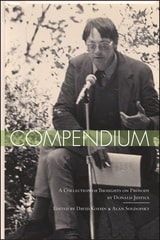
Compendium
A Collection of Thoughts on ProsodyDonald Justice
Omnidawn, 2017
Justice’s insights serve as a sort of de facto taxonomy, an organically designed system that he uses to present his lecture on each respective aspect of the evolution of poetic form. There is no formal thesis here, but rather a kind of scrapbook that has a broader motive. The material possesses no hidden secrets; the treasures lie in plain sight and simply need be discerned to open the artist’s mind to their possibilities.
[more]
Free Verse
An Essay on ProsodyCharles O. Hartman
Northwestern University Press, 1996
To make sense of "free verse" in theory of in practice, the study of prosody—the function of rhythm in poetry—must be revised and rethought. In Free Verse: An Essay on Prosody, Charles Hartman develops a theory of prosody that includes the most characteristic form of twentieth-century poetry.
[more]
Sound and Form in Modern Poetry
A Study of Prosody from Thomas Hardy to Robert LowellHarvey Gross
University of Michigan Press, 1964
Sound and Form in Modern Poetry: A Study of Prosody from Thomas Hardy to Robert Lowell by Harvey Gross offers a comprehensive and nuanced exploration of poetic form and prosody in twentieth-century poetry. Delving deeply into the rhythmic and sonic dimensions that shape modern English verse, Gross guides readers through both traditional metrical conventions and the innovative departures of modern poets.Navigating the “dark wood” of conflicting theories and approaches to poetic rhythm, Gross traces the evolution of English-language prosody from the late nineteenth century to the mid-twentieth century. The book provides detailed analyses of the techniques and stylistic achievements of poets such as Thomas Hardy, W. B. Yeats, Robert Frost, Marianne Moore, Ezra Pound, T. S. Eliot, Hart Crane, W. H. Auden, Dylan Thomas, and Robert Lowell. Gross doesn't just analyze meter—he considers a broader concept of rhythmic structure, one that encompasses visual, syntactic, and auditory patterns and recognizes prosody as a vital means by which poetry communicates feeling, expectation, and psychological process.Blending close readings, literary criticism, and insights from linguistics and aesthetics, Sound and Form in Modern Poetry challenges simplistic accounts of meter and embraces the complexity of both metrical and nonmetrical verse. Generously referencing both classical and contemporary critics, the book supplies readers with a clear framework for understanding the convergences and tensions between tradition and innovation in modern poetry. Essential for students, scholars, and poetry lovers alike, Gross’s study reveals how the nuances of sound and rhythm are central to a poem’s expressive power.
[more]
The Ghost of Meter
Culture and Prosody in American Free VerseAnnie Finch
University of Michigan Press, 1993
The Ghost of Meter: Culture and Prosody in American Free Verse provides a new strategy for interpreting the ways in which metrical patterns contribute to the meaning of poems. Annie Finch puts forth the theory of "the metrical code," a way of tracing the changing cultural connotations of metered verse, especially iambic pentameter. By applying the code to specific poems, the author is able to analyze a writer's relation to literary history and to trace the evolution of modern and contemporary poetries from the forms that precede them.Poet, translator, and critic Annie Finch is director of the Stonecoast low-residency MFA program at the University of Southern Maine. She is co-editor, with Kathrine Varnes, of An Exaltation of Forms: Contemporary Poets Celebrate the Diversity of Their Art, and author of Calendars. She is the winner of the eleventh annual Robert Fitzgerald Prosody Award for scholars who have made a lasting contribution to the art and science of versification. Author bio:Annie Finch, poet, editor, and critic, has published twenty books of poetry and poetics including Spells: New and Selected Poems, The Body of Poetry: Essays on Women, Form, and the Poetic Self, An Exaltation of Forms: Contemporary Poets Celebrate the Diversity of Their Art, A Poet's Craft: A Comprehensive Guide to Making and Sharing Your Poetry, and The Ghost of Meter: Culture and Prosody in American Free Verse. Based in New York, Dr. Finch travels widely to teach and perform her poetry and is the founder of PoetryWitchCommunity.org, where she teaches poetry, meter, and more. She is the winner of the eleventh annual Robert Fitzgerald Prosody Award for scholars who have made a lasting contribution to the art and science of versification.
[more]
Yuarn Music Dramas
Studies in Prosody and Structure and a Complete Catalogue of Northern Arias in the Dramatic StyleDale R. Johnson
University of Michigan Press, 1981
Part One of Yuarn Music Dramas presents a detailed analysis of form and structure in Yuarn music drama, with sections on the act, the suite, the aria, the verse, metrics of repeated graph patterns, parallelism, and the matching of suite and mode. [vii]
Part Two presents the first catalogue of arias of its kind to be published in a language other than Chinese. It is a compilation of all of the arias in the northern dramatic style that are found in the 162 titles contained in the Yuarn-chyuu shyuann and the Yuarn-chyuu shyuaan waih-bian. It is modeled on several such catalogues compiled over the past six hundred years. [99]
[more]