Results by title
14 books match the query 'Prosperity'
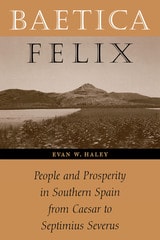
Baetica Felix
People and Prosperity in Southern Spain from Caesar to Septimius SeverusBy Evan W. Haley
University of Texas Press, 2003
Baetica, the present-day region of Andalusia in southern Spain, was the wealthiest province of the Roman Empire. Its society was dynamic and marked by upward social and economic mobility, as the imperial peace allowed the emergence of a substantial middle social and economic stratum. Indeed, so mutually beneficial was the imposition of Roman rule on the local population of Baetica that it demands a new understanding of the relationship between Imperial Rome and its provinces.
Baetica Felix builds a new model of Roman-provincial relations through a socio-economic history of the province from Julius Caesar to the end of the second century A.D. Describing and analyzing the impact of Roman rule on a core province, Evan Haley addresses two broad questions: what effect did Roman rule have on patterns of settlement and production in Baetica, and how did it contribute to wealth generation and social mobility? His findings conclusively demonstrate that meeting the multiple demands of the Roman state created a substantial freeborn and ex-slave "middle stratum" of the population that outnumbered both the super-rich elite and the destitute poor.
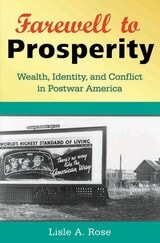
Farewell to Prosperity
Wealth, Identity, and Conflict in Postwar AmericaLisle A. Rose
University of Missouri Press, 2014

Hollywood Faith
Holiness, Prosperity, and Ambition in a Los Angeles ChurchMarti, Gerardo
Rutgers University Press, 2008
In Hollywood Faith, Gerardo Marti shows how a multiracial evangelical congregation of 2,000 people accommodates itself to the entertainment industry and draws in many striving to succeed in this harsh and irreverent business. Oasis strategically sanctifies ambition and negotiates social change by promoting a new religious identity as "champion of life"-an identity that provides people who face difficult career choices and failed opportunities a sense of empowerment and endurance.
The first book to provide an in-depth look at religion among the "creative class," Hollywood Faith will fascinate those interested in the modern evangelical movement and anyone who wants to understand how religion adapts to social change.
In Pursuit of Prosperity
Industrial Policy and the Politics of Economic UpgradingCharles R. Hankla
University of Michigan Press, 2025
Using a mixed-methods approach, Charles R. Hankla draws upon archival research and interviews from France and India as well as quantitative models of sixteen countries across six decades. He finds that when state and private actors are aligned in their institutional structures, which can happen in both corporatist and pluralist systems, industrial policy tends to be more effective. It is when the state or the private sector independently dominates industrial policy that poor outcomes are most likely. As In Pursuit of Prosperity shows, rather than being fixed characteristics of countries, policymaking styles vary across time and across sectors of the economy, reflecting the changing power dynamics and organizational resources of stakeholders. The book sheds light on how industrial policy—which is experiencing a comeback in the United States and beyond—can best be harnessed for upgrading. It offers a valuable contribution to our understanding of the complex relationship between state politics and economic performance in the modern globalized world.
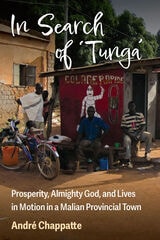
In Search of Tunga
Prosperity, Almighty God, and Lives in Motion in a Malian Provincial TownAndré Chappatte
University of Michigan Press, 2022
In the context of the current global war on terrorism, most studies of Muslim life have focused on the politics of piety of reformist movements, their leaders, and members. By contrast, In Search of “Tunga” takes a perspective from below. It opens piety up to “simply Muslims,” although the religious elites have always claimed authority and legitimacy over piety. Is piety an exclusive field of experiences for those who claim to strive for it? What does piety involve for the majority of Muslims, the non-elite and unaffiliated Muslims? This volume “democratizes” piety by documenting its practice as going beyond sharply defined religious affiliations and Islamic scholarship, and by showing it is both alive and normative, existential and prescriptive. As opposed to studies that build on the classic historical connections between the Maghreb and the Sahel, the southbound migration from the Sahel documented in this book stresses the overlooked historical connections between the southern shores of the Sahara and the lands south of those shores. It demonstrates how the Malian savanna, this former buffer-zone between ancient Mande kingdoms and thereafter remote areas of French Sudan, is increasingly becoming central in today’s Sahel contexts of desiccation and insecurity.
Labyrinths of Prosperity
Economic Follies, Democratic RemediesReuven Brenner
University of Michigan Press, 1994
Paradoxes of Prosperity
Wealth Seeking in Pre-Civil War AmericaLorman A. Ratner, Paula T. Kaufman and Dwight L. Teeter Jr.
University of Illinois Press, 2008
At the same time, the United States felt the influence of the rise of popular mass-circulation newspapers and magazines and the surge in American book publishing. Concern over living correctly as well as prosperously was commonly discussed by leading authors and journalists, who were now writing for ever-expanding regional and national audiences. Women became more important as authors and editors, giving advice and building huge markets for women readers, with the magazine Godey's Lady's Book and novels by Susan Warner, Maria Cummins, and Harriet Beecher Stowe expressing women's views about the troubled state of society. Best-selling male writers--including novelist George Lippard, historian George Bancroft, and travel writer Bayard Taylor--were among those adding their voices to concerns about prosperity and morality and about America's place in the world. Writers and publishers discovered that a high moral tone could be exceedingly good for business.
The authors of this book examine how popular writers and widely read newspapers, magazines, and books expressed social tensions between prosperity and morality. This study draws on that nationwide conversation through leading mass media, including circulation-leading newspapers, the New York Herald and the New York Tribune, plus prominent newspapers from the South and West, the Richmond Enquirer and the Cincinnati Enquirer. Best-selling magazines aimed at middle-class tastes, Harper's Magazine and the Southern Literary Messenger, added their voices, as did two leading business magazines.
Prosperity in the Twenty-First Century
Concepts, Models and MetricsEdited by Henrietta L. Moore, Matthew Davies, Nikolay Mintchev, and Saffron Woodcraft
University College London, 2023
Prosperity in the Twenty-First Century sets out a new vision for prosperity in the twenty-first century and how it can be achieved for all. The volume challenges orthodox understandings of economic models but goes beyond contemporary debates to show how social innovation drives economic value. Drawing on substantive research in the UK, Lebanon, and Kenya, it develops new concepts, frameworks, models, and metrics for prosperity across a wide range of contexts, emphasizing commonalities and differences. Departing from general propositions about post-growth to delineate pathways to prosperity, the volume emphasizes that visions of the good life are diverse and require empirical work co-designed with local communities and stakeholders to drive change. It will be essential reading for policymakers who are stuck, local government officers who need new tools, activists who wonder what is next, academics in need of refreshment, and students and people of all ages who want a way forward.
The Menace of Prosperity
New York City and the Struggle for Economic Development, 1865–1981Daniel Wortel-London
University of Chicago Press, 2025
Many local policymakers make decisions based on a deep-seated belief: what’s good for the rich is good for cities. Convinced that local finances depend on attracting wealthy firms and residents, municipal governments lavish public subsidies on their behalf. Whatever form this strategy takes—tax-exempt apartments, corporate incentives, debt-financed mega projects—its rationale remains consistent and assumed to be true. But this wasn’t always the case. Between the 1870s and the 1970s, a wide range of activists, citizens, and intellectuals in New York City connected local fiscal crises to the greed and waste of the rich. These figures saw other routes to development, possibilities rooted in alternate ideas about what was fiscally viable.
In The Menace of Prosperity, Daniel Wortel-London argues that urban economics and politics are shaped by what he terms the “fiscal imagination” of policymakers, activists, advocates, and other figures. His survey of New York City during a period of explosive growth shows how residents went beyond the limits of redistributive liberalism to imagine how their communities could become economically viable without the largesse of the wealthy. Their strategies—which included cooperatives, public housing, land-value taxation, public utilities, and more—centered the needs and capabilities of ordinary residents as the basis for local economies that were both prosperous and just.
Overturning stale axioms about economic policy, The Menace of Prosperity shows that not all growth is productive for cities. Wortel-London’s ambitious history demonstrates the range of options we’ve abandoned and hints at the economic frameworks we could still realize—and the more democratic cities that might result.
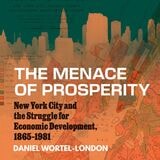
The Menace of Prosperity
New York City and the Struggle for Economic Development, 1865–1981Daniel Wortel-London
University of Chicago Press, 2025
Upends entrenched thinking about cities, demonstrating how urban economies are defined—or constrained—by the fiscal imagination of policymakers, activists, and residents.
Many local policymakers make decisions based on a deep-seated belief: what’s good for the rich is good for cities. Convinced that local finances depend on attracting wealthy firms and residents, municipal governments lavish public subsidies on their behalf. Whatever form this strategy takes—tax-exempt apartments, corporate incentives, debt-financed mega projects—its rationale remains consistent and assumed to be true. But this wasn’t always the case. Between the 1870s and the 1970s, a wide range of activists, citizens, and intellectuals in New York City connected local fiscal crises to the greed and waste of the rich. These figures saw other routes to development, possibilities rooted in alternate ideas about what was fiscally viable.
In The Menace of Prosperity, Daniel Wortel-London argues that urban economics and politics are shaped by what he terms the “fiscal imagination” of policymakers, activists, advocates, and other figures. His survey of New York City during a period of explosive growth shows how residents went beyond the limits of redistributive liberalism to imagine how their communities could become economically viable without the largesse of the wealthy. Their strategies—which included cooperatives, public housing, land-value taxation, public utilities, and more—centered the needs and capabilities of ordinary residents as the basis for local economies that were both prosperous and just.
Overturning stale axioms about economic policy, The Menace of Prosperity shows that not all growth is productive for cities. Wortel-London’s ambitious history demonstrates the range of options we’ve abandoned and hints at the economic frameworks we could still realize—and the more democratic cities that might result.
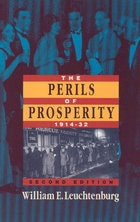
The Perils of Prosperity, 1914-1932
William E. Leuchtenburg
University of Chicago Press, 1993
William E. Leuchtenburg's lively yet balanced account of this hotly debated era in American history has been a standard text for many years. This substantial revision gives greater weight to the roles of women and minorities in the great changes of the era and adds new insights into literature, the arts, and technology in daily life. He has also updated the lists of important dates and resources for further reading.
“This book gives us a rare opportunity to enjoy the matured interpretation of an American Historian who has returned to the story and seen how recent decades have added meaning and vividness to this epoch of our history.”—Daniel J. Boorstin, from the Preface
The Perils of Prosperity, 1914-1932
William E. Leuchtenburg
University of Chicago Press, 1993
Beginning with Woodrow Wilson and U.S. entry into World War I and closing with the Great Depression, The Perils of Prosperity traces the transformation of America from an agrarian, moralistic, isolationist nation into a liberal, industrialized power involved in foreign affairs in spite of itself.
William E. Leuchtenburg's lively yet balanced account of this hotly debated era in American history has been a standard text for many years. This substantial revision gives greater weight to the roles of women and minorities in the great changes of the era and adds new insights into literature, the arts, and technology in daily life. He has also updated the lists of important dates and resources for further reading.
“This book gives us a rare opportunity to enjoy the matured interpretation of an American Historian who has returned to the story and seen how recent decades have added meaning and vividness to this epoch of our history.”—Daniel J. Boorstin, from the Preface
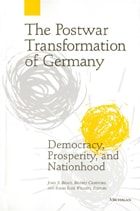
The Postwar Transformation of Germany
Democracy, Prosperity and NationhoodJohn S. Brady, Beverly Crawford, and Sarah Elise Wiliarty, Editors
University of Michigan Press, 1999

War, Peace, and Prosperity in the Name of God
The Ottoman Role in Europe's Socioeconomic EvolutionMurat Iyigun
University of Chicago Press, 2015
War, Peace, and Prosperity in the Name of God turns the focus on the “big three monotheisms”—Judaism, Islam, and Christianity—to consider these questions. Chronicling the relatively rapid spread of the Abrahamic religions among the Old World, Murat Iyigun shows that societies that adhered to a monotheistic belief in that era lasted longer, suggesting that monotheism brought some sociopolitical advantages. While the inherent belief in one true god meant that these religious communities had sooner or later to contend with one another, Iyigun shows that differences among them were typically strong enough to trump disagreements within. The book concludes by documenting the long-term repercussions of these dynamics for the organization of societies and their politics in Europe and the Middle East.