Results by title
2 books match the query 'Proteins'
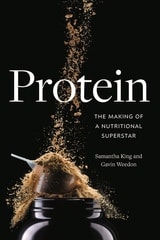
Protein
The Making of a Nutritional SuperstarSamantha King and Gavin Weedon
Duke University Press, 2026
Protein explores the contemporary obsession with a nutritional superstar, tracing how protein moves through food systems and fitness cultures, strengthening some bodies and environments at the expense of others.
Protein is everywhere—praised as a muscle builder, a weight-loss miracle, an anti-aging elixir, and the catch-all solution for everything from exercise recovery to global malnutrition. In Protein, Samantha King and Gavin Weedon argue that protein’s rise to nutritional superstardom has less to do with human dietary needs and more to do with how its indeterminate, adhesive qualities are marshalled towards commercial, scientific, and social imperatives. Tracing its path from nineteenth-century biochemistry to the status it enjoys today, they expose how protein has been marketed as a cure for global hunger, repackaged as an eco-friendly meat alternative, and wielded as a symbol of masculinity in the fitness industry. From whey waste in industrial farming to longevity drugs for aging bodies, Protein unpacks the myths behind the macronutrient and challenges what we think we know about food, health, and the forces that shape our diets.
Protein is everywhere—praised as a muscle builder, a weight-loss miracle, an anti-aging elixir, and the catch-all solution for everything from exercise recovery to global malnutrition. In Protein, Samantha King and Gavin Weedon argue that protein’s rise to nutritional superstardom has less to do with human dietary needs and more to do with how its indeterminate, adhesive qualities are marshalled towards commercial, scientific, and social imperatives. Tracing its path from nineteenth-century biochemistry to the status it enjoys today, they expose how protein has been marketed as a cure for global hunger, repackaged as an eco-friendly meat alternative, and wielded as a symbol of masculinity in the fitness industry. From whey waste in industrial farming to longevity drugs for aging bodies, Protein unpacks the myths behind the macronutrient and challenges what we think we know about food, health, and the forces that shape our diets.
[more]
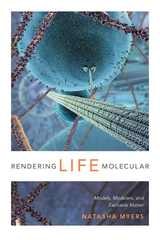
Rendering Life Molecular
Models, Modelers, and Excitable MatterNatasha Myers
Duke University Press, 2015
What are living bodies made of? Protein modelers tell us that our cells are composed of millions of proteins, intricately folded molecular structures on the scale of nanoparticles. Proteins twist and wriggle as they carry out the activities that keep cells alive. Figuring out how to make these unruly substances visible, tangible, and workable is a challenging task, one that is not readily automated, even by the fastest computers. Natasha Myers explores what protein modelers must do to render three-dimensional, atomic-resolution models of these lively materials. Rendering Life Molecular shows that protein models are not just informed by scientific data: model building entangles a modeler’s entire sensorium, and modelers must learn to feel their way through the data in order to interpret molecular forms. Myers takes us into protein modeling laboratories and classrooms, tracking how gesture, affect, imagination, and intuition shape practices of objectivity. Asking, ‘What is life becoming in modelers' hands?’ she tunes into the ways they animate molecules through their moving bodies and other media. In the process she amplifies an otherwise muted liveliness inflecting mechanistic accounts of the stuff of life.
[more]