Results by title
37 books match the query 'Protest'
A Century of Brazilian Documentary Film
From Nationalism to ProtestDarlene J. Sadlier
University of Texas Press, 2022
Since the late nineteenth century, Brazilians have turned to documentaries to explain their country to themselves and to the world. In a magisterial history covering one hundred years of cinema, Darlene J. Sadlier identifies Brazilians’ unique contributions to a diverse genre while exploring how that genre has, in turn, contributed to the making and remaking of Brazil.
A Century of Brazilian Documentary Film is a comprehensive tour of feature and short films that have charted the social and political story of modern Brazil. The Amazon appears repeatedly and vividly. Sometimes—as in a prize-winning 1922 feature—the rainforest is a galvanizing site of national pride; at other times, the Amazon has been a focus for land-reform and Indigenous-rights activists. Other key documentary themes include Brazil’s swings from democracy to dictatorship, tensions between cosmopolitanism and rurality, and shifting attitudes toward race and gender. Sadlier also provides critical perspectives on aesthetics and media technology, exploring how documentaries inspired dramatic depictions of poverty and migration in the country’s Northeast and examining Brazilians’ participation in streaming platforms that have suddenly democratized filmmaking.

Articulating Dissent
Protest and the Public SpherePollyanna Ruiz
Pluto Press, 2014
Articulating Dissent analyses the new communicative strategies of coalition protest movements and how these impact on a mainstream media unaccustomed to fractured articulations of dissent.
Pollyanna Ruiz shows how coalition protest movements against austerity, war and globalisation build upon the communicative strategies of older single issue campaigns such as the anti-criminal justice bill protests and the women’s peace movement. She argues that such protest groups are dismissed in the mainstream for not articulating a ‘unified position’ and explores the way in which contemporary protesters stemming from different traditions maintain solidarity.
Articulating Dissent investigates the ways in which this diversity, so inherent in coalition protest, affects the movement of ideas from the political margins to the mainstream. In doing so this book offers an insightful and original analysis of the protest coalition as a developing political form.
Beyond Civil Society
Activism, Participation, and Protest in Latin AmericaSonia E. Alvarez, Jeffrey W. Rubin, Millie Thayer, Gianpaolo Baiocchi, and Agustín Laó-Montes, editors
Duke University Press, 2017
Contributors. Sonia E. Alvarez, Kiran Asher, Leonardo Avritzer, Gianpaolo Baiocchi, Andrea Cornwall, Graciela DiMarco, Arturo Escobar, Raphael Hoetmer, Benjamin Junge, Luis E. Lander, Agustín Laó-Montes, Margarita López Maya, José Antonio Lucero, Graciela Monteagudo, Amalia Pallares, Jeffrey W. Rubin, Ana Claudia Teixeira, Millie Thayer

Beyond Vietnam
The Politics of Protest in Massachusetts, 1974-1990Robert Surbrug
University of Massachusetts Press, 2009
Narratives of the 1960s typically describe an ascending arc of political activism that peaked in 1968, then began a precipitous descent as the revolutionary dreams of the New Left failed to come to fruition. The May 1970 killings at Kent State often stand as an epitaph to a decade of protest, after which the principal story becomes the resurgence of the right.
In Beyond Vietnam: The Politics of Protest in Massachusetts, 1974–1990, Robert Surbrug challenges this prevailing paradigm by examining three protest movements that were direct descendants of Vietnam-era activism: the movement against nuclear energy; the nuclear weapons freeze movement; and the Central American solidarity movement. Drawing lessons from the successes and failures of the preceding era, these movements had a significant impact on the liberal wing of the Democratic Party, which itself had been undergoing major transformations in the wake of the 1960s.
By focusing on one state—Massachusetts—Surbrug is able to illuminate the interaction between the activist left and mainstream liberalism, showing how each influenced the other and how together they helped shape the politics of the 1970s and 1980s. During these years, Massachusetts emerged as a center of opposition to nuclear power, the continuing Cold War arms race, and Ronald Reagan's interventionist policies in Central America. The state's role in national policy was greatly enhanced by prominent political figures such as Senator Edward Kennedy, Speaker of the House Thomas “Tip” O'Neill, presidential candidate Governor Michael Dukakis, Vietnam veteran Senator John Kerry, and moderate Republican Silvio Conte.
What Beyond Vietnam shows is that the rise of the right in the aftermath of the 1960s was by no means a unilateral ascendancy. Instead it involved a bifurcation of American politics in which an increasingly strong conservative movement was vigorously contested by an activist left and a reinvigorated mainstream liberalism.

Design for the Crowd
Patriotism and Protest in Union SquareJoanna Merwood-Salisbury
University of Chicago Press, 2019
In this sweeping history of an iconic urban square, Merwood-Salisbury gives us a review of American political activism, philosophies of urban design, and the many ways in which a seemingly stable landmark can change through public engagement and design.
Published with the support of Furthermore: a program of the J. M. Kaplan Fund.
Fields Of Protest
Women’s Movement in IndiaRaka Ray
University of Minnesota Press, 1999
A comparative analysis of women’s struggle for change in India.
The women’s movement in India has a long and rich history in which millions of women live, work, and struggle to survive in order to remake their family, home, and social lives. Whether fighting for safe contraception, literacy, water, and electricity or resisting sexual harassment, they are participating in vibrant and active women’s movements that are thriving in many parts of India today.
Fields of Protest explores the political and cultural circumstances under which groups of women organize to fight for their rights and self-worth. Starting with Bombay and Calcutta, Raka Ray discusses the creation of “political fields”-structured, unequal, and socially constructed political environments within which organizations exist, flourish, or fail. Women’s organizations are not autonomous or free agents; rather, they inherit a “field” and its accompanying social relations, and when they act, they act in response to it and within it. Drawing on the literature of both social movements and feminism, Ray analyzes the striking differences between the movements in these two cities.Using an innovative and comparative perspective, Ray offers a unique look at Indian activist women and adds a new dimension to the study of women’s movements on a global level.
From Protest to President
A Social Justice Journey through the Emergence of Adult Education and the Birth of Distance LearningGeorge A Pruitt
Rutgers University Press, 2023
From barbershop encounters with Malcolm X to death threats at Illinois State University and gunfire at Towson State, Pruitt provides a powerful narrative poised at the intersection of social justice, higher education and politics. He recounts leadership experiences at HBCUs and public universities across the country, as he advocated for autonomy at Morgan State and fought to preserve Tennessee State University.
His steadfast activism, integrity and courage led to groundbreaking work in providing access to higher education for working adults and the military.
From his days as a student protester in high school and college to his appearances on Capitol Hill, Pruitt has earned the reputation as a candid and influential leader in higher education.

How to Protest
Lessons on Nonviolent ActionMegan Hershey, Illustrations by Matthew Cahill
University of Wisconsin Press, 2026
Many people around the world are frustrated with their governments yet do not know what actions to take. Protest may feel out of reach, like something only seasoned activists can do. This accessible guide explores the creativity, joy, and accessibility of peaceful protest. Megan Hershey introduces readers to twenty-five specific and inspiring nonviolent protest methods through real-life examples from the past fifty years. Each chapter includes a short, vivid description of a bold nonviolent action taken by everyday people who demanded that their leaders listen to them. From patriotic choir concerts in Estonia to live painted pigs at the Ugandan parliament, these unique protest strategies will inspire those looking to effect change and offer encouragement from past successes.

In Protest
150 Poems for Human RightsEdited by Helle Abelvik-Lawson, Anthony Hett, and Laila Sumpton
University of London Press, 2013
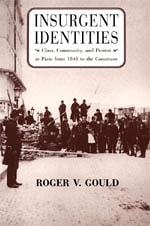
Insurgent Identities
Class, Community, and Protest in Paris from 1848 to the CommuneRoger V. Gould
University of Chicago Press, 1995
The difference was due to Baron Haussmann's massive urban renovation projects between 1852 and 1868, which dispersed workers from Paris's center to newly annexed districts on the outskirts of the city. In these areas, residence rather than occupation structured social relations. Drawing on evidence from trail documents, marriage records, reports of police spies, and the popular press, Gould demonstrates that this fundamental rearrangement in the patterns of social life made possible a neighborhood insurgent movement; whereas the insurgents of 1848 fought and died in defense of their status as workers, those in 1871 did so as members of a besieged urban community.
A valuable resource for historians and scholars of social movements, this work shows that collective identities vary with political circumstances but are nevertheless constrained by social networks. Gould extends this argument to make sense of other protest movements and to offer predictions about the dimensions of future social conflict.
It Was Like a Fever
Storytelling in Protest and PoliticsFrancesca Polletta
University of Chicago Press, 2006
Francesca Polletta’s It Was Like a Fever sets out to account for the power of storytelling in mobilizing political and social movements. Drawing on cases ranging from sixteenth-century tax revolts to contemporary debates about the future of the World Trade Center site, Polletta argues that stories are politically effective not when they have clear moral messages, but when they have complex, often ambiguous ones. The openness of stories to interpretation has allowed disadvantaged groups, in particular, to gain a hearing for new needs and to forge surprising political alliances. But popular beliefs in America about storytelling as a genre have also hurt those challenging the status quo.
A rich analysis of storytelling in courtrooms, newsrooms, public forums, and the United States Congress, It Was Like a Fever offers provocative new insights into the dynamics of culture and contention.
Nightwatch
The Politics of Protest in the AndesOrin Starn
Duke University Press, 1999
Drawing on fieldwork conducted over the course of a decade, Orin Starn chronicles the historical conditions that led to the formation of the rondas, the social and geographical expansion of the movement, and its gradual decline in the 1990s. Throughout this anecdotal yet deeply analytical account, the author relies on interviews with ronda participants, villagers, and Peru’s regional and national leaders to explore the role of women, the involvement of nongovernmental organizations, and struggles for leadership within the rondas. Starn moves easily from global to local contexts and from the fifteenth to the twentieth century, presenting this movement in a straightforward manner that makes it accessible to both specialists and nonspecialists.
An engagingly written story of village mobilization, Nightwatch is also a meditation on the nature of fieldwork, the representation of subaltern people, the relationship between resistance and power, and what it means to be politically active at the end of the century. It will appeal widely to scholars and students of anthropology, Latin American studies, cultural studies, history, subaltern studies, and those interested in the politics of social movements.

Paper Pusher
Power and Protest in Higher EducationKathryn J. Gindlesparger
University of Minnesota Press, 2027
Paperwork is the new protest: leveraging bureaucracy for progressive action
In contemporary higher education, power increasingly circulates through documents rather than debate, making paperwork one of the most consequential sites of protest. Yet as universities become more corporatized and subject to authoritarian influence, bureaucratic writing is often treated as passive, procedural, or politically neutral. Paper Pusher shows how paperwork is a central mechanism of governance and therefore a formidable, underused medium for democratic action and protest within bureaucracies.
Kathryn J. Gindlesparger reframes the “paper pusher” from a symbol of compliance into an agent of institutional accountability and resistance. She develops four avenues for protesting through bureaucracy—voice, filing, circulation, and stasis-seeking—showing how everyday documents such as meeting minutes, policy drafts, budgets, and accreditation reports can be used to push back against authoritarian and corporate forces that undermine an institution’s mission. Rather than emphasizing visible confrontation, Paper Pusher demonstrates how activism can operate quietly and credibly from within systems where overt protest may carry professional risk.
Grounded in story and lived experience, this book is a love letter to office workers, staff, and middle managers whose labor sustains institutions and whose expertise is often overlooked. It foregrounds feminist, working-class, queer, disabled, Black, and brown voices, highlighting how marginalized workers have long used bureaucratic knowledge to create access, protection, and change. Practical and people-centered, Paper Pusher calls for bureaucratic literacy to be taught wherever writing is taught, insisting that paperwork is not grunt work but power work.
Retail e-book files for this title are screen-reader friendly with images accompanied by short alt text and/or extended descriptions.

Penetration & Protest in Tanzania
Impact Of World Economy On The Pare, 1860-1960Isaria N. Kimambo
Ohio University Press, 1990
The originality of this study of rural transformation stems from the way in which Professor Kimambo has used the oral tradition to reveal the history of the impact of the world economy in northeastern Tanzania. First under the pressures of commodity trade, and later under German and British imperialism, the peasant producers of this region were forced into participation in capitalist production.
These partial changes destroyed the Pare’s balanced subsistence structure. But throughout the colonial period they were frustrated in their efforts to transform themselves fully into capitalist producers. These struggles finally led to open revolt in 1947 and it was three years before the protest ended. Between 1947 and 1960 the colonial government tried to reverse the effects of the revolt without providing the kind of transformation desired by the peasants.
This study illustrates vividly the difference between the intentions of capital and those of the colonized peasantry. The intentions of the two sides seemed to be incompatible. While imperialism would allow for the limited participation that would maximize profits for metropolitan capital, the peasants were struggling for freedom to transform themselves into capitalist producers.
Performance Constellations
Networks of Protest and Activism in Latin AmericaMarcela A. Fuentes
University of Michigan Press, 2019

Power and Protest in the Countryside
Studies of Rural Unrest in Asia, Europe, and Latin AmericaRobert P. Weller and Scott Guggenheim
Duke University Press, 1993
Power, Participation, and Protest in Flint, Michigan
Unpacking the Policy Paradox of Municipal TakeoversAshley E. Nickels
Temple University Press, 2019
When the 2011 municipal takeover in Flint, Michigan placed the city under state control, some supported the intervention while others saw it as an affront to democracy. Still others were ambivalent about what was supposed to be a temporary disruption. However, the city’s fiscal emergency soon became a public health emergency—the Flint Water Crisis—that captured international attention.
But how did Flint’s municipal takeovers, which suspended local representational government, alter the local political system? In Power, Participation, and Protest in Flint, Michigan, Ashley Nickels addresses the ways residents, groups, and organizations were able to participate politically—or not—during the city’s municipal takeovers in 2002 and 2011. She explains how new politics were created as organizations developed, new coalitions emerged and evolved, and people’s understanding of municipal takeovers changed.
Inwalking readers through the policy history of, implementation of, and reaction to Flint’s two municipal takeovers, Nickels highlights how the ostensibly apolitical policy is, in fact, highly political.
Power, Protest, and the Public Schools
Jewish and African American Struggles in New York CityMelissa F. Weiner
Rutgers University Press, 2012
Protest In Belgrade
Winter of DiscontentMladen Lazic
Central European University Press, 1999
Protest in Belgrade addresses one of the most important social movements of this decade - the civil and student peace demonstrations which took place in Belgrade during the winter of 1996/97. The demonstrations, the largest ever in history, were in response to Milošević’s nullifying of the results of local elections in fourteen towns in Serbia which created global media attention and attracted worldwide sympathy.
This in-depth study of a society calling for democracy is based on interviews with over 1000 civilians and students. The book is unique because much of the research was carried out and completed while the demonstrations were still in progress and before the outcome of events was known. A chronology of events is also included.
The book provides an abundance of valuable information for analysts of post-socialist transformation, researchers of social movements and social change, and for all those concerned with the tragic events in Southeast Europe.
Protest and Opportunities
A Theory of Social Movements and Political ChangeFelix Kolb
Campus Verlag, 2007
In addition to reviewing the existing literature on the political outcomes of social movements, this volume analyzes the examples of the American civil rights movement and anti-nuclear energy efforts in eighteen countries to forge a new understanding of their momentous impact.
Protest and Propaganda
W. E. B. Du Bois, the CRISIS, and American HistoryEdited by Amy Helene Kirschke and Phillip Luke Sinitiere
University of Missouri Press, 2013
In looking back on his editorship of Crisis magazine, W. E. B. Du Bois said, “We condensed more news about Negroes and their problems in a month than most colored papers before this had published in a year.” Since its founding by Du Bois in 1910, Crisis has been the primary published voice of the NAACP. Born in an age of Jim Crow racism, often strapped for funds, the magazine struggled and endured, all the while providing a forum for people of color to document their inherent dignity and proclaim their definitive worth as human beings.
As the magazine’s editor from 1910 until 1934, Du Bois guided the content and the aim of Crisis with a decisive hand. He ensured that each issue argued for civil rights, economic justice, and social equality, always framing America’s intractable color line in an international perspective. Du Bois benefited from a deep pool of black literary and artistic genius, whether by commissioning the visual creativity of Harlem Renaissance artists for Crisis covers or by publishing poems and short stories from New Negro writers. From North to South, from East to West, and even reaching across the globe, Crisis circulated its ideas and marshaled its impact far and wide.
Building on the solid foundation Du Bois laid, subsequent editors and contributors covered issues vital to communities of color, such as access to resources during the New Deal era, educational opportunities related to the historic Brown decision, the realization of basic civil rights at midcentury, American aid to Africa and Caribbean nations, and the persistent economic inequalities of today’s global era.
Despite its importance, little has been written about the historical and cultural significance of this seminal magazine. By exploring how Crisis responded to critical issues, the essays in Protest and Propaganda provide the first well-rounded, in-depth look at the magazine's role and influence. The authors show how the essays, columns, and visuals published in Crisis changed conversations, perceptions, and even laws in the United States, thereby calling a fractured nation to more fully live up to its democratic creed. They explain how the magazine survived tremendous odds, document how the voices of justice rose above the clamor of injustice, and demonstrate how relevant such literary, journalistic, and artistic postures remain in a twenty-first-century world still in crisis.
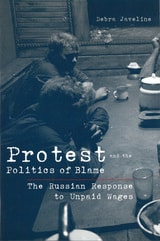
Protest and the Politics of Blame
The Russian Response to Unpaid WagesDebra Javeline
University of Michigan Press, 2003
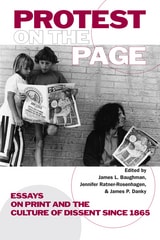
Protest on the Page
Essays on Print and the Culture of Dissent since 1865Edited by James L. Baughman, Jennifer Ratner-Rosenhagen, and James P. Danky
University of Wisconsin Press, 2015
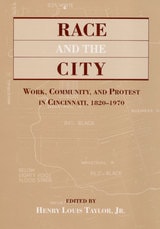
RACE & THE CITY
Work, Community, and Protest in Cincinnati, 1820-1970Edited by Henry Louis Taylor, Jr.
University of Illinois Press, 1993
of black Cincinnati. These studies offer insight into both the dynamics of racism and a
community's changing responses to it." -- Peter Rachleff, author of Black Labor in
Richmond
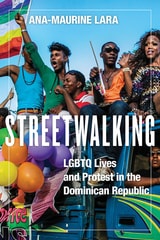
Streetwalking
LGBTQ Lives and Protest in the Dominican RepublicAna-Maurine Lara
Rutgers University Press, 2021
Streetwalking: LGBTQ Lives and Protest in the Dominican Republic is an exploration of the ways that lesbian, gay, bisexual, trans and queer persons exercise power in a Catholic Hispanic heteropatriarchal nation-state, namely the Dominican Republic. Lara presents the specific strategies employed by LGBTQ community leaders in the Dominican Republic in their struggle for subjectivity, recognition, and rights. Drawing on ethnographic encounters, film and video, and interviews, LGBTQ community leaders teach readers about streetwalking, confrontación, flipping the script, cuentos, and the use of strategic universalisms in the exercise of power and agency. Rooted in Maria Lugones's theorization of streetwalker strategies and Audre Lorde's theorization of silence and action, this text re-imagines the exercise and locus of power in examples provided by the living, thriving LGBTQ community of the Dominican Republic.
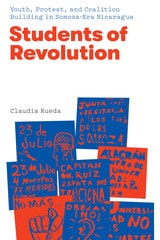
Students of Revolution
Youth, Protest, and Coalition Building in Somoza-Era NicaraguaBy Claudia Rueda
University of Texas Press, 2019
Students played a critical role in the Sandinista struggle in Nicaragua, helping to topple the US-backed Somoza dictatorship in 1979—one of only two successful social revolutions in Cold War Latin America. Debunking misconceptions, Students of Revolution provides new evidence that groups of college and secondary-level students were instrumental in fostering a culture of insurrection—one in which societal groups, from elite housewives to rural laborers, came to see armed revolution as not only legitimate but necessary.
Drawing on student archives, state and university records, and oral histories, Claudia Rueda reveals the tactics by which young activists deployed their age, class, and gender to craft a heroic identity that justified their political participation and to help build cross-class movements that eventually paralyzed the country. Despite living under a dictatorship that sharply curtailed expression, these students gained status as future national leaders, helping to sanctify their right to protest and generating widespread outrage while they endured the regime’s repression. Students of Revolution thus highlights the aggressive young dissenters who became the vanguard of the opposition.
Surviving Lamentations
Catastrophe, Lament, and Protest in the Afterlife of a Biblical BookTod Linafelt
University of Chicago Press, 2000
In Surviving Lamentations, Tod Linafelt offers an alternative reading of Lamentations in light of the "literature of survival" (works written by survivors of catastrophe) as well as literary and philosophical reflections on "the survival of literature." He refocuses attention on the figure of Zion as a manifestation of a basic need to give voice to suffering, and traces the afterlife of Lamentations in Jewish literature, in which text after text attempts to provide the response to Zion's lament that is lacking in Lamentations itself.
Seen through Linafelt's eyes, Lamentations emerges as uncannily relevant to contemporary discourse on survival.
The Art of Protest
Culture and Activism from the Civil Rights Movement to the PresentT.V. Reed
University of Minnesota Press, 2019
A second edition of the classic introduction to arts in social movements, fully updated and now including Black Lives Matter, Occupy Wall Street, and new digital and social media forms of cultural resistance
The Art of Protest, first published in 2006, was hailed as an “essential” introduction to progressive social movements in the United States and praised for its “fluid writing style” and “well-informed and insightful” contribution (Choice Magazine). Now thoroughly revised and updated, this new edition of T. V. Reed’s acclaimed work offers engaging accounts of ten key progressive movements in postwar America, from the African American struggle for civil rights beginning in the 1950s to Occupy Wall Street and Black Lives Matter in the twenty-first century.
Reed focuses on the artistic activities of these movements as a lively way to frame progressive social change and its cultural legacies: civil rights freedom songs, the street drama of the Black Panthers, revolutionary murals of the Chicano movement, poetry in women’s movements, the American Indian Movement’s use of film and video, anti-apartheid rock music, ACT UP’s visual art, digital arts in #Occupy, Black Lives Matter rap videos, and more.
Through the kaleidoscopic lens of artistic expression, Reed reveals how activism profoundly shapes popular cultural forms. For students and scholars of social change and those seeking to counter reactionary efforts to turn back the clock on social equality and justice, the new edition of The Art of Protest will be both informative and inspiring.
The Art of Protest
Culture and Activism from the Civil Rights Movement to the Streets of SeattleT.V. Reed
University of Minnesota Press, 2005
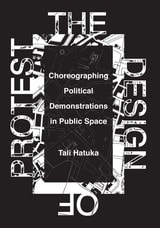
The Design of Protest
Choreographing Political Demonstrations in Public SpaceBy Tali Hatuka
University of Texas Press, 2018
Public protests are a vital tool for asserting grievances and creating temporary, yet tangible, communities as the world becomes more democratic and urban in the twenty-first century. While the political and social aspects of protest have been extensively studied, little attention has been paid to the physical spaces in which protests happen. Yet place is a crucial aspect of protests, influencing the dynamics and engagement patterns among participants. In The Design of Protest, Tali Hatuka offers the first extensive discussion of the act of protest as a design: that is, a planned event in a space whose physical geometry and symbolic meaning are used and appropriated by its organizers, who aim to challenge socio-spatial distance between political institutions and the people they should serve.
Presenting case studies from around the world, including Tiananmen Square in Beijing; the National Mall in Washington, DC; Rabin Square in Tel Aviv; and the Plaza de Mayo in Buenos Aires, Hatuka identifies three major dimensions of public protests: the process of planning the protest in a particular place; the choice of spatial choreography of the event, including the value and meaning of specific tactics; and the challenges of performing contemporary protests in public space in a fragmented, complex, and conflicted world. Numerous photographs, detailed diagrams, and plans complement the case studies, which draw upon interviews with city officials, urban planners, and protesters themselves.
The Emotions of Protest
James M. Jasper
University of Chicago Press, 2018
There is an extensive body of research on protest, but the focus has mostly been on the calculating brain—a byproduct of structuralism and cognitive studies—and less on the feeling brain. James M. Jasper’s work changes that, as he pushes the boundaries of our present understanding of the social world. In The Emotions of Protest, Jasper lays out his argument, showing that it is impossible to separate cognition and emotion. At a minimum, he says, we cannot understand the Tea Party or Occupy Wall Street or pro- and anti-Trump rallies without first studying the fears and anger, moral outrage, and patterns of hate and love that their members feel.
This is a book centered on protest, but Jasper also points toward broader paths of inquiry that have the power to transform the way social scientists picture social life and action. Through emotions, he says, we are embedded in a variety of environmental, bodily, social, moral, and temporal contexts, as we feel our way both consciously and unconsciously toward some things and away from others. Politics and collective action have always been a kind of laboratory for working out models of human action more generally, and emotions are no exception. Both hearts and minds rely on the same feelings racing through our central nervous systems. Protestors have emotions, like everyone else, but theirs are thinking hearts, not bleeding hearts. Brains can feel, and hearts can think.
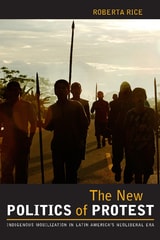
The New Politics of Protest
Indigenous Mobilization in Latin America's Neoliberal EraRoberta Rice
University of Arizona Press, 2012
In June 1990, Ecuador saw the first major indigenous rebellion within its borders since the colonial era. For weeks, indigenous protesters participated in marches, staged demonstrations, seized government offices, and blockaded roads. Since this insurrection, indigenous movements have become increasingly important in the fight against Latin American Neoliberalism.
Roberta Rice's New Politics of Protest seeks to analyze when, where, and why indigenous protests against free-market reforms have occurred in Latin America. Comparing cases in Ecuador, Peru, Bolivia, and Chile, this book details the emergence of indigenous movements under and against Neoliberal governments. Rice uses original field research and interviews with indigenous leaders to examine long-term patterns of indigenous political activism and overturn accepted theories on the role of the Indian in democracy.
A useful and engaging study, The New Politics of Protest seeks to determine when indigenous movements become viable political parties. It covers the most recent rounds of protest to demonstrate how a weak and unresponsive government is more likely to experience revolts against unpopular reforms. This influential work will be of interest to scholars of Latin American politics and indigenous studies as well as anyone studying oppressed peoples who have organized nationwide strikes and protests, blocked economic reforms, toppled corrupt leaders, and even captured presidencies.
The Political Economy of Protest and Patience
East European and Latin American Trasformations ComparedBéla Greskovits
Central European University Press, 1998
Despite gloomy prophecies, democracy and the market economy seem to be taking root throughout Central and Eastern Europe, although set against a background of a recession deeper and longer than that of the Great Depression. How is this possible? Why did Eastern Europeans protest less about the brutal social consequences of systemic change than the people of Latin America a decade earlier? Why has the region-wide authoritarian or populist turnabout not occurred? Why has democracy in these countries proved to be crisis-proof? In what ways has economic crisis impacted on the politics of the region?
In addressing these questions, Béla Greskovits uses a comparative analysis of the structures, institutions, cultures, and actors shaping both the Eastern European and the Latin American transformations. He argues that structural, institutional, and cultural factors have put a brake on destabilizing collective actions and have paved the way for the emergence of the enduring, low-level equilibrium between incomplete democracy and imperfect market economy which seems set to characterize the Central and Eastern European experience for the foreseeable future.

The Sit-Ins
Protest and Legal Change in the Civil Rights EraChristopher W. Schmidt
University of Chicago Press, 2018
The Sit-Ins tells the story of the student lunch counter protests and the national debate they sparked over the meaning of the constitutional right of all Americans to equal protection of the law. Christopher W. Schmidt describes how behind the now-iconic scenes of African American college students sitting in quiet defiance at “whites only” lunch counters lies a series of underappreciated legal dilemmas—about the meaning of the Constitution, the capacity of legal institutions to remedy different forms of injustice, and the relationship between legal reform and social change. The students’ actions initiated a national conversation over whether the Constitution’s equal protection clause extended to the activities of private businesses that served the general public. The courts, the traditional focal point for accounts of constitutional disputes, played an important but ultimately secondary role in this story. The great victory of the sit-in movement came not in the Supreme Court, but in Congress, with the passage of the Civil Rights Act of 1964, landmark legislation that recognized the right African American students had claimed for themselves four years earlier. The Sit-Ins invites a broader understanding of how Americans contest and construct the meaning of their Constitution.
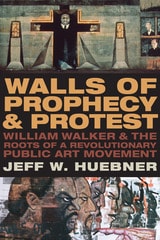
Walls of Prophecy and Protest
William Walker and the Roots of a Revolutionary Public Art MovementJeff W. Huebner
Northwestern University Press, 2019
Though his art could not have been more public, Walker maintained a low profile during his working life and virtually withdrew from the public eye after his retirement in 1989. Author Jeff W. Huebner met Walker in 1990 and embarked on a series of insightful interviews that stretched over the next two decades. Those meetings and years of research form the basis of Walls of Prophecy and Protest, the story of Walker’s remarkable life and the movement that he inspired.
Featuring forty-three color images of Walker’s work, most long since destroyed or painted over, this handsome edition reveals the artist who was the primary figure behind Chicago’s famed Wall of Respect and who created numerous murals that depicted African American historical figures, protested social injustice, and promoted love, respect, racial unity, and community change.
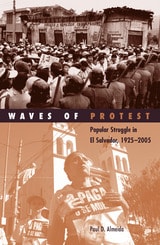
Waves of Protest
Popular Struggle in El Salvador, 1925–2005Paul D. Almeida
University of Minnesota Press, 2008
One of the first longitudinal studies of collective resistance in the developing world, Waves of Protest examines large-scale contentious action in El Salvador during critical eras in the country’s history.
Providing a compelling analysis of the massive waves of protests from the early twentieth century to the present in El Salvador, Paul D. Almeida fully chronicles one of the largest and most successful campaigns against globalization and privatization in the Americas. Drawing on original protest data from newspapers and other archival sources, Almeida makes an impassioned argument that regime liberalization organizes civil society and, conversely, acts of state-sponsored repression radicalize society. He correlates the ebb and flow of protest waves to the changes in regime liberalization and subsequent de-democratization and back to liberalization.
Almeida shows how institutional access and competitive elections create opportunity for civic organizations that become radicalized when authoritarianism increases, resulting at times in violent protest campaigns that escalate to revolutionary levels. In doing so, he brings negative political conditions and threats to the forefront as central forces driving social movement activity and popular contention in the developing world.
Paul D. Almeida is assistant professor of sociology at Texas A&M University. He is coeditor with Hank Johnston of Latin American Social Movements: Globalization, Democratization, and Transnational Networks.
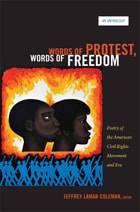
Words of Protest, Words of Freedom
Poetry of the American Civil Rights Movement and EraJeffrey Lamar Coleman, ed.
Duke University Press, 2012
Some of the poems address crucial movement-related events—such as the integration of the Little Rock schools, the murders of Emmett Till and Medgar Evers, the emergence of the Black Panther party, and the race riots of the late 1960s—and key figures, including Martin Luther King Jr., Malcolm X, and John and Robert Kennedy. Other poems speak more broadly to the social and political climate of the times. Along with Jeffrey Lamar Coleman's headnotes, the poems recall the heartbreaking and jubilant moments of a tumultuous era. Altogether, more than 150 poems by approximately 100 poets showcase the breadth of the genre of civil rights poetry.
Selected contributors. Maya Angelou, W. H. Auden, Amiri Baraka, Gwendolyn Brooks, Lucille Clifton Lawrence Ferlinghetti, Allen Ginsberg, Langston Hughes, June Jordan, Philip Levine, Audre Lorde, Robert Lowell, Pauli Murray, Huey P. Newton, Adrienne Rich, Sonia Sanchez, Léopold Sédar Senghor, Derek Walcott, Alice Walker, Yevgeny Yevtushenko