Results by title
11 books match the query 'Psychoanalysis and culture'

Autoaffection
Unconscious Thought in the Age of TechnologyPatricia Ticineto Clough
University of Minnesota Press, 2000
Explores the connection between new theories, new technologies, and new ways of thinking.
In this book, Patricia Ticineto Clough reenergizes critical theory by viewing poststructuralist thought through the lens of "teletechnology," using television as a recurring case study to illuminate the changing relationships between subjectivity, technology, and mass media.
Autoaffection links diverse forms of cultural criticism-feminist theory, queer theory, film theory, postcolonial theory, Marxist cultural studies and literary criticism, the cultural studies of science and the criticism of ethnographic writing—to the transformation and expansion of teletechnology in the late twentieth century. These theoretical approaches, Clough suggests, have become the vehicles of unconscious thought in our time.In individual chapters, Clough juxtaposes the likes of Derridean deconstruction, Deleuzian philosophy, and Lacanian psychoanalysis. She works through the writings of Fredric Jameson, Donna Haraway, Judith Butler, Bruno Latour, Nancy Fraser, Elizabeth Grosz—to name only a few—placing all in dialogue with a teletechnological framework. Clough shows how these cultural criticisms have raised questions about the foundation of thought, allowing us to reenvision the relationship of nature and technology, the human and the machine, the virtual and the real, the living and the inert.
Male Fantasies
Volume 1: Women Floods Bodies HistoryKlaus Theweleit
University of Minnesota Press, 1987
This first volume of Male Fantasies centers on the fantasies that preoccupied a group of men who played a crucial role in the rise of Nazism. These men were officers in the Freikorps--private, volunteer armies that roamed Germany, serving the cause of domestic repression in the aftermath of World War I. Klaus Theweleit draws upon the novels, letters, and autobiographies of these proto-fascists and their contemporaries, as well as cartoons, advertisements, engravings, and posters. He explores these sources, not to discover what their creators thought about fighting or the fatherland, but to seek out and reconstruct their images of women. He shows that the Freikorps male identity was shaped by the dread and revulsion that characterized their relations with women (real or imagined) and that this dread was, in turn, linked to the aggressive racism and anticommunism at the heart of most fascist movements.
Theweleit’s second volume, Male Bodies: Psychoanalyzing the White Terror, carries Male Fantasies from the female image to the self-image of manhood and its ritualized forms of mass behavior, culminating in warfare. It also is available from the University of Minnesota Press.
Male Fantasies
Volume 2: Male Bodies: Psychoanalyzing the White TerrorKlaus Theweleit
University of Minnesota Press, 1989
Theweleit’s project in Male Fantasies is to discover the emotional core of fascism as it was revealed in the novels and memoirs of the Freikorps, mercenary bands that fought Germany’s border disputes and put down worker revolts in the aftermath of World War I. His excavation of Freikorps literary remains (and the writings of some of their protofascist contemporaries) enabled Theweleit to reconstruct the mythical content of the fascist imagination. An integral part of Male Fantasies is Theweleit’s choice of illustrations--cartoons, advertisements, engravings, posters--that serve as an ironic commentary on the text and extend its meaning in time and space.
In this second volume of the two-volume work Theweleit discovers how the repudiation of one’s own body--and of femininity--became a psychic compulsion associating masculinity with hardness, self-denial, and destruction. We are shown how the body becomes a mechanism for eluding the dreaded liquid--the “Red Flood,” lava, mud--and the “feminine” emotions associated with it. Armored, organized by mental and physical procedures like the military drill, the male body is transformed into a “man of steel.” As Theweleit shows, only in war does this body find redemption from constraint.
The first volume of Male Fantasies, also available from the University of Minnesota Press, deals primarily with the image of women in the collective unconscious of the fascist warrior that threatens to engulf the male ego.

Repossessions
Psychoanalysis and the Phantasms of Early Modern CultureTimothy Murray and Alan K. Smith, Editors
University of Minnesota Press, 1998
Repossessions was first published in 1998. Minnesota Archive Editions uses digital technology to make long-unavailable books once again accessible, and are published unaltered from the original University of Minnesota Press editions.
A double-edged critical forum, this volume brings early modern culture and psychoanalysis into revisionist dialogue with each other. The authors reflect on how psychoanalysis remains
"possessed" by its incorporation of early modern mythologies, visions, credos, and phantasms. Their essays explore the conceptual and ideological foundations of psychoanalysis while articulating fresh insights into the vicissitudes of autobiography, translation, mourning, and eroticism in the transitional period from the waning of feudalism to the emergence of capitalism.Employing a broad spectrum of the most recent, Continental psychoanalytic approaches, the book covers topics and figures ranging from King James to Leonardo, demonology to cartography, astronomy to cross-dressing, and mythology to biology. Its detailed readings of Boccaccio, Ficino, Finé, Michelangelo, Montaigne, and others dramatically reassess the foundational concepts of cultural history, secularization, autobiography, reason, and government. Through a sustained focus on visual and verbal residues of personal and cultural trauma, the essays generate innovative analyses of the interrelation of writing, graphic space, self, and social identification in early modern texts, paintings, maps, and other artifacts.
Contributors: Elizabeth J. Bellamy, Tom Conley, Mitchell Greenberg, Kathleen Perry Long, Julia Reinhard Lupton, Christopher Pye, Juliana Schiesari.
Timothy Murray is professor of English and director of graduate studies in Film and Video at Cornell University. Alan K. Smith is assistant professor in the Department of Languages and Literature at the University of Utah.

The Ability to Mourn
Disillusionment and the Social Origins of PsychoanalysisPeter Homans
University of Chicago Press, 1989
Psychoanalysis, Homans shows, originated as a creative response to the withering away of traditional communities and their symbols in the aftermath of the industrial revolution. The loss of these attachments played a crucial role in the lives of the founders of psychoanalysis, especially Sigmund Freud but also Karl Abraham, Carl Jung, Otto Rank, and Ernest Jones. The personal, political, and religious losses that these figures experienced, the introspection that followed, and the psychological discovery that resulted are what Homans calls "the ability to mourn."
Homans expands this historical analysis to construct a general model of psychological discovery: the loss of shared ideals and symbols can produce a deeper sense of self (psychological structure-building, or individuation) and can then lead to the creation of new forms of meaning and self-understanding. He shows how Freud, Jung, and other psychoanalysts began to extend their introspection outward, reinterpreting the meanings of Western art, history, and religion. In conclusion, Homans evaluates Freud's theory of culture and discusses the role that psychoanalysis might play in social and cultural criticism.
Throughout the book, Homans makes use of the many histories, biographies, and psychobiographies that have been written about the origins of psychoanalysis, drawing them into a comprehensive sociocultural model. Rich in insights and highly original in approach, this work will interest psychoanalysts and students of Freud, sociologists concerned with modernity and psychoanalysis, and cultural critics in the fields of religion, anthropology, political science, and social history.
The Cultural Dialectics of Knowledge and Desire
Charles W. Nuckolls
University of Wisconsin Press, 1996
Why is culture a problem that can never be solved? Charles W. Nuckolls poses this question to his readers, and offers a genuinely synthetic approach to culture that is both cognitive and psychoanalytic. He develops a theory of cultural dialectics based on the concept of paradox, in which he shows how ambivalence and conflicts, and the desire to resolve them, are at the heart of all cultural knowledge systems.
Nuckolls combines and synthesizes the ideas of Max Weber and Sigmund Freud—major influences in the cognitive and psychoanalytic paradigms—and develops the concept basic to both: the dialectic. He recovers the legacy of Gregory Bateson, who provided the foundation for a theory of paradox in culture. With his integrated theory, Nuckolls explains the conflicts of knowledge and desire in a South Asian knowledge system, in particular the religious mythology and divinatory system of the Jalaris, a Telugu-speaking fishing caste on the southeastern coast of India.
This provocative book allows us to rethink the relationship between the currently competing discourses in psychological and cultural anthropology, and at the same time offers a general synthetic theory of cultural dynamics.

The Feeling Intellect
Selected WritingsPhilip Rieff
University of Chicago Press, 1989

The Jacqueline Rose Reader
Jacqueline Rose
Duke University Press, 2011
The Triumph of the Therapeutic
Uses of Faith after FreudPhilip Rieff
University of Chicago Press, 1987
"A triumphantly successful exploration of certain key themes in cultural life. Rieff's incidental remarks are not only illuminating in themselves; they suggest whole new areas of inquiry."—Alasdair MacIntyre, Guardian

The Vanishing
Shakespeare, the Subject, and Early Modern CultureChristopher Pye
Duke University Press, 2000
Pye explores the emergence of the early modern subject in terms of a range of subjectivizing mechanisms tied to the birth of a modern conception of history, one that is structured around a spatial and temporal horizon—a vanishing point. He also discusses the distinctly economic character of early modern subjectivity and how this, too, is implicated in our own modern modes of historical understanding. After explaining how the aims of New Historicist and Foucauldian approaches to the Renaissance are inseparably linked to such a historical conception, Pye demonstrates how the early modern subject can be understood in terms of a Lacanian and Zizekian account of the emerging social sphere. By focusing on the Renaissance as a period of remarkable artistic and cultural production, he is able to illustrate his points with discussions of a number of uniquely fascinating topics—for instance, how demonism was intimately related to a significant shift in law and symbolic order and how there existed at the time a “demonic” preoccupation with certain erotic dimensions of the emergent social subject.
Highly sophisticated and elegantly crafted, The Vanishing will be of interest to students of Shakespeare and early modern culture, Renaissance visual art, and cultural and psychoanalytic theory.
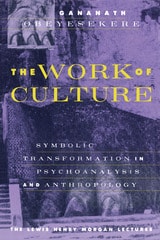
The Work of Culture
Symbolic Transformation in Psychoanalysis and AnthropologyGananath Obeyesekere
University of Chicago Press, 1990