Results by title
6 books match the query 'Psychoanalysis and feminism'
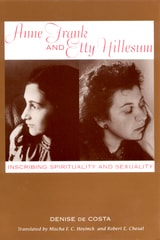
Anne Frank and Etty Hillesum
Inscribing Spirituality and Sexualityde Costa, Denise
Rutgers University Press, 1998
Studies of Nazi persecution and destruction of Jews have to date largely been based on the accounts of men. And yet gender difference in Western society is so profound that women and men seem to have divergent experiences, speak different languages, and see and hear in dissimilar ways. Denise de Costa's book explores the significance of sex and gender differences in the construction of history and society-specifically, the Nazi genocide of Jews in World War II-by focusing on the writing of two Jewish women, Anne Frank and Etty Hillesum.
De Costa argues that although both of these writers have received much attention, little has been done to understand how the significant difference occasioned by both gender and Jewishness helps to define cultural or personal identity in relation to the Holocaust. De Costa uses a variety of psychoanalytic and feminist theories to approach the writing of Frank and Hillesum. Critiquing as well as employing the concepts of Julia Kristeva, Hélène Cixous, Luce Irigaray, and Simone de Beauvoir among others, she presents a detailed and rich discussion of each writer.
De Costa approaches Anne Frank largely from a psychoanalytical perspective that emphasizes the function of writing itself in the development of self-identity. For Etty Hillesum, she is more concerned with how writing establishes a philosophy, and a faith, that can entertain and is indeed based in doubleness and paradox. Her assessment of these two writers makes a significant contribution to our understanding of the Holocaust as a cultural and historical phenomenon, of the role of writing in the production and expression of gendered identity, and of the complex relation between women, writing, and culture.
Freudian Slips
Woman, Writing, the Foreign TongueMary S. Gossy
University of Michigan Press, 1995
Gossy believes that Freud's most popular statement of a theory of the unconscious is written over foreign and feminized texts, bodies, and places, by way of anecdotes that range from the Dora case to menstruation to travel phobias. Freudian Slips: Woman, Writing, the Foreign Tongue does a feminist psychoanalytic reading of Freud's book and shows how slippery- textually, erotically, and historically- the writing of theory can be, and also how much we can learn from our slips when we are willing to admit that we have made them.
Bringing together autobiography, psychoanalysis, close readings, pedagogy, and politics in provocative and innovative ways, Gossy discusses Freud's work from both textual and theoretical perspectives and asks what his writing can teach us about authority, theory, home, and the foreign. Arguing that the dominant metaphor in the Psychopathology is that of the female body as foreign text, and that this body, writing, and the foreign tongue are identified with a feminized unconscious that threatens authoritative discourse, Freudian Slips moves toward fashioning a feminist theory that is both "slippery and (para)practical" and constantly searches for ways of writing theory that free, rather than sacrifice, the bodies of women.
"The readings of individual slips are often highly productive; the argument is both hardworking and playful. Freudian Slips is a book that people will enjoy reading and from which they will learn a great deal."-- Helena Michie, Rice University
Mary S. Gossy is Associate Professor of Spanish and Comparative Literature, Rutgers University. She is the author of The Untold Story: Women and Theory in Golden Age Texts.
From Klein to Kristeva
Psychoanalytic Feminism and the Search for the "Good Enough" MotherJanice Doane and Devon Hodges
University of Michigan Press, 1993
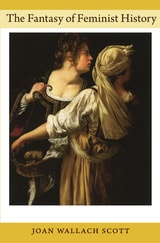
The Fantasy of Feminist History
Joan Wallach Scott
Duke University Press, 2012

The Future of an Illusion
Film, Feminism, and PsychoanalysisConstance Penley
University of Minnesota Press, 1989
The Future of an Illusion was first published in 1989. Minnesota Archive Editions uses digital technology to make long-unavailable books once again accessible, and are published unaltered from the original University of Minnesota Press editions.
The Future of an Illusion documents the pivotal role Constance Penley has played in the development of feminist film theory. Penley analyzes the primary movements that have shaped the field: the conjunction of feminism, film theory, and psychoanalysis, and the inherent debates surrounding the politics of women and representation. These debates center on the position of women in the classical Hollywood narrative, the construction of the spectator's desire in pornography and eroticism, and the implicitly male bias in psychoanalytically oriented film theory. Essential to anyone studying the sexual policies of representation, The Future of an Illusion ranges from avant-garde films to video, popular cinema, television, literature, and critical and cultural theory.
Constance Penley is associate professor of English and film studies at the University of Rochester. A co-editor of the journal Camera Obscura,she is the editor of Feminism and Film Theory.

The Jacqueline Rose Reader
Jacqueline Rose
Duke University Press, 2011