Results by title
17 books match the query 'Psychological fiction, American'
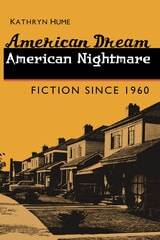
American Dream, American Nightmare
Fiction since 1960Kathryn Hume
University of Illinois Press, 2000
In breaking down the divisions among standard categories of race, religion, ethnicity, and gender, Hume identifies shared core concerns, values, and techniques among seemingly disparate and unconnected writers including T. Coraghessan Boyle, Ralph Ellison, Russell Banks, Gloria Naylor, Tim O'Brien, Maxine Hong Kingston, Walker Percy, N. Scott Momaday, John Updike, Toni Morrison, William Kennedy, Julia Alvarez, Thomas Pynchon, Leslie Marmon Silko, and Don DeLillo.
Hume explores fictional treatments of the slippage in the immigrant experience between America's promise and its reality. She exposes the political link between contemporary stories of lost innocence and liberalism's inadequacies. She also invites us to look at the literary challenge to scientific materialism in various searches for a spiritual dimension in life.
The expansive future promised by the American Dream has been replaced, Hume finds, by a sense of tarnished morality and a melancholy loss of faith in America's exceptionalism. American Dream, American Nightmare examines the differing critiques of America embedded in nearly a hundred novels and points to the source for recovery that appeals to many of the authors.
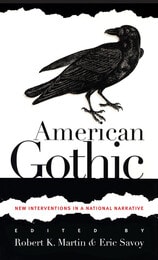
American Gothic
New Interventions in a National NarrativeRobert K. Martin
University of Iowa Press, 1998
In America as in Britain, the rise of the Gothic represented the other—the fearful shadows cast upon Enlightenment philosophies of common sense, democratic positivism, and optimistic futurity. Many critics have recognized the centrality of these shadows to American culture and self-identification. American Gothic, however, remaps the field by offering a series of revisionist essays associated with a common theme: the range and variety of Gothic manifestations in high and popular art from the roots of American culture to the present.
The thirteen essayists approach the persistence of the Gothic in American culture by providing a composite of interventions that focus on specific issues—the histories of gender and race, the cultures of cities and scandals and sensations—in order to advance distinct theoretical paradigms. Each essay sustains a connection between a particular theoretical field and a central problem in the Gothic tradition.
Drawing widely on contemporary theory—particularly revisionist views of Freud such as those offered by Lacan and Kristeva—this volume ranges from the well-known Gothic horrors of Edgar Allan Poe and Nathaniel Hawthorne to the popular fantasies of Stephen King and the postmodern visions of Kathy Acker. Special attention is paid to the issues of slavery and race in both black and white texts, including those by Ralph Ellison and William Faulkner. In the view of the editors and contributors, the Gothic is not so much a historical category as a mode of thought haunted by history, a part of suburban life and the lifeblood of films such as The Exorcist and Fatal Attraction.
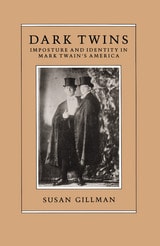
Dark Twins
Imposture and Identity in Mark Twain's AmericaSusan Gillman
University of Chicago Press, 1989
Gillman shows that laws regulating race classification, paternity, and rape cases underwrite Twain's critical exploration of racial and sexual difference in the writings of the 1890s and after, most strikingly in the little-known manuscripts that Gillman calls the "tales of transvestism." The "pseudoscience" of spiritualism and the "science" of psychology provide the cultural vocabularies essential to Twain's fantasy and science fiction writings of his last two decades. Twain stands forth finally as a representative man, not only a child of his culture, but also as one implicated in a continuing American anxiety about freedom, race, and identity.
Gender and the Gothic in the Fiction of Edith Wharton
Kathy A. Fedorko
University of Alabama Press, 1995
Revealing the Gothic foundations of Edith Wharton's vision of gender and identity.
Gender and the Gothic in the Fiction of Edith Wharton is an innovative study that provides fresh insights into Wharton’s male characters while at the same time showing how Wharton’s imagining of a fe/male self evolves throughout her career. Using feminist archetypal theory and theory of the female Gothic, Kathy A. Fedorko shows how Wharton, in sixteen short stories and six major novels written during four distinct periods of her life, adopts and adapts Gothic elements to explore the nature of feminine and masculine ways of knowing and being and to dramatize the tension between them.
Edith Wharton’s contradictory views of women and men—her attitudes toward the feminine and the masculine—reflect a complicated interweaving of family and social environment, historical time, and individual psychology. Studies of Wharton have exhibited this same kind of contradiction, with some seeing her as disparaging men and the masculine and others depicting her as disparaging women and the feminine. The use of Gothic elements in her fiction provided Wharton, who was often considered the consummate realist, with a way to dramatize the conflict between feminine and masculine selves as she experienced them and to evolve an alternative to the dualism.
Fedorko’s work is unique in its careful consideration of Wharton’s sixteen Gothic works, which are seldom discussed. Further, the revelation of how these Gothic stories are reflected in her major realistic novels. In the novels with Gothic texts, Wharton draws multiple parallels between male and female protagonists, indicating the commonalities between women and men and the potential for a female self. Eventually, in her last completed novel and her last short story, Wharton imagines human beings who are comfortable with both gender selves.
I KNOW THAT YOU KNOW THAT I KNOW
NARRATING SUBJECTS FROM MOLL FLANDERS TO MARNIEGeorge Butte
The Ohio State University Press, 2004
In I Know That You Know That I Know, Butte explores how stories narrate human consciousness. Butte locates a historical shift in the representation of webs of consciousnesses in narrative—what he calls “deep intersubjectivity”—and examines the effect this shift has since had on Western literature and culture. The author studies narrative practices in two ways: one pairing eighteenth-and nineteenth-century British novels (Moll Flanders and Great Expectations, for example), and the other studying genre practices—comedy, anti-comedy and masquerade—in written and film narratives (Jane Austen and His Girl Friday, for example, and Hitchcock’s Cary Grant films).
Butte’s second major claim argues for new ways to read representations of human consciousness, whether or not they take the form of deep intersubjectivity. Phenomenological criticism has lost its credibility in recent years, but this book identifies better reading strategies arising out of what the author calls poststructuralist phenomenology, grounded largely in the work of the French philosopher Merleau-Ponty. Butte criticizes the extreme of transcendental idealism (first-wave phenomenological criticism) and cultural materialism (when it rules out the study of consciousness). He also criticizes the dominant Lacanian framework of much academic film criticism.
Last Stands
StoriesStories by Gordon Weaver
University of Missouri Press, 2004
Passionate Doubts
Interpretation In FictionPatrick O'Donnell
University of Iowa Press, 1986
In an introductory dialogue and a closing chapter on the reader in contemporary fiction, O'Donnell shows that the formation of the reader's self, like character, plot, or any other element in fiction, is also part of the experience of the text, requiring a distinctive conception of interpretation. Calling upon a wide assemblage of modern theorists including Foucault, Derrida, Serres, Binswanger, Geertz, and Gadamer, O'Donnell elicits a broad range of interpretive possibilities—philosophical, psychological, archaeological, and linguistic—which speak to each novel's central concern with the act of reading as a form of signification.
While Passionate Doubts is broadly a hermeneutic study of contemporary fiction, the heart of this intriguing work resides in the close scrutiny of six modern novels which so richly evoke the very elements from which theories derive: language, form, and impulse. It is this specific application of theory that sets Passionate Doubts apart from other works in the field, yielding a series of important insights on the subject of language, sign, and the self in modern literature.
Sanity Plea
Schizophrenia in the Novels of Kurt VonnegutLawrence R. Broer
University of Alabama Press, 1994
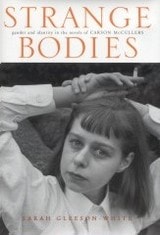
Strange Bodies
Gender and Identity in the Novels of Carson McCullersSarah Gleeson-White
University of Alabama Press, 2003
Adapts Mikhail Bakhtin's theory of the grotesque, as well as the latest in gender and psychoanalytic theory, to the major works of acclaimed southern writer Carson McCullers.
This innovative reconsideration of the themes of Carson McCullers's fiction argues that her work has heretofore suffered under the pall of narrow gothic interpretations, obscuring a more subversive agenda. By examining McCullers’s major novels—The Heart is a Lonely Hunter, Reflections in a Golden Eye, The Member of the Wedding, and The Ballad of the Sad Café—Gleeson-White locates a radical and specific form of the grotesque in the author's fiction: the liberating and redemptive possibilities of errant gender roles and shifting sexuality. She does this by employing Bakhtin's theory of the grotesque, which is both affirming and revolutionary, and thereby moves McCullers's texts beyond the 'gloom and doom' with which they have been charged for over fifty years.
The first chapter explores female adolescence by focusing on McCullers's tomboys in the context of oppressive southern womanhood. The second chapter analyzes McCullers's fascinating struggle to depict homosexual desire outside of traditional stereotypes. Gleeson-White then examines McCullers's portrayals of feminine and masculine gender through the tropes of cross-dressing, transvestism, and masquerade. The final chapter takes issue with earlier readings of androgyny in the texts to suggest a more useful concept McCullers herself called "the hybrid." Underpinning the whole study is the idea of a provocative, dynamic form of the grotesque that challenges traditional categories of normal and abnormal.
Because the characters and themes of McCullers's fiction were created in the 1940s and 1950s, a time of tension between the changing status of women and the southern ideal of womanhood, they are particularly fertile ground for a modern reexamination of this nature. Gleeson-White's study will be valued by scholars of American literature and gender and queer studies, by students of psychology, by academic libraries, and by readers of Carson McCullers. Strange Bodies is a thoughtful, highly credible analysis that adds dimension to the study of southern literature.
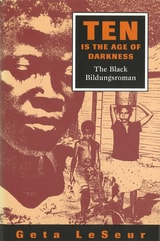
Ten Is the Age of Darkness
The Black BildungsromanGeta LeSeur
University of Missouri Press, 1995
In Ten Is the Age of Darkness, Geta LeSeur explores how black authors of the United States and English- speaking Caribbean have taken a European literary tradition and adapted it to fit their own needs for self-expression. LeSeur begins by defining the structure and models of the European genre of the bildungsroman, then proceeds to show how the circumstances of colonialism, oppression, race, class, and gender make the maturing experiences of selected young black protagonists different from those of their white counterparts.
Examining the parallels and differences in attitudes toward childhood in the West Indies and the United States, as well as the writers' individual perspectives in each work of fiction, LeSeur reaches intriguing conclusions about family life, community participation in the nurturing of children, the timing and severity of the youngsters' confrontation of adult society, and the role played by race in the journey toward adulthood.
LeSeur's readings of African American novels provide new insights into the work of Langston Hughes, James Baldwin, Toni Morrison, Paule Marshall, and Richard Wright, among others. When read as examples of the bildungsroman rather than simply as chronicles of black experiences, these works reveal an even deeper significance and have a more powerful impact. LeSeur convincingly demonstrates that such African American novels as Baldwin's Go Tell It on the Mountain, Wright's Black Boy, and Morrison's The Bluest Eye concentrate to a large extent on protest, while such African West Indian works as George Lamming's In the Castle of My Skin, Austin Clarke's Amongst Thistles and Thorns, Jamaica Kincaid's Annie John, and Erna Brodber's Jane and Louisa Will Soon Come Home reflect a more naive, healthy re-creation of what childhood can and should be, despite economic and physical impoverishment. She also gives a special space within the genre to Paule Marshall's BrownGirl, Brownstones and Ntozake Shange's Betsey Brown and the importance of "woman time," "woman voice," and mothers.
While enlarging our understanding of both the similarities and the differences in the black experiences of the Carribean and American youngsters coming of age, Ten Is the Age of Darkness also suggests that children of color in similar spheres share many common experiences. LeSeur concludes that the bildungsromane by black writers provide uniquely revealing contributions to the Afro-World literary canon and point the way for others to examine literary pieces in Third World communities of color.

The Fragility of Manhood
Hawthorne, Freud, and the Politics of GenderDavid Greven
The Ohio State University Press, 2012
The Plight of Feeling
Sympathy and Dissent in the Early American NovelJulia A. Stern
University of Chicago Press, 1997
Stern argues that these novels gave voice to a collective mourning over the violence of the Revolution and the foreclosure of liberty for the nation's noncitizens—women, the poor, Native and African Americans. Properly placed in the context of late eighteenth-century thought, the republican novel emerges as essentially political, offering its audience gothic and feminized counternarratives to read against the dominant male-authored accounts of national legitimation.
Drawing upon insights from cultural history and gender studies as well as psychoanalytic, narrative, and genre theory, Stern convincingly exposes the foundation of the republic as an unquiet crypt housing those invisible Americans who contributed to its construction.
The Theoretical Dimensions of Henry James
John Carlos Rowe
University of Wisconsin Press, 1985
Rowe examines James from the perspectives of the psychology of literary influence, feminism, Marxism, psychoanalysis, literary phenomenology and impressionism, and reader-response criticism, transforming a literary monument into the telling point of intersection for modern critical theories.
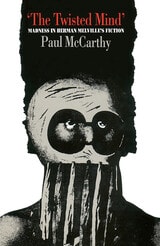
The Twisted Mind
Madness In Melville'S FictionPaul Mccarthy
University of Iowa Press, 1990
Paul McCarthy
"Though madness has been a consistent topic in considerations of Melville's work, this is the first full-scale treatment of the subject. It is in a sense, then, a pioneering work that will no doubt receive widespread attention."
—William B. Dillingham
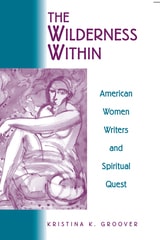
The Wilderness Within
American Women Writers and Spiritual QuestKristina K. Groover
University of Arkansas Press, 1999
Kristina K. Groover, in examining this question, finds that books by American women writers offer alternative patterns for seeking revelation—patterns which emphasize not solitary journeys, but the sacredness of everyday life. Drawing on the work of feminist theorists and theologians, including Carol Gilligan, Naomi Goldenberg, and Rosemary Ruether, Groover explores the spiritual nature and force of domesticity, community, storytelling, and the garden in the works of such writers as Toni Morrison, Katherine Anne Porter, Kaye Gibbons, and Alice Walker. Ordinary, personal experience in these works becomes a source for spiritual revelation. Wisdom is gained, lessons are learned, and lives are healed not in spite of home and communal ties, but because of them.
Thus, American women writers, Groover argues, make alternative literary and spiritual paradigms possible. Similarly, Kristina K. Groover, in this lucid and groundbreaking work, opens up new fields of exploration for any reader interested in women’s spirituality or in the rich, diverse field of American literature.
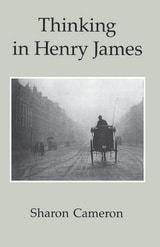
Thinking in Henry James
Sharon Cameron
University of Chicago Press, 1989

Whale
K.L. Evans
University of Minnesota Press, 2003
An entirely fresh approach to Moby Dick, by way of Ludwig Wittgenstein
The aim of this thoroughly unconventional work is to demonstrate that Herman Melville’s Moby Dick and Ludwig Wittgenstein’s Philosophical Investigations share the same projects and are, in effect, one and the same book. Confounding and improbable as such an enterprise might seem, Whale! not only successfully reveals the vital intersections between Melville and Wittgenstein but also, more important, makes a compelling argument for why such intersections are essential to understanding common political projects in literature and philosophy.
Written with grace, passion, and wit, Whale! manages to produce a startling and remarkably original reading of one of the most written-about and interpreted books in the American canon. K. L. Evans explores Melville’s vast work as a tale not of vengeance but of affection, and Ahab’s near-pathological agitation as indicative of his refusal to accept the world as unknowable. Between Ahab and the whale, Evans traces a longing for connection and meaning and finds a forceful response to the skeptical view that language is bankrupt and knowledge is uncertain. In Ahab’s hunt for Moby Dick, Whale! discovers a way to reconnect matter with meaning, object with knowledge.