Results by title
43 books match the query 'Public Relations'

Abolition’s Public Sphere
Robert Fanuzzi
University of Minnesota Press, 2003
An innovative analysis of the Enlightenment’s effects on the anti-slavery movement
Echoes of Thomas Paine and Enlightenment thought resonate throughout the abolitionist movement and in the efforts of its leaders to create an antislavery reading public. In Abolition’s Public Sphere Robert Fanuzzi critically examines the writings of William Lloyd Garrison, Frederick Douglass, Henry David Thoreau, and Sarah and Angelina Grimke, and their massive abolition publicity campaign—pamphlets, newspapers, petitions, and public gatherings—geared to an audience of white male citizens, free black noncitizens, women, and the enslaved. Including provocative readings of Thoreau’s Walden and of the symbolic space of Boston’s Faneuil Hall, Abolition’s Public Sphere demonstrates how abolitionist public discourse sought to reenact eighteenth-century scenarios of revolution and democracy in the antebellum era.
Fanuzzi illustrates how the dissemination of abolitionist tracts served to create an “imaginary public” that promoted and provoked the discussion of slavery. However, by embracing Enlightenment abstractions of liberty, reason, and progress, Fanuzzi argues, abolitionist strategy introduced aesthetic concerns that challenged political institutions of the public sphere and prevailing notions of citizenship. Insightful and thought-provoking, Abolition’s Public Sphere questions standard versions of abolitionist history and, in the process, our understanding of democracy itself.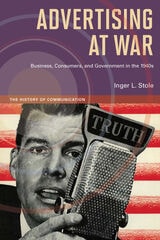
Advertising at War
Business, Consumers, and Government in the 1940sInger L. Stole
University of Illinois Press, 2012
Using archival sources, newspapers accounts, and trade publications, Stole demonstrates that the war elevated and magnified the seeming contradictions of advertising and allowed critics of these practices one final opportunity to corral and regulate the institution of advertising. Exploring how New Dealers and consumer advocates such as the Consumers Union battled the advertising industry, Advertising at War traces the debate over two basic policy questions: whether advertising should continue to be a tax-deductible business expense during the war, and whether the government should require effective standards and labeling for consumer products, which would render most advertising irrelevant. Ultimately the postwar climate of political intolerance and reverence for free enterprise quashed critical investigations into the advertising industry. While advertising could be criticized or lampooned, the institution itself became inviolable.

Advertising on Trial
Consumer Activism and Corporate Public Relations in the 1930sInger L. Stole
University of Illinois Press, 2006
Inger L. Stole examines how consumer activists sought to limit corporate influence by rallying popular support to moderate and change advertising. Stole weaves the story through the extensive use of primary sources, including archival research done with consumer and trade group records, as well as trade journals and engagement with the existing literature. Her account of the struggle also demonstrates how public relations developed in order to justify laissez-faire corporate advertising in light of a growing consumer rights movement, and how the failure to rein in advertising was significant not just for civic life in the 1930s but for our era as well.
Advocacy and Awareness for Archivists
Kathleen D. Roe
Society of American Archivists, 2019

Artwash
Big Oil and the ArtsMel Evans
Pluto Press, 2015
Reflecting on the role and function of art galleries, Artwash considers how the association with oil money might impede these institutions in their cultural endeavors. Outside the gallery space, Mel Evans examines how corporate sponsorship of the arts can obscure the strategies of corporate executives to maintain brand identity and promote their public image through cultural philanthropy. Ultimately, Evans sounds a note of hope, presenting ways artists themselves have challenged the ethics of contemporary art galleries and examining how cultural institutions might change.
Being Indispensable
A School Librarian's Guide to Becoming an Invaluable LeaderRuth Toor
American Library Association, 2010

Berlin Sports
Spectacle, Recreation, and Media in Germany’s MetropolisHeather L. Dichter
University of Arkansas Press, 2024
This book begins with a long-distance equestrian race in the 1890s and continues with the role of media in spectacle, celebrity, urban life, and gender from the 1890s to the 1920s.It then turns to grassroots sport participation and spectatorship as well as sport diplomacy at the elite international level during the postwar period and the years of German division. Next, it explores recreational sport associations within the context of immigration and youth counterculture. It concludes with the 2015 European Maccabi Games, an international Jewish sports festival through which Berlin sought to grapple with the infamous 1936 Olympics and showcase Berlin as a cosmopolitan and multicultural city. Taken together, the book’s scholarly essays on all of these sporting endeavors reveal the rich and varied sporting culture in Berlin and yield fresh insights into spectacle, recreation, and media in the city.

Blueprint for Your Library Marketing Plan
A Guide to Help You Survive and ThrivePatricia H. Fisher
American Library Association, 2006
Building a Buzz
Libraries & Word-of-Mouth MarketingPeggy Barber
American Library Association, 2010
Creating a Winning Online Exhibit
Martin R. Kalfatovic
American Library Association, 2002
Creating the Customer-Driven Academic Library
Jeannette Woodward
American Library Association, 2009
Creating the Customer-Driven Library
Building on the Bookstore ModelJeannette Woodward
American Library Association, 2004

Culture Incorporated
Museums, Artists, And Corporate SponsorshipsMark W. Rectanus
University of Minnesota Press, 2002
An exposé of the hidden costs of corporate funding of the arts
Photographer Annie Leibowitz collaborates with American Express on a portrait exhibition. Absolut Vodka engages artists for their advertisements. Philip Morris mounts an "Arts Against Hunger" campaign in partnership with prominent museums. Is it art or PR, and where is the line that separates the artistic from the corporate? According to Mark Rectanus, that line has blurred. These mergers of art, business, and museums, he argues, are examples of the worldwide privatization of cultural funding.
In Culture Incorporated, Rectanus calls for full disclosure of corporate involvement in cultural events and examines how corporations, art institutions, and foundations are reshaping the cultural terrain. In turn, he also shows how that ground is destabilized by artists subverting these same institutions to create a heightened awareness of critical alternatives. Rectanus exposes how sponsorship helps maintain social legitimation in a time when corporations are the target of significant criticism. He provides wide-ranging examples of artists and institutions grappling with corporate sponsorship, including artists’s collaboration with sponsors, corporate sponsorship of museum exhibitions, festivals, and rock concerts, and cybersponsoring. Throughout, Rectanus analyzes the convergence of cultural institutions with global corporate politics and its influence on our culture and our communities.Dealing with Difficult People in the Library
American Library Association, 1999
Engagement in the Digital Era
Christopher Prom
Society of American Archivists, 2020

Engaging Diverse Communities
A Guide to Museum Public RelationsMelissa A. Johnson
University of Massachusetts Press, 2020
Melissa A. Johnson interviews communicators at cultural heritage museums to understand the challenges of representing communities based on racial and ethnic, generational, immigrant, and language identities. Exploring how communications professionals function as cultural intermediaries by negotiating competing and intersecting identities and mastering linguistic and visual code-switching, she presents an analysis of the communication tactics of more than two hundred art, history, African American, American Indian, and other diverse museums. Engaging Diverse Communities illuminates best public relations practices, especially in media relations, digital press relations, website content production, social media, and event planning. This essential text for museum professionals also addresses visual aesthetics, cultural expression, and counter-stereotypes, and offers guidance on how to communicate cultural attractiveness.

Frontier Religion
Mormons and America, 1857–1907Konden Smith Hansen
University of Utah Press, 2019
In Frontier Religion Konden Smith Hansen examines the dramatic influence these perceptions of the frontier had on Mormonism and other religions in America. Endeavoring to better understand the sway of the frontier on religion in the United States, this book follows several Mormon-American conflicts, from the Utah War and the antipolygamy crusades to the Reed Smoot hearings. The story of Mormonism’s move toward American acceptability represents a larger story of the nation’s transition to modernity and the meaning of religious pluralism. This book challenges old assumptions and provokes further study of the ever changing dialectic between society and faith.
Grassroots Library Advocacy
Lauren Comito
American Library Association, 2012
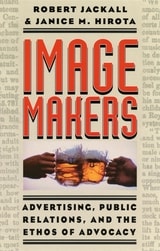
Image Makers
Advertising, Public Relations, and the Ethos of AdvocacyRobert Jackall and Janice M. Hirota
University of Chicago Press, 2000
Robert Jackall and Janice M. Hirota explore the fashioning of the apparatus of advocacy through the stories of two organizations, the Committee on Public Information, which sold the Great War to the American public, and the Advertising Council, which since the Second World War has been the main coordinator of public service advertising. They then turn to the career of William Bernbach, the adman's adman, who reinvented advertising and grappled creatively with the profound skepticism of a propaganda-weary midcentury public. Jackall and Hirota argue that the tools-in-trade and habits of mind of "image makers" have now migrated into every corner of modern society. Advocacy is now a vocation for many, and American society abounds as well with "technicians in moral outrage," including street-smart impresarios, feminist preachers, and bombastic talk-radio hosts.
The apparatus and ethos of advocacy give rise to endlessly shifting patterns of conflicting representations and claims, and in their midst Image Makers offers a clear and spirited understanding of advocacy in contemporary society and the quandaries it generates.
Librarians as Community Partners
An Outreach HandbookCarol Smallwood
American Library Association, 2010
Library Marketing and Communications
Strategies to Increase Relevance and ResultsCordelia Anderson
American Library Association, 2020
Effectively marketing libraries by persuasively communicating their relevance is key to ensuring their future. Speaking directly to those in senior leadership positions, Anderson lays out the structural and organizational changes needed to help libraries answer the relevance question and maximize their marketing and communications efforts. Focusing on big-picture strategies, she shares lessons learned from her 20+ year career in library marketing and communications. No matter what type or size of library you help to lead, by reading this book you will
- gain insight into why libraries need to tell their stories more effectively than they are today;
- be able to craft a strategic roadmap for marketing your library and communicating its value in a variety of ways that resonate with key audiences;
- see why improvements to the structure of your marketing and communications team can lead to better results;
- learn practical methods for incorporating audience research into your planning;
- know how to remove customer barriers and discontinue practices that are thwarting your marketing efforts;
- receive guidance on preparing for potential crises;
- understand how to be more community-focused by forming and sustaining partnerships; and
- feel confident in engaging with stakeholders so that they become your library’s best ambassadors.

Many Happy Returns
Advocacy and the Development of ArchivesLarry J. Hackman
Society of American Archivists, 2011
Marketing Today's Academic Library
A Bold New Approach to Communicating with StudentsBrian Mathews
American Library Association, 2009

Petroturfing
Refining Canadian Oil through Social MediaJordan B. Kinder
University of Minnesota Press, 2024
How social media has become a critical tool for advancing the interests of the Canadian oil industry
Petroturfing presents an incisive look into how Canada’s pro-oil movement has leveraged social media to rebrand the extractive economy as a positive force. Adapting its title from the concept of astroturfing, which refers to the practice of disguising political and corporate media campaigns as grassroots movements, the book exposes the consequences of this mutually informed relationship between social media and environmental politics.
Since the early 2010s, an increasingly influential network of pro-oil groups, organizations, and campaigns has harnessed social media strategies originally developed by independent environmental organizations in order to undermine resistance to the fossil fuel industry. Situating these actions within the broader oil culture wars that have developed as an outgrowth of contemporary right-wing media, Petroturfing details how this coalition of groups is working to reform the public view of oil extraction as something socially, economically, and ecologically beneficial.
By uncovering these concerted efforts to influence the “energy consciousness,” Jordan B. Kinder reveals the deep divide between Canada’s environmentally progressive reputation and the economic interests of its layers of government and private companies operating within its borders. Drawing attention to the structures underlying online political expression, Petroturfing highlights the limitations of social media networks in the work of promoting environmental justice and contributing to a more equitable future.
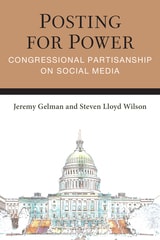
Posting for Power
Congressional Partisanship on Social MediaJeremy Gelman and Steven Lloyd Wilson
University of Michigan Press, 2026
In the US Congress, lawmakers regularly choose to bicker for political gain, whether or not they disagree on issues. By classifying millions of social media posts as partisan or not, Gelman and Wilson quantify a legislator’s partisan intensity through the time and effort they spend supporting their party and bickering with the opposition. The authors argue that the partisan personas politicians create are both a home style, to help them win reelection, and hill style, to help them become politically influential by showing off as good team players. Bringing together a wide range of data on leadership races, elections, voting records, cosponsorship patterns, and lawmaking outcomes, they demonstrate the nearly consequence-free way that legislators strategically deploy partisanship to impress their copartisans and voters. Gelman and Wilson closely examine what motivates members to differ so much in developing this part of their public personas and offer clear recommendations for how to turn down the partisan heat on Capitol Hill.
Powerful Public Relations
American Library Association, 2002

Preparing Students to Engage in Equitable Community Partnerships
A HandbookElizabeth A. Tryon
Temple University Press, 2023
Preparing Students to Engage in Equitable Community Partnerships provides a wealth of valuable resources and activities to help impart ideas of identity, privilege, oppression, bias, and power dynamics to best support students and community in these relationships. Believing that authenticity only comes about in an atmosphere of mutual respect and self-awareness, the authors argue for cultural and intellectual humility.
Each chapter looks at topics and issues through different lenses, complete with underlying theories, and relates those discussions to concrete classroom activities, facilitation strategies, and scholarly frames. In addition, the authors include contributions from a diverse group of practitioners at community colleges, private colleges, historically Black colleges and universities, and minority-serving institutions.
Preparing Students to Engage in Equitable Community Partnerships is a much-needed, comprehensive resource for community-engaged professionals as they prepare students for building relationships when entering a community for learning or research purposes.
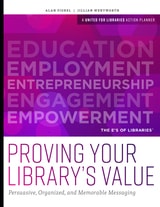
Proving Your Library's Value
Persuasive, Organized, and Memorable MessagingAlan Fishel
American Library Association, 2020
You know the value of your library, but elected officials, donors, community leaders, funders, and other important stakeholders may not. How can you make the library a priority for these groups, who may have preconceived notions about what the library does, as you compete with other important community organizations for funding? In this book from United for Libraries, you’ll learn how to use The E’s of Libraries® (Education, Employment, Entrepreneurship, Engagement, and Empowerment) to quickly demonstrate why your library is essential and worthy of funding, using messaging that is organized, persuasive, and memorable. With the help of worksheets, charts, and prompts, you will learn how to
- use language designed to win over stakeholders, funders, and partners;
- craft custom messaging in several formats that is easily accessible and memorable, including elevator speeches, budget presentations, and annual appeals; and
- create presentations and other materials tailored to any audience based on the sample documents included.
This book's innovative framework can be used by any size or type of library, and by any library advocate, including Friends groups, library staff, trustees, and foundations.
Public Relations and Marketing for Archives
A How-To-Do-It ManualRussell D. James
American Library Association, 2011
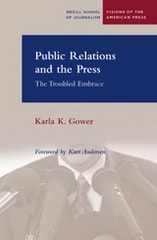
Public Relations and the Press
The Troubled EmbraceKarla Gower
Northwestern University Press, 2007
A democracy works when individuals have access to reliable information upon which to base decisions—information that in our day comes from the mass media. But what if journalists do not have the wherewithal to question their sources and evaluate the information they provide? This, Karla K. Gower explains, is precisely what happens when economic and competitive pressures shift power from the journalist to the source—and the source, not the journalist, controls the flow of information to the public. Gowers describes a situation in which people, “informed” by practitioners of public relations, do not have sufficient information to make valid decisions. At stake is the core credibility of the press itself, and therefore the essential claim of journalism to a privileged role in a democratic social order.
RSF
The Russell Sage Foundation Journal of the Social Sciences: Three Decades Since 'Making Ends Meet': What We Know about How Single Mothers Survive TodayElizabeth O. Ananat
Russell Sage Foundation, 2026
In their seminal 1995 book Making Ends Meet: How Low-Income Single Mothers Survive Welfare and Low-Wage Employment, Kathryn Edin and Laura Lein laid bare the strategies and challenges of low-income single mothers who were struggling to provide for their families. Even in an era when cash welfare was a federal entitlement, these women struggled to get by. In the thirty years since the book’s publication, many single parents wrestle with volatility and precarious resources from work, informal and formal supports. In this double issue of RSF, economist Elizabeth O. Ananat, political scientist and public policy scholar Carolyn Y. Barnes, sociologists Sandra K. Danziger and Kathryn Edin, and an interdisciplinary group of contributors examine how the policy landscape has changed since welfare reform and how it impacts low-income single mothers’ ability to make ends meet today.
Issue 1 has 8 articles that examine how the traditional safety net has evolved and new supports that have been developed since Making Ends Meet. For example, Sarah K. Bruch and colleagues assess changes to the social safety net since welfare reform in the 1990s and find that benefits have become more exclusive, have more constraints, and are less generous. Kelley Fong and Nora McCarthy reveal that, in an attempt to decrease child maltreatment, the child welfare system increasingly provides material resources to system-involved parents, including in-kind donations and assistance accessing childcare. However, parents often avoid obtaining resources through the system because it opens them up to increased state surveillance. Heather D. Hill and colleagues show that access to paid family and medical leave (PFML) varies greatly for single mothers, with two-thirds of single mothers living in states without PMFL. For those who live in states with PFML, the accessibility and generosity of benefits vary greatly.
Issue 2 has 5 articles that look at lessons that can be learned from COVID Era policies, how single mothers currently try to make ends meet, and men’s contributions to families. For example, Natasha V. Pilkauskas and Kevin Bruey find that low-income single mothers, with and without employment, utilize a variety of public and private resources to make ends meet. Despite this, both groups face high levels of material hardship, including food and housing insecurity. Hope Harvey examines how members of doubled up households understand their economic and social relationships and reveals that there are often disagreements about shared resources, such as money and food. However, it is not just the precise contributions that cause conflict, but how the exchanges are interpreted within the context of household members’ relationships. Allison Dwyer Emory and colleagues show that nonresident fathers often have trouble making ends meet themselves and are unable to make up for the loss of cash support post-welfare reform.
This double issue of RSF showcases the persistence of precarity that low-income families face since Making Ends Meet.
Note: This copy refers to both issues of the journal double issue.
RSF
The Russell Sage Foundation Journal of the Social Sciences: Three Decades Since 'Making Ends Meet': What We Know about How Single Mothers Survive TodayElizabeth O. Ananat
Russell Sage Foundation, 2026
In their seminal 1995 book Making Ends Meet: How Low-Income Single Mothers Survive Welfare and Low-Wage Employment, Kathryn Edin and Laura Lein laid bare the strategies and challenges of low-income single mothers who were struggling to provide for their families. Even in an era when cash welfare was a federal entitlement, these women struggled to get by. In the thirty years since the book’s publication, many single parents wrestle with volatility and precarious resources from work, informal and formal supports. In this double issue of RSF, economist Elizabeth O. Ananat, political scientist and public policy scholar Carolyn Y. Barnes, sociologists Sandra K. Danziger and Kathryn Edin, and an interdisciplinary group of contributors examine how the policy landscape has changed since welfare reform and how it impacts low-income single mothers’ ability to make ends meet today.
Issue 1 has 8 articles that examine how the traditional safety net has evolved and new supports that have been developed since Making Ends Meet. For example, Sarah K. Bruch and colleagues assess changes to the social safety net since welfare reform in the 1990s and find that benefits have become more exclusive, have more constraints, and are less generous. Kelley Fong and Nora McCarthy reveal that, in an attempt to decrease child maltreatment, the child welfare system increasingly provides material resources to system-involved parents, including in-kind donations and assistance accessing childcare. However, parents often avoid obtaining resources through the system because it opens them up to increased state surveillance. Heather D. Hill and colleagues show that access to paid family and medical leave (PFML) varies greatly for single mothers, with two-thirds of single mothers living in states without PMFL. For those who live in states with PFML, the accessibility and generosity of benefits vary greatly.
Issue 2 has 5 articles that look at lessons that can be learned from COVID Era policies, how single mothers currently try to make ends meet, and men’s contributions to families. For example, Natasha V. Pilkauskas and Kevin Bruey find that low-income single mothers, with and without employment, utilize a variety of public and private resources to make ends meet. Despite this, both groups face high levels of material hardship, including food and housing insecurity. Hope Harvey examines how members of doubled up households understand their economic and social relationships and reveals that there are often disagreements about shared resources, such as money and food. However, it is not just the precise contributions that cause conflict, but how the exchanges are interpreted within the context of household members’ relationships. Allison Dwyer Emory and colleagues show that nonresident fathers often have trouble making ends meet themselves and are unable to make up for the loss of cash support post-welfare reform.
This double issue of RSF showcases the persistence of precarity that low-income families face since Making Ends Meet.
Note: This copy refers to both issues of the journal double issue.
Reputation Analytics
Public Opinion for CompaniesDaniel Diermeier
University of Chicago Press, 2023
A scientific approach to corporate reputation from the field’s leading scholar.
Public opinion is a core factor of any organization’s success—and sometimes its failings. Whether through crisis, mismanagement, or sudden shifts in public sensibility, an organization can run afoul in the span of a Tweet.
In Reputation Analytics, Daniel Diermeier offers the first rigorous analytical framework for understanding and managing corporate reputation and public perception. Drawing on his expertise as a political scientist and management scholar, Diermeier incorporates lessons from game theory, psychology, and text analytics to create a methodology that has immediate application in both scholarship and practice.
A milestone work from one of social science’s most eminent scholars, Reputation Analytics unveils an advanced understanding of an elusive topic, resulting in an essential guide for academics and readers across industries.
Start a Revolution
Stop Acting Like a LibraryBen Bizzle
American Library Association, 2014

Students Lead The Library
The Importance Of StudentCarissa Tomlinson
Assoc of College & Research Libraries, 2016

Sustainable Thinking
Ensuring Your Library's Future in an Uncertain WorldRebekkah Smith Aldrich
American Library Association, 2018

Taking the Risk Out of Democracy
Corporate Propaganda versus Freedom and LibertyAlex Carey
University of Illinois Press, 1995
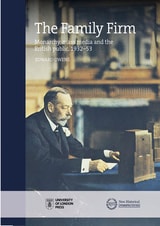
The Family Firm
monarchy, mass media and the British public, 1932-53Edward Owens
University of London Press, 2019
The Librarian’s Guide to Book Programs and Author Events
Brad Hooper
American Library Association, 2016

Thinker, Faker, Spinner, Spy
Corporate PR and the Assault on DemocracyEdited by David Miller and William Dinan
Pluto Press, 2007
Written by leading activists and writers, this book reveals the secrets of the PR trade including deception, the use of fake 'institutes', spying and dirty tricks. The impact can be devastating -- when the public is denied access to the truth, the results are rising inequality and environmental catastrophe.
Exposing the misdeeds of famous companies including Coca Cola, British Aerospace, Exxon and Monsanto, and revealing information about the covert funding of various apparently independent thinks tanks and institutes, the authors offer a guide to campaigns that can help us roll back corporate power and resist deceptive PR.
Visible Librarian
Judith A. Siess
American Library Association, 2003

Waves of Opposition
Labor and the Struggle for Democratic RadioElizabeth Fones-Wolf
University of Illinois Press, 2006
Radio sparked the massive upsurge of organized labor during the Great Depression. The powerful new medium became an important weapon in the ideological war between labor and business. Corporations used radio to sing the praises of individualism and consumerism, while unions emphasized equal rights, industrial democracy, and social justice.
Elizabeth Fones-Wolf analyzes the battle to utilize, and control, the airwaves in radio's early era. Working chronologically, she explores the advent of local labor radio stations such as WCFL and WEVD, labor's campaigns against corporate censorship, and union experiments with early FM broadcasting. Using union archives and broadcast industry records, Fones-Wolf demonstrates radio's key role in organized labor's efforts to fight business's domination of political discourse throughout the 1930s, 1940s, and 1950s. She concludes with a look at how labor's virtual disappearance from today's media helps explain why unions have become so marginalized, and offers important historical lessons for revitalizing organized labor.
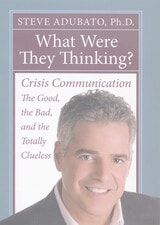
What Were They Thinking?
Crisis Communication: The Good, the Bad, and the Totally CluelessSteve Adubato, Ph.D.
Rutgers University Press, 2008
Nationally recognized communication coach and four-time Emmy Awardûwinning broadcaster Steve Adubato has been teaching, writing, and thinking about comm¡unication, leadership, and crisis communication for nearly two decades. In What Were They Thinking? Adubato examines twenty-two controversial and complex public relations and media mishaps, many of which were played out in public. Among cases and people discussed are:
- The Johnson & Johnson Tylenol scare: Perhaps the best crisis management ever
- Don Imus: Sometimes saying "sorry" is too little too late
- Former Attorney General Alberto Gonzales: Authority does not put you above questioning
- Bill O'Reilly: Know when to stop defending yourself and save face
- Former EPA Administrator Christie Whitman: Proof that your written words can come back to haunt you
- Hurricane Katrina: A natural disaster that led to a larger governmental disaster
- The Catholic Church's pedophilia scandal: Denial won't get rid of the skeletons in your closet
Arranged in short chapters detailing each case individually, the book provides a brief history of the topics and answers the questions: Who got it right? Who got it wrong? What can the rest of us learn from them?