Results by title
19 books match the query 'Public interest'
A New Constitutionalism
Designing Political Institutions for a Good SocietyEdited by Stephen L. Elkin and Karol Edward Soltan
University of Chicago Press, 1993
Believing that constitutionalism needs to go beyond the classical goal of limiting the arbitrary exercise of political power, the contributors argue that it should—and can—be designed to achieve economic efficiency, informed democratic control, and other valued political ends. More broadly, they believe that political and social theory needs to turn away from the negativism of critical theory to consider how a good society should be "constituted" and to direct the work of designing institutions that can constitute a "good polity," in both the economic and civic senses.
Stephen L. Elkin and Karol Edward Soltan begin with an overview of constitutionalist theory and a discussion of the new constitutionalism within the broader intellectual and historical context of political and social thought. Charles Anderson, James Ceaser, and the editors then offer different interpretations of the central issues regarding institutional design in a constitutionalist social science, consider various ways of performing the task, and discuss the inadequacy of recent political science to the job it ought to be doing. The book concludes with essays by Ted Lowi, Cass Sunstein and Edwin Haefele which apply these themes to the American regime.
After the Public Turn
Composition, Counterpublics, and the Citizen BricoleurFrank Farmer
Utah State University Press, 2013
Farmer examines two very different kinds of publics, cultural and disciplinary, and discusses two counterpublics within those broad categories: zine discourses and certain academic discourses. By juxtaposing these two significantly different kinds of publics, Farmer suggests that each discursive world can be seen, in its own distinct way, as a counterpublic, an oppositional social formation that has a stake in widening or altering public life as we know it.
Drawing on major figures in rhetoric and cultural theory, Farmer builds his argument about composition teaching and its relation to the public sphere, leading to a more sophisticated understanding of public life and a deeper sense of what democratic citizenship means for our time.

Archives Power
Randall C. Jimerson
American Library Association, 2009
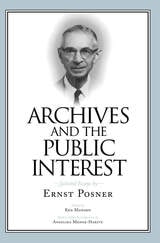
Archives and the Public Interest
Selected Essays by Ernest PosnerKen Munden
Society of American Archivists, 2006
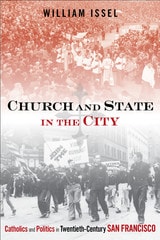
Church and State in the City
Catholics and Politics in Twentieth-Century San FranciscoWilliam Issel
Temple University Press, 2012
Church and State in the City provides the first comprehensive analysis of the city’s long debate about the public interest. Historian William Issel explores the complex ways that the San Francisco Catholic Church—and its lay men and women—developed relationships with the local businesses, unions, other community groups, and city government to shape debates about how to define and implement the common good. Issel’s deeply researched narrative also sheds new light on the city’s socialists, including Communist Party activists—the most important transnational challengers of both capitalism and Catholicism during the twentieth century.
Moreover, Church and State in the City is revisionist in challenging the notion that the history of urban politics and policy can best be understood as the unfolding of a progressive, secular modernization of urban political culture. Issel shows how tussles over the public interest in San Francisco were both distinctive to the city and shaped by its American character.
In the series Urban Life, Landscape, and Policy, edited by Zane L. Miller, David Stradling, and Larry Bennett
Freedom of the Air and the Public Interest
First Amendment Rights in Broadcasting to 1935Louise M. Benjamin
Southern Illinois University Press, 2006
Drawing on primary resources from sixteen archives plus contemporary secondary sources, Benjamin analyzes interactions among the players involved and argues that First Amendment rights in radio evolved in the 1920s and 1930s through the interaction of many entities having social, political, or economic interests in radio. She shows how free speech and First Amendment rights were defined and perceived up to 1935.
Focusing on the evolution of various electronic media rights, Benjamin looks at censorship, speakers’ rights of access to the medium, broadcasters’ rights to use radio as they desired, and listeners’ rights to receive information via the airwaves. With many interested parties involved, conflict was inevitable, resulting in the establishment of industry policies and government legislation—particularly the Radio Act of 1927. Further debate led to the Communications Act of 1934, which has provided the regulatory framework for broadcasting for over sixty years. Controversies caused by new technology today continue to rage over virtually the same rights and issues that Benjamin deals with.

Imagining Interest in Political Thought
Origins of Economic RationalityStephen G. Engelmann
Duke University Press, 2003
Tracing the development of monistic interest from its origins in Reformation political theory and theology through late-twentieth-century neoliberalism, Engelmann reconceptualizes the history of liberalism as consisting of phases in the history of monistic interest or economic government. He describes how monistic interest, as formulated by Bentham, is made up of the individual’s imagined expectations, which are constructed by the very regime that maximizes them. He asserts that this construction of interests is not the work of a self-serving manipulative state. Rather, the state, which is itself subject to strict economic regulation, is only one cluster of myriad "public" and "private" agencies that produce and coordinate expectations. In place of a liberal vision in which government appears only as a protector of the free pursuit of interest, Engelmann posits that the free pursuit of interest is itself a mode of government, one that deploys individual imagination and choice as its agents.
In the Public Interest
Medical Licensing and the Disciplinary ProcessHorowitz, Ruth
Rutgers University Press, 2012
Winner of the American Sociological Association Sociology of Law Section 2013 Outstanding Book Award
How do we know when physicians practice medicine safely? Can we trust doctors to discipline their own? What is a proper role of experts in a democracy? In the Public Interest raises these provocative questions, using medical licensing and discipline to advocate for a needed overhaul of how we decide public good in a society dominated by private interest groups. Throughout the twentieth century, American physicians built a powerful profession, but their drive toward professional autonomy has made outside observers increasingly concerned about physicians’ ability to separate their own interests from those of the general public.
Ruth Horowitz traces the history of medical licensure and the mechanisms that democratic societies have developed to certify doctors to deliver critical services. Combining her skills as a public member of medical licensing boards and as an ethnographer, Horowitz illuminates the workings of the crucial public institutions charged with maintaining public safety. She demonstrates the complex agendas different actors bring to board deliberations, the variations in the board authority across the country, the unevenly distributed institutional resources available to board members, and the difficulties non-physician members face as they struggle to balance interests of the parties involved.
In the Public Interest suggests new procedures, resource allocation, and educational initiatives to increase physician oversight. Horowitz makes the case for regulations modeled after deliberative democracy that promise to open debates to the general public and allow public members to take a more active part in the decision-making process that affects vital community interests.

Patent Politics
Life Forms, Markets, and the Public Interest in the United States and EuropeShobita Parthasarathy
University of Chicago Press, 2017
To demonstrate this, Parthasarathy takes readers through a particularly fierce and prolonged set of controversies over patents on life forms linked to important advances in biology and agriculture and potentially life-saving medicines. Comparing battles over patents on animals, human embryonic stem cells, human genes, and plants in the United States and Europe, she shows how political culture, ideology, and history shape patent system politics. Clashes over whose voices and which values matter in the patent system, as well as what counts as knowledge and whose expertise is important, look quite different in these two places. And through these debates, the United States and Europe are developing very different approaches to patent and innovation governance. Not just the first comprehensive look at the controversies swirling around biotechnology patents, Patent Politics is also the first in-depth analysis of the political underpinnings and implications of modern patent systems, and provides a timely analysis of how we can reform these systems around the world to maximize the public interest.
Public and Private in Thought and Practice
Perspectives on a Grand DichotomyEdited by Jeff Weintraub and Krishan Kumar
University of Chicago Press, 1997
In contexts ranging from friendship, the family, and personal life to nationalism, democratic citizenship, the role of women in social and political life, and the contrasts between western and (post-)Communist societies, this book brings out the ways the various uses of the public/private distinction are simultaneously distinct and interconnected. Public and Private in Thought and Practice will be of interest to students and scholars in disciplines including politics, law, philosophy, history, sociology, and women's studies.
Contributors include Jeff Weintraub, Allan Silver, Craig Calhoun, Daniela Gobetti, Jean L. Cohen, Jean Bethke Elshtain, Alan Wolfe, Krishan Kumar, David Brain, Karen Hansen, Marc Garcelon, and Oleg Kharkhordin.
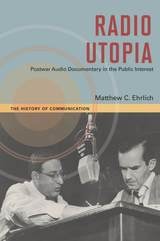
Radio Utopia
Postwar Audio Documentary in the Public InterestMatthew Ehrlich
University of Illinois Press, 2017
Reconstructing the Commercial Republic
Constitutional Design after MadisonStephen L. Elkin
University of Chicago Press, 2006
The deficiencies Elkin points out provide the starting point for his own constitutional theory of the republic—a theory that, unlike Madison’s, lays out a substantive conception of the public interest that emphasizes the power of institutions to shape our political, economic, and civic lives. Elkin argues that his theory should guide us toward building a commercial republic that is rooted in a politics of the public interest and the self-interest of the middle class. He then recommends specific reforms to create this kind of republic, asserting that Americans today can still have the lives a commercial republic is intended to promote: lives with real opportunities for economic prosperity, republican political self-government, and individual liberty.
Regulatory Rights
Supreme Court Activism, the Public Interest, and the Making of Constitutional LawLarry Yackle
University of Chicago Press, 2007
Traversing a wide range of Supreme Court decisions that established crucial precedents about racial discrimination, the death penalty, and sexual freedom, Yackle contends that the rights we enjoy are neither more nor less than what the justices choose to make of them. Regulatory Rights is a bracing read that will be heatedly debated by all those interested in constitutional law and the judiciary.
Signaling Goodness
Social Rules and Public ChoicePhillip J. Nelson and Kenneth V. Greene
University of Michigan Press, 2003
The Causes and Consequences of Antitrust
The Public-Choice PerspectiveEdited by Fred S. McChesney and William F. Shughart II
University of Chicago Press, 1995
The contributors are Peter Asch, George Bittlingmayer, Donald J. Boudreaux, Malcolm B. Coate, Louis De Alessi, Thomas J. DiLorenzo, B. Epsen Eckbo, Robert B. Ekelund, Jr., Roger L. Faith, Richard S. Higgins, William E. Kovacic, Donald R. Leavens, William F. Long, Fred S. McChesney, Mike McDonald, Stephen Parker, Richard A. Posner, Paul H. Rubin, Richard Schramm, Joseph J. Seneca, William F. Shughart II, Jon Silverman, George J. Stigler, Robert D. Tollison, Charlie M. Weir, Peggy Wier, and Bruce Yandle.
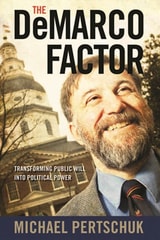
The DeMarco Factor
Transforming Public Will into Political PowerMichael Pertschuk
Vanderbilt University Press, 2010
DeMarco's unique strategic template, developed over two decades of serial campaigning, includes momentum-building stages over a multiyear campaign; unrelenting, skillful access to the media for engaging public support; coalitions of hundreds, even thousands, of faith, community, labor, public health, and business groups; and a hard press on candidates to support legislation before elections, rather than after they are comfortably in office. As an organizer/leader, Demarco also succeeds in his campaigns through force of personality: his unquenchable exuberance and idiosyncrasies delight and madden his opponents--sometimes his allies, too.
Michael Pertschuk, himself a veteran advocate, here chronicles three of DeMarco's campaigns, each facing a different obstacle course. His deep analysis draws out strategic and leadership lessons that engaged citizens and advocates for popular causes stonewalled by powerful lobbies can put to immediate and practical use.
The People's Agents and the Battle to Protect the American Public
Special Interests, Government, and Threats to Health, Safety, and the EnvironmentRena Steinzor and Sidney Shapiro
University of Chicago Press, 2010
Reasonable people disagree about the reach of the federal government, but there is near-universal consensus that it should protect us from such dangers as bacteria-infested food, harmful drugs, toxic pollution, crumbling bridges, and unsafe toys. And yet, the agencies that shoulder these responsibilities are in shambles; if they continue to decline, lives will be lost and natural resources will be squandered. In this timely book, Rena Steinzor and Sidney Shapiro take a hard look at the tangled web of problems that have led to this dire state of affairs.
It turns out that the agencies are not primarily to blame and that regulatory failure actually stems from a host of overlooked causes. Steinzor and Shapiro discover that unrelenting funding cuts, a breakdown of the legislative process, an increase in the number of political appointees, a concurrent loss of experienced personnel, chaotic White House oversight, and ceaseless political attacks on the bureaucracy all have contributed to the broken system. But while the news is troubling, the authors also propose a host of reforms, including a new model for measuring the success of the agencies and a revitalization of the civil service. The People’s Agents and the Battle to Protect the American Public is an urgent and compelling appeal to renew America’s best traditions of public service.
The Private Abuse of the Public Interest
Market Myths and Policy MuddlesLawrence D. Brown and Lawrence R. Jacobs
University of Chicago Press, 2008
The authors support their pragmatic approach with evidence drawn from in-depth analyses of education, transportation, and health care policies. In each policy area, initiatives such as school choice, deregulation of airlines and other carriers, and the promotion of managed care have introduced or enlarged the role of market forces with the aim of eliminating bureaucratic inefficiency. But in each case, the authors show, reality proved to be much more complex than market models predicted. This complexity has resulted in a political cycle—strikingly consistent across policy spheres—that culminates in public interventions to sustain markets while protecting citizens from their undesirable effects. Situating these case studies in the context of more than two hundred years of debate about the role of markets in society, Brown and Jacobs call for a renewed focus on public-private partnerships that recognize and respect each sector’s vital—and fundamentally complementary—role.
What's Fair on the Air?
Cold War Right-Wing Broadcasting and the Public InterestHeather Hendershot
University of Chicago Press, 2011