Results by title
9 books match the query 'Publics'

Audiences and Publics
When Cultural Engagement Matters for the Public SphereEdited by Sonia Livingstone
Intellect Books, 2005

Celebrities and Publics in the Internet Era
Sharon Marcus, special issue editor
Duke University Press, 0
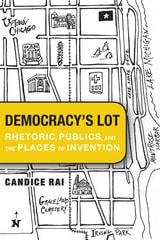
Democracy's Lot
Rhetoric, Publics, and the Places of InventionCandice Rai
University of Alabama Press, 2016
Candice Rai’s Democracy’s Lot is an incisive exploration of the limitations and possibilities of democratic discourse for resolving conflicts in urban communities. Rai roots her study of democratic politics and publics in a range of urban case studies focused on public art, community policing, and urban development. These studies examine the issues that erupted within an ethnically and economically diverse Chicago neighborhood over conflicting visions for a vacant lot called Wilson Yard. Tracing how residents with disparate agendas organized factions and deployed language, symbols, and other rhetorical devices in the struggle over Wilson Yard’s redevelopment and other contested public spaces, Rai demonstrates that rhetoric is not solely a tool of elite communicators, but rather a framework for understanding the agile communication strategies that are improvised in the rough-and-tumble work of democratic life.
Wilson Yard, a lot eight blocks north of Wrigley Field in Chicago’s gentrifying Uptown neighborhood, is a diverse enclave of residents enlivened by recent immigrants from Guatemala, Mexico, Vietnam, Ethiopia, and elsewhere. The neighborhood’s North Broadway Street witnesses a daily multilingual hubbub of people from a wide spectrum of income levels, religions, sexual identifications, and interest groups. When a fire left the lot vacant, this divided community projected on Wilson Yard disparate and conflicting aspirations, the resolution of which not only determined the fate of this particular urban space, but also revealed the lot of democracy itself as a process of complex problem-solving. Rai’s detailed study of one block in an iconic American city brings into vivid focus the remarkable challenges that beset democratic urban populations anywhere on the globe—and how rhetoric supplies a framework to understand and resolve those challenges.
Based on exhaustive field work, Rai uses rhetorical ethnography to study competing publics, citizenship, and rhetoric in action, exploring “rhetorical invention,” the discovery or development by individuals of the resources or methods of engaging with and persuading others. She builds a case for democratic processes and behaviors based not on reflexive idealism but rather on the hard work and practice of democracy, which must address apathy, passion, conflict, and ambivalence.

Engaging Social Media in China
Platforms, Publics, and ProductionGuobin Yang
Michigan State University Press, 2021
Genre and the Performance of Publics
Mary Jo Reiff
Utah State University Press, 2016
In recent decades, genre studies has focused attention on how genres mediate social activities within workplace and academic settings. Genre and the Performance of Publics moves beyond institutional settings to explore public contexts that are less hierarchical, broadening the theory of how genres contribute to the interconnected and dynamic performances of public life.
Chapters examine how genres develop within publics and how genres tend to mediate performances in public domains, setting up a discussion between public sphere scholarship and rhetorical genre studies. The volume extends the understanding of genres as not only social ways of organizing texts or mediating relationships within institutions but as dynamic performances themselves.
By exploring how genres shape the formation of publics, Genre and the Performance of Publicsbrings rhetoric/composition and public sphere studies into dialogue and enhances the understanding of public genre performances in ways that contribute to research on and teaching of public discourse.

Peripheral Visions
Publics, Power, and Performance in YemenLisa Wedeen
University of Chicago Press, 2008
Lisa Wedeen, who spent a year and a half in Yemen observing and interviewing its residents, argues that national solidarity in such weak states tends to arise not from attachments to institutions but through both extraordinary events and the ordinary activities of everyday life. Yemenis, for example, regularly gather to chew qat, a leafy drug similar to caffeine, as they engage in wide-ranging and sometimes influential public discussions of even the most divisive political and social issues. These lively debates exemplify Wedeen’s contention that democratic, national, and pious solidarities work as ongoing, performative practices that enact and reproduce a citizenry’s shared points of reference. Ultimately, her skillful evocations of such practices shift attention away from a narrow focus on government institutions and electoral competition and toward the substantive experience of participatory politics.
Presidential Responsiveness and Public Policy-Making
The Publics and the Policies that Presidents ChooseJeffrey E. Cohen
University of Michigan Press, 1999
We expect a president to respond to public opinion as an elected official in a democracy. Indeed, the president needs public support to overcome opposition to his policies in Congress and the bureaucracy. At the same time the president may want to pursue policies that do not have widespread support. How does public opinion affect presidential policy making? Jeffrey Cohen finds that presidents are responsive to the public in selecting issues to focus on. If an issue has captured the interest of the people, then the president will focus on that issue. Cohen finds that having chosen to work on an issue, presidents pay less attention to public opinion when making a policy. The president will try to maintain control over the details of the policy so that the outcome fits his policy agenda. Cohen examines the way presidents from Eisenhower through Clinton have dealt with public opinion in policy making. He uses case studies of issues such as Clinton and gays in the military, Bush and the extension of unemployment benefits, and Kennedy and cutting the income tax, to explore the relationship between presidents and public opinion. In addition Cohen uses a quantitative analysis of State of the Union addresses and positions on roll call votes of presidents from Eisenhower through George Bush to test his theories. This book should appeal to political scientists and historians interested in the presidency and in public opinion, as well as general readers interested in the history of the American presidency.
Science Communication Online
Engaging Experts and Publics on the InternetAshley Rose Mehlenbacher
The Ohio State University Press, 2019
Bringing together genre studies and the rhetoric of science, Mehlenbacher examines a range of new forms of science communication that challenge traditional presumptions about experts and nonexperts—including Twitter and Reddit AMAs, crowdfunding proposals such as Kickstarter and Experiment.com, civic-minded databases such as Safecast, and the PLOS blogging network. Science Communication Online illustrates the unique features of these genres and connects them to their rhetorical functions and the larger context leading to their emergence and evolution—from the democratization of science, challenges to expertise and expert status, and new political economies. Science Communication Online captures the important moment we find ourselves in now—one not defined by science and society but science in society.
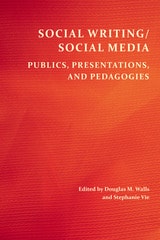
Social Writing/Social Media
Publics, Presentations, and PedagogiesDouglas M. Walls
University Press of Colorado, 2018
Social media have been (for quite some time now) part of the fabric of our lives. But as with many new technologies, it often takes a while for us to be able to step back, assess the tool's impact, and consider what's next. This collection offers one of the first sets of scholarly work in our field that responds to social media's influence on both popular and extra-curricular writing as well as on scholarly communication. Too frequently, social media is dismissed as non-academic, unworthy of sustained attention by researchers. The authors featured here present compelling reasons why this oft-neglected form of writing deserves—and demands—continued academic response.
Social Writing/Social Media: Publics, Presentations, and Pedagogies makes this contribution by examining the impact of social media on three writing-related themes: publics and audiences, presentation of self and groups, and pedagogy at various levels of higher education. The contributors to this collection urge readers to pay attention to an undertheorized aspect of writing online—the acts of composing that occur specifically in social-media spaces. Organized in three sections—social media and public audiences; social media and presentation; and social media and pedagogy—it builds on previous explorations of the role of multimodality in composition studies by extending ongoing conversations that have asked readers to expand notions of literacy in the twenty-first century. By addressing the wide range of composing activities that take place in social media and the rich variety of genres, audiences, stylistic choices, and pedagogical possibilities, this collection offers an important contribution to our understanding of pedagogy and practice in social media spaces.