Results by title
54 books match the query 'Publishers and publishing' and 7 start with a
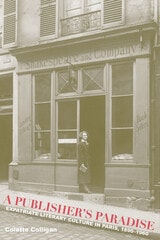
A Publisher's Paradise
Expatriate Literary Culture in Paris, 1890-1960Colette Colligan
University of Massachusetts Press, 2014
From 1890 to 1960, some of Anglo-America's most heated cultural contests over books, sex, and censorship were staged not at home, but abroad in the City of Light. Paris, with its extraordinary liberties of expression, became a special place for interrogating the margins of sexual culture and literary censorship, and a wide variety of English language “dirty books” circulated through loose expatriate publishing and distribution networks.
A Publisher's Paradise explores the political and literary dynamics that gave rise to this expatriate cultural flourishing, which included everything from Victorian pornography to the most daring and controversial modernist classics. Colette Colligan tracks the British and French politicians and diplomats who policed Paris editions of banned books and uncovers offshore networks of publishers, booksellers, authors, and readers. She looks closely at the stories the “dirty books” told about this publishing haven and the smut peddlers and literary giants it brought together in transnational cultural formations. The book profiles an eclectic group of expatriates living and publishing in Paris, from relatively obscure figures such as Charles Carrington, whose list included both The Picture of Dorian Gray and the pornographic novel Randiana, to bookshop owner Sylvia Beach, famous for publishing James Joyce's Ulysses in 1922.
A Publisher's Paradise is a compelling exploration of the little-known history of foreign pornography in Paris and the central role it played in turning the city into a modernist outpost for literary and sexual vanguardism, a reputation that still lingers today in our cultural myths of midnight in Paris.
Against the Grain
Interviews with Maverick American PublishersRobert Dana
University of Iowa Press, 1986
Against the Grain is a collection of interviews with nine small press publishers, each one characterized by strength of resolve and a dedication to good books. Each press reflects, perhaps more directly than any large trade publisher could, the character of its founder; and each has earned its own place in the select group of important small presses in America.
This collection is the first of its kind to explore with the publishers themselves the historical, aesthetic, practical, and personal impulses behind literary publishing. The publishers included are Harry Duncan (the Cummington Press), Lawrence Ferlinghetti (City Lights), David Godine (David R. Godine), Daniel Halpern (the Ecco Press), Sam Hamill and Tree Swenson (Copper Canyon Press), James Laughlin (New Directions), John Martin (Black Sparrow), and Jonathan Williams (the Jargon Society). Their passion for books, their belief in their individual visions of what publishing is or could be, their inspired mulishness crackle on the page.

American Intelligence
Small-Town News and Political Culture in Federalist New HampshireBen P. Lafferty
University of Massachusetts Press, 2020
Taking up the New Hampshire newspaper industry as its case study, American Intelligence unpacks the ways in which an unprecedented quantity of printed material was gathered, distributed, marketed, and consumed, as well as the strong influence that it had on the shaping of the American political imagination. Ben P. Lafferty also considers the lives of the printers themselves and asks why so many men chose to pursue such a fraught and turbulent profession. This snapshot resonates with the contemporary media-saturated and politically chaotic age.

Andy Warhol, Publisher
Lucy Mulroney
University of Chicago Press, 2018
Journeying from the 1950s, when Warhol was starting to make his way through the New York advertising world, through the height of his career in the 1960s, to the last years of his life in the 1980s, Andy Warhol, Publisher unearths fresh archival material that reveals Warhol’s publications as complex projects involving a tantalizing cast of collaborators, shifting technologies, and a wide array of fervent readers.
Lucy Mulroney shows that whether Warhol was creating children’s books, his infamous “boy book” for gay readers, writing works for established houses like Grove Press and Random House, helping found Interview magazine, or compiling a compendium of photography that he worked on to his death, he readily used the elements of publishing to further and disseminate his art. Warhol not only highlighted the impressive variety in our printed culture but also demonstrated how publishing can cement an artistic legacy.

Anti-Book
On the Art and Politics of Radical PublishingNicholas Thoburn
University of Minnesota Press, 2016
No, Anti-Book is not a book about books. Not exactly. And yet it is a must for anyone interested in the future of the book. Presenting what he terms “a communism of textual matter,” Nicholas Thoburn explores the encounter between political thought and experimental writing and publishing, shifting the politics of text from an exclusive concern with content and meaning to the media forms and social relations by which text is produced and consumed. Taking a “post-digital” approach in considering a wide array of textual media forms, Thoburn invites us to challenge the commodity form of books—to stop imagining books as transcendent intellectual, moral, and aesthetic goods unsullied by commerce. His critique is, instead, one immersed in the many materialities of text.
Anti-Book engages with an array of writing and publishing projects, including Antonin Artaud’s paper gris-gris, Valerie Solanas’s SCUM Manifesto, Guy Debord’s sandpaper-bound Mémoires, the collective novelist Wu Ming, and the digital/print hybrid of Mute magazine. Empirically grounded, it is also a major achievement in expressing a political philosophy of writing and publishing, where the materiality of text is interlaced with conceptual production. Each chapter investigates a different form of textual media in concert with a particular concept: the small-press pamphlet as “communist object,” the magazine as “diagrammatic publishing,” political books in the modes of “root” and “rhizome,” the “multiple single” of anonymous authorship, and myth as “unidentified narrative object.”
An absorbingly written contribution to contemporary media theory in all its manifestations, Anti-Book will enrich current debates about radical publishing, artists’ books and other new genre and media forms in alternative media, art publishing, media studies, cultural studies, critical theory, and social and political theory.
Artistic Liberties
American Literary Realism and Graphic Illustration, 1880-1905Adam Sonstegard
University of Alabama Press, 2013
Though today we commonly read major works of nineteenth-century American literature in unillustrated paperbacks or anthologies, many of them first appeared as magazine serials, accompanied by ample illustrations that sometimes made their way into the serials’ first printings as books. The graphic artists creating these illustrations often visually addressed questions that the authors had left for the reader to interpret, such as the complexions of racially ambiguous characters in Uncle Tom’s Cabin. The artists created illustrations that depicted what outsiders saw in Huck and Jim in Adventures of Huckleberry Finn, rather than what Huck and Jim learned to see in one another. These artists even worked against the texts on occasion—for instance, when the illustrators reinforced the same racial stereotypes that writers such as Paul Laurence Dunbar had intended to subvert in their works.
Authors of American realism commonly submitted their writing to editors who allowed them little control over the aesthetic appearance of their work. In his groundbreaking Artistic Liberties, Adam Sonstegard studies the illustrations from these works in detail and finds that the editors employed illustrators who were often unfamiliar with the authors’ intentions and who themselves selected the literary material they wished to illustrate, thereby taking artistic liberties through the tableaux they created.
Sonstegard examines the key role that the appointed artists played in visually shaping narratives—among them Mark Twain’s Pudd’nhead Wilson, Stephen Crane’s The Monster, and Edith Wharton’s The House of Mirth—as audiences tended to accept their illustrations as guidelines for understanding the texts. In viewing these works as originally published, received, and interpreted, Sonstegard offers a deeper knowledge not only of the works, but also of the realities surrounding publication during this formative period in American literature.

Asylum, Prison, and Poorhouse
The Writings and Reform Work of Dorothea Dix in IllinoisDavid L. Lightner
Southern Illinois University Press, 1999
This illustrated collection of annotated newspaper articles and memorials by Dorothea Dix provides a forum for the great mid-nineteenth-century humanitarian and reformer to speak for herself.
Dorothea Lynde Dix (1802–87) was perhaps the most famous and admired woman in America for much of the nineteenth century. Beginning in the early 1840s, she launched a personal crusade to persuade the various states to provide humane care and effective treatment for the mentally ill by funding specialized hospitals for that purpose. The appalling conditions endured by most mentally ill inmates in prisons, jails, and poorhouses led her to take an active interest also in prison reform and in efforts to ameliorate poverty.
In 1846–47 Dix brought her crusade to Illinois. She presented two lengthy memorials to the legislature, the first describing conditions at the state penitentiary at Alton and the second discussing the sufferings of the insane and urging the establishment of a state hospital for their care. She also wrote a series of newspaper articles detailing conditions in the jails and poorhouses of many Illinois communities.
These long-forgotten documents, which appear in unabridged form in this book, contain a wealth of information on the living conditions of some of the most unfortunate inhabitants of Illinois. In his preface, David L. Lightner describes some of the vivid images that emerge from Dorothea Dix's descriptions of social conditions in Illinois a century and a half ago: "A helpless maniac confined throughout the bitter cold of winter to a dark and filthy pit. Prison inmates chained in hallways and cellars because no more men can be squeezed into the dank and airless cells. Aged paupers auctioned off by county officers to whoever will maintain them at the lowest cost."
Lightner provides an introduction to every document, placing each memorial and newspaper article in its proper social and historical context. He also furnishes detailed notes, making these documents readily accessible to readers a century and a half later. In his final chapter, Lightner assesses both the immediate and the continuing impact of Dix's work.