Results by title
20 books match the query 'Queer'
Aberrations In Black
Toward a Queer of Color CritiqueRoderick A. Ferguson
University of Minnesota Press, 2003
A hard-hitting look at the regulation of sexual difference and its role in circumscribing African American culture
The sociology of race relations in America typically describes an intersection of poverty, race, and economic discrimination. But what is missing from the picture—sexual difference—can be as instructive as what is present. In this ambitious work, Roderick A. Ferguson reveals how the discourses of sexuality are used to articulate theories of racial difference in the field of sociology. He shows how canonical sociology—Gunnar Myrdal, Ernest Burgess, Robert Park, Daniel Patrick Moynihan, and William Julius Wilson—has measured African Americans’s unsuitability for a liberal capitalist order in terms of their adherence to the norms of a heterosexual and patriarchal nuclear family model. In short, to the extent that African Americans’s culture and behavior deviated from those norms, they would not achieve economic and racial equality.
Aberrations in Black tells the story of canonical sociology’s regulation of sexual difference as part of its general regulation of African American culture. Ferguson places this story within other stories—the narrative of capital’s emergence and development, the histories of Marxism and revolutionary nationalism, and the novels that depict the gendered and sexual idiosyncrasies of African American culture—works by Richard Wright, Ralph Ellison, James Baldwin, Audre Lorde, and Toni Morrison. In turn, this book tries to present another story—one in which people who presumably manifest the dysfunctions of capitalism are reconsidered as indictments of the norms of state, capital, and social science. Ferguson includes the first-ever discussion of a new archival discovery—a never-published chapter of Invisible Man that deals with a gay character in a way that complicates and illuminates Ellison’s project.
Unique in the way it situates critiques of race, gender, and sexuality within analyses of cultural, economic, and epistemological formations, Ferguson’s work introduces a new mode of discourse—which Ferguson calls queer of color analysis—that helps to lay bare the mutual distortions of racial, economic, and sexual portrayals within sociology.

Abolitionist Intimacies
Queer and Trans Migrants against the Deportation StateEithne Luibheid
Duke University Press, 2025
Big Feelings
Queer and Feminist Indie Rock After Riot GrrrlDan DiPiero
University of Michigan Press, 2025
By bringing listeners’ experiences into the analysis, DiPiero shows how indie rock feminisms have shifted since the 1990s, rejecting overt political messages in favor of sonic catharsis, and reflecting the complex, ambivalent feeling of being young while the world burns. In reprising the sounds of an alt-rock associated in public consciousness with white male pain, Big Feelings doubles down on the stereotypical association between femininity and emotionality to perform whole spectrums of feeling in varied states of overwhelm. In doing so, these artists draw attention to overlooked histories of women and queer musicians who have been forging indie rock all along, while also remaking how the music matters in the present.
Courtly and Queer
Deconstruction, Desire, and Medieval French LiteratureCharlie Samuelson
The Ohio State University Press, 2022
In Visible Archives
Queer and Feminist Visual Culture in the 1980sMargaret Galvan
University of Minnesota Press, 2023
Analyzing how 1980s visual culture provided a vital space for women artists to theorize and visualize their own bodies and sexualities
In 1982, the protests of antiporn feminists sparked the censorship of the Diary of a Conference on Sexuality, a radical and sexually evocative image-text volume whose silencing became a symbol for the irresolvable feminist sex wars. In Visible Archives documents the community networks that produced this resonant artifact and others, analyzing how visual culture provided a vital space for women artists to theorize and visualize their own bodies and sexualities.
Margaret Galvan explores a number of feminist and cultural touchstones—the feminist sex wars, the HIV/AIDS crisis, the women in print movement, and countercultural grassroots periodical networks—and examines how visual culture interacts with these pivotal moments. She goes deep into the records to bring together a decade’s worth of research in grassroots and university archives that include comics, collages, photographs, drawings, and other image-text media produced by women, including Hannah Alderfer, Beth Jaker, Marybeth Nelson, Roberta Gregory, Lee Marrs, Alison Bechdel, Gloria Anzaldúa, and Nan Goldin.
The art highlighted in In Visible Archives demonstrates how women represented their bodies and sexualities on their own terms and created visibility for new, diverse identities, thus serving as blueprints for future activism and advocacy—work that is urgent now more than ever as LGBTQ+ and women’s rights face challenges and restrictions across the nation.
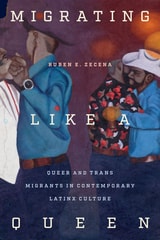
Migrating like a Queen
Queer and Trans Migrants in Contemporary Latinx CultureRuben E. Zecena
University of Texas Press, 2026
An imaginative exploration of queer and trans Latinx migrant survival, examining literature, film, and performance to challenge normative constructions of citizenship and belonging.
Queer and trans migrants in the US face persistent fictions depicting them as powerless. Through the lens of “impossible possibilities,” what Ruben Zecena defines as a space between the possible and impossible, the book presents a complex account of undocumented migrants that goes beyond good and bad dichotomies expressed by the state.
Migrating like a Queen highlights the joy, fabulosity, glamour, and complex desires of queer and trans Latinx migrants in the context of dehumanizing legal and representational structures. Analyzing a rich archive of twenty-first century media and literature, Ruben Zecena reveals how individuals imagine a reality that pushes against the constraints of narrative tropes created by the nation-state. The book foregrounds work by and about queer and trans Latinx migrants, including Alexandra DeRuiz, tatiana de la tierra, Sonia Guiñansaca, and Julián Delgado Lopera, illustrating the defining of a movement. Engaging multiple genres and forms, from testimonio to the bildungsroman, this book is a testament to the ever-shifting cultural strategies of survival that seize power from systems of subjection.
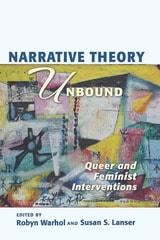
Narrative Theory Unbound
Queer and Feminist InterventionsEdited by Robyn Warhol and Susan S. Lanser
The Ohio State University Press, 2015
Through twenty-one essays prefaced by a cogent history of the field, Narrative Theory Unbound offers new perspectives on narrative discourse and its constituent elements; on intersectional approaches that recognize race, religion, and national culture as integral to understanding sexuality and gender; on queer temporalities; on cognitive research; and on lifewriting in graphic, print, and digital constellations. Exploring genres ranging from reality TV to fairy tales to classical fiction, contributors explore the thorny, contested relationships between feminist and queer theory, on the one hand, and between feminist/queer theory and contemporary narratologies, on the other. Rather than aiming for cohesiveness or conclusiveness, the collection stages open-ended debates designed to unbind the assumptions that have kept gender and sexuality on the periphery of narrative theory.
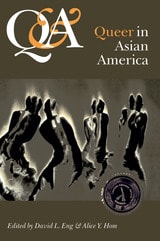
Q & A Queer And Asian
Queer & Asian In AmericaAlvin Eng
Temple University Press, 1998
Q & A approaches matters of identity from a variety of points of view and academic disciplines in order to explore the multiple crossings of race and ethnicity with sexuality and gender. Drawing together the work of visual artists, fiction writers, community organizers, scholars, and participants in roundtable discussions, the collection gathers an array of voices and experiences that represent the emerging communities of a queer Asian America. Collectively, these contributors contend that Asian American studies needs to be more attentive to issues of sexuality and that queer studies needs to be more attentive to other aspects of difference, especially race and ethnicity. Vigorously rejecting the notion that a symmetrical relationship between race and homosexuality would weaken lesbian/gay and queer movements, the editors refuse to "believe that a desirably queer world is one in which we remain perpetual aliens -- queer houseguests -- in a queer nation."
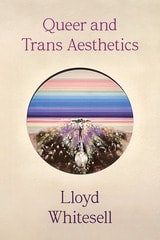
Queer and Trans Aesthetics
Lloyd Whitesell
University of Michigan Press, 2026
If a creative individual identifies as queer or trans, does that fact belong solely to the realm of biography, or does it pertain to their artistic achievement? In Queer and Trans Aesthetics, Lloyd Whitesell discusses literature, visual culture, audio-visual media, music, and performance from the 19th to the 21st century. Through this analysis, Whitesell develops a systematic framework to enrich our understanding of LGBTQ aesthetics and cultural production. He traces the history of queer aesthetic inquiry, develops a justification for a synthetic approach, identifies a fund of expressive strategies motivated by queer subjectivity, and highlights how such strategies create affinity across differences of gender, race, local context, and artistic media.
Rooted in a gender-inclusive theory of queer/trans subjectivity, the book draws on testimony from people of diverse backgrounds, genders, and races. Whitesell engages with debates in the existing scholarly literature while making connections between a wide range of artists: some from mainstream canons, some established subcultural figures, and others only now emerging as notable contributors to queer culture. The book explores five expressive archetypes or poses which have had profound significance in queer art traditions: the Monster, the Victim, the Trickster, the Dandy, and the Dreamer. Each offers a repertoire of creative responses to social oppression and configures queer subjective experience in a unique way. With its unique systematic approach, Queer and Trans Aesthetics enhances our knowledge of queer aesthetic traditions across genres and time.
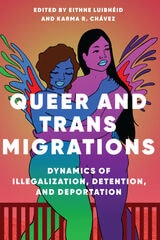
Queer and Trans Migrations
Dynamics of Illegalization, Detention, and DeportationEdited by Eithne Luibheid and Karma R. Chavez
University of Illinois Press, 2020
Bridging voices and works from inside and outside of the academy, and international in scope, Queer and Trans Migrations illuminates new perspectives in the field of queer and trans migration studies.
Contributors: Andrew J. Brown, Julio Capó, Jr., Anna Carastathis, Jack Cáraves, Karma R. Chávez, Ryan Conrad, Elif, Katherine Fobear, Monisha Das Gupta, Jamila Hammami, Edward Ou Jin Lee, Leece Lee-Oliver, Eithne Luibhéid, Hana Masri, Yasmin Nair, Bamby Salcedo, Fadi Saleh, Rafael Ramirez Solórzano, José Guadalupe Herrera Soto, Myrto Tsilimpounidi, Suyapa Portillo Villeda, Sasha Wijeyeratne, Ruben Zecena

Queer in Russia
A Story of Sex, Self, and the OtherLaurie Essig
Duke University Press, 1999
While male homosexual acts were criminalized in Russia before 1993, women attracted to women were policed by the medical community, who saw them less as criminals than as diseased persons potentially cured by drug therapy or transsexual surgery. After describing accounts of pre-perestroika persecution, Essig examines the more recent state of sexual identities in Russia. Although the fall of communism brought new freedom to Russian queers, there are still no signs of a mass movement forming around the issue, and few identify themselves as lesbians or gay men, even when they are involved in same-sex relations. Essig does reveal, however, vibrant manifestations of gay life found at the local level—in restaurants, discos, clubs, and cruising strips, in newspapers, journals, literature, and the theater. Concluding with a powerful exploration of the surprising affinities between some of Russia’s most prominent nationalists and its queers, Queer in Russia fills a gap in both Russian and cultural studies.
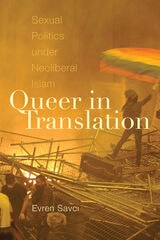
Queer in Translation
Sexual Politics under Neoliberal IslamEvren Savci
Duke University Press, 2021
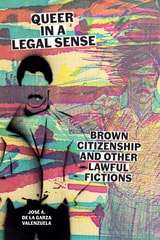
Queer in a Legal Sense
Brown Citizenship and Other Lawful FictionsJosé A. de la Garza Valenzuela
University of Texas Press, 2026
Contrasting works by queer Chicano writers against the legal landscape of sexuality and migration to interrogate the “lawful fiction” that denies queer migrants citizenship and community.
Activists for immigrants and queer people under assault by US authorities focus overwhelmingly on protections presumed to be afforded by citizenship through narratives that have rarely had a place for queer immigrants, who have consistently faced special obstacles to legal entry and citizenship that only recently are being applied more widely. Queer in a Legal Sense studies literary works by gay Chicanx writers alongside instruments of law, showing through this juxtaposition how racialized queer people have been imagined as nonviable from the standpoint of citizenship. In stories by John Rechy, Arturo Islas, Rigoberto González, Michael Nava, and Jaime Cortez, José de la Garza Valenzuela finds what has gone missing in the migrant movement’s pursuit of gendered avenues to civic participation. Further, these works illuminate the production of fictions in canons of law, like those announced by the Florida legislature’s “Purple Pamphlet” and by the US Supreme Court in Boutilier v. INS and Bowers v. Hardwick. Queer in a Legal Sense argues that, through selective ommissions and inclusions, legal fictions place queerness outside the boundaries of citizenship and powerfully undermine queer representation in pro-migrant advocacy.
Queer, Women of Color, and Critical Approaches to Feminist Mentorship and Pedagogy
Edited by Leandra H. Hernández, Stevie M. Munz, and Jessica Pauly
University of Illinois Press, 2025
The first section draws upon the contributors’ unique and situated experiences of mentorship in academia. Essays explore their past and current experiences with feminist mentorship in relationships that take many forms: faculty members with fellow faculty members; faculty members with undergraduate and graduate students; and faculty members who feel as if they have become family with their mentors and mentees. In the second section, the contributors deeply interrogate the practices of feminist mentoring by problematizing practices and offering new ways, places, and formats that make space and consider new possibilities. A conclusion reflects on the future of feminist mentorship amidst contemporary debates and concerns in higher education.
Enriching and hopeful, Queer, Women of Color, and Critical Approaches to Feminist Mentorship and Pedagogy is a much-needed challenge to traditional forms of mentorship.
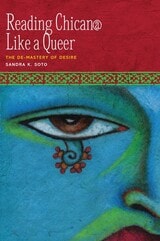
Reading Chican@ Like a Queer
The De-Mastery of DesireBy Sandra K. Soto
University of Texas Press, 2010
A race-based oppositional paradigm has informed Chicano studies since its emergence. In this work, Sandra K. Soto replaces that paradigm with a less didactic, more flexible framework geared for a queer analysis of the discursive relationship between racialization and sexuality. Through rereadings of a diverse range of widely discussed writers—from Américo Paredes to Cherríe Moraga—Soto demonstrates that representations of racialization actually depend on the sexual and that a racialized sexuality is a heretofore unrecognized organizing principle of Chican@ literature, even in the most unlikely texts. Soto gives us a broader and deeper engagement with Chican@ representations of racialization, desire, and both inter- and intracultural social relations.
While several scholars have begun to take sexuality seriously by invoking the rich terrain of contemporary Chicana feminist literature for its portrayal of culturally specific and historically laden gender and sexual frameworks, as well as for its imaginative transgressions against them, this is the first study to theorize racialized sexuality as pervasive to and enabling of the canon of Chican@ literature. Exemplifying the broad usefulness of queer theory by extending its critical tools and anti-heteronormative insights to racialization, Soto stages a crucial intervention amid a certain loss of optimism that circulates both as a fear that queer theory was a fad whose time has passed, and that queer theory is incapable of offering an incisive, politically grounded analysis in and of the current historical moment.
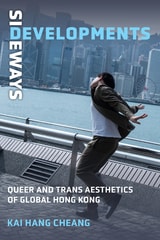
Sideways Developments
Queer and Trans Aesthetics of Global Hong KongKai Hang Cheang
University of Michigan Press, 2026
In this moment of multiple crises, Sideways Developments offers a timely hermeneutic and theory of solidarity and sustainability. The book tracks how sideways aesthetics have evolved from a feature of LGBTQ+ plots, performance, and nonlinear approaches to space-time to a form of togetherness that links postcolonial Hong Kong with struggles worldwide. Using what Cheang terms intersectional formalism as an analytical tool, the book provides a multilayered examination of the alternative pathways exemplified by queer and trans resilience and regeneration.

The Lives of Jessie Sampter
Queer, Disabled, ZionistSarah Imhoff
Duke University Press, 2022

Time Out of Joint
The Queer and the Customary in AfricaKirk Fiereck, Neville Hoad, and Danai Mupotsa, special issue editors
Duke University Press, 0
Contributors. Cal (Crystal) Biruk, Laura Edmondson, Kirk Fiereck, Neville Hoad, Phoebe Kisubi, Keguro Macharia, Danai Mupotsa, Edgar Nabutanyi, Eddie Ombagi, Ruth Ramsden-Karelse
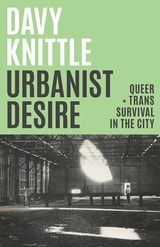
Urbanist Desire
Queer and Trans Survival in the CityDavy Knittle
University of Minnesota Press, 2026
How writers and artists have used city planning strategies to push back against harm
Black queer feminist thinker Audre Lorde famously declared that “the master’s tools will never dismantle the master’s house.” This language is normally understood as a metaphor, but as author Davy Knittle argues in this provocative book, queer and trans activists have long used the tools of city planning and urban design to create written and visual art that critiques those in power and offers points of resilience to their own communities.
A close look at the ways queer and trans writers and artists resisted predatory redevelopment in New York City from 1950 to 2020, Urbanist Desire draws on the work of James Schuyler, June Jordan, David Wojnarowicz, Julian Talamantez Brolaski, and Zeyn Joukhadar, exploring how they intervened in major political flashpoints like the War on Poverty, the AIDS-era housing crisis, and gentrification in Brooklyn and Queens. Presenting a new cultural history of New York City, Knittle explains how urban change and the more-than-human life of cities have been foundational concerns for queer and trans cultural production since the 1950s.
Ending with analysis of the 2022 speculative novel Everything for Everyone: An Oral History of the New York Commune, 2052–2072, Urbanist Desire looks to the past to imagine a better future for New York City and for all marginalized people. Knittle demonstrates how to move past a recuperative response to harm and toward one that can change the structure of society by documenting how queer and trans activists have engaged the strategies of planning and design to address spatial, social, and economic inequality.
Retail e-book files for this title are screen-reader friendly with images accompanied by short alt text and/or extended descriptions.
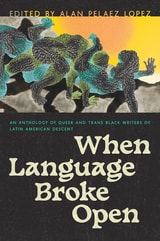
When Language Broke Open
An Anthology of Queer and Trans Black Writers of Latin American DescentEdited by Alan Pelaez Lopez
University of Arizona Press, 2023
By exploring themes of memory, care, and futurity, these contributions expand understandings of Blackness in Latin America, the Caribbean, and their U.S.-based diasporas. The volume offers up three central questions: How do queer and/or trans Black writers of Latin American descent address memory? What are the textures of caring, being cared for, and accepting care as Black queer and/or trans people of Latin American descent? And how do queer and trans embodiments help us understand and/or question the past and the present, and construct a Black, queer, and trans future?
The works collected in this anthology encompass a multitude of genres—including poetry, autobiography, short stories, diaries, visual art, and a graphic memoir—and feature the voices of established writers alongside emerging voices. Together, the contributors challenge everything we think we know about gender, sexuality, race, and what it means to experience a livable life.