Results by title
10 books match the query 'Queer History'
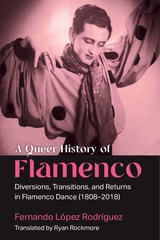
A Queer History of Flamenco
Diversions, Transitions, and Returns in Flamenco Dance (1808–2018)Fernando López Rodríguez, translation by Ryan Rockmore
University of Michigan Press, 2024
A Queer History of Flamenco offers a groundbreaking exploration of flamenco through the lenses of queer theory and cultural studies. Previous histories have provided a largely distorted image about why, where, and how people have done flamenco—as well as who has performed flamenco. Yet feminists, transvestites, butches, femmes, the Spanish Roma, disabled people, guiris, and “incomprehensible” artists have been determined to do things differently without giving up their flamenco status. In this skillful translation of his book Historia queer del flamenco, Fernando López Rodríguez draws on diverse archival materials as well as his own lived experience and artistic practice, unearthing queer flamenco histories, voices, and perspectives that were previously unknown, avoided, or purposely hidden.
Tracing flamenco’s development from its birth up to the contemporary era, the book places flamenco within significant historical periods such as the Spanish Civil War, Franco’s dictatorship, the transition to democracy, and the economic crisis of 2008, up to contemporary performances of the late 2010s. In taking a queer approach to History, the author abandons antiquated debates about purities and impurities; anecdotes about the lives of artists that are completely detached from their processes of creation; and myths about geniuses who seem to make art alone and completely detached from their collaborators and the historical, social, economic and artistic moment in which they lived. A Queer History of Flamenco is not only about the present and the queerness of people living, performing, or creating in it, but also about flamenco’s past in which so many queer artists and practices and their lives have remained unearthed and unaddressed.
Tracing flamenco’s development from its birth up to the contemporary era, the book places flamenco within significant historical periods such as the Spanish Civil War, Franco’s dictatorship, the transition to democracy, and the economic crisis of 2008, up to contemporary performances of the late 2010s. In taking a queer approach to History, the author abandons antiquated debates about purities and impurities; anecdotes about the lives of artists that are completely detached from their processes of creation; and myths about geniuses who seem to make art alone and completely detached from their collaborators and the historical, social, economic and artistic moment in which they lived. A Queer History of Flamenco is not only about the present and the queerness of people living, performing, or creating in it, but also about flamenco’s past in which so many queer artists and practices and their lives have remained unearthed and unaddressed.
[more]
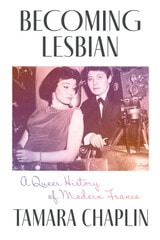
Becoming Lesbian
A Queer History of Modern FranceTamara Chaplin
University of Chicago Press, 2024
A landmark analysis of how a marginalized subculture used modern media to transform public attitudes toward sexual desire.
In Becoming Lesbian, historian Tamara Chaplin argues that the history of female same-sex intimacy is central to understanding the struggle to control the public sphere. This monumental study draws on undiscovered sources culled from cabaret culture, sexology, police files, radio, TV, photography, the Minitel (an early form of internet), and private letters, as well as over one hundred interviews filmed by the author. Becoming Lesbian demonstrates how women of diverse classes and races came to define themselves as lesbian and used public spaces and public media to exert claims on the world around them in ways that made possible new forms of gendered and sexual citizenship. Chaplin begins in the sapphic cabarets of interwar Paris. These venues, she shows, exploited female same-sex desire for profit while simultaneously launching an incipient queer female counterpublic. Refuting claims that World War II destroyed this female world, Chaplin reveals instead how prewar sapphic subcultures flourished in the postwar period, laying crucial groundwork for the politicization of lesbian identity into the twenty-first century.
Becoming Lesbian is filled with colorful vignettes about female cabaret owners, singers, TV personalities, writers, and activists, all brought to life to make larger points about rights, belonging, and citizenship. As a history of lesbianism, this book represents a major contribution to modern French history, queer studies, and genealogies of the media and its publics.
[more]

Conferencing on the Edge
A Queer History of Feminist Field FormationRachel Corbman
Duke University Press, 2027
Rachel Corbman’s Conferencing on the Edge tells the story of how feminism and queer liberation became academic pursuits. Corbman centers five academic conferences with notable afterlives in feminist and queer studies, from the West Coast Women’s Studies conference at Sacramento State in 1973 to the 1989 Outside/Inside conference at Yale. Each of these conferences is cited for its role in bringing a conflict in the field—over race, sexuality, or professionalization—to a head. Corbman’s detailed oral and archival histories of these conferences, from their planning to the events themselves to their mythologizing in feminist and queer scholarship, expand a conventional narrative premised on turning points: from social movement to university discipline, from white to intersectional, from feminist to queer. Both a social movement history and a study of feminist and queer field formation, Conferencing on the Edge helps make sense of the profound entanglements of these fields and the administrative dangers they face today.
[more]
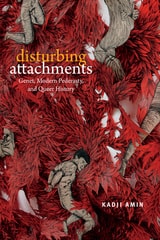
Disturbing Attachments
Genet, Modern Pederasty, and Queer HistoryKadji Amin
Duke University Press, 2017
Jean Genet (1910–1986) resonates, perhaps more than any other canonical queer figure from the pre-Stonewall past, with contemporary queer sensibilities attuned to a defiant non-normativity. Not only sexually queer, Genet was also a criminal and a social pariah, a bitter opponent of the police state, and an ally of revolutionary anticolonial movements. In Disturbing Attachments, Kadji Amin challenges the idealization of Genet as a paradigmatic figure within queer studies to illuminate the methodological dilemmas at the heart of queer theory. Pederasty, which was central to Genet's sexuality and to his passionate cross-racial and transnational political activism late in life, is among a series of problematic and outmoded queer attachments that Amin uses to deidealize and historicize queer theory. He brings the genealogy of Genet's imaginaries of attachment to bear on pressing issues within contemporary queer politics and scholarship, including prison abolition, homonationalism, and pinkwashing. Disturbing Attachments productively and provocatively unsettles queer studies by excavating the history of its affective tendencies to reveal and ultimately expand the contexts that inform the use and connotations of the term queer.
[more]
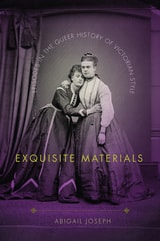
Exquisite Materials
Episodes in the Queer History of Victorian StyleAbigail Joseph
University of Delaware Press, 2011
Exquisite Materials explores the connections between gay subjects, material objects, and the social and aesthetic landscapes in which they circulated. Each of the book’s four chapters takes up as a case study a figure or set of figures whose life and work dramatize different aspects of the unique queer relationship to materiality and style. These diverse episodes converge around the contention that paying attention to the multitudinous objects of the Victorian world-and to the social practices surrounding them-reveals the boundaries and influences of queer forms of identity and aesthetic sensibility that emerged in the mid-nineteenth century and have remained recognizable up to our own moment. In the cases that author Abigail Joseph examines, objects become unexpected sites of queer community and desire.
Published by University of Delaware Press. Distributed worldwide by Rutgers University Press.
Published by University of Delaware Press. Distributed worldwide by Rutgers University Press.
[more]
In a New Century
Essays on Queer History, Politics, and Community LifeJohn D’Emilio
University of Wisconsin Press, 2014
For gay, lesbian, bisexual, and transgender people in the United States, the twenty-first century has brought dramatic changes: the end of sodomy laws, the elimination of “Don’t Ask, Don’t Tell,” a move toward recognition of same-sex marriage, Gay-Straight Alliances in thousands of high schools, and an explosion of visibility in the media and popular culture. All of this would have been unimaginable to those living just a few decades ago. Yet, at the same time, the American political system has grown ever more conservative, and increasing economic inequality has been a defining feature of the new century.
A pioneering scholar of gay history, John D’Emilio reflects in this wide-ranging collection of essays upon the social, cultural, and political changes provoked by LGBT activism. He offers provocative questions and historical analyses: What can we learn from a life-long activist like Bayard Rustin, who questioned the wisdom of “identity politics”? Was Richard Nixon a “gay liberationist”? How can knowing local stories—like those of Chicago in the 1950s, 1960s, and 1970s—help build stronger communities and enrich traditions of activism? Might the focus on achieving actually be evidence of growing conservatism in LGBT communities?
In a New Century provides a dynamic, thoughtful, and important resource for identifying changes that have occurred in the United States since 1960, taking stock of the work that still needs to be done, and issuing an urgent call to action for getting there.
Best Books for General Audiences, selected by the American Association of School Librarians
Best Special Interest Books, selected by the Public Library Reviewers
[more]
Information Activism
A Queer History of Lesbian Media TechnologiesCait McKinney
Duke University Press, 2020
For decades, lesbian feminists across the United States and Canada have created information to build movements and survive in a world that doesn't want them. In Information Activism Cait McKinney traces how these women developed communication networks, databases, and digital archives that formed the foundation for their work. Often learning on the fly and using everything from index cards to computers, these activists brought people and their visions of justice together to organize, store, and provide access to information. Focusing on the transition from paper to digital-based archival techniques from the 1970s to the present, McKinney shows how media technologies animate the collective and unspectacular labor that sustains social movements, including their antiracist and trans-inclusive endeavors. By bringing sexuality studies to bear on media history, McKinney demonstrates how groups with precarious access to control over information create their own innovative and resourceful techniques for generating and sharing knowledge.
[more]
Menace to the Future
A Disability and Queer History of Carceral EugenicsJess Whatcott
Duke University Press, 2024
In Menace to the Future, Jess Whatcott traces the link between US disability institutions and early twentieth-century eugenicist ideology, demonstrating how the legacy of those ideas continues to shape incarceration and detention today. Whatcott focuses on California, examining records from state institutions and reform organizations, newspapers, and state hospital museum exhibits. They reveal that state confinement, coercive treatment, care neglect, and forced sterilization were done out of the belief that the perceived unfitness of disabled, mad, and neurodivergent people was hereditary and thus posed a biological threat—a so-called menace to the future. Whatcott uncovers a history of disabled resistance to these institutions that predates disability rights movements, builds a genealogy of resistance, and tells a history of eugenics from below. Theorizing how what they call “carceral eugenics” informed state treatment of disabled, mad, and neurodivergent people a century ago, Whatcott shows not only how that same logic still exists in secure treatment facilities, state prisons, and immigration detention centers, but also why it must continue to be resisted.
[more]
Vanguard
A Queer History of Mutual AidJoseph Plaster
Duke University Press, 2027
Joseph Plaster traces the emergence and impact of Vanguard, a street-based activist organization forged in mid-1960s San Francisco by an unlikely coalition of sex workers, street queens, urban ministers, young adults, and War on Poverty reformers. Facing displacement, policing, and economic exclusion in the downtown “vice” district, organizers pooled food, housing, and medical aid while staging militant street theater and protests against a social order that treated street kids as disposable. Drawing on original oral histories and a newly assembled archive, Plaster follows Vanguard from all-night cafeterias to church basements to psychedelic shops. Its organizers developed drug-safety tools and published underground magazines while using federal antipoverty resources to establish experimental drop-in and employment centers. Vanguard’s irreverent tactics and uncompromising sexual and gender visibility drew national attention, helping catalyze gay liberation and trans organizing while laying the groundwork for harm reduction and LGBTQ shelter activism. In Vanguard, Plaster recovers an electrifying history of mutual aid in action, showing how those pushed to the margins remade care, kinship, and political struggle.
[more]
Work!
A Queer History of ModelingElspeth H. Brown
Duke University Press, 2019
From the haute couture runways of Paris and New York and editorial photo shoots for glossy fashion magazines to reality television, models have been a ubiquitous staple of twentieth- and twenty-first-century American consumer culture. In Work! Elspeth H. Brown traces the history of modeling from the advent of photographic modeling in the early twentieth century to the rise of the supermodel in the 1980s. Brown outlines how the modeling industry sanitized and commercialized models' sex appeal in order to elicit and channel desire into buying goods. She shows how this new form of sexuality—whether exhibited in the Ziegfeld Follies girls' performance of Anglo-Saxon femininity or in African American models' portrayal of black glamour in the 1960s—became a central element in consumer capitalism and a practice that has always been shaped by queer sensibilities. By outlining the paradox that queerness lies at the center of capitalist heteronormativity and telling the largely unknown story of queer models and photographers, Brown offers an out of the ordinary history of twentieth-century American culture and capitalism.
[more]