140 books match the query 'Queer theory' and 8 start with a
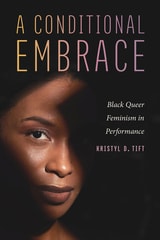
cover of A Conditional Embrace: Black Queer Feminism in Performance

A Conditional Embrace

Black Queer Feminism in Performance

Kristyl D. Tift

The Ohio State University Press, 2026

Uses an intersectional and intertextual methodology to present a rigorous yet accessible study of Black queer women artists in theater and film.

In A Conditional Embrace, Kristyl D. Tift seeks to understand how Black queer women theater and film artists depict their own survival in heterosexist temporalities and spaces. Using the framework of lovin’ on—a theory inspired by Black feminist thought, performance theory, and queer theory—Tift closely reads the works of a selection of artists to investigate the “conditional embrace” of Black queer art in society. Her intersectional and intertextual methodology considers the text and body as part and parcel of performance work, allowing her to examine the multiple and complex intersections of identity at play in works meant to be read and performed. Tift puts the work of more visible artists such as Dee Rees, Sharon Bridgforth, and Staceyann Chin in direct conversation with lesser-known contributors to Black queer feminist performance such as Shirlene Holmes and Donnetta Lavinia Grays, analyzing not only their plays, installations, and poetry but also interviews, personal essays, performances, and more. Centering the works of artists situated, by birth or migration, in the Southern US and the Caribbean, A Conditional Embrace explores how artists at the margins of art and society represent Black queer women’s survival through processes of self-making, community-building, and homemaking.
[more]
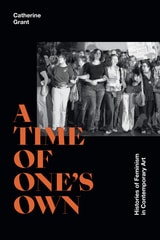
cover of A Time of One's Own: Histories of Feminism in Contemporary Art

A Time of One's Own

Histories of Feminism in Contemporary Art

Catherine Grant

Duke University Press, 2022
In A Time of One’s Own Catherine Grant examines how contemporary feminist artists are turning to broad histories of feminism ranging from political organizing and artworks from the 1970s to queer art and activism in the 1990s. Exploring artworks from 2002 to 2017 by artists including Sharon Hayes, Mary Kelly, Allyson Mitchell, Deirdre Logue, Lubaina Himid, Pauline Boudry, and Renate Lorenz, Grant maps a revival of feminism that takes up the creative and political implications of forging feminist communities across time and space. Grant characterizes these artists’ engagement with feminism as a fannish, autodidactic, and collective form of learning from history. This fandom of feminism allows artists to build relationships with previous feminist ideas, artworks, and communities that reject a generational model and embrace aspects of feminism that might be seen as embarrassing, queer, or anachronistic. Accounting for the growing interest in feminist art, politics, and ideas across generations, Grant demonstrates that for many contemporary feminist artists, the present moment can only be understood through an embodied engagement with history in which feminist pasts are reinhabited and reimagined.
[more]
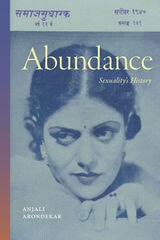
cover of Abundance: Sexuality’s History

Abundance

Sexuality’s History

Anjali Arondekar

Duke University Press, 2023

In Abundance, Anjali Arondekar refuses the historical common sense that archival loss is foundational to a subaltern history of sexuality, and that the deficit of our minoritized pasts can be redeemed through acquisitions of lost pasts. Instead, Arondekar theorizes the radical abundance of sexuality through the archives of the Gomantak Maratha Samaj—a caste-oppressed devadasi collective in South Asia—that are plentiful and quotidian, imaginative and ordinary. For Arondekar, abundance is inextricably linked to the histories of subordinated groups in ways that challenge narratives of their constant devaluation. Summoning abundance over loss upends settled genealogies of historical recuperation and representation and works against the imperative to fix sexuality within wider structures of vulnerability, damage, and precarity. Multigeneric and multilingual, transregional and historically supple, Abundance centers sexuality within area, post/colonial, and anti/caste histories.
[more]
cover of After Queer Theory: The Limits of Sexual Politics

After Queer Theory

The Limits of Sexual Politics

James Penney

Pluto Press, 2013

After Queer Theory makes the provocative claim that queer theory has run its course, made obsolete by the elaboration of its own logic within capitalism. James Penney argues that far from signalling the end of anti-homophobic criticism, however, the end of queer presents the occasion to rethink the relation between sexuality and politics.

Through a critical return to Marxism and psychoanalysis (Freud and Lacan), Penney insists that the way to implant sexuality in the field of political antagonism is paradoxically to abandon the exhausted premise of a politicised sexuality.

After Queer Theory argues that it is necessary to wrest sexuality from the dead end of identity politics, opening it up to a universal emancipatory struggle beyond the reach of capitalism's powers of commodification.

[more]
cover of After Sex?: On Writing since Queer Theory

After Sex?

On Writing since Queer Theory

Janet Halley and Andrew Parker, eds.

Duke University Press, 2011

Since queer theory originated in the early 1990s, its insights and modes of analysis have been taken up by scholars across the humanities and social sciences. In After Sex? prominent contributors to the development of queer studies offer personal reflections on the field’s history, accomplishments, potential, and limitations. They consider the purpose of queer theory and the extent to which it is or is not defined by its engagement with sex and sexuality. For many of the contributors, a broad notion of sexuality is essential to queer thought. At the same time, some of them caution against creating an all-embracing idea of queerness, because it empties the term “queer” of meaning and assumes the universality of ideas developed in the North American academy. Some essays recall the political urgency of the late 1980s and early 1990s, when gay and lesbian activist and queer theory projects converged in response to the AIDS crisis. Other pieces exemplify more recent trends in queer critique, including the turn to affect and the debates surrounding the “antisocial thesis,” which associates queerness with the repudiation of heteronormative forms of belonging. Contributors discuss queer theory’s engagement with questions of transnationality and globalization, temporality and historical periodization. Meditating on the past and present of queer studies, After Sex? illuminates its future.

Contributors. Lauren Berlant, Leo Bersani, Michael Cobb, Ann Cvetkovich, Lee Edelman, Richard Thompson Ford, Carla Freccero, Elizabeth Freeman, Jonathan Goldberg, Janet Halley, Neville Hoad, Joseph Litvak, Heather Love, Michael Lucey, Michael Moon, José Esteban Muñoz, Jeff Nunokawa, Andrew Parker, Elizabeth A. Povinelli, Richard Rambuss, Erica Rand, Bethany Schneider, Eve Kosofsky Sedgwick, Kate Thomas

[more]
cover of Against the Closet: Black Political Longing and the Erotics of Race

Against the Closet

Black Political Longing and the Erotics of Race

Aliyyah I. Abdur-Rahman

Duke University Press, 2012

In Against the Closet, Aliyyah I. Abdur-Rahman interrogates and challenges cultural theorists' interpretations of sexual transgression in African American literature. She argues that, from the mid-nineteenth century through the twentieth, black writers used depictions of erotic transgression to contest popular theories of identity, pathology, national belonging, and racial difference in American culture. Connecting metaphors of sexual transgression to specific historical periods, Abdur-Rahman explains how tropes such as sadomasochism and incest illuminated the psychodynamics of particular racial injuries and suggested forms of social repair and political redress from the time of slavery, through post-Reconstruction and the civil rights and black power movements, to the late twentieth century.

Abdur-Rahman brings black feminist, psychoanalytic, critical race, and poststructuralist theories to bear on literary genres from slave narratives to science fiction. Analyzing works by African American writers, including Frederick Douglass, Pauline Hopkins, Harriet Jacobs, James Baldwin, and Octavia Butler, she shows how literary representations of transgressive sexuality expressed the longings of African Americans for individual and collective freedom. Abdur-Rahman contends that those representations were fundamental to the development of African American forms of literary expression and modes of political intervention and cultural self-fashioning.
[more]
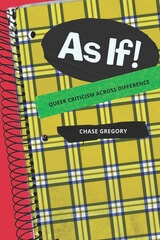
cover of As If!: Queer Criticism Across Difference

As If!

Queer Criticism Across Difference

Chase Gregory

Duke University Press, 2025
In As If!, Chase Gregory explores the stylistically strategic, often campy, and productively fraught cross-identifications of early queer criticism. Gregory calls this form of aids-era criticism as if!—a mode of writing in which authors struggle to read, write, and identify with and across categories of race, sexuality, and gender. Analyzing the work of Robert Reid-Pharr, Deborah E. McDowell, Barbara Johnson, and Eve Kosofsky Sedgwick, Gregory shows how their writing productively challenges fixed ideas of identity and knowledge production. Using these four writers as case studies of a larger trend within early queer criticism, Gregory demonstrates that even when critical attempts at relation are met by impasse, as if! criticism breaks down social relation, especially within those fields influenced by queer theory, deconstructionist feminist theory, and Black feminist theory. By advocating a return to as if! criticism as a politically useful blueprint for contemporary cultural inquiry, Gregory draws attention to the obstacles to forging identification across difference and insists on the impossible project of solidarity across such difference.
[more]
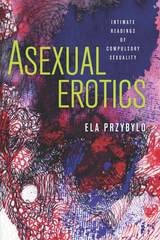
cover of Asexual Erotics: Intimate Readings of Compulsory Sexuality

Asexual Erotics

Intimate Readings of Compulsory Sexuality

Ela Przybylo

The Ohio State University Press, 2019

Challenging what she sees as an obsession with sex and sexuality, Ela Przybylo examines the silence around asexuality in queer, feminist, and lesbian thinking—turning to Audre Lorde’s work on erotics to propose instead an approach she calls asexual erotics, an alternative language for discussing forms of intimacy that are not reducible to sex and sexuality. Beginning with the late 1960s as a time when compulsory sexuality intensified and became increasingly tied to feminist, lesbian, and queer notions of empowerment, politics, and subjectivity, Przybylo looks to feminist political celibacy/asexuality, lesbian bed death, the asexual queer child, and the aging spinster as four figures that are asexually resonant and which benefit from an asexual reading—that is, from being read in an asexually affirming rather than asexually skeptical manner.
 
Through a wide-ranging analysis of pivotal queer, feminist, and anti-racist movements; television and film; art and photography; and fiction, nonfiction, and theoretical texts, each chapter explores asexual erotics and demonstrates how asexuality has been vital to the formulation of intimate ways of knowing and being. Asexual Erotics assembles a compendium of asexual possibilities that speaks against the centralization of sex and sexuality, asking that we consider the ways in which compulsory sexuality is detrimental not only to asexual and nonsexual people but to all.
 
[more]