Results by title
25 books match the query 'Questions'
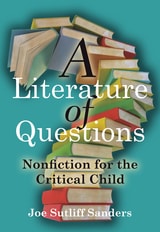
A Literature of Questions
Nonfiction for the Critical ChildJoe Sutliff Sanders
University of Minnesota Press, 2018
Nonfiction books for children—from biographies and historical accounts of communities and events to works on science and social justice—have traditionally been most highly valued by educators and parents for their factual accuracy. This approach, however, misses an opportunity for young readers to participate in the generation and testing of information.
In A Literature of Questions, Joe Sutliff Sanders offers an innovative theoretical approach to children’s nonfiction that goes beyond an assessment of a work’s veracity to develop a book’s equivocation as a basis for interpretation. Addressing how such works are either vulnerable or resistant to critical engagement, Sanders pays special attention to the attributes that nonfiction shares with other forms of literature, including voice and character, and those that play a special role in the genre, such as peritexts and photography.
The first book-length work to theorize children’s nonfiction as nonfiction from a literary perspective, A Literature of Questions carefully explains how the genre speaks in unique ways to its young readers and how it invites them to the project of understanding. At the same time, it clearly lays out a series of techniques for analysis, which it then applies and nuances through extensive close readings and case studies of books published over the past half century, including recent award-winning books such as Tanya Lee Stone’s Almost Astronauts: Thirteen Women Who Dared to Dream and We Are the Ship: The Story of Negro League Baseball by Kadir Nelson. By looking at a text’s willingness or reluctance to let children interrogate its information and ideological context, Sanders reveals how nonfiction can make young readers part of the project of learning rather than passive recipients of information.
Endings
Questions of Memory in Hegel and HeideggerEdited by Rebecca Comay and John McCumber
Northwestern University Press, 1999
Beginning at the point where Heidegger encountered Hegel, this volume of provocative essays addresses the respective philosophies of the two men. Leading scholars provide a variety of models from which to view the unique relationship between the bodies of thought of Heidegger and Hegel: bodies of thought that cannot be taken as two objects to be compared, contrasted, and finally evaluated but that must be viewed in dynamic terms, as a relationship in which self-transformations lead to mutual transformations and vice versa.
Exploring the Scientific Method
Cases and QuestionsEdited by Steven Gimbel
University of Chicago Press, 2011
From their grade school classrooms forward, students of science are encouraged to memorize and adhere to the “scientific method”—a model of inquiry consisting of five to seven neatly laid-out steps, often in the form of a flowchart. But walk into the office of a theoretical physicist or the laboratory of a biochemist and ask “Which step are you on?” and you will likely receive a blank stare. This is not how science works. But science does work, and here award-winning teacher and scholar Steven Gimbel provides students the tools to answer for themselves this question: What actually is the scientific method?
Exploring the Scientific Method pairs classic and contemporary readings in the philosophy of science with milestones in scientific discovery to illustrate the foundational issues underlying scientific methodology. Students are asked to select one of nine possible fields—astronomy, physics, chemistry, genetics, evolutionary biology, psychology, sociology, economics, or geology—and through carefully crafted case studies trace its historical progression, all while evaluating whether scientific practice in each case reflects the methodological claims of the philosophers. This approach allows students to see the philosophy of science in action and to determine for themselves what scientists do and how they ought to do it.
Exploring the Scientific Method will be a welcome resource to introductory science courses and all courses in the history and philosophy of science.

Hermeneutics
Questions and ProspectsShapiro Gary
University of Massachusetts Press, 0
Kujibizana
Questions of Language and Power in Nineteenth- and Twentieth-Century Poetry in KishwahiliAnn Biersteker
Michigan State University Press, 1996
The author argues that reading poetry in Kiswahili provides important insights into questions of language and power, as well as into discussions of socialist practice in East Africa and East African resistance to colonialism and neo-colonialism. Includes the text of numerous poems and footnotes.
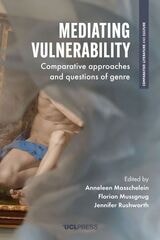
Mediating Vulnerability
Comparative Approaches and Questions of GenreEdited by Anneleen Masschelein, Florian Mussgnug, and Jennifer Rushworth
University College London, 2021
To experience vulnerability is to experience the tension between ruin and creativity: a vulnerable species faces extinction but also evolution, and a vulnerable person risks both irreparable harm and transformative connection. Mediating Vulnerability explores how this tension plays out across contemporary literary studies. Examining a variety of approaches to the destructive and remediating powers of genre, the authors consider how vulnerability intersects a range of representational forms including high-profile fiction by Margaret Atwood and Cormac McCarthy as well as lesser-known graphic novels, video games, television, and photography.

New Formations, New Questions
Asian American Studies, Volume 5Elaine H. Kim and Lisa Lowe, eds.
Duke University Press, 0
In one essay, the status of Asians born in America both before and after the 1965 Immigration and Nationality Act is compared, with particular attention directed toward the exploitation of Asian immigrants as a source of cheap physical labor. In another piece, the link between America’s colonization of Asian countries and international sex tourism is explored. As these essays make clear, the United States easily exploits Asians and Asian Americans as it simultaneously enforces distinctions that render Asians linguistically, culturally, and racially “foreign.” Also included is an essay based on a series of interviews with Filipino store owners and workers in Southern California; analysis of the Christian Ecumenical perspectives on the Asian sex tour industry and the activities of ECPAT, a group established to end child prostitution in Asian tourism; and an account of a South Asian woman’s attempt to unionize taxicab drivers in New York City.
Contributors. Anuradha G. Advani, Enrique Bonus, Oscar V. Campomanes, Y. David Chung, Allan DeSouza, Gayatri Gopinath, Helen Heran Jun, Laura Hyun Yi Kang, Peter Kiang, Elaine H. Kim, Min-Jung Kim, Lisa Lowe, Eithne Liubheid, Long Nguyen, Viet Thanh Nguyen, Eliza Noh
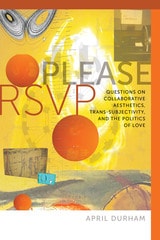
Please RSVP
Questions on Collaborative Aesthetics, Trans-Subjectivity, and the Politics of LoveApril Durham
Dartmouth College Press, 2019
Questions Of Modernity
Timothy Mitchell
University of Minnesota Press, 2000
Well-known contributors offer an illuminating look at how modernity develops in non-Western contexts.
Modernity has always laid claim to universal certainty—which meant assigning a different and lesser significance to anything deemed purely local, non-Western, or lacking a universal expression. This book makes those very non-Western, non-universal elements the tools for fashioning a more complex, rigorous, and multifaceted understanding of how the modern comes about. Focusing on the making of modernity outside the West, eight leading anthropologists, historians, and political theorists explore the production of new forms of politics, sensibility, temporality, and selfhood in locations ranging from nineteenth-century Bengal to contemporary Morocco.
Topics include the therapeutics of colonial medical practice, the multiple registers of popular film, television serials and their audiences, psychiatrists and their patients, the iconic figure of the young widow, and the emergence of new political forms beyond the grasp of civil society. Contributors: Lila Abu-Lughod, Columbia U; Dipesh Chakrabarty, U of Chicago; Partha Chatterjee, Centre for Studies in Social Sciences, Calcutta; Veena Das, U of Delhi; Nicholas B. Dirks, Columbia U; Stefania Pandolfo, UC Berkeley; and Gyan Prakash, Princeton U.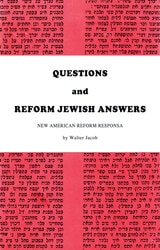
Questions and Reform Jewish Answers - PDF Electronic Version
New American Reform ResponsaRabbi Walter Jacob
Central Conference of American Rabbis, 1992
Shall CPR be given to the frail elderly? Can genetic engineering be patented? Can there be a berit for Messianic Jews? May a tallit be worn at an interfaith service? May a criminal be a member of the congregation? Must a Jewish lawyer defend terrorists? These are just a few of the questions answered in this volume, which includes 246 Responsa. Originally published in 1992, many of these questions are still relevant for Jewish life today.
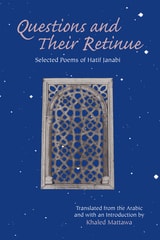
Questions and Their Retinue
Selected Poems of Hatif JanabiHatif Janabi
University of Arkansas Press, 1996
Hatif Janabi’s poems are passionate, jolting, apocalyptic, and painful. They deal with war and death, perception and truth, drawing from his family life, his exile in Poland, the Gulf War, violence in Iraq, and his experience in the United States.
The speaker in many of Janabi’s poems moves from a confrontational stance to one of resigned desperation, and from coyness to deep longing, where, occasionally, hope surfaces. The associative processes and the often bizarre surreal imagery he employs are very effective in expressing his profound sense of political and spiritual alienation. Janabi is among a generation of Arab poets who, because of censorship, can speak only obliquely about the harsh reality of their lives. In these poems he has created symbolic landscapes that attempt to reveal the political, social, and psychological stresses with which suffering people live.
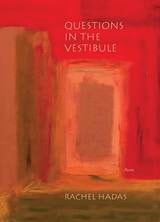
Questions in the Vestibule
PoemsRachel Hadas
Northwestern University Press, 2016
Rachel Hadas reaches the peak of her poetic prowess in Questions in the Vestibule. A deeply personal and meditative collection in three sections, Questions moves through the liminal space of solitude and the coded landscape of dreams toward the startling power of a life-changing love.
Hadas’s voice and her formal elegance, as distinctive and distinguished as ever, endow this new work with a precise and thoughtful beauty. Questions in the Vestibule takes readers into a new territory of unapologetic bliss.
Questions of Evidence
Proof, Practice, and Persuasion across the DisciplinesEdited by James Chandler, Arnold I. Davidson, and Harry D. Harootunian
University of Chicago Press, 1994
The essays and rejoinders are by Terry Castle, Lorraine Daston, Carlo Ginzburg, Ian Hacking, Mark Kelman, R. C. Lewontin, Pierre Vidal-Naquet, Mary Poovey, Donald Preziosi, Simon Schaffer, Joan W. Scott, Eve Kosofsky Sedgwick, and Barbara Herrnstein Smith.
The critical responses are by Lauren Berlant, James Chandler, Jean Comaroff, Arnold I. Davidson, Harry D. harootunian, Elizabeth Helsinger, Thomas C. Holt, Francoise Meltzer, Robert J. Richards, Lawrence Rothfield, Joel Snyder, Cass R. Sunstein, and William Wimsatt.

Questions of Form
Logic and Analytic Proposition from Kant to CarnapJoelle ProustTranslated by Anastasios Albert Brenner
University of Minnesota Press, 1989
Questions of Form was first published in 1989. Minnesota Archive Editions uses digital technology to make long-unavailable books once again accessible, and are published unaltered from the original University of Minnesota Press editions.
In Questions on Form, Joelle Proust traces the concept of the analytic proposition from Kant's development of the notion down to its place in the work of Rudolf Carnap, a founder of logical empiricism and a key figure in contemporary analytic philosophy. Using a method known in France as topique comparative,she provides a rigorous exposition of analyticity, situating it within four major philosophical systems—those of Kant, Bolzano, Frege, and Carnap—and clearly delineating its development from one system to the next.
Proust takes as her point of departure Kant's distinction between analytic and synthetic judgments. Though she makes clear that Kant drew on Locke, Hume, and Leibniz, she argues that his notion of analyticity was innovative, not simply an elaboration of something already found in their work. She shows that the analytic proposition unexpectedly (given its modest status in Kant) came to play an important part in efforts to convert problems considered "transcendental" into questions of belonging to formal logic.
Ultimately, her comparison of their systems reveals that the concept of the analytic, however specific its rile in each, remains linked to a foundationalist strategy—in effect, to the transcendentalist questions Kant used when he reinterpreted the findings of his empiricist predecessors. Hence, this book's provocative claim: today's so-called logical empiricism owes much more to Kant's notion of science than to Hume's.
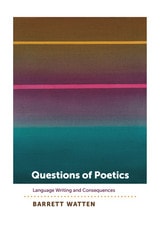
Questions of Poetics
Language Writing and ConsequencesBarrett Watten
University of Iowa Press, 2016
Each chapter is a theoretical inquiry into an aspect of poetics in an expanded sense—from the relation of experimental poetry to cultural logics of liberation and political economy, to questions of community and the politics of the avant-garde, to the cultural contexts where it is produced and intervenes. Each serves as a kind of thought experiment that theorizes and assesses the consequences of Language writing in expanded fields of meaning that include history, political theory, art history, and narrative theory. While all are grounded in a series of baseline questions of poetics, they also polemically address the currently turbulent debates on the politics of the avant-garde, especially Language writing, among emerging communities of poets.
In manifold ways, Watten masterfully demonstrates the aesthetic and political aims of Language writing, its influence on emerging literary schools, and its present aesthetic, critical, and political horizons. Questions of Poetics will be a major point of reference in continuing debates on poetry and literary history, a critical reexamination for already familiar readers and a clearly presented introduction for new ones.
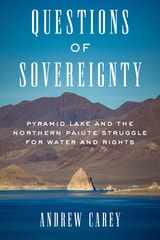
Questions of Sovereignty
Pyramid Lake and the Northern Paiute Struggle for Water and RightsAndrew W. Carey
University of Nevada Press, 2027
Questions of Sovereignty examines the enduring struggle of the Pyramid Lake Paiute Tribe to assert and exercise sovereignty in defense of its most sacred homeland: Pyramid Lake. At the center of this story is a century-long fight over water, law, and survival that reveals how Indigenous nations navigate a political landscape in which tribal sovereignty is both recognized and continually challenged.
Indian tribes retain inherent powers of self-governance, yet those powers are often tested when they conflict with powerful state, federal, and private interests. Using the Pyramid Lake Paiute experience as a case study, author Andrew W. Carey demonstrates how tribal sovereignty functions in practice.
At the heart of the narrative is water—the lifeblood of Pyramid Lake and the Truckee River system that feeds it. Decades of diversion and development left the lake in ecological and cultural crisis. As competing interests sought control of the region’s water, the tribe engaged in legal and political battles to secure the resources essential to its survival.
Spanning late twentieth-century litigation and negotiations into the twenty-first century, Questions of Sovereignty reveals how the Pyramid Lake Paiute Tribe used law, governance, and persistence to protect its homeland. In doing so, it offers a powerful example of Indigenous resilience and a deeper understanding of sovereignty as a living force shaping environmental justice and tribal self-determination.
Questions of Travel
Postmodern Discourses of DisplacementCaren Kaplan
Duke University Press, 1996
Addressing a wide range of writers, including Paul Fussell, Edward Said, James Clifford, Gilles Deleuze, Jean Baudrillard, Gayatri Spivak, Edward Soja, Doreen Massey, Chandra Mohanty, and Adrienne Rich, Kaplan demonstrates that symbols and metaphors of travel are used in ways that obscure key differences of power between nationalities, classes, races, and genders. Neither rejecting nor dismissing the powerful testimony of individual experiences of modern exile or displacement, Kaplan asks how mystified metaphors of travel might be avoided. With a focus on theory’s colonial discourses, she reveals how these metaphors continue to operate in the seemingly liberatory critical zones of poststructuralism and feminist theory. The book concludes with a critique of the politics of location as a form of essentialist identity politics and calls for new feminist geographies of place and displacement.
Questions on Aristotle's Categories
John Duns Scotus
Catholic University of America Press, 2014
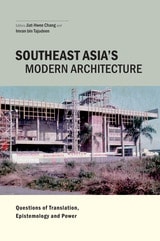
Southeast Asia's Modern Architecture
Questions of Translation, Epistemology and PowerEdited by Jiat-Hwee Chang and Imran bin Tajudeen
National University of Singapore Press, 2018
Textual and Theatrical Shakespeare
Questions of EvidenceEdward Pechter
University of Iowa Press, 1996
Bridging the stage-versus-page gap between actors, critics, and scholars, the contributors in this carefully crafted yet energizing book reflect upon the many kinds of evidence available to us from Shakespeare's various incarnations as historical subject and as “our contemporary” as well as from his amphibious occupation of both stage and study. The constraints become arbitrary as each essayist clarifies the sources of this evidence; the seemingly rigid boundaries of scholarly and creative disciplines are crossed and redrawn.
The Diaconate Revisited
Questions and Developments Since Vatican IIMarc B. Caron
Catholic University of America Press, 2026
The Questions on the Octateuch, Volume 1
John F. Theodoret of Cyrus
Catholic University of America Press, 2007
The Questions on the Octateuch, Volume 2
John F. Theodoret of Cyrus
Catholic University of America Press, 2007

Them and Us
Questions of Citizenship in a Globalizing WorldRob Kroes
University of Illinois Press, 2000
An accomplished set of meditations by one of Europe's leading Americanists, Them and Us is a rich comparative study of European and American cultural traditions and their influence on conceptions of community. In contrast with the ethnic and nationalist allegiances that historically have splintered Europe, Rob Kroes identifies a complex of cultural practices that have mitigated against ethnically rooted divisions in the United States. He argues that the American approach–-articulated by a national rhetoric emphasizing openness rather than closure, diversity rather than uniformity--has much to offer a Europe where the nationalist and ethnic conflicts that spawned two world wars continue to sow terror and destruction.
Kroes discusses European and American attitudes toward the welfare state, the human rights tradition in the United States, and the role of regionalism in shaping conceptions of national identity. He also considers new, transnational forms of cultural membership that are emerging to take the place of nation-based citizenship. He contends that the frame of reference Europeans now use to make sense of their collective situation draws on ingredients provided by the worldwide dissemination of American mass culture. He investigates the way this emerging world culture, under American auspices, affects the way people in their local and national settings structure their sense of the past and conceive of their citizenship.
Imagining a new set of cultural relationships that could serve as the basis for global citizenship, Them and Us is an insightful consideration of the types of solidarity that might weave humankind together into a meaningful community.
Time for Childhoods
Young Poets and Questions of AgencyRachel Conrad
University of Massachusetts Press, 2020
Time for Childhoods presents a selection of striking twentieth-and twenty-first-century American poetry written by young people, and highlights how young poets imagined and shaped time for their own poetic purposes. Through close engagement with archival materials, as well as select interviews and correspondence with adult mentors, Conrad discerns how young writers figured social realities and political and racial injustices, and discusses what important advocates such as Gwendolyn Brooks and June Jordan can teach us about supporting the agency of young poets. This essential study demonstrates that young poets have much to contribute to ongoing conversations about time and power.