Results by title
11 books match the query 'Quiché Indians'
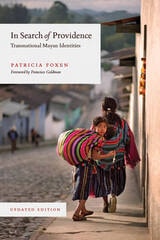
In Search of Providence
Transnational Mayan Identities, Updated EditionPatricia Foxen
Vanderbilt University Press, 2020
In the mid-1990s, Patricia Foxen traveled back and forth between the Guatemalan highlands and Providence, Rhode Island, to understand the migration paths of K'iche' Mayan Indians who had fled the Guatemalan civil war to work in the factories and fisheries of New England. More than two decades later, many Mayans are still migrating to the US. As Foxen argues, the recent surge in Mayan border crossings must be contextualized within both the longer history of violence, marginality, and exclusion that has long led Guatemala's Indigenous populations to be "survivors on the move," as well as contemporary push factors such as climate change and growing inequality that have forced people from their communities.
And yet one of the most significant drivers of continued emigration today, ironically, is the very culture of migration (described in the book) that has accelerated social change within many Indigenous communities, setting in motion a complex series of economic and cultural shifts that have compelled a continuous movement of people and generations to the US. Reading this story in 2020—at a time of massive growth in flows of irregular migrations around the world—can help us better understand the highly complex set of factors that propel long-term migrations and that shape transnational communities on both sides of the border.
In Search of Providence offers a layered, historically grounded perspective that speaks to the local specificity behind the migration experience in order to point to the universal themes and contradictions of contemporary global displacements.
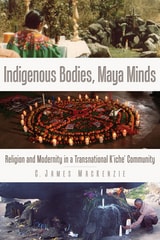
Indigenous Bodies, Maya Minds
Religion and Modernity in a Transnational K'iche' CommunityC. James MacKenzie
University Press of Colorado, 2016
Indigenous Bodies, Maya Minds examines tension and conflict over ethnic and religious identity in the K’iche’ Maya community of San Andrés Xecul in the Guatemalan Highlands and considers how religious and ethnic attachments are sustained and transformed through the transnational experiences of locals who have migrated to the United States.
Author C. James MacKenzie explores the relationship among four coexisting religious communities within Highland Maya villages in contemporary Guatemala—costumbre, traditionalist religion with a shamanic substrate; “Enthusiastic Christianity,” versions of Charismaticism and Pentecostalism; an “inculturated” and Mayanized version of Catholicism; and a purified and antisyncretic Maya Spirituality—with attention to the modern and nonmodern worldviews that sustain them. He introduces a sophisticated set of theories to interpret both traditional religion and its relationship to other contemporary religious options, analyzing the relation among these various worldviews in terms of the indigenization of modernity and the various ways modernity can be apprehended as an intellectual project or an embodied experience.
Indigenous Bodies, Maya Minds investigates the way an increasingly plural religious landscape intersects with ethnic and other identities. It will be of interest to Mesoamerican and Mayan ethnographers, as well as students and scholars of cultural anthropology, indigenous cultures, globalization, and religion.
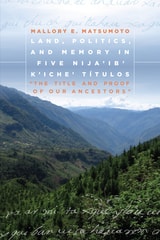
Land, Politics, and Memory in Five Nija'ib' K'iche' Títulos
"The Title and Proof of Our Ancestors"Mallory Matsumoto
University Press of Colorado, 2017
Land, Politics, and Memory in Five Nija’ib’ K’iche’ Títulos is a careful analysis and translation of five Highland Maya títulos composed in the sixteenth century by the Nija’ib’ K’iche’ of Guatemala. The Spanish conquest of Highland Guatemala entailed a series of sweeping changes to indigenous society, not the least of which were the introduction of the Roman alphabet and the imposition of a European system of colonial government. Introducing the history of these documents and placing them within the context of colonial-era Guatemala, this volume provides valuable information concerning colonial period orthographic practice, the K’iche’ language, and language contact in Highland Guatemala.
For each text, author Mallory E. Matsumoto provides a photographic copy of the original document, a transliteration of its sixteenth-century modified Latin script, a transcription into modern orthography, an extensive morphologic analysis, and a line-by-line translation into English, as well as separate prose versions of the transcription and translation. No complete English translation of this set of manuscripts has been available before, nor has any Highland Maya título previously received such extensive analytical treatment.
Offering insight into the reality of indigenous Highland communities during this period, Land, Politics, and Memory in Five Nija’ib’ K’iche’ Títulos is an important primary source for linguists, historians, and experts in comparative literature. It will also be of significant interest to students and scholars of ethnohistory, linguistics, Latin American studies, anthropology, and archaeology.
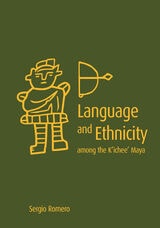
Language and Ethnicity among the K'ichee' Maya
Sergio Romero
University of Utah Press, 2015
This book explores the articulation between “accent” and ethnic identification in K’ichee’, a Mayan language spoken by more than one million people in the western highlands of Guatemala. Based on years of ethnographic work, it is the first anthropological examination of the social meaning of dialectal difference in any Mayan language. Romero deconstructs essentialist perspectives on ethnicity in Mesoamerica and argues that ethnic identification among the highland Maya is multiple and layered, the result of a diverse linguistic precipitate created by centuries of colonial resistance.
In K’ichee’, dialect stereotypes—accents—act as linguistic markers embodying particular ethnic registers. K’ichee’ speakers use and recombine their linguistic repertoire—colloquial K’ichee’, traditional K’ichee’ discourse, colloquial Spanish, Standard Spanish, and language mixing—in strategic ways to mark status and authority and to revitalize their traditional culture. The book surveys literary genres such as lyric poetry, political graffiti, and radio broadcasts, which express new experiences of Mayan-ness and anticolonial resistance. It also takes a historical perspective in examining oral and written K’ichee’ discourses from the sixteenth to the twenty-first centuries, including the famous chronicle known as the Popol Vuh, and explores the unbreakable link between language, history, and culture in the Maya highlands.
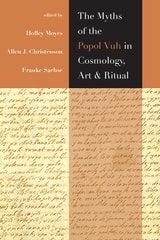
Myths of the Popol Vuh in Cosmology, Art, and Ritual
Holley Moyes
University Press of Colorado, 2021
The chapters are grouped into four sections. The first section interprets the Highland Maya worldview through examination of the text, analyzing interdependence between deities and human beings as well as the textual and cosmological coherence of the Popol Vuh as a source. The second section analyzes the Precolumbian Maya archaeological record as it relates to the myths of the Popol Vuh, providing new interpretations of the use of space, architecture, burials, artifacts, and human remains found in Classic Maya caves. The third explores ancient Maya iconographic motifs, including those found in Classic Maya ceramic art; the nature of predatory birds; and the Hero Twins’ deeds in the Popol Vuh. The final chapters address mythological continuities and change, reexamining past methodological approaches using the Popol Vuh as a resource for the interpretation of Classic Maya iconography and ancient Maya religion and mythology, connecting the myths of the Popol Vuh to iconography from Preclassic Izapa, and demonstrating how narratives from the Popol Vuh can illuminate mythologies from other parts of Mesoamerica.
The Myths of the Popol Vuh in Cosmology, Art, and Ritual is the first volume to bring together multiple perspectives and original interpretations of the Popol Vuh myths. It will be of interest not only to Mesoamericanists but also to art historians, archaeologists, ethnohistorians, iconographers, linguists, anthropologists, and scholars working in ritual studies, the history of religion, historic and Precolumbian literature and historic linguistics.
Contributors: Jaime J. Awe, Karen Bassie-Sweet, Oswaldo Chinchilla Mazariegos, Michael D. Coe, Iyaxel Cojtí Ren, Héctor Escobedo, Thomas H. Guderjan, Julia Guernsey, Christophe Helmke, Nicholas A. Hopkins, Barbara MacLeod, Jesper Nielsen, Colin Snider, Karl A. Taube
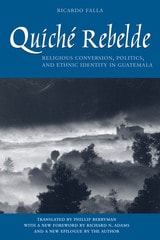
Quiché Rebelde
Religious Conversion, Politics, and Ethnic Identity in GuatemalaBy Ricardo Falla
University of Texas Press, 2001
Since the arrival of the Spanish in the sixteenth century, the Maya population of Guatemala has been forced to adapt to extraordinary challenges. Under colonial rule, the Indians had to adapt enough to satisfy the Spanish while resisting those changes not necessary for survival, applying their understanding of the world to the realities they confronted daily. Despite the major changes wrought in their way of life by centuries of submission, the Maya have managed to regenerate, and thus maintain, their self-identity.
Among the major challenges they have faced has been the imposition of outside religions. Quiché Rebelde examines what happened when Acción Católica came into the Guatemalan municipio of San Antonio Ilotenango, Quiché, to convert its inhabitants.
Ricardo Falla, a Guatemalan Jesuit priest and anthropologist, analyzes the movement's origins and why some people became part of it while others resisted. He shows how religion was used as another tool to readapt to the changing environment—natural, economic, political, and social. His work is the first major empirical study of how change occurred in a Maya community with no serious loss of Maya identity—and how the process of conversion is related to more general processes of cultural change that actually strengthen ethnic identity.
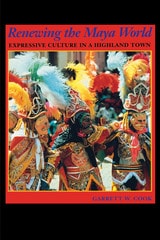
Renewing the Maya World
Expressive Culture in a Highland TownBy Garrett W. Cook
University of Texas Press, 2000
Each year in the Highland Guatemala town of Santiago Momostenango, Maya religious societies, dance teams, and cofradías perform the annual cycle of rituals and festivals prescribed by Costumbre (syncretized Maya Christian religion), which serves to renew the cosmic order. In this richly detailed ethnography, Garrett Cook explores how these festivals of Jesucristo and the saints derive from and reenact three major ancient Maya creation myths, thus revealing patterns of continuity between contemporary expressive culture and the myths, rituals, and iconography of the Classic and Postclassic Maya.
Drawing on fieldwork conducted in the 1970s and renewed in the 1990s, Cook describes the expressive culture tradition performed in and by the cofradías and their dance teams. He listens as dancers and cofrades explain the meaning of service and of the major ritual symbols in the cults of the saints and Jesucristo. Comparing these symbols to iconographic evidence from Palenque and myths from the Popol Vuh, Cook persuasively argues that the expressive culture of Momostenango enacts major Maya creation myths—the transformative sunrise, the representation of the year as the life cycle of anthropomorphized nature, and the erection of an axis mundi.
This research documents specific patterns of continuity and discontinuity in the communal expression of Maya religious and cosmogonic themes. Along with other recent research, it demonstrates the survival of a basic Maya pattern—the world-creating vegetative renewal cycle—in the highland Maya cults of the saints and Jesucristo.
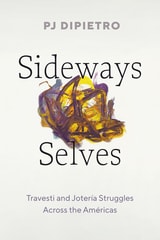
Sideways Selves
Travesti and Jotería Struggles Across the AméricasPJ DiPietro
University of Texas Press, 2025
2026 Sylvia Rivera Award in Transgender Studies, The Center for LGBTQ Studies (CLAGS), CUNY
How trans and non-binary networks engage in decoloniality across hemispheres.
A deeply informed, theoretically rich work of inquiry and critique, Sideways Selves learns from two communities of migrants as they contest their marginalization under the colonial regime of gender—colonial because, as PJ DiPietro affirms, Indigenous and Afro-diasporic conceptions of embodiment have been displaced by the European-Christian order of gender. Following gender-nonconforming Aymara, Kolla, and mixed-race exiles in Buenos Aires and K’iche’, Nahua, and Central American migrants in the San Francisco Bay Area, DiPietro takes stock of a collective, transnational effort to reimagine ideas of personhood and kinship that gender makes unthinkable.
The communities DiPietro studies create new kinds of identities, collective and genderless in nature. Their ways of thinking and doing, though radical, are motivated by old wisdom, storytelling, healing, and religion—brujería, curanderismo, Voudoun, and other practices that colonialism, capitalism, and the nation-state have unsuccessfully tried to erase. In equal measures philosophical and ethnographic, Sideways Selves witnesses and listens as these displaced people—displaced from their homes and from the moral geography of the West—show us what a just, decolonial world could actually be.
The Blood of Guatemala
A History of Race and NationGreg Grandin
Duke University Press, 2000
Focusing on Mayan elites in the community of Quetzaltenango, Grandin shows how their efforts to maintain authority over the indigenous population and secure political power in relation to non-Indians played a crucial role in the formation of the Guatemalan nation. To explore the close connection between nationalism, state power, ethnic identity, and political violence, Grandin draws on sources as diverse as photographs, public rituals, oral testimony, literature, and a collection of previously untapped documents written during the nineteenth century. He explains how the cultural anxiety brought about by Guatemala’s transition to coffee capitalism during this period led Mayan patriarchs to develop understandings of race and nation that were contrary to Ladino notions of assimilation and progress. This alternative national vision, however, could not take hold in a country plagued by class and ethnic divisions. In the years prior to the 1954 coup, class conflict became impossible to contain as the elites violently opposed land claims made by indigenous peasants.
This “history of power” reconsiders the way scholars understand the history of Guatemala and will be relevant to those studying nation building and indigenous communities across Latin America.
Title of Totonicapán
transcription, translation, and commentary by Allen J. Christenson
University Press of Colorado, 2022
The Title of Totonicapán is a land title written by surviving members of the K’iche’ Maya nobility, a branch of the Maya that dominated the highlands of western Guatemala prior to the Spanish invasion in 1524, and it was duly signed by the ruling lords of all three major K’iche’ lineages—the Kaweqib’, the Nijayib’, and the Ajaw K’iche’s. Titles of this kind were relatively common for Maya communities in the Guatemalan highlands in the first century after the Spanish Conquest as a means of asserting land rights and privileges for its leaders. Like the Popol Vuh, the Title of Totonicapán is written in the elevated court language of the early Colonial period and eloquently describes the mythic origins and history of the K’iche’ people. For the most part, the Title of Totonicapán agrees with the Popol Vuh’s version of K’iche’ history and cosmology, providing a complementary account that attests traditions that must have been widely known and understood. But in many instances the Totonicapán document is richer in detail and departs from the Popol Vuh’s more cursory description of history, genealogy, and political organization. In other instances, it contradicts assertions made by the authors of the Popol Vuh, perhaps a reflection of internal dissent and jealousy between rival lineages within the K’iche’ hierarchy. It also contains significant passages of cosmology and history that do not appear in any other highland Maya text.
This volume makes a comprehensive and updated edition of the Title of Totonicapán accessible to scholars and students in history, anthropology, archaeology, and religious studies in Latin America, as well as those interested in Indigenous literature and Native American/Indigenous studies more broadly. It is also a stand-alone work of Indigenous literature that provides additional K’iche’ perspectives, enhancing the reading of other colonial Maya sources.
Utatlán
The Constituted Community of the K'iche' Maya of Q'umarkajThomas F. Babcock
University Press of Colorado, 2012
Most information available on Utatlán focuses on the ceremonial center and ignores the city of the commoners. Using the archaeological data, Utatlán attempts to determine the boundaries of the community and to characterize subdivisions within it. Evidence of indigenous nonelite houses, rich burials, and grave goods unlike those found in contemporary sites reveals information about the supporting residence zone. In addition, Babcock applies the concept of "constituted community," interpreting the archaeological data from a prehistoric context, and proposes a theoretical framework for interpreting prehistoric sites with respect to urbanism and political complexity.
Utatlán: The Constituted Community of the K'iche' Maya of Q'umarkaj will be of interest to students and scholars of Mesoamerican anthropology, archaeology, and ethnohistory.