Results by title
25 books match the query 'Rabbis'
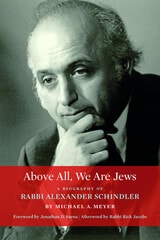
Above All, We Are Jews
A Biography of Rabbi Alexander SchindlerMichael A. Meyer
Central Conference of American Rabbis, 2025
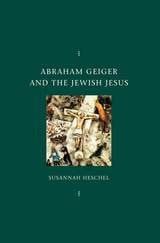
Abraham Geiger and the Jewish Jesus
Susannah Heschel
University of Chicago Press, 1998
Geiger, a pioneer of Reform Judaism and a founder of Jewish studies, developed a Jewish version of Christian origins. He contended that Jesus was a member of the Pharisees, a progressive and liberalizing group within first-century Judaism, and that he taught nothing new or original. This argument enraged German Protestant theologians, some of whom produced a tragic counterargument based on racial theory.
In this fascinating book, Susannah Heschel traces the genesis of Geiger's argument and examines the reaction to it within Christian theology. She concludes that Geiger initiated an intellectual revolt by the colonized against the colonizer, an attempt not to assimilate into Christianity by adopting Jesus as a Jew, but to overthrow Christian intellectual hegemony by claiming that Christianity—and all of Western civilization—was the product of Judaism.
An American Rabbi in Korea
A Chaplain's Journey in the Forgotten WarMilton J. Rosen, translated and edited by Stanley R. Rosen
University of Alabama Press, 2004
During the height of the Korean conflict, 1950–51, Orthodox Jewish chaplain Milton J. Rosen wrote 19 feature-length articles for Der Morgen Zhornal, a Yiddish daily in New York, documenting his wartime experiences as well as those of the servicemen under his care. An American Rabbi in Korea is an English translation of Rosen's important articles prepared by his son and annotated with background about Rosen's military service, a general introduction to the war and conflict on the Korean peninsula, and numerous maps and photographs.
Rosen was among those nearly caught in the Chinese entrapment of American and Allied forces in North Korea in late 1950, and some of his most poignant writing details the trying circumstances that faced both soldiers and civilians during that time. As chaplain, Rosen was able to offer a unique account of the American Jewish experience on the frontlines and in the United States military while also describing the impact of the American presence on Korean citizens and their culture. His interest in Korean attitudes toward Jews is also a significant theme within these articles. The sum is a readable account of war and its turmoil from an astute and compassionate observer.
Birmingham's Rabbi
Morris Newfield and Alabama, 1895-1940Mark Cowett
University of Alabama Press, 1986
Taking a multidimensional approach, Cowett places Newfield's early life in the context of his Hungarian childhood and also relates Newfield’s career to those of fellow Hebrew Union College graduates and to national Reform Jewish history. The reader is made aware constantly of changing conditions in Birmingham, in Alabama, and in the south and how those changes affected Newfield’s congregants. Cowett illuminates Newfield’s efforts to help Jews maintain a sense of religious identity in a predominately Southern and Christian environment.
Based upon essential sources including interviews, newspapers, and manuscript collections in Alabama and at the American Jewish Archives in Cincinnati, Cowett shows Newfield’s struggle to support social welfare efforts in Alabama during the Progressive Era. He recognized the need for Jews to develop bonds with other American ethnic groups. Cowett portrays him as a mediator between not only Jew and Christian but also black and white, labor and capital, liberal and conservative—in short, within the full spectrum of political and social exchange in an industrial city of the New South.
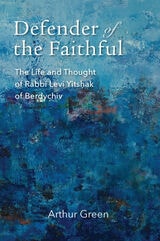
Defender of the Faithful
The Life and Thought of Rabbi Levi Yitshak of BerdychivArthur Green
Brandeis University Press, 2022
Defender of the Faithful explores the life and thought of Levi Yitshak of Berdychiv (1740–1809), one of the most fascinating and colorful Hasidic leaders of his time. This is an intellectual and religious biography, a reading of the development of his thought and career. Featuring examples of Levi Yitshak’s extraordinary texts alongside insightful analysis by scholar and theologian Arthur Green, Defender of the Faithful is a compelling study of both Levi Yitshak’s theology and broader philosophy.
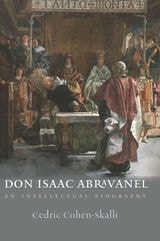
Don Isaac Abravanel
An Intellectual BiographyCedric Cohen-Skalli
Brandeis University Press, 2020
Don Isaac Abravanel (1437–1508) was one of the great inventors of Jewish modernity. A merchant, banker, and court financier, a scholar versed in both Jewish and Christian writings, a preacher and exegete, a prominent political actor in royal entourages and Jewish communities, Abravanel was one of the greatest leaders and thinkers of Iberian Jewry in the aftermath of the expulsion of 1492. This book, the first new intellectual biography of Abravanel in twenty years, depicts his life in three cultural milieus—Portugal, Castile, and post-expulsion Italy—and analyzes his major literary accomplishments in each period. Abravanel was a traditionalist with innovative ideas, a man with one foot in the Middle Ages and the other in the Renaissance. An erudite scholar, author of a monumental exegetical opus that is still studied today, and an avid book collector, he was a transitional figure, defined by an age of contradictions. Yet, it is these very contradictions that make him such an important personality for understanding the dawn of Jewish modernity.
Haim Nahum
A Sephardic Chief Rabbi in Politics, 1892-1923Esther Benbassa
University of Alabama Press, 1995
A collection of rare writings and correspondence by a rabbi and diplomat active at the end of the Ottoman Empire
Rabbi, diplomat, linguist, fixer of delicate problems, Haim Nahum moved through the last years of the Ottoman world and the birth of the modern Middle East with uncommon dexterity. He left behind a rich trove of letters and writing, the best of which are collected in this volume. For contemporary readers, his story feels surprisingly current. He inhabited an age crowded with competing identities, clashing nationalisms, and endless political improvisations. In other words, he would feel perfectly at home today.
The most intriguing feature of Nahum is not that he occupied important positions, but that he seemed constitutionally incapable of belonging to only one world. Equally at ease among statesmen, clerics, scholars, and bureaucrats, he functioned as a human connecting flight between cultures. In this fascinating biography first edited and published in French in 1990, Esther Benbassa captures this cosmopolitan figure without embalming him in reverence, allowing readers to encounter a subtle, resourceful, and occasionally elusive man whose métier was negotiation and whose natural habitat was complexity.
This book will delight readers of Ottoman history, Jewish history, Middle Eastern affairs, diplomatic history, biography, religious studies, and Mediterranean culture. It will also appeal to polyglots, antiquarians, devotees of vanished empires, and anyone attracted to those liminal figures who stand at the crossroads of civilizations, translating not merely languages but entire ways of seeing the world.
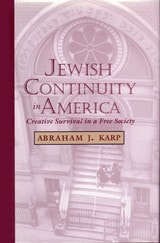
Jewish Continuity in America
Creative Survival in a Free SocietyAbraham J. Karp
University of Alabama Press, 1998
Presents an overview of a life's work by a preeminent scholar and brings new insight to the challenge of American Jewish continuity
Jews have historically lived within a paradox of faith and fear: faith that they are an eternal people and fear that their generation may be the last. In the United States, the Jewish community has faced to a heightened degree the enduring question of identity and assimilation: How does the Jewish community in this free, open, pluralistic society discover or create factors-both ideological and existential-that make group survival beneficial to the larger society and rewarding to the individual Jew?
Abraham J. Karp's Jewish Continuity in America focuses on the three major sources of American Judaism's continuing vitality: the synagogue, the rabbinate, and Jewish religious pluralism. Particularly illuminating is Karp's examination of the coexistence and unity-in-diversity of American religious Jewry's three divisions-Orthodox, Reform, and Conservative-and of how this Jewish religious pluralism fits into the larger picture of American religious pluralism.
Informing the larger enterprise through sharp and full delineation of discrete endeavors, the essays collected in Jewish Continuity in America-some already acknowledged as classics, some appearing here for the first time-describe creative individual and communal responses to the challenge of Jewish survival. As the title suggests, this book argues that continuity in a free and open society demands a high order of creativity, a creativity that, to be viable, must be anchored in institutions wholly pledged to continuity.
Judaism and Story
The Evidence of The Fathers According to Rabbi NathanJacob Neusner
University of Chicago Press, 1992
Judaism and Story documents a chapter of rabbinic tradition that explored the possibility of historical orientation by means of stories. As Neusner demonstrates, this experiment with narrative went beyond the borders of rabbinic preoccupation with rhetorical argumentation focused on the explication of the Torah. The sage story moved in the direction of biography, but without allowing biography to emerge. This development, in Neusner's account, parallels the movement from epistle to Gospel in early Christianity and thus has broad implications for the history of religions.
Just and Righteous Causes
Rabbi Ira Sanders and the Fight for Racial and Social Justice in Arkansas, 1926-1963James L. Moses
University of Arkansas Press, 2018
Winner, 2019 Booker Worthen Prize from the Central Arkansas Library System.
A dedicated advocate for social justice long before the term entered everyday usage, Rabbi Ira Sanders began striving against the Jim Crow system soon after he arrived in Little Rock from New York in 1926. Sanders, who led Little Rock’s Temple B’nai Israel for nearly forty years, was a trained social worker as well as a rabbi and his career as a dynamic religious and community leader in Little Rock spanned the traumas of the Great Depression, World War II and the Holocaust, and the social and racial struggles of the 1950s and 1960s.
Just and Righteous Causes—a full biographical study of this bold social-activist rabbi—examines how Sanders expertly navigated the intersections of race, religion, and gender to advocate for a more just society. It joins a growing body of literature about the lives and histories of Southern rabbis, deftly balancing scholarly and narrative tones to provide a personal look into the complicated position of the Southern rabbi and the Jewish community throughout the political struggles of the twentieth-century South.
Kindler of Souls
Rabbi Henry Cohen of TexasBy Rabbi Henry Cohen II
University of Texas Press, 2007
In September 1930, the New York Times published a list of the clergy whom Rabbi Stephen Wise considered "the ten foremost religious leaders in this country." The list included nine Christians and Rabbi Henry Cohen of Galveston, Texas. Little-known today, Henry Cohen was a rabbi to be reckoned with, a man Woodrow Wilson called "the foremost citizen of Texas" who also impressed the likes of William Howard Taft and Clarence Darrow. Cohen's fleeting fame, however, was built not on powerful friendships but on a lifetime of service to needy Jews—as well as gentiles—in London, South Africa, Jamaica, and, for the last sixty-four years of his life, Galveston, Texas.
More than 10,000 Jews, mostly from Eastern Europe, arrived in Galveston in the early twentieth century. Rabbi Cohen greeted many of the new arrivals in Yiddish, then helped them find jobs through a network that extended throughout the Southwest and Midwest United States. The "Galveston Movement," along with Cohen's pioneering work reforming Texas prisons and fighting the Ku Klux Klan, made the rabbi a legend in his time. As this portrait shows, however, he was also a lovable mensch to his grandson. Rabbi Henry Cohen II reminisces about his grandfather's jokes while placing the legendary rabbi in historical context, creating the best picture yet of this important Texan, a man perhaps best summarized by Rabbi Wise in the New York Times as "a soul who touches and kindles souls."
Nothing Like Sunshine
A Story in the Aftermath of the MLK AssassinationBen Kamin
Michigan State University Press, 2010
Rabbi Ben Kamin has written a definitive personal expression about race, coming of age in the 1960s, a forbidden friendship, and his personal love for Dr. Martin Luther King Jr. This is a story that spans a four-decade search for a lost high school chum, a deep misunderstanding, and a coming to terms with an America painfully evolving from the blood of MLK to the promise of Barack Obama.
The book is a remembrance of Kamin's life at Cincinnati's notorious Woodward High School, a microcosm of the 1960s and of America itself, as well as detailing Kamin's search-for Clifton, for America, for the key to understanding what race relations really are in the United States. Simultaneously, it is the story of the emerging rabbi's search for the legacy of his spiritual mentor, Dr. Martin Luther King Jr., taking Kamin from Cincinnati to Cleveland to Memphis to New Orleans and other points, and constantly bringing him home to his friend Clifton and "the heaving hallways" of that high school.
Rabbi Esriel Hildesheimer and the Creation of a Modern Jewish Orthodoxy
David Ellenson
University of Alabama Press, 1990
Tradition, Modernity, and the Making of Modern Orthodoxy.
For many histories of Modern Orthodox Judaism, Rabbi Samson Raphael Hirsch stands as the primary architect of the movement's encounter with modernity. In Rabbi Esriel Hildesheimer and the Creation of a Modern Jewish Orthodoxy, distinguished scholar David Ellenson expands that narrative by recovering the life, thought, and enduring influence of one of Hirsch's most important contemporaries. Through a careful examination of Rabbi Esriel Hildesheimer's writings, leadership, educational initiatives, and responses to the social and intellectual challenges of nineteenth-century Europe, Ellenson demonstrates how Hildesheimer helped forge a model of Orthodoxy that remained firmly committed to Jewish tradition while engaging constructively with the modern world.
Set against a period of profound cultural, political, and religious transformation, this volume explores the tensions confronting European Jewry as modernization, secular education, religious pluralism, and changing political realities reshaped Jewish communal life. Ellenson shows how Hildesheimer addressed these challenges not through rigid isolation but through a pragmatic and intellectually sophisticated approach that balanced fidelity to halakhah with openness to selected aspects of modern culture and scholarship. His vision helped establish a framework for Modern Orthodoxy that continues to influence contemporary Jewish thought and practice.
Beyond its biographical focus, the study provides broader insights into the emergence of Modern Orthodoxy as a religious and intellectual movement. By illuminating Hildesheimer's efforts to integrate traditional scholarship with contemporary realities, Ellenson offers readers a deeper understanding of how Judaism has negotiated the relationship between heritage and change. The result is both a compelling portrait of an influential rabbinic figure and an important examination of the forces that shaped modern Jewish religious identity.
Rabbi Esriel Hildesheimer and the Creation of a Modern Jewish Orthodoxy is essential reading for scholars and students of Jewish studies, religious studies, theology, European history, intellectual history, and modern Judaism. It will also appeal to rabbis, educators, and general readers seeking to understand the historical roots of contemporary Orthodox Jewish life and the ongoing dialogue between tradition and modernity.
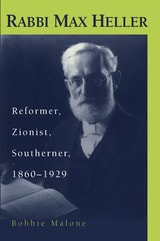
Rabbi Max Heller
Reformer, Zionist, Southerner, 1860-1929Barbara S. Malone
University of Alabama Press, 1997
Max Heller was a man of both passionate conviction and inner contradiction. He sought to be at the center of current affairs, not as a spokesperson of centrist opinion, but as an agitator or mediator, constantly struggling to find an acceptable path as he confronted the major issues of the day--racism and Jewish emancipation in eastern Europe, nationalism and nativism, immigration and assimilation. Heller's life experience provides a distinct vantage point from which to view the complexity of race relations in New Orleans and the South and the confluence of cultures that molded his development as a leader. A Bohemian immigrant and one of the first U.S.-trained rabbis, Max Heller served for 40 years as spiritual leader of a Reform Jewish congregation in New Orleans--at that time the largest city in the South. Far more than a congregational rabbi, Heller assumed an activist role in local affairs, Reform Judaism, and the Zionist movement, maintaining positions often unpopular with his neighbors, congregants, and colleagues. His deep concern for social justice led him to question two basic assumptions that characterized his larger social milieu--segregation and Jewish assimilation.
Heller, a consummate Progressive with clear vision and ideas substantially ahead of their time, led his congregation, his community, Reform Jewish colleagues, and Zionist sympathizers in a difficult era.
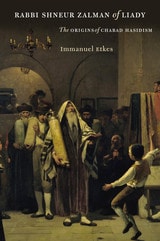
Rabbi Shneur Zalman of Liady
The Origins of Chabad HasidismImmanuel Etkes
Brandeis University Press, 2014

Rabbi's Manual
David Polish
Central Conference of American Rabbis, 1988
Reading Reform Responsa
Jewish Tradition, Reform Rabbis, and Today's IssuesRabbi Mark Washofsky, PhD
Central Conference of American Rabbis, 2024
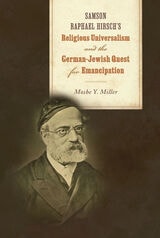
Samson Raphael Hirsch's Religious Universalism and the German-Jewish Quest for Emancipation
Moshe Y. Miller
University of Alabama Press, 0
An account of how Rabbi Samson Raphael Hirsch promulgated an inclusive vision of Judaism in the context of advancing the civic equality of German Jews in the nineteenth century
In Samson Raphael Hirsch’s Religious Universalism and the German-Jewish Quest for Emancipation, Moshe Miller contends that nineteenth-century German Jews of all denominations actively sought acceptance within German society and aspired to achieve full emancipation from the many legal strictures on their status as citizens and residents. While non-Orthodox Jews sought a large measure of cultural assimilation, Orthodox Jews were content with more delimited acculturation, but they were no less enthusiastic about achieving emancipation and acceptance in German society. There was one issue, though, which was seen by non-Jewish critics of emancipation as a barrier to granting civic rights to Jews: namely, the alleged tribalism of Judaism and the supposedly chauvinistic notion of Jews as “the Chosen People.”
These charges could not go unanswered, and in the writings of Rabbi Samson Raphael Hirsch (1808–1888), the leading thinker of the Orthodox camp, they did not. Hirsch stressed the universalism of the Jewish ethic and the humanistic concern for the welfare of all mankind, which he believed was one of the core teachings of Judaism. His colleagues in the German Orthodox rabbinate largely concurred with Hirsch’s assessment. Samson Raphael Hirsch’s Religious Universalism and the German-Jewish Quest for Emancipation places Hirsch’s views in their historical context and provides a detailed account of his attitude toward non-Jews and the Christianity practiced by the vast majority of nineteenth-century Europeans.
The First Fifty Years
A Jubilee in Prose and Poetry Honoring Women RabbisRabbi Sue Levi Elwell, Jessica Greenbaum, Rabbi Hara E. Person
Central Conference of American Rabbis, 2023
The ordination of Rabbi Sally J. Priesand in 1972 was a watershed moment in Jewish history. In The First Fifty Years, contributors from across the Jewish and gender spectrums reflect on the meaning of this moment and the ensuing decades, both personally and for the Jewish community. In short pieces of new prose, authors—many of them pioneering rabbis—share stories, insights, analysis, and celebrations of women in the rabbinate. These are intertwined with a wealth of poetry that poignantly captures the spirit of this anniversary. The volume is a deep, heartfelt tribute to women rabbis and their indelible impact on all of us.
The Formation of a Modern Rabbi
The Life and Times of the Viennese Scholar and Preacher Adolf JellinekSamuel Joseph Kessler
SBL Press, 2022
An intellectual biography that critically engages Adolf Jellinek’s scholarship and communal activities
Adolf Jellinek (1821–1893), the Czech-born, German-educated, liberal chief rabbi of Vienna, was the most famous Jewish preacher in Central Europe in the second half of the nineteenth century. As an innovative rhetorician, Jellinek helped mold and define the modern synagogue sermon into an instrument for expressing Jewish religious and ethical values for a new era. As a historian, he made groundbreaking contributions to the study of the Zohar and medieval Jewish mysticism. Jellinek was emblematic of rabbi-as-scholar-preacher during the earliest, formative years of communal synagogues as urban religious space. In a world that was rapidly losing the felt and remembered past of premodern Jewish society, the rabbi, with Jellinek as prime exemplar, took hold of the Sabbath sermon as an instrument to define and mold Judaism and Jewish values for a new world.
The Quiet Voices
Southern Rabbis and Black Civil Rights, 1880s to 1990sMark K. Bauman
University of Alabama Press, 1997
These wide-ranging essays reveal the various roles played by southern rabbis in the struggle for black civil rights since Reconstruction
The study of black-Jewish relations has become a hotbed of controversy, especially with regard to the role played by Jewish leaders during the Civil Rights movement. Did these leaders play a pivotal role, or did many of them, especially in the South, succumb to societal pressure and strive to be accepted rather than risk being persecuted? If some of these leaders did choose a quieter path, were their reasons valid? And were their methods successful?
Individually, each essay offers a glimpse into both the private and public difficulties these rabbis faced in their struggle to achieve good. Collectively, the essays provide an unparalleled picture of Jewish leadership during the civil rights era.
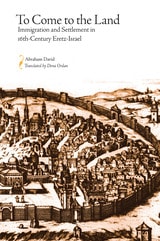
To Come to the Land
Immigration and Settlement in 16th-Century Eretz-IsraelAbraham David, translated by Dena Ordan
University of Alabama Press, 1999
To Come to the Land makes available in English a vast body of research,
previously available only in Hebrew, on the early history of the land now
known as Israel.
Abraham David here focuses on the Spanish and Portuguese Jews who fled
the Iberian Peninsula during the 16th century, tracing the beginnings of
Sephardic influence in the land of Israel.
After the Ottoman Turks conquered Syria, Palestine, and Egypt in 1516,
the Ottoman regime, unlike their Mamluk predecessors, encouraged economic
development and settlement throughout the region. This openness to immigration
offered a solution to the crisis Iberian Jews were undergoing as a result
of their expulsion from Spain and the forced conversions in Portugal. Within
a few years of the Ottoman conquest, Jews of Spanish extraction, many of
them clustered in urban areas, dominated the Jewish communities of Eretz-Israel.
In this carefully researched study, David examines the lasting impression
made by these enterprising Jewish settlers on the commercial, social, and
intellectual life of the area under early Ottoman rule. Of particular interest
is his examination of the cities of Jerusalem and Safed and David's succinct
biographies of leading Jewish personalities throughout the region.
This first English translation of a ground-breaking Hebrew work provides
a comprehensive overview of a significant chapter in the history of Israel
and explores some of the factors that brought to it the best minds of the
age. Essential for scholars of late Medieval Jewish history, To Come to
the Land will also be an important resource for scholars of intellectual
history, as it provides background crucial to an understanding of the intellectual
flourishing of the period.
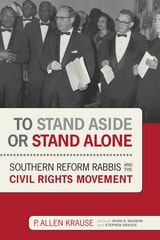
To Stand Aside or Stand Alone
Southern Reform Rabbis and the Civil Rights MovementP. Allen Krause, Edited by Mark K. Bauman with Stephen Krause
University of Alabama Press, 2016
In 1966, a young rabbinical student named P. Allen Krause conducted interviews with twelve Reform rabbis from southern congregations concerning their thoughts, principles, and activities as they related to the civil rights movement. Perhaps because he was a young seminary student or more likely because the interviewees were promised an embargo of twenty-five years before the interviews would be released to the public, the rabbis were extremely candid about their opinions on and their own involvement with what was still an incendiary subject. Now, in To Stand Aside or Stand Alone: Southern Reform Rabbis and the Civil Rights Movement, their stories help elucidate a pivotal moment in time.
After a distinguished rabbinical career, Krause wrote introductions to and annotated the interviews. When Krause succumbed to cancer in 2012, Mark K. Bauman edited the manuscripts further and wrote additional introductions with the assistance of Stephen Krause, the rabbi’s son. The result is a unique volume offering insights into these rabbis’ perceptions and roles in their own words and with more depth and nuance than hitherto available. This exploration into the lives of these teachers and civic leaders is supported by important contextual information on the local communities and other rabbis, with such background information forming the basis of a demographic profile of the Reform rabbis working in the South.
The twelve rabbis whom Krause interviewed served in Alabama, Georgia, Louisiana, Mississippi, Tennessee, and Virginia, and the substance and scope of their discussions cover some of the most crucial periods in the civil rights movement. Although some have provided accounts that appeared elsewhere or have written about their experiences themselves, several new voices appear here, suggesting that more southern rabbis were active than previously thought. These men functioned within a harsh environment: rabbis’ homes, synagogues, and Jewish community centers were bombed; one rabbi, who had been beaten and threatened, carried a pistol to protect himself and his family. The views and actions of these men followed a spectrum from gradualism to activism; while several of the rabbis opposed the evils of the separate and unequal system, others made peace with it or found reasons to justify inaction. Additionally, their approaches differed from their activist colleagues in the North even more than from each other.
Within these pages, readers learn about the attitudes of the rabbis toward each other, toward their congregants, toward national Jewish organizations, and toward local leaders of black and white and Protestant and Catholic groups. Theirs are dramatic stories of frustration, cooperation, and conflict.
Tormented Master
A Life of Rabbi Nahman of BratslavWritten by Arthur E. Green
University of Alabama Press, 1979
“If Hasidism begins in the life-enhancing spirituality of the Baal Shem Tov, it concludes in the tortuous, elitist and utterly fascinating career of Nahman of Bratslav (1722–1810) whose biography and teaching Arthur Green has set forth in his comprehensive, moving, and subtle study, Tormented Master.
“Arthur Green has managed to lead us through the thickets of the Bratslaver discourse with a grace and facility thus far unequaled in the English language literature on Hasidism. Tormented Master is a model of clarity and percipience, balancing awed respect and honor for its subject with a ruthless pursuit of documented truth. . . . Tormented Master is sufficiently open to the agonies of religion in general and the issues of modern religion in particular to make Nahman a thinker utterly relevant to our time.
“Nahman of Bratslav is unique in the history of Judaism, Green emphasizes, for having made the individual’s quest for intimacy with God the center of the religious way. He was a Kierkegaard before his time, believing in the utter abandon of the life of faith and the risk of paradoxicality. . . . He was, more than all others, the predecessor of Kafka, whose tales, like Nahman’s, have no explicit key and rankle, flush and irritate the spirit, compelling us—even in our failure to understand—to acknowledge their potency and challenge.”
—New York Times

gone bird in the glass hours
a poem playZachary Asher
University of Utah Press, 2020
Winner of the 2019 Agha Shahid Ali Prize in Poetry
Zachary Asher’s second collection, gone bird in the glass hours, is a play in verse, featuring seven voices. It begins with a rabbi, bewildered and bent by personal grief, guided and beguiled by elusive Blue Postman into the world of “the glass hours” and its inhabitants.
Rooted in magical realism, gone bird in the glass hours experiments with multiple forms from epistles to centos, from fractals to prayers. These poems are brave in their excavations of grief and solace, wonder and rage, collective trauma and, ultimately, transcendence.